

Honestly, I once doubted wavelength mattered too.
Honestly, I once doubted wavelength mattered too.
Honestly, I once doubted wavelength mattered too.
Why wavelength matters in Laser hair removal: 755nm vs. 1064nm, plus area-by-area session guidance.
Published -
Updated -

Author
Wi Young-jin · Chief director
Seoul National University College of Medicine · Seoul National University Hospital Specialist
→

Honestly, I used to think
whether talking about wavelengths even mattered
As summer approaches,
the clinic starts getting crowded with
clients in sleeveless tops and shorts.
"I had 6 sessions somewhere else,
so why does it keep growing back?"
There are really a lot of people
who ask this.
Today, I’ll explain the reason using
the keyword 'wavelength.'
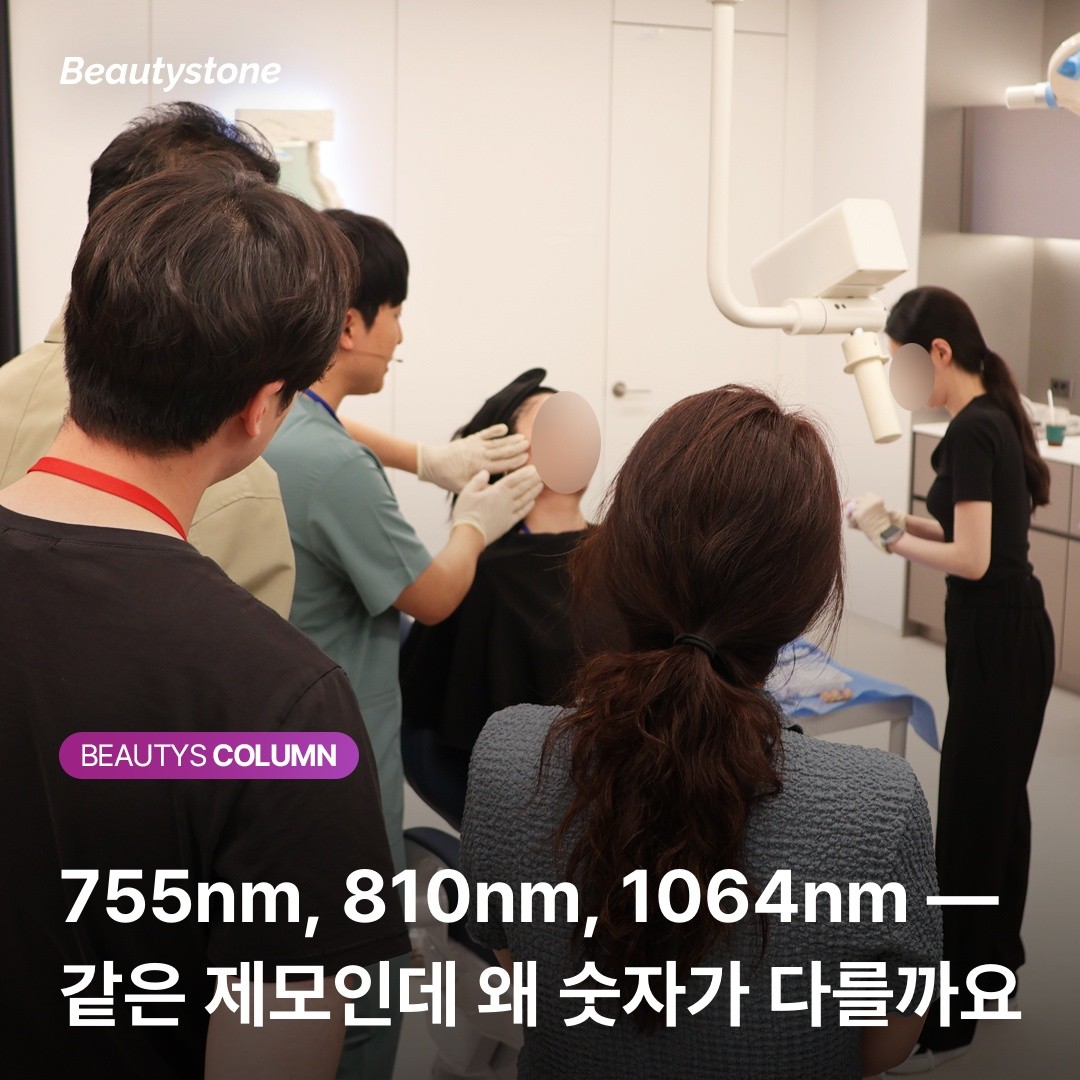
755nm, 810nm, 1064nm
— same hair removal, so why are the numbers different?
Laser hair removal is a procedure in which
melanin in the hair follicle absorbs light energy,
turns it into heat, and destroys the follicle.
Unlike diode (810nm),
Alexandrite uses 755nm,
and Nd:YAG uses a 1064nm wavelength.
If the number changes, the color of the light,
and the depth it penetrates into the skin
change completely.

The longer the wavelength, the deeper it goes
— this one line determines the outcome
Key point of this article
755nm is red light, 1064nm is infrared.
The longer the wavelength, the deeper it goes.
755 is for shallow peach fuzz,
and 1064 is for thick, deep beard hair.
Let me tell you about one patient first.
Last month, a 43-year-old man came in,
and he said he had 8 sessions on his beard with 755nm,
but it barely worked.
Looking at the photos, the follicles were
a textbook case of thick beard hair buried deep in the dermis.
In this case,
I did not recommend any additional treatment.
Even if we did the same wavelength several more times,
the results would likely be similar,
I told him honestly.
The reason lies in the physics of wavelength.
The penetration depth of 755nm is about 1.5~2mm,
while 1064nm reaches 4~5mm.
For shallow peach fuzz or leg hair,
755nm is efficient, but
for a deep beard, only 1064nm can
deliver energy all the way to the roots.
Director Woo Young-jin’s key summary
Wavelength determines 'how deep it reaches,'
and the hair-growth cycle determines
'how many times it needs to be hit.'
Checking whether your hair is shallow or deep
is the first step in hair removal.

See where your area
falls once by checking this
Area | Recommended wavelength | Recommended sessions | Treatment interval |
Facial peach fuzz | 755nm | 8~10 sessions | 3~4 weeks |
Men’s beard | 1064nm | 10~15 sessions | 4~6 weeks |
Underarms | 755 / 810nm | 6~8 sessions | 5~6 weeks |
Arms·legs | 755 / 810nm | 6~10 sessions | 6~8 weeks |
Brazilian | 1064nm in combination | 8~12 sessions | 5~6 weeks |
Hair goes through the growth, regression, and resting phases.
Laser only works during the growth phase.
Only 20~30% of follicles are active at one time.
of the total follicles are active at once.
This is exactly the real reason why you need
'4~6-week intervals, 8 or more sessions'
of treatment.
If you’ve read this far,
Frequently asked questions
Q. Where does the diode (810 nm) fall under?
A. 810nm is a medium-depth ‘mid-wave’ wavelength. It’s the most versatile, so it’s commonly used for full-body hair removal.
Q. I’ve had 6 sessions, but the hair is growing back. Is it a failure?
A. Six sessions are actually just the beginning. About 70% of the active hair follicles have been cleared.
Q. Then can’t I just always use 1064 nm?
A. Using it on fine hair is inefficient because it doesn’t reach deeply. The pain is also stronger, and the risk of burns goes up slightly, so the best approach is to mix and use it according to the area.
Q. Why do I need to get hair removal at least 8 times? If the wavelength is right, shouldn't it be over quickly?
A. Even if the laser wavelength is a perfect match, multiple sessions are necessary due to the natural hair growth cycle. Since only about 20% to 30% of hair follicles are active at any one time, we recommend cumulative treatments of at least 8 sessions spaced 4 to 6 weeks apart.
you’re probably wondering this
Q1. Where does diode (810nm) fit?
A. 810nm is a mid-range wavelength with intermediate depth.
It’s the most versatile, so
it’s commonly used for full-body hair removal.
However, it can be less efficient than specialized wavelengths
for very shallow peach fuzz or deep beard hair.
Q2. I had 6 sessions and the hair is growing back.
Is it a failure?
A. Six sessions is actually just the beginning.
About 70% of the active follicles have been addressed.
To fully get it under control, you need about 10 sessions,
and areas like the beard require maintenance treatments.
Q3. Then can’t I just get 1064nm all the time?
A. It reaches deeper, but
it is inefficient for peach fuzz.
It also hurts more and slightly increases
the risk of burns,
so the right answer is to combine wavelengths according to the area.
If you take away just one thing today,
— wavelength numbers ultimately come down to
whether they reach the depth of your follicles.
In the next post,
I’ll explain the 'paradoxical phenomenon'
where hair becomes thicker after laser hair removal.
This was Woo Young-jin.
Related reading
Honestly, I used to think
whether talking about wavelengths even mattered
As summer approaches,
the clinic starts getting crowded with
clients in sleeveless tops and shorts.
"I had 6 sessions somewhere else,
so why does it keep growing back?"
There are really a lot of people
who ask this.
Today, I’ll explain the reason using
the keyword 'wavelength.'
755nm, 810nm, 1064nm
— same hair removal, so why are the numbers different?
Laser hair removal is a procedure in which
melanin in the hair follicle absorbs light energy,
turns it into heat, and destroys the follicle.
Unlike diode (810nm),
Alexandrite uses 755nm,
and Nd:YAG uses a 1064nm wavelength.
If the number changes, the color of the light,
and the depth it penetrates into the skin
change completely.
The longer the wavelength, the deeper it goes
— this one line determines the outcome
Key point of this article
755nm is red light, 1064nm is infrared.
The longer the wavelength, the deeper it goes.
755 is for shallow peach fuzz,
and 1064 is for thick, deep beard hair.
Let me tell you about one patient first.
Last month, a 43-year-old man came in,
and he said he had 8 sessions on his beard with 755nm,
but it barely worked.
Looking at the photos, the follicles were
a textbook case of thick beard hair buried deep in the dermis.
In this case,
I did not recommend any additional treatment.
Even if we did the same wavelength several more times,
the results would likely be similar,
I told him honestly.
The reason lies in the physics of wavelength.
The penetration depth of 755nm is about 1.5~2mm,
while 1064nm reaches 4~5mm.
For shallow peach fuzz or leg hair,
755nm is efficient, but
for a deep beard, only 1064nm can
deliver energy all the way to the roots.
Director Woo Young-jin’s key summary
Wavelength determines 'how deep it reaches,'
and the hair-growth cycle determines
'how many times it needs to be hit.'
Checking whether your hair is shallow or deep
is the first step in hair removal.
See where your area
falls once by checking this
Area | Recommended wavelength | Recommended sessions | Treatment interval |
Facial peach fuzz | 755nm | 8~10 sessions | 3~4 weeks |
Men’s beard | 1064nm | 10~15 sessions | 4~6 weeks |
Underarms | 755 / 810nm | 6~8 sessions | 5~6 weeks |
Arms·legs | 755 / 810nm | 6~10 sessions | 6~8 weeks |
Brazilian | 1064nm in combination | 8~12 sessions | 5~6 weeks |
Hair goes through the growth, regression, and resting phases.
Laser only works during the growth phase.
Only 20~30% of follicles are active at one time.
of the total follicles are active at once.
This is exactly the real reason why you need
'4~6-week intervals, 8 or more sessions'
of treatment.
If you’ve read this far,
Frequently asked questions
Q. Where does the diode (810 nm) fall under?
A. 810nm is a medium-depth ‘mid-wave’ wavelength. It’s the most versatile, so it’s commonly used for full-body hair removal.
Q. I’ve had 6 sessions, but the hair is growing back. Is it a failure?
A. Six sessions are actually just the beginning. About 70% of the active hair follicles have been cleared.
Q. Then can’t I just always use 1064 nm?
A. Using it on fine hair is inefficient because it doesn’t reach deeply. The pain is also stronger, and the risk of burns goes up slightly, so the best approach is to mix and use it according to the area.
Q. Why do I need to get hair removal at least 8 times? If the wavelength is right, shouldn't it be over quickly?
A. Even if the laser wavelength is a perfect match, multiple sessions are necessary due to the natural hair growth cycle. Since only about 20% to 30% of hair follicles are active at any one time, we recommend cumulative treatments of at least 8 sessions spaced 4 to 6 weeks apart.
you’re probably wondering this
Q1. Where does diode (810nm) fit?
A. 810nm is a mid-range wavelength with intermediate depth.
It’s the most versatile, so
it’s commonly used for full-body hair removal.
However, it can be less efficient than specialized wavelengths
for very shallow peach fuzz or deep beard hair.
Q2. I had 6 sessions and the hair is growing back.
Is it a failure?
A. Six sessions is actually just the beginning.
About 70% of the active follicles have been addressed.
To fully get it under control, you need about 10 sessions,
and areas like the beard require maintenance treatments.
Q3. Then can’t I just get 1064nm all the time?
A. It reaches deeper, but
it is inefficient for peach fuzz.
It also hurts more and slightly increases
the risk of burns,
so the right answer is to combine wavelengths according to the area.
If you take away just one thing today,
— wavelength numbers ultimately come down to
whether they reach the depth of your follicles.
In the next post,
I’ll explain the 'paradoxical phenomenon'
where hair becomes thicker after laser hair removal.
This was Woo Young-jin.
Related reading


Latest post
Latest post

Hair Removal
레이저 제모 1회에도 남는 몫이 있어요 — 밀도를 모자이크로 보는 법

Tattoo removal
Why Extremity Tattoos Are Slower to Remove

Tattoo removal
Tattoo Removal Cost: Why Quotes Vary by Area

Tattoo removal
Unused Tattoo Removal Sessions: What Happens?

Lifting
Forehead Thread Lifting: How Far Can It Go?

skin
Skin Booster Prices: What to Check in a Quote
1:1 Custom Approach
1:1 Consultation Whatsapp
🌸 Beautystone Clinic attends the Meditox Bangkok Cadaver Workshop 🌸
1:1 Custom Approach