

Thermage vs. Domestic: The 1.3mm Depth Gap
Thermage vs. Domestic: The 1.3mm Depth Gap
Thermage vs. Domestic: The 1.3mm Depth Gap
Thermage vs domestic: it splits at 1.3mm. Reaching SMAS Layer is what makes Lifting.
Published -
Updated -

Author
Wi Young-jin · Chief director
Seoul National University College of Medicine · Seoul National University Hospital Specialist
→
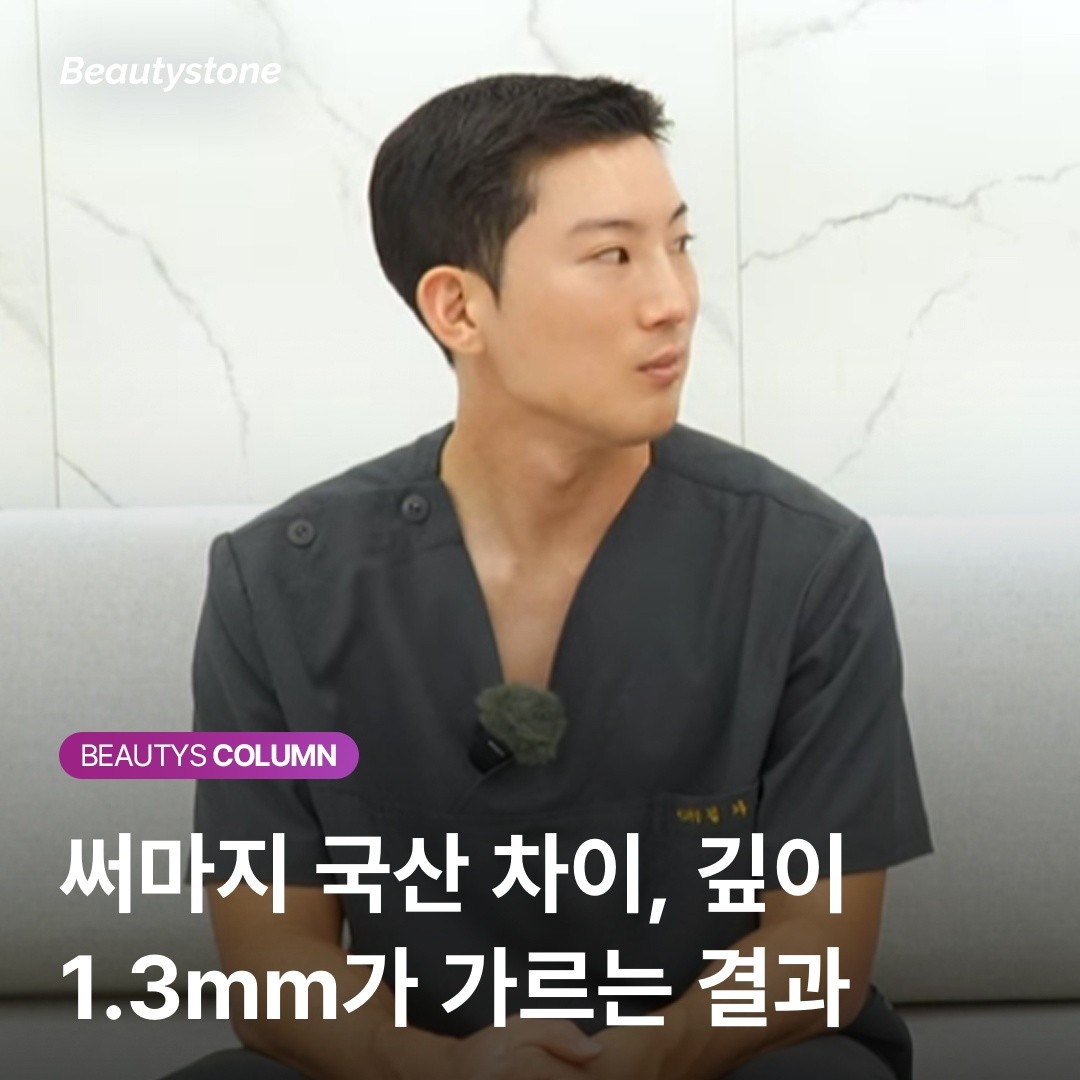
Thermage vs. Domestic RF,
The 1.3 mm depth difference that determines the result
"I got domestic treatment,
but I couldn’t really tell the difference,"
is something I hear from many people.
Today, I’ll walk you through why that is, step by step.

Domestic RF and Thermage,
They all look similar, right? But here’s the thing
Thermage FLX uses radiofrequency (RF)
to deliver heat deep into the dermis,
making it a lifting device.
Domestic devices use the same basic method, but
output stability and penetration depth are different.
It’s actually hard to simply say, "Same principle means same effect."

If you get domestic RF often, does it become like Thermage?
Actually, it’s the exact opposite
Key point of this article
Domestic RF reaches a depth of 3 mm,
while Thermage FLX reaches up to 4.3 mm.
This 1.3 mm difference
determines whether it reaches the SMAS layer.
"If I get domestic treatments several times,
won’t it become similar to Thermage?"
I get this question a lot.
But there are areas that can be compensated for with repeated sessions,
and areas that simply can’t be.
The key is 'depth.'
Domestic RF usually delivers heat to about
3 mm deep in the dermis.
By contrast, Thermage FLX
reaches as deep as 4.3 mm.
That’s only a 1.3 mm difference on paper, but
the SMAS layer (fascia) lies within that range.
The SMAS is a net-like structure
that suspends the face,
and lifting occurs when heat reaches it.
If it only reaches 3 mm,
dermal collagen stimulation is still enough, so
skin texture improves.
But the force that lifts sagging itself upward
will inevitably be limited.
Director Wi Young-jin’s key summary
The difference is not the brand, but
the 'reached depth.'
If you only want dermal elasticity, domestic devices are enough.
But if you want to lift sagging lines upward,
it needs to reach the SMAS layer.

So, is Thermage right for me too?
Concern type | Domestic RF | Thermage FLX |
Skin texture · fine wrinkles | Sufficient | Sufficient (overkill) |
Jawline · cheek sagging | Limited | Very suitable |
Prevention (early 30s) | Suitable | May still be a bit early |
Maintenance period | On the shorter side | 12~18 months |
If you don’t really have sagging,
and only have rough skin texture, Thermage may
feel less cost-effective.
However, for those whose sagging has already started,
it is still the most proven option.
Also, before the procedure, checking the genuine tip is
not optional—it’s essential.
Ask them to show you the tip box directly, and
the genuine-product certification sticker
is safest if you remove it yourself.
If you’ve read this far,
you’re probably wondering this
Q1. Can I get domestic RF and Thermage together?
A. Getting them together is fine.
But make Thermage your main treatment once a year.
In between,
adding domestic treatments as a support
creates the best synergy.
Q2. If one Thermage session costs the same as four domestic sessions,
isn’t that better?
A. If your goal is elasticity maintenance,
multiple domestic sessions make sense.
But if your goal is to lift sagging lines,
even ten domestic sessions
can’t match one Thermage treatment.
Q3. Does Thermage make your face lose fat?
A. If someone with a thin face gets high-output treatment,
their cheeks may look sunken.
That’s why it’s important to carefully evaluate your facial shape and fat volume
before the procedure.
If you take away just one thing from today,
—the difference between Thermage and domestic devices is
whether or not it reaches the SMAS layer.
In the next article,
I’ll explain the 'specific steps for checking the genuine tip'
with photos.
This has been Dr. Wi Young-jin of Beautystone Clinic.
Read more
"Thermage doesn’t work?" Honest lifting story from the consultation room - Hongdae Thermage
Thermage 600-shot price: 3 reasons why custom design matters more than a cheap place
Frequently asked questions
Q. Can I get a Korean RF treatment and Thermage together?
A. Getting them together is fine. However, make Thermage your main treatment once a year.
Q. If the cost of one Thermage treatment gets you four domestic treatments, isn’t that better?
A. If your goal is to improve skin elasticity, several sessions with domestic treatments are a reasonable option.
Q. Will Thermage make my face look thinner?
A. If you have a thin face, receiving treatment at high intensity may make your cheeks appear sunken.
Q. I'm in my early 30s and looking for preventive care. Should I get Thermage, or would a Korean RF treatment be sufficient?
A. If you are in your early 30s with minimal sagging and looking for preventive care, a Korean-made RF device is a great fit, and Thermage might be a bit premature. Thermage FLX reaches 4.3mm down to the SMAS layer to lift sagging contours, making it much more beneficial for those who have already started to notice sagging.
Thermage vs. Domestic RF,
The 1.3 mm depth difference that determines the result
"I got domestic treatment,
but I couldn’t really tell the difference,"
is something I hear from many people.
Today, I’ll walk you through why that is, step by step.
Domestic RF and Thermage,
They all look similar, right? But here’s the thing
Thermage FLX uses radiofrequency (RF)
to deliver heat deep into the dermis,
making it a lifting device.
Domestic devices use the same basic method, but
output stability and penetration depth are different.
It’s actually hard to simply say, "Same principle means same effect."
If you get domestic RF often, does it become like Thermage?
Actually, it’s the exact opposite
Key point of this article
Domestic RF reaches a depth of 3 mm,
while Thermage FLX reaches up to 4.3 mm.
This 1.3 mm difference
determines whether it reaches the SMAS layer.
"If I get domestic treatments several times,
won’t it become similar to Thermage?"
I get this question a lot.
But there are areas that can be compensated for with repeated sessions,
and areas that simply can’t be.
The key is 'depth.'
Domestic RF usually delivers heat to about
3 mm deep in the dermis.
By contrast, Thermage FLX
reaches as deep as 4.3 mm.
That’s only a 1.3 mm difference on paper, but
the SMAS layer (fascia) lies within that range.
The SMAS is a net-like structure
that suspends the face,
and lifting occurs when heat reaches it.
If it only reaches 3 mm,
dermal collagen stimulation is still enough, so
skin texture improves.
But the force that lifts sagging itself upward
will inevitably be limited.
Director Wi Young-jin’s key summary
The difference is not the brand, but
the 'reached depth.'
If you only want dermal elasticity, domestic devices are enough.
But if you want to lift sagging lines upward,
it needs to reach the SMAS layer.
So, is Thermage right for me too?
Concern type | Domestic RF | Thermage FLX |
Skin texture · fine wrinkles | Sufficient | Sufficient (overkill) |
Jawline · cheek sagging | Limited | Very suitable |
Prevention (early 30s) | Suitable | May still be a bit early |
Maintenance period | On the shorter side | 12~18 months |
If you don’t really have sagging,
and only have rough skin texture, Thermage may
feel less cost-effective.
However, for those whose sagging has already started,
it is still the most proven option.
Also, before the procedure, checking the genuine tip is
not optional—it’s essential.
Ask them to show you the tip box directly, and
the genuine-product certification sticker
is safest if you remove it yourself.
If you’ve read this far,
you’re probably wondering this
Q1. Can I get domestic RF and Thermage together?
A. Getting them together is fine.
But make Thermage your main treatment once a year.
In between,
adding domestic treatments as a support
creates the best synergy.
Q2. If one Thermage session costs the same as four domestic sessions,
isn’t that better?
A. If your goal is elasticity maintenance,
multiple domestic sessions make sense.
But if your goal is to lift sagging lines,
even ten domestic sessions
can’t match one Thermage treatment.
Q3. Does Thermage make your face lose fat?
A. If someone with a thin face gets high-output treatment,
their cheeks may look sunken.
That’s why it’s important to carefully evaluate your facial shape and fat volume
before the procedure.
If you take away just one thing from today,
—the difference between Thermage and domestic devices is
whether or not it reaches the SMAS layer.
In the next article,
I’ll explain the 'specific steps for checking the genuine tip'
with photos.
This has been Dr. Wi Young-jin of Beautystone Clinic.
Read more
"Thermage doesn’t work?" Honest lifting story from the consultation room - Hongdae Thermage
Thermage 600-shot price: 3 reasons why custom design matters more than a cheap place
Frequently asked questions
Q. Can I get a Korean RF treatment and Thermage together?
A. Getting them together is fine. However, make Thermage your main treatment once a year.
Q. If the cost of one Thermage treatment gets you four domestic treatments, isn’t that better?
A. If your goal is to improve skin elasticity, several sessions with domestic treatments are a reasonable option.
Q. Will Thermage make my face look thinner?
A. If you have a thin face, receiving treatment at high intensity may make your cheeks appear sunken.
Q. I'm in my early 30s and looking for preventive care. Should I get Thermage, or would a Korean RF treatment be sufficient?
A. If you are in your early 30s with minimal sagging and looking for preventive care, a Korean-made RF device is a great fit, and Thermage might be a bit premature. Thermage FLX reaches 4.3mm down to the SMAS layer to lift sagging contours, making it much more beneficial for those who have already started to notice sagging.


Latest post
Latest post

Tattoo removal
손가락 문신은 작으니까 금방 지워질 거라 생각하셨나요?

Tattoo removal
문신제거 견적이 병원마다 다른 이유, 크기 기준부터 달라서예요

Tattoo removal
10회 결제했는데 그 전에 다 지워지면 돈이 아깝지 않을까요?

Lifting
Forehead Thread Lifting: How Far Can It Go?

skin
Skin Booster Prices: What to Check in a Quote

Contouring & Volume
InMode Cost: Why One Area, Three Line Items
1:1 Custom Approach
1:1 Consultation Whatsapp
🌸 Beautystone Clinic attends the Meditox Bangkok Cadaver Workshop 🌸
1:1 Custom Approach