Thermage Doesn't Work? A Doctor's Real Truth
Seoul NU doctor reveals how many Thermage sessions your skin actually needs. Honest results inside.
If you're considering Thermage?
Before your consultation, these 3 things
be sure to check

These days, the weather
seems to change several times a day.
You let your guard down because it feels like spring, then suddenly it gets dry,
and more and more people say their skin looks dull.
To get straight to the point, Thermage is now
a fairly well-known, mainstream procedure.
A quick search turns up countless pieces of information,
and you can easily find people around you
who have tried it at least once.
But just because many people get it
doesn't mean it suits everyone equally well.
I meet a surprising number of people in the clinic who say,
"I got Thermage, but I don't know if it worked."
Today, I'll honestly tell you how much lifting you can expect
from a single Thermage treatment.
💡 Key takeaways from today's post
Q. Does one Thermage treatment
definitely show results?
A. Some people do see results, and some don't.
The perceived effect varies quite a bit depending on skin condition.
Q. Who is Thermage best for?
A. It works best for people in the early to mid stages
of skin sagging, where loss of firmness
comes before volume loss.
Q. How many sessions do you need,
and how long do the results last?
A. In my experience, we start with one session,
then usually repeat it every 6 to 12 months
depending on how the skin responds.
I'll cover this in detail in the main text.
What exactly does Thermage do to the skin,
precisely?

Thermage (Thermage)
delivers radiofrequency (RF) energy
deep into the skin
to stimulate and tighten collagen.
The tricky part is that
saying it "tightens the skin with heat" is not wrong, but
more precisely, it instantly contracts the collagen structure
in the dermis
while also inducing new collagen production.
So there are two stages: the lifting effect right after treatment,
and the collagen regeneration effect that appears
over the following 3 to 6 months.
This principle is also supported by
clinical RF lifting studies published on PubMed.
That said, research results do not always match
an individual's clinical outcome
one to one.
I'll talk more about that below.
Who responds well,
and who doesn't

This is a point many people misunderstand,
but Thermage works much better for people in the early to mid stages
of sagging than for those whose sagging has already progressed a lot.
If a lot of volume has been lost
and the skin has dropped significantly,
Thermage alone has its limits.
In such cases, we often need to consider a combination with
thread lifting or fillers.
On the other hand, it works well for people like these.
People in their late 30s to early 50s who first notice a loss of firmness
People whose facial contours are starting to look blurred
People whose skin around the nasolabial folds is starting to loosen
People whose under-eye area beneath the aegyo-sal is starting to sag
And people with a certain amount of skin thickness
are also better suited to receiving RF energy.
If the skin is too thin, the en
ergy may disperse at the surface
or the discomfort may feel greater.
If you're wondering how it differs from thread lifting,
reading our comparison of thread lifting and Thermage
first may be helpful.
👨⚕️ Dr. Wi Young-jin's practical note:
In my experience, the people who feel the best results are
those who say, "It's not that saggy yet,
but my face looks more tired than before."
But that doesn't mean it's all good news.
Thermage does hurt during the procedure.
It has improved a lot in the FLX generation compared with older models,
but saying it "doesn't hurt" wouldn't be honest.
And the downside is the cost ^^..
It's a procedure that costs a substantial amount per session,
and repeat treatments are needed to maintain the effect.
Still, if you get it done properly once,
many people keep the effect for 6 to 12 months,
so in the long run it's not a bad choice.
Honestly,
how many sessions do you need?
It varies by case,
but this is usually how I explain it.
After one treatment, wait 3 to 6 months
and then see the skin changes for yourself
before deciding whether to add another session.
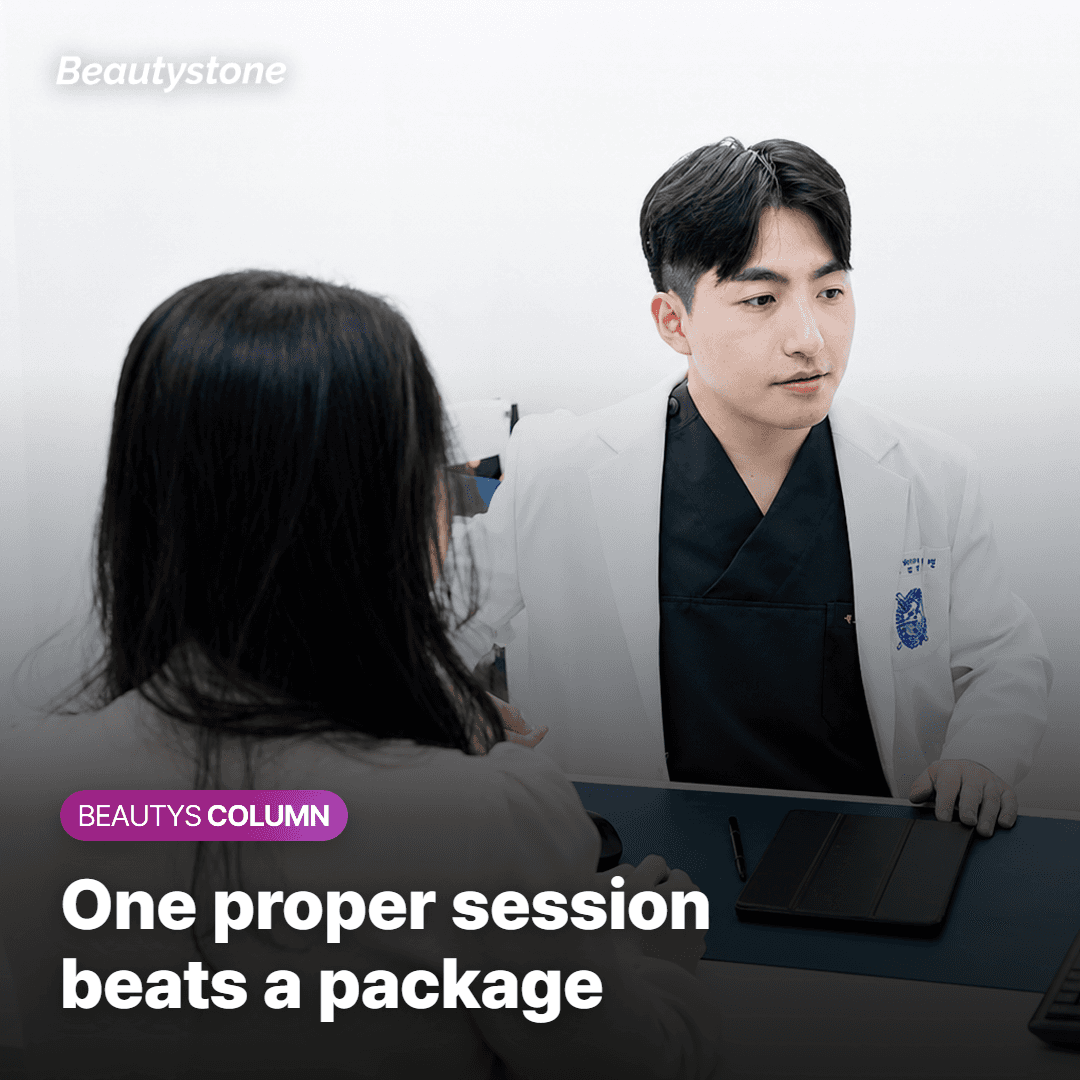
Starting right away with a "multi-session package"
means deciding before seeing your individual skin response,
so I don't usually recommend that approach.
In my experience, the maintenance period is
about 6 months for faster responders,
and 12 to 18 months for slower responders.
It varies quite a bit depending on age, skin thickness, and lifestyle.
Item | Typical range | Notes |
Onset of effect | Immediately after treatment ~ 3 months | Collagen regeneration is gradual |
Peak effect | 3 to 6 months later | Varies by individual |
Maintenance period | 6 to 18 months | Depends on skin condition |
Recommended repeat interval | 6 to 12 months | Decide based on response |
Summary
A practical approach is to start Thermage with one session,
check the response after 3 to 6 months,
and if needed, repeat it every 6 to 12 months.
This is the most realistic approach.
Be sure to check before
getting Thermage
There's one important thing I need to mention:
Thermage results can vary a lot depending on the device generation and the energy settings used.
Even within Thermage, the CPT, NXT, and FLX generations are different,
and if the total number of shots and
the energy level setting differ, the results will naturally differ too.
During consultation,
I check the skin thickness and the degree of sagging directly
before deciding on the energy level and treatment areas.
Using the same settings uniformly
can put unnecessary energy into
fragile skin or skin with little sagging.
Also, after Thermage, the skin may remain sensitive for a while.
You can wash your face on the day of treatment,
but it's best to avoid strong irritation and saunas.
Frequently Asked Questions
Q1. If I get Thermage once,
how much lifting will I see?
A. Honestly, "how much"
really depends on your skin condition.
People whose firmness is just starting to drop
often notice it clearly even after one session,
while those with more advanced sagging
sometimes say, "I can't really tell."
If it's your first time, seeing your skin change for yourself after 3 months
becomes the benchmark.
Q2. Thermage and Ulthera,
how are they different?
A. Thermage uses radiofrequency (RF),
while Ulthera uses ultrasound (HIFU).
Ulthera reaches deeper layers (SMAS, the fascial layer),
while Thermage delivers heat more evenly throughout the dermis.
Q3. Thermage,
can I get it on Sundays too?
A. Yes, BeautyStone Clinic in Hongdae
is open on Sundays too.
We also provide consultations on the day of treatment,
so you can ask us first on KakaoTalk before coming in.
Thermage is definitely an effective treatment
when it's used for the right person.
But it does not produce the same result for everyone.
I recommend getting enough consultation before deciding
on the procedure.
If you have any questions,
feel free to contact us via KakaoTalk.
This was Dr. Wi Young-jin.
Read more
▶Shoulder filler effects and side effects, 3 key principles for creating square shoulders
▶The "real" reason the director never recommends nasolabial fold Botox
▶"Isn't eye-area Botox for prevention??" Cases where Sofwave should be chosen
▶[BeautyStone] How to save on Rejuran costs: treatment intervals matter quite a bit.
If you're considering Thermage?
Before your consultation, these 3 things
be sure to check

These days, the weather
seems to change several times a day.
You let your guard down because it feels like spring, then suddenly it gets dry,
and more and more people say their skin looks dull.
To get straight to the point, Thermage is now
a fairly well-known, mainstream procedure.
A quick search turns up countless pieces of information,
and you can easily find people around you
who have tried it at least once.
But just because many people get it
doesn't mean it suits everyone equally well.
I meet a surprising number of people in the clinic who say,
"I got Thermage, but I don't know if it worked."
Today, I'll honestly tell you how much lifting you can expect
from a single Thermage treatment.
💡 Key takeaways from today's post
Q. Does one Thermage treatment
definitely show results?
A. Some people do see results, and some don't.
The perceived effect varies quite a bit depending on skin condition.
Q. Who is Thermage best for?
A. It works best for people in the early to mid stages
of skin sagging, where loss of firmness
comes before volume loss.
Q. How many sessions do you need,
and how long do the results last?
A. In my experience, we start with one session,
then usually repeat it every 6 to 12 months
depending on how the skin responds.
I'll cover this in detail in the main text.
What exactly does Thermage do to the skin,
precisely?

Thermage (Thermage)
delivers radiofrequency (RF) energy
deep into the skin
to stimulate and tighten collagen.
The tricky part is that
saying it "tightens the skin with heat" is not wrong, but
more precisely, it instantly contracts the collagen structure
in the dermis
while also inducing new collagen production.
So there are two stages: the lifting effect right after treatment,
and the collagen regeneration effect that appears
over the following 3 to 6 months.
This principle is also supported by
clinical RF lifting studies published on PubMed.
That said, research results do not always match
an individual's clinical outcome
one to one.
I'll talk more about that below.
Who responds well,
and who doesn't

This is a point many people misunderstand,
but Thermage works much better for people in the early to mid stages
of sagging than for those whose sagging has already progressed a lot.
If a lot of volume has been lost
and the skin has dropped significantly,
Thermage alone has its limits.
In such cases, we often need to consider a combination with
thread lifting or fillers.
On the other hand, it works well for people like these.
People in their late 30s to early 50s who first notice a loss of firmness
People whose facial contours are starting to look blurred
People whose skin around the nasolabial folds is starting to loosen
People whose under-eye area beneath the aegyo-sal is starting to sag
And people with a certain amount of skin thickness
are also better suited to receiving RF energy.
If the skin is too thin, the en
ergy may disperse at the surface
or the discomfort may feel greater.
If you're wondering how it differs from thread lifting,
reading our comparison of thread lifting and Thermage
first may be helpful.
👨⚕️ Dr. Wi Young-jin's practical note:
In my experience, the people who feel the best results are
those who say, "It's not that saggy yet,
but my face looks more tired than before."
But that doesn't mean it's all good news.
Thermage does hurt during the procedure.
It has improved a lot in the FLX generation compared with older models,
but saying it "doesn't hurt" wouldn't be honest.
And the downside is the cost ^^..
It's a procedure that costs a substantial amount per session,
and repeat treatments are needed to maintain the effect.
Still, if you get it done properly once,
many people keep the effect for 6 to 12 months,
so in the long run it's not a bad choice.
Honestly,
how many sessions do you need?

It varies by case,
but this is usually how I explain it.
After one treatment, wait 3 to 6 months
and then see the skin changes for yourself
before deciding whether to add another session.
Starting right away with a "multi-session package"
means deciding before seeing your individual skin response,
so I don't usually recommend that approach.
In my experience, the maintenance period is
about 6 months for faster responders,
and 12 to 18 months for slower responders.
It varies quite a bit depending on age, skin thickness, and lifestyle.
Item | Typical range | Notes |
Onset of effect | Immediately after treatment ~ 3 months | Collagen regeneration is gradual |
Peak effect | 3 to 6 months later | Varies by individual |
Maintenance period | 6 to 18 months | Depends on skin condition |
Recommended repeat interval | 6 to 12 months | Decide based on response |
Summary
A practical approach is to start Thermage with one session,
check the response after 3 to 6 months,
and if needed, repeat it every 6 to 12 months.
This is the most realistic approach.
Be sure to check before
getting Thermage
There's one important thing I need to mention:
Thermage results can vary a lot depending on the device generation and the energy settings used.
Even within Thermage, the CPT, NXT, and FLX generations are different,
and if the total number of shots and
the energy level setting differ, the results will naturally differ too.
During consultation,
I check the skin thickness and the degree of sagging directly
before deciding on the energy level and treatment areas.
Using the same settings uniformly
can put unnecessary energy into
fragile skin or skin with little sagging.
Also, after Thermage, the skin may remain sensitive for a while.
You can wash your face on the day of treatment,
but it's best to avoid strong irritation and saunas.
Frequently Asked Questions
Q1. If I get Thermage once,
how much lifting will I see?
A. Honestly, "how much"
really depends on your skin condition.
People whose firmness is just starting to drop
often notice it clearly even after one session,
while those with more advanced sagging
sometimes say, "I can't really tell."
If it's your first time, seeing your skin change for yourself after 3 months
becomes the benchmark.
Q2. Thermage and Ulthera,
how are they different?
A. Thermage uses radiofrequency (RF),
while Ulthera uses ultrasound (HIFU).
Ulthera reaches deeper layers (SMAS, the fascial layer),
while Thermage delivers heat more evenly throughout the dermis.
Q3. Thermage,
can I get it on Sundays too?
A. Yes, BeautyStone Clinic in Hongdae
is open on Sundays too.
We also provide consultations on the day of treatment,
so you can ask us first on KakaoTalk before coming in.
Thermage is definitely an effective treatment
when it's used for the right person.
But it does not produce the same result for everyone.
I recommend getting enough consultation before deciding
on the procedure.
If you have any questions,
feel free to contact us via KakaoTalk.
This was Dr. Wi Young-jin.
Read more
▶Shoulder filler effects and side effects, 3 key principles for creating square shoulders
▶The "real" reason the director never recommends nasolabial fold Botox
▶"Isn't eye-area Botox for prevention??" Cases where Sofwave should be chosen
▶[BeautyStone] How to save on Rejuran costs: treatment intervals matter quite a bit.
Recommended post
Recommended post
Latest post
Latest post

Contouring & Volume
팔자주름, 선이 문제가 아닙니다! 필러로 '그늘'을 지워야 하는 이유
팔자주름 필러, 어떤 원리로 어려 보이게 만들까요? 꺼진 부위에 생기는 그늘과 필러 탄성의 관계를 알기 쉽게 설명합니다.

skin
기미 레이저, 세게 쏠수록 잘 빠진다? "오히려 더 진해질 수 있습니다"
기미 치료, 강한 레이저가 능사가 아닙니다. 뿌리 깊은 기미일수록 약한 에너지로 반복 토닝해야 하는 이유를 원리부터 설명합니다.

Hair Removal
다리 제모 싸다고 덥석 결제하면 사실 손해인 이유
레이저 제모는 금액이아닌 효과를 중점적으로 봐야합니다. 다리 제모 레이저는 왜 5회 이상 필요할까요? 왜 에너지와 파장이 중요한지. 알려드립니다.


Hair Removal
남자 제모, 병원마다 결과가 다른 진짜 이유는?
홍대 남자제모 피부과를 찾는다면 레이저 장비 차이부터 확인해야 합니다. 피부 타입에 맞춘 파장 설정이 효과와 부작용 여부를 가릅니다.

Contouring & Volume
턱선 보톡스, 진짜 어디에 맞는 건지 아세요?
턱선 보톡스의 핵심은 광대나 저작근이 아닌 경광근(platysma) 억제에 있습니다. 원리와 적합한 대상을 정리했습니다.


Contouring & Volume
Jaw Botox 60U: Don’t believe the claim that more is always better.
Why 60U of jaw Botox is not simply a "large dose." The clinic director personally explains the appropriate dosage 기준 and the differences in effects by gender and body type.

![[Beauty Stone] How to Avoid Failing at Dark Circle Filler? "The Precision of 0.3cc Changes the Results"](https://framerusercontent.com/images/F4Q84TUWgjbZJV6MNheLnWHnaw.jpg?width=1080&height=1080)