Don't squeeze nodular acne: scarring starts here
Scarring isn't from squeezing but how deep inflammation goes. Scar risk by stage in one table.
Stop Squeezing From the Nodule Stage: That's When Scarring Begins
🔗 Read More
Understanding Acne — 1.1 Folliculitis vs. Acne
How to Stop It Now — 3.1 The Importance of Drainage · 3.2 Understanding Acne Injections Properly
Managing Remaining Marks — 4.1 PIH, PIE, Atrophic, & hypertrophic Scars
Not all acne is created equal. If you are at the non-inflammatory comedies stage (like tiny whiteheads), scarring is highly unlikely as long as you are careful when squeezing them. However, once it progresses to hard, deep nodules or painful cysts, the collagen within the dermis* breaks down, leading to permanent scars. Scarring isn't just about whether you squeezed it; it is determined by how deep the inflammation has traveled.
Not all acne is created equal. If you are at the non-inflammatory comedones stage (like tiny whiteheads), scarring is highly unlikely as long as you are careful when squeezing them. However, once it progresses to hard, deep nodules or painful cysts, the collagen within the dermis* breaks down, leading to permanent scars. Scarring isn't just about whether you squeezed it; it is determined by how deep the inflammation has traveled.
Comedones and Papules: Stages That Only Leave Temporary Marks
Comedones, such as whiteheads and blackheads, are non-inflammatory stages where sebum is trapped inside the pores. Since there is almost no damage to the dermis, they can heal without scarring if left alone or managed with retinoids*. However, if you pick at them with your fingernails, the epidermis and shallow dermis can get scratched, leaving behind brown marks (PIH) or red marks (PIE).
Red, raised papules are very similar. If left untouched, they only leave temporary marks that fade over time. Up to this stage, the rate of acne turning into permanent scars is extremely low.
* Dermis: The layer beneath the epidermis where collagen and elastic fibers are woven like a net. This is exactly where the fate of acne scarring is decided. If only the epidermis is damaged, it ends as a temporary mark; if the dermal collagen collapses, it solidifies into a scar.

Pustules: How You Pop Them is the Turning Point
Pustules, which show a yellow head in the center, are filled with pus. If the head has formed on the surface, releasing the pressure with sterilized tools will speed up recovery. The real issue is *how* you squeeze them.
Squeezing with your fingers or fingernails pushes the pus into the surrounding dermis, widening the area of inflammation. This leads to long-lasting marks or shallow scars. Even for the same pustule, extracting it through hygienic incision and drainage significantly reduces the risk of scarring. We will cover acne extraction methods in more detail in the next post of this series.

From Nodules Onward, the Dermis is Damaged
Nodules are deep pockets of inflammation that feel hard and swollen underneath while the surface remains flat. Since they are located deep inside the dermis, the surface does not easily move even when pressed with a finger. From this stage, the inflammation directly destroys the collagen network.
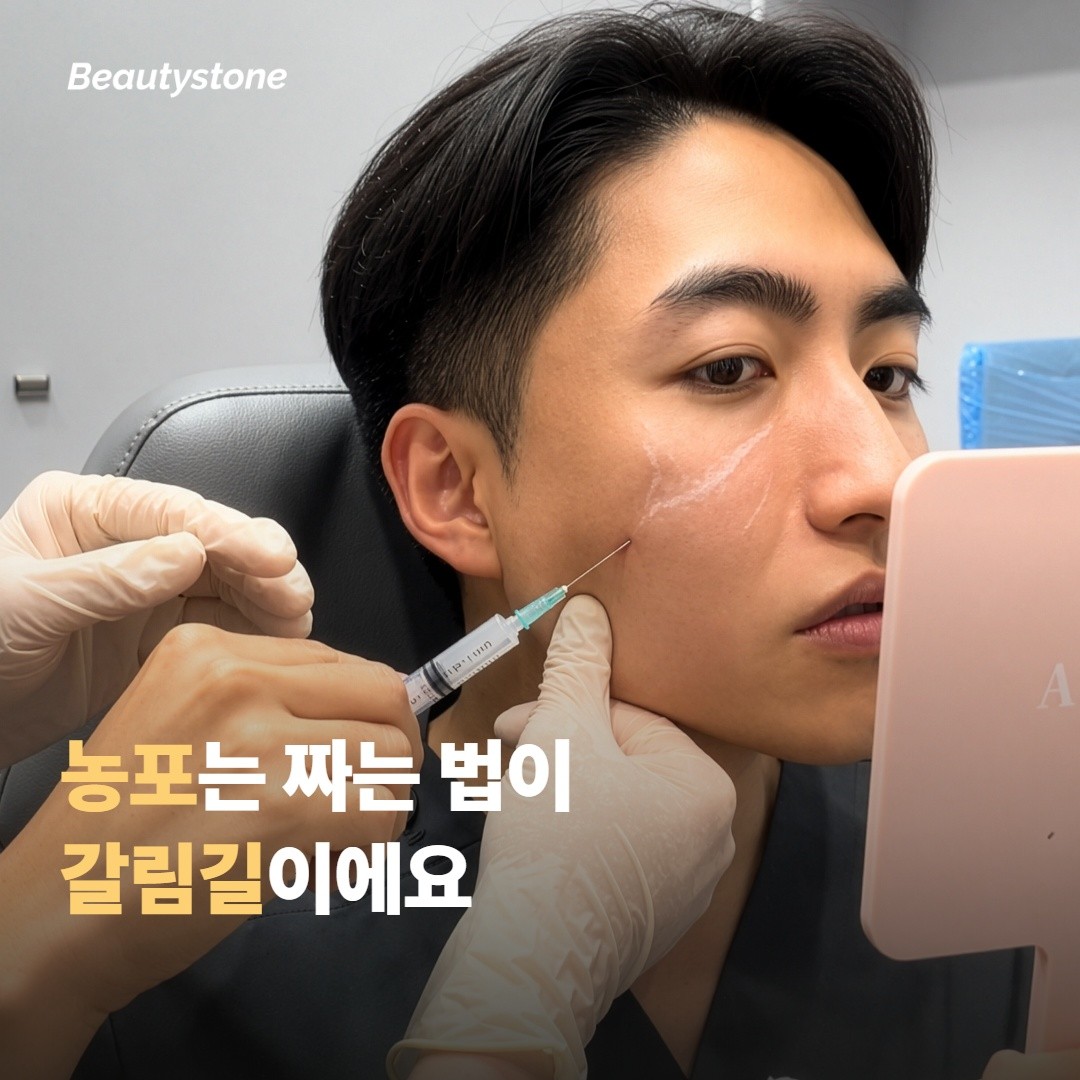
Damaged collagen does not naturally fill back up. Therefore, if a nodule is left untreated, the indentation deepens with every extra day it remains. The key to reducing scars is not squeezing, but "quickly calming the inflammation." What helps at this stage is a corticosteroid injection delivered in small amounts directly into the lesion.

Cysts Almost Always Lead to Scarring
Cysts are deep dermal pockets filled with pus and inflammatory materials in a sac-like form. They feel soft to the touch and are highly painful. The internal pressure pushes against the dermis and subcutaneous tissue, causing collagen loss even without any physical touching.
The most effective approach at the cyst stage is a combination of two treatments: incision and drainage to empty the internal pressure and inflammatory substances, and a triamcinolone* injection to rapidly calm the inflammation itself. Using both together will reduce the swelling within a few days. For deep and recurring cases, oral medications such as isotretinoin should be considered.
* Triamcinolone: A localized corticosteroid. Injecting a small amount (diluted to 2.5–5 mg/mL) inside nodules or cysts calms inflammation within 24 to 48 hours. Unlike systemic steroids, it only targets 'inside the lesion,' limiting side effects to the local area.

Repeated Breakouts in the Same Spot Solidify Into Scars
When pustules and nodules repeatedly occur in the same spot, the dermis is continuously damaged with no time to heal. This causes PIH and PIE to settle in as permanent marks, eventually progressing into atrophic scars. This is why it is crucial to intervene early in the cycle before the inflammation goes too deep.
Here is a summary of scar risks by acne stage:
Stage | Depth | Scar Risk | Clinical Response |
|---|---|---|---|
Comedones (Whiteheads/Blackheads) | Superficial | Very Low | Retinoids, Salicylic acid |
Papules (Red bumps) | Superficial to Medium | Low (Mainly temporary marks) | Topical antibiotics, BPO |
Pustules (Pus-filled) | Medium | Moderate (Depends on extraction method) | Hygienic incision and drainage |
Nodules (Hard, deep) | Deep | High | Triamcinolone injection + Oral antibiotics |
Cysts (Fluid-filled sacs) | Very Deep | Very High | Injection + Drainage + Consider Isotretinoin |
Take a moment to identify where your breakout falls on this chart. If it is a comedone or papule, simply leaving it alone is enough. For pustules and beyond, how you extract them and how quickly you calm the inflammation are the real determining factors in avoiding permanent scars.
Frequently Asked Questions
Q. Does putting an acne patch over a nodule help?
Acne patches are helpful for surface pustules by absorbing exudate and protecting them from irritation. However, for flat nodules and cysts, the pressure is located deep within the skin, so patches alone won't do much. If the swelling does not subside after a few days, seeing a doctor is the quickest path.
Q. If a large pimple doesn't go away in a few days, will it scar?
If a nodule or cyst persists in the same spot for more than a week, the likelihood of collagen loss increases. Whenever possible, calming it with an acne injection or drainage within the first few days is the most effective way to prevent scarring.
Q. Can I squeeze comedones without scarring?
Hygienic extraction that targets only the comedone is safe. However, squeezing and twisting with your fingernails can scratch the epidermis and irritate the surrounding dermis, leaving long-lasting brown or red marks. At the comedone stage, it is much cleaner to let it subside with retinoids rather than squeezing it.
Recommended Reads
Stop Squeezing From the Nodule Stage: That's When Scarring Begins
🔗 Read More
Understanding Acne — 1.1 Folliculitis vs. Acne
How to Stop It Now — 3.1 The Importance of Drainage · 3.2 Understanding Acne Injections Properly
Managing Remaining Marks — 4.1 PIH, PIE, Atrophic, & hypertrophic Scars
Not all acne is created equal. If you are at the non-inflammatory comedies stage (like tiny whiteheads), scarring is highly unlikely as long as you are careful when squeezing them. However, once it progresses to hard, deep nodules or painful cysts, the collagen within the dermis* breaks down, leading to permanent scars. Scarring isn't just about whether you squeezed it; it is determined by how deep the inflammation has traveled.
Not all acne is created equal. If you are at the non-inflammatory comedones stage (like tiny whiteheads), scarring is highly unlikely as long as you are careful when squeezing them. However, once it progresses to hard, deep nodules or painful cysts, the collagen within the dermis* breaks down, leading to permanent scars. Scarring isn't just about whether you squeezed it; it is determined by how deep the inflammation has traveled.
Comedones and Papules: Stages That Only Leave Temporary Marks
Comedones, such as whiteheads and blackheads, are non-inflammatory stages where sebum is trapped inside the pores. Since there is almost no damage to the dermis, they can heal without scarring if left alone or managed with retinoids*. However, if you pick at them with your fingernails, the epidermis and shallow dermis can get scratched, leaving behind brown marks (PIH) or red marks (PIE).
Red, raised papules are very similar. If left untouched, they only leave temporary marks that fade over time. Up to this stage, the rate of acne turning into permanent scars is extremely low.
* Dermis: The layer beneath the epidermis where collagen and elastic fibers are woven like a net. This is exactly where the fate of acne scarring is decided. If only the epidermis is damaged, it ends as a temporary mark; if the dermal collagen collapses, it solidifies into a scar.

Pustules: How You Pop Them is the Turning Point
Pustules, which show a yellow head in the center, are filled with pus. If the head has formed on the surface, releasing the pressure with sterilized tools will speed up recovery. The real issue is *how* you squeeze them.
Squeezing with your fingers or fingernails pushes the pus into the surrounding dermis, widening the area of inflammation. This leads to long-lasting marks or shallow scars. Even for the same pustule, extracting it through hygienic incision and drainage significantly reduces the risk of scarring. We will cover acne extraction methods in more detail in the next post of this series.

From Nodules Onward, the Dermis is Damaged
Nodules are deep pockets of inflammation that feel hard and swollen underneath while the surface remains flat. Since they are located deep inside the dermis, the surface does not easily move even when pressed with a finger. From this stage, the inflammation directly destroys the collagen network.
Damaged collagen does not naturally fill back up. Therefore, if a nodule is left untreated, the indentation deepens with every extra day it remains. The key to reducing scars is not squeezing, but "quickly calming the inflammation." What helps at this stage is a corticosteroid injection delivered in small amounts directly into the lesion.

Cysts Almost Always Lead to Scarring
Cysts are deep dermal pockets filled with pus and inflammatory materials in a sac-like form. They feel soft to the touch and are highly painful. The internal pressure pushes against the dermis and subcutaneous tissue, causing collagen loss even without any physical touching.
The most effective approach at the cyst stage is a combination of two treatments: incision and drainage to empty the internal pressure and inflammatory substances, and a triamcinolone* injection to rapidly calm the inflammation itself. Using both together will reduce the swelling within a few days. For deep and recurring cases, oral medications such as isotretinoin should be considered.
* Triamcinolone: A localized corticosteroid. Injecting a small amount (diluted to 2.5–5 mg/mL) inside nodules or cysts calms inflammation within 24 to 48 hours. Unlike systemic steroids, it only targets 'inside the lesion,' limiting side effects to the local area.

Repeated Breakouts in the Same Spot Solidify Into Scars
When pustules and nodules repeatedly occur in the same spot, the dermis is continuously damaged with no time to heal. This causes PIH and PIE to settle in as permanent marks, eventually progressing into atrophic scars. This is why it is crucial to intervene early in the cycle before the inflammation goes too deep.
Here is a summary of scar risks by acne stage:
Stage | Depth | Scar Risk | Clinical Response |
|---|---|---|---|
Comedones (Whiteheads/Blackheads) | Superficial | Very Low | Retinoids, Salicylic acid |
Papules (Red bumps) | Superficial to Medium | Low (Mainly temporary marks) | Topical antibiotics, BPO |
Pustules (Pus-filled) | Medium | Moderate (Depends on extraction method) | Hygienic incision and drainage |
Nodules (Hard, deep) | Deep | High | Triamcinolone injection + Oral antibiotics |
Cysts (Fluid-filled sacs) | Very Deep | Very High | Injection + Drainage + Consider Isotretinoin |
Take a moment to identify where your breakout falls on this chart. If it is a comedone or papule, simply leaving it alone is enough. For pustules and beyond, how you extract them and how quickly you calm the inflammation are the real determining factors in avoiding permanent scars.
Frequently Asked Questions
Q. Does putting an acne patch over a nodule help?
Acne patches are helpful for surface pustules by absorbing exudate and protecting them from irritation. However, for flat nodules and cysts, the pressure is located deep within the skin, so patches alone won't do much. If the swelling does not subside after a few days, seeing a doctor is the quickest path.
Q. If a large pimple doesn't go away in a few days, will it scar?
If a nodule or cyst persists in the same spot for more than a week, the likelihood of collagen loss increases. Whenever possible, calming it with an acne injection or drainage within the first few days is the most effective way to prevent scarring.
Q. Can I squeeze comedones without scarring?
Hygienic extraction that targets only the comedone is safe. However, squeezing and twisting with your fingernails can scratch the epidermis and irritate the surrounding dermis, leaving long-lasting brown or red marks. At the comedone stage, it is much cleaner to let it subside with retinoids rather than squeezing it.
Recommended Reads
Recommended post
Recommended post
Latest post
Latest post

skin
Think it's a pimple? It may be folliculitis
Acne vs folliculitis: tell apart by comedones, itch, and site, and why diagnosis prevents scars.

skin
Don't squeeze nodular acne: scarring starts here
Scarring isn't from squeezing but how deep inflammation goes. Scar risk by stage in one table.

skin
Leaving pustules can worsen scars: timing matters
'Never pop acne' is half true. When to extract pustules, how, and stages you must never touch.

skin
Acne cortisone shots work like burn-scar care
Waiting out nodules damages dermal collagen. How cortisone shots work, plus side effects, limits.

skin
Brown, red, indented acne marks: different fixes
Brown is melanin, red is vessels, dents are lost collagen, raised is excess. Four types, four fixes.

Contouring & Volume
The frontalis muscle also helps open your eyes
Why same dose, same spot differs per person: the forehead muscle's dual role and muscle interplay.
1:1 Custom Approach
💬 Eng Available 1:1 consultations available via Whatsapp
🌸 Beautystone Clinic attends the Meditox Bangkok Cadaver Workshop 🌸
1:1 Custom Approach


![[Beauty Stone] How to Avoid Failing at Dark Circle Filler? "The Precision of 0.3cc Changes the Results"](https://framerusercontent.com/images/F4Q84TUWgjbZJV6MNheLnWHnaw.jpg?width=1080&height=1080)