

Red marks after brow tattoo removal? Seoul expert explains causes & laser fix. See results.
Published -
Updated -

Author
Wi Young-jin · Chief director
Seoul National University College of Medicine · Seoul National University Hospital Specialist
→
Eyebrow tattoo removal — red residual marks,
will they actually go away?

Hello, welcome to Beautystone Clinic.
I'm Dr. Wi Young-jin, a Seoul National University-trained specialist.
Many patients come in after removing their eyebrow tattoo —
only to be left with red marks
that bother them even more
than the original tattoo.
"Why is my skin so red
after laser eyebrow tattoo removal?"
It's one of the most common questions
I hear in the clinic.
The short answer:
red marks usually go away.
But understanding the cause
is key to clearing them faster.
Check out our other posts too!
Give them a read 😊
✦ Related Reading
▶3 Causes of Red Marks After Eyebrow Tattoo Removal — And How to Fix Them
▶Why We Measure Skin Thickness With an Expensive Ultrasound Device
▶Seoul LDM in Hongdae — Does It Really Help with 5 Skin Concerns?
▶5 Things to Know Before Getting an Exosome Treatment in Hongdae
1. Red marks after eyebrow tattoo removal —
what causes them?
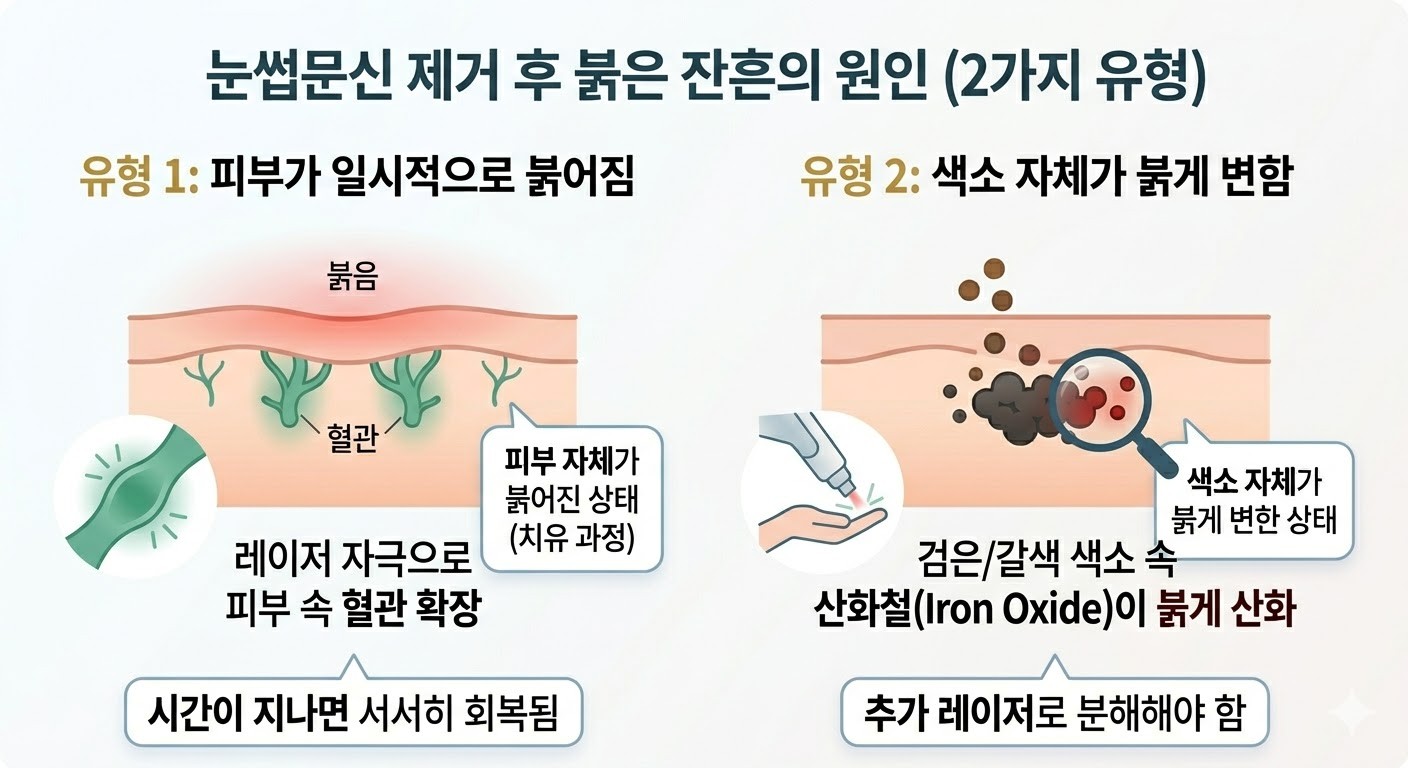
When laser breaks down tattoo pigment,
an inflammatory response occurs in the skin.
Most people, however,
don't describe that kind of redness
as "red marks."
In many cases, the red marks are actually
pigment that has turned red.
If the black or brown tattoo ink
contains iron oxide pigments,
laser energy can oxidize them —
turning them red instead of fading them.
Don't worry —
red tattoo pigment can absolutely be removed
with laser treatment!
2. When do red marks
tend to last longer?

From what I've seen clinically,
skin type makes a significant difference.
Skin with higher melanin levels
(Fitzpatrick Type III–IV — darker skin tones prone to pigmentation)
tends to hold onto red marks
for longer.
Treatment intervals matter too.
Too frequent sessions
don't give skin time to heal —
and can actually prolong redness.
In general, laser sessions are spaced
based on individual condition,
but as a general guideline,
we recommend every 4–6 weeks.
Clinical studies have shown that
adequate spacing between sessions
improves both pigment clearance
and skin recovery.
Also, semi-permanent tattoo pigment
sits in the superficial dermis —
making it easier to remove than regular tattoos.
That said, results can vary
depending on the provider's skill
and the type of pigment originally used.
3. Will red marks fade on their own?
What about treatment?
Honestly, mild red marks
do fade naturally over time.

On average,
About 3 to 6 months.
But if oxidized red pigment remains,
or vascular redness is severe,
leaving it alone
often won't make it go away.
In that case, V-Laser (vascular coagulation)
can be a great option! 😄
Don't worry too much!
We use V-Laser at our clinic,
with 5 years of vascular laser experience.
Safe and effective vascular removal
is absolutely possible.
If visible vessels bother you,
it's worth giving it a try.
It offers two wavelengths — 532nm and 1064nm —
selectable based on your condition,
so both red pigment and vascular issues
can be addressed together. 👉
That said, this treatment
isn't right for everyone.
The approach varies depending on
skin condition and pigment type,
so jumping into more laser without proper diagnosis
can actually lead to PIH or scarring.
According to dermatology society guidelines,
identifying the cause of red marks
comes before choosing treatment..
Frequently Asked Questions (FAQ)
Q1. How long does it take
for red marks to fade?
A. Mild vascular redness often fades naturally
within 3 to 6 months.
But oxidized red pigment
usually won't clear without additional laser treatment.
Depending on the condition,
2 to 5 sessions may be needed.
Q2. Won't laser on red marks
make things worse?
A. When the cause is properly identified
and the right wavelength and energy are used,
it actually improves quickly.
The issue is applying strong laser
without knowing the cause —
that's something I don't recommend either.
Q3. Is there a way to manage
red marks at home?
A. Sun protection is the most important step.
Sun exposure can worsen redness
and even lead to PIH.
Use a sunscreen with
SPF 50 or higher every day.
Moisturizers with Hyaluronic Acid or panthenol
also help restore the skin barrier.
Red marks after eyebrow tattoo removal can have various causes —
it's not easy to figure out on your own.
At Beautystone Clinic in Hongdae / Seoul,
our doctor personally assesses your condition
and determines whether it's oxidized pigment or vascular issues
before discussing the best approach together.
If you're near Korea / Sinchon / Ewha / Mangwon,
feel free to book a consultation. 😊
Related Posts: Tattoo Removal with PicoWay — How Many Sessions? A Complete Guide by Color & Location ㅣ Pre-Wedding Skincare Routine: A Day-by-Day Guide Written by Our DoctorㅣFolliculitis After Beard Hair Removal — It's Because You're Not Doing These 3 Things!
With brow pigment, clinical suitability and safety are assessed separately from any session estimate. Where removal is appropriate, Beautystone uses the Kirby–Desai assessment in consultation, reviewing skin type, location, ink amount, layering, scarring and colour, to discuss an expected range. That range is revised as your skin responds over the course.
Content


skin
Why Does Fractional CO2 Take Longer to Heal?

Contouring & Volume
How Many cc Does Forehead Filler Need?

skin
Why Is My Skin Oily but Tight in the Fall?

Hair Removal
Underarm Laser Hair Removal Cost: Do the Math

Tattoo removal
Laser Before a Cover-Up: How Many Sessions?

skin
큐어젯 다운타임, 다음 날 출근과 화장은 언제부터 될까요?