

Worried about lettering tattoo removal? Pico laser clears ink easily—see the process and sessions.
Published
Updated

Author
Wi Young-jin · Chief director
Seoul National University College of Medicine · Seoul National University Hospital Specialist
→
Lettering Tattoo Removal Isn't as Hard as You Think
I'm Director Wi Young-jin of Beauty's Doctors.
As a Seoul National University-trained specialist,
I practice at Beautystone Clinic in Hongdae.
💡 Please check this before reading
Q. Isn't lettering tattoo removal harder because the lines are so dense?
A. Quite the opposite. Among tattoos, lettering is one of the easiest types to remove.
Q. Why do results differ even with the same laser?
A. Ink depth, color composition, and whether there have been touch-ups are far bigger variables than the machine itself.
📌 Key point of this article
Lettering tattoo removal is easy. It's a very easy kind of tattoo, and touch-ups are not common, so it's easy to break apart too.

The reason lettering is easy to remove actually lies in its structure
When you search for tattoo removal,
you often see things like,
"Tattoo removal takes a long time,"
"You should be prepared for at least 10 sessions."
That's not entirely wrong,
but if you think the same applies to lettering,
that's a different story.
To be honest,
lettering tattoos are among the easiest tattoos
to remove.
The subtle point here is,
it's not that they are always easy,
but that they have
'structurally favorable conditions for removal.'
There are three main reasons.
First, the ink color is simple.
Lettering is usually done with a single black ink color.
Black is the color that responds best
to laser removal.
Laser works by breaking up ink particles,
and black absorbs all wavelengths,
so it responds much faster than other colors.
Second, touch-ups are rare.
Color tattoos or illustrated tattoos
are often touched up by layering more ink on top
when the color spreads or fades over time.
That creates a thicker ink layer
and greatly increases the difficulty of removal.
Lettering is different.
If one line fades, people usually just leave it
or start over entirely,
rather than repeatedly repainting the same area.
The thinner the ink layer, the fewer removal sessions are needed.
Third, the treated area itself is small.
There isn't a large filled-in area,
since it's made only of lines,
so there is less total area for the laser to target.
That means the range that can be treated
without skin damage is smaller.
👨⚕️ Director Wi Young-jin's key summary:
Lettering tattoos are single-color black, rarely retouched, and line-based in structure
These three conditions come together
to make them the type of tattoo that responds fastest to laser treatment.
Even if you were told elsewhere that you need more than 10 sessions,
in the case of lettering, it's quite common in clinical practice
for it to end in less than half that.
So which lettering tattoos are relatively more difficult,
and how should we approach them?
But there's one important thing here.
The point is, 'not all lettering tattoos are the same.'
It varies by case,
but in the clinic I usually classify them like this.
① Standard black lettering
This is the most common case.
Single-color black, no touch-ups,
within 3 to 5 years after the procedure.
Based on pico laser,
it often finishes in about 4 to 6 sessions.
② Cases mixed with white ink or gray shading
This is where things start to differ.
White ink paradoxically responds poorly to laser,
so it can actually oxidize and turn black
or react more slowly.
In these cases, more sessions may be needed.
③ Cases that have had even one touch-up
This is a point many people misunderstand.
"Isn't a touch-up just maintenance?"
A touch-up isn't maintenance; it's a repeat procedure.
Because ink has built up twice in the same area,
the number of removal sessions increases noticeably.
When I consult patients,
this touch-up history is something I always ask about.
It's the key variable for predicting the number of sessions.
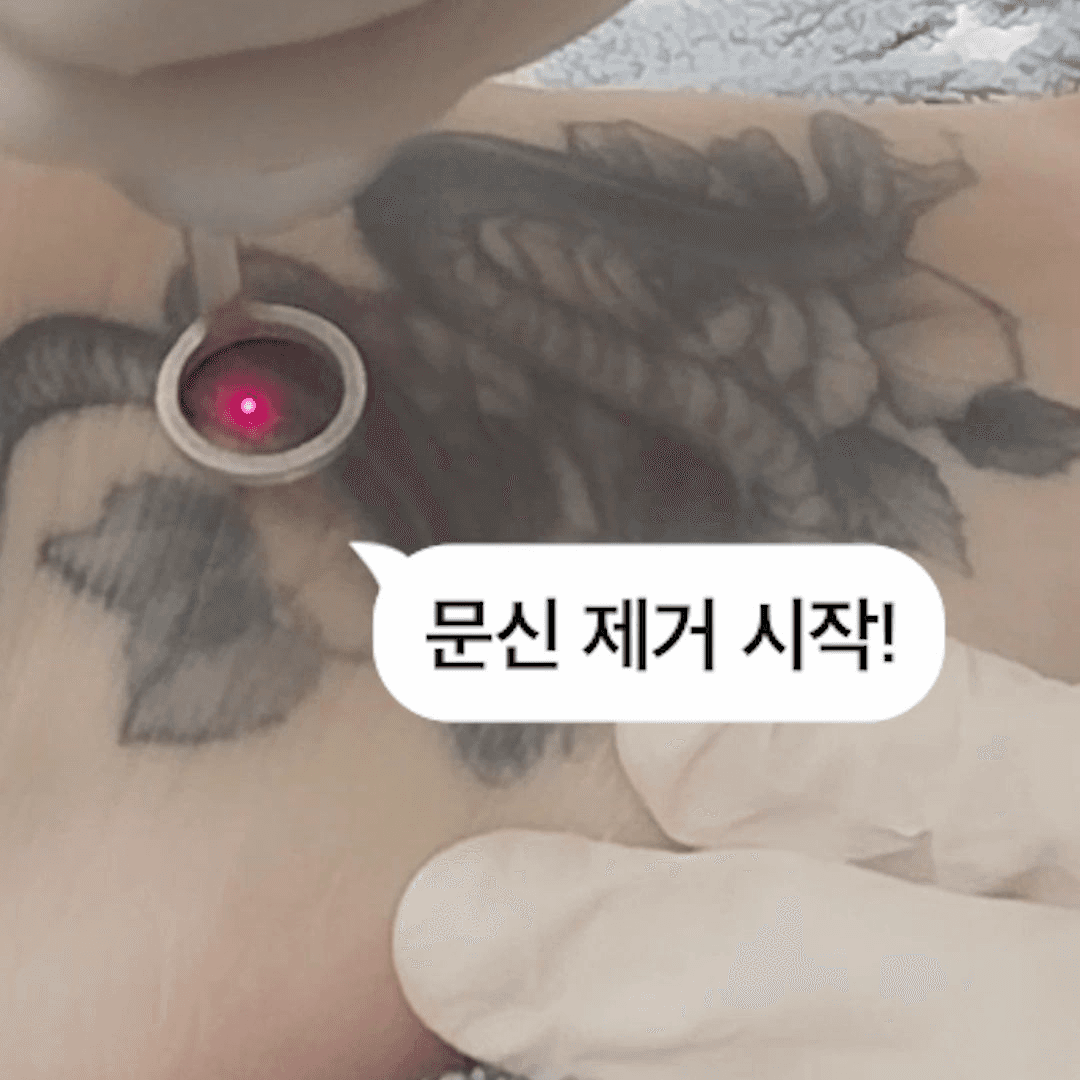
For laser treatment, we mainly use pico-second devices,
which are ultra-short pulse lasers measured in trillionths of a second.
They break ink particles into much finer pieces,
allowing faster absorption by the body.
Compared with nano-second lasers (older models),
they have the advantages of less thermal damage and faster response.
One thing I must emphasize is,
even if the laser device is good,
if the settings aren't appropriate,
efficiency drops sharply.
To remove it quickly without scars,
adjusting the energy setting per session
while watching the skin's reaction
is just as important as choosing the device.
When people come to us after receiving 8 sessions elsewhere
and still have residue left,
we recheck the settings,
and quite often it finishes in 2 to 3 more sessions.
Frequently Asked Questions
Q1. Does removal work well even on areas close to bone, like the wrist or collarbone?
A. Removal works well for the wrist and collarbone too.
Even areas close to bone
can be removed without issue.
Q2. If I just got the tattoo, can I remove it right away?
A. In general, at least 4 weeks should pass after the procedure
for the skin to stabilize
and for the laser response to become predictable.
Starting before then
actually increases the risk of skin troubles.
There's no need to rush,
and we recommend coming in for consultation after 1 to 2 months.
Q3. Can scars remain after removal?
A. Tattoo removal, like getting a tattoo, is a procedure that irritates the skin,
so if the settings are too aggressive or care during recovery is poor,
hyperpigmentation or shallow scars may remain.
So it's important to leave enough time between sessions
(usually 6 to 8 weeks or more)
and proceed to the next session
while confirming that the skin has recovered.
That said, with proper settings and care,
most cases finish without scars.
That's all from Wi Young-jin.
▶ Also read
▶Saxenda vs. Mounjaro: honestly, Mounjaro wins by a landslide.
▶Where is the best place in Hongdae for forehead filler?
▶There's a reason it's called a mecca for laser hair removal in Hongdae.
▶Body treatment with Juvelook Glam, explained by Director Wi Young-jin
▶Why Juvelook Glam is less painful than Rejuran and lasts longer in radiance
Lettering often does clear in fewer sessions, but the range still depends on your own tattoo. Beautystone uses the Kirby–Desai assessment during consultation to review skin type, location, ink amount, layering, scarring and colour, including any touch-up history, before estimating sessions. The figure is an estimate rather than a guarantee, and we revise it as your skin responds over the course of treatment.


Lifting
XERF for a Thin Face: Depth vs. Hollowing?

Lifting
Thread Lift Swelling: What's Normal in 5 Days?

Lifting
Thermage Cost: 4 Lines to Check on a Quote

Contouring & Volume
Xeomin Cost: Why Do 50-Unit Quotes Differ?

skin
Back Acne That Won't Clear? It Might Be Fungal

Tattoo removal
Bad Brow Tattoo: Cover It Up or Fade It First?