

Scabs and blisters can be normal—why not to pick them, and how to time your sessions.
Published
Updated

Author
Wi Young-jin · Chief director
Seoul National University College of Medicine · Seoul National University Hospital Specialist
→
If you have decided to remove your tattoo with Picoway, you are probably as curious about the recovery process as you are about the treatment itself. It is easy to worry if you see scabs or blisters and wonder if something went wrong, but understanding the general timeline of recovery beforehand can help ease any unnecessary anxiety.
In short, after Picoway tattoo removal, your skin will go through a gradual process: redness and swelling → scabbing and blistering → ink elimination. Scabs and blisters can be a completely normal part of the healing process, and the key is to never pick or pop them. Also, since tattoos cannot be removed in a single session, your skin needs time to heal between treatments.
In this guide
The step-by-step recovery process from immediately after the session
Why scabs and blisters form and how to care for them
Why multiple sessions are needed and why intervals are important
What to avoid during your recovery
Recovery Timeline: From Right After the Session to Healing
Picoway uses ultra-short laser* pulses to shatter ink particles into tiny fragments, which your body then naturally eliminates over time. Because of this, recovery does not happen overnight but rather progresses in stages.
Laser*: Refers to short pulses of light that are selectively absorbed by the ink pigment. It is used to shatter only the pigment while minimizing damage to the surrounding skin.
American Academy of Dermatology Laser Tattoo Removal Guide explains that after the laser shatters the ink, the body needs time to flush those particles out. Usually, redness and swelling occur first immediately after the session, followed by scabs or mild blisters forming and healing within a few days.
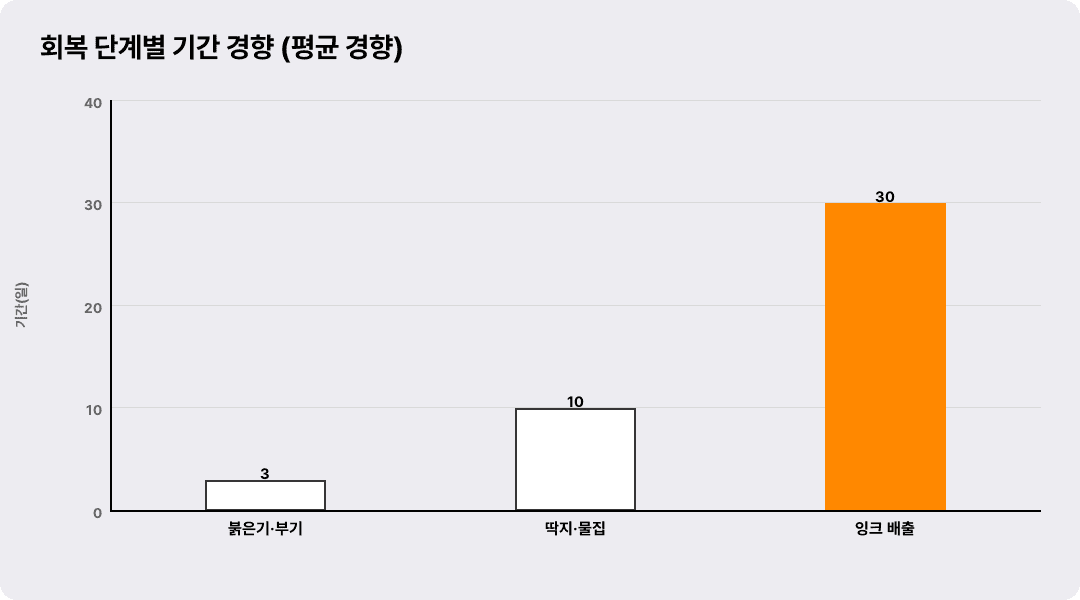
Here is a general timeline of how long each recovery phase typically takes. Please keep in mind that this is an average guideline and can vary depending on the ink depth, color, and your individual skin type.
Why Do Scabs and Blisters Form, and How Should I Handle Them?
When the laser energy targets the pigment, it can cause mild irritation on the skin surface, leading to scabs or light blistering. This is a natural part of the healing process, but the most important thing is not to pick at scabs or pop blisters. Doing so can lead to infection, scarring, or hyperpigmentation.
Let scabs fall off naturally on their own
Do not pop blisters; protect them instead
If oozing occurs, keep the area clean and moisturized so it does not dry out
Do not scratch the area, even if it feels itchy
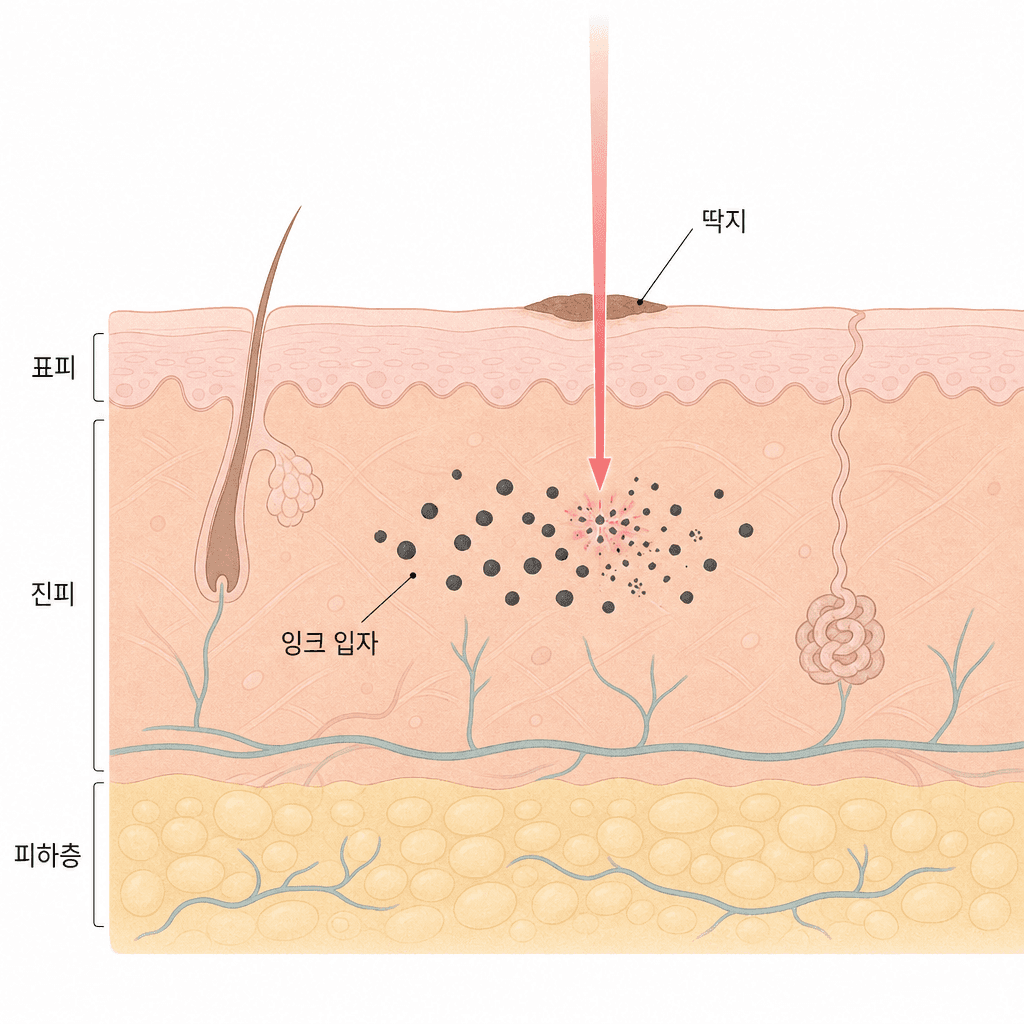
Looking at a cross-section of how the Picoway laser targets ink in different skin layers makes it easier to understand why scabbing occurs on the surface and why the elimination process takes time.

Why Multiple Sessions and Intervals Are Necessary
Tattoo ink is layered deep within the skin, making it difficult to safely shatter all of it in a single visit. Therefore, the treatment is divided into multiple sessions, leaving sufficient time between them for your skin to heal and the shattered ink to be cleared away.
American Society for Dermatologic Surgery Tattoo Removal Guide also states that most tattoos require several treatments, and different lasers or settings may be used depending on the colors. Black and dark colors generally respond faster, while certain colors may require more sessions.
American Academy of Dermatology resources also explain that the laser cannot safely shatter all layers at once, and recovery time between sessions is crucial for your skin's health. For your safety, it is always best to let your skin fully recover before scheduling your next session, rather than rushing the intervals.
Hapjeong Beautystone Guides You Through Every Step of Your Recovery
At Hapjeong Beautystone, even for the same Picoway tattoo removal, we carefully assess your ink color, depth, and skin condition to customize your sessions and intervals. We also guide you beforehand on what is normal and what to watch out for during each stage of healing. Our care goes beyond just performing the treatment—we walk with you through the entire recovery journey.
Since we are located within walking distance of Hapjeong Station, you can easily drop by for a quick check-up between sessions to determine the best timing for your next appointment. Since this article provides general information, it is highly recommended to consult with our medical team before and after your treatment to determine your personalized recovery plan and session intervals.

What to Avoid During Recovery
Knowing what to avoid can help prevent delayed healing, scarring, or pigmentation issues.
Picking at scabs or popping blisters
Roughly rubbing or exfoliating the treated area
Excessive heat or irritation like saunas, steam rooms, and swimming before full recovery
Exposing the area to direct sunlight without sun protection
In particular, UV rays can significantly increase the risk of hyperpigmentation, so it is crucial to protect the treated area from the sun during recovery. The golden rule of healing is to keep the area clean and lightly moisturized while letting scabs fall off naturally.
Frequently Asked Questions
Q. Can I peel off the scabs once they form?
A. It is best not to. Forcing scabs off can increase the risk of scarring, pigmentation, and infection. It is safest to let them fall off naturally while keeping the area clean and moisturized.
Q. Is it bad if blisters form?
A. Mild blistering can happen as part of the natural healing process. However, it is important not to pop them and to keep them protected. If the blisters are unusually large, painful, or accompanied by a fever, please have them checked by a medical professional.
Q. How long is the typical interval between sessions?
A. Since your skin needs time to heal and the ink needs time to clear out, intervals are usually spaced several weeks apart. Rather than rushing, it is much safer to monitor your skin's recovery progress before scheduling the next session. This can vary from person to person.
Q. Do certain colors require more sessions?
A. Black and dark colors generally respond relatively quickly, while some colors may require more sessions or different laser settings. It is best to consult with our medical team before your treatment to set up a session plan based on your tattoo's specific colors and depth.
Recommended Reading
Picoway Tattoo Removal*: How Many Sessions Does It Safely Take on Average?
Thinking of Removing a Color Tattoo? The Real Reason Why It Takes More Sessions
How Many Picoway Tattoo Removal Sessions Do I Need? A Complete Guide by Color and Location
Picoway Tattoo Removal Reviews*: The Truth Behind "Done in Just 3 Sessions"
Aftercare and recovery are guided by the doctor's examination of your skin, not by a scoring form. Separately, Beautystone uses the Kirby–Desai assessment during consultation to estimate how many sessions your tattoo may need, reviewing skin type, location, ink amount, layering, scarring and colour. That estimate can move as your response becomes clear, so we go over it again as sessions continue and your schedule allows.






Contouring & Volume
Glabella Botox Side Effects: Droopy Eyelids

Contouring & Volume
Juvelook Volume Not Working After 3 Sessions?

Contouring & Volume
Hip Dip Filler Before and After: 4 Checks

Body
Potenza Treatment Interval: Why 4 Weeks?

Lifting
Ultherapy Before and After: Why Wait 90 Days?

Contouring & Volume
Belotero Revive Cost: 2cc Price vs. 3 Sessions