

Filler is most likely to shift early, when pressure and heavy movement act on it. Here is what to skip in week 1, what returns in week 2, and when to call.
Published -
Updated -

Author
Wi Young-jin · Chief director
Seoul National University College of Medicine · Seoul National University Hospital Specialist
→
If you have just had filler and want to know what to avoid so it does not move, the short answer is anything that puts firm pressure on the area or works the muscles around it hard. That means heavy exercise, firm massage, and sleeping with your face pressed into a pillow for the first days.
Most of what determines whether filler stays put was decided before you left the treatment room, in the plane it was placed into and how much went in at once. But the first week or two is the part you hold, and it is worth knowing which precautions actually do something and which are just folklore.
The First 48 Hours: Why Pressure Is the Thing to Watch
In the first two days, the single most useful rule is to leave the treated area alone. Filler migration* happens when product moves away from where it was placed, and the forces that push it are ordinary ones: massage, muscle movement, gravity, and displacement under pressure. None of those need to be dramatic to have an effect while the product is newly placed.

*Filler migration: injected filler moving away from where it was placed into the surrounding tissue. It is not the same as the temporary spreading you see with early swelling.*
That distinction matters right now, because what you are looking at in the first 48 hours is almost always swelling rather than movement. Mild swelling and redness at the injection site are common and generally ease within a few days. A firm feel early on is also usual, and it often softens as the filler settles.
So the goal in this window is not to inspect the area constantly but to keep hands off it. Practical version:
No firm massage or rubbing, even if the area feels uneven
No sleeping face-down, and avoid pressing the area into a pillow or your hand
Skip heavy exercise, which combines pressure, heat, and sustained movement
Leave anything that clamps or presses on the area, such as tight straps, until it settles
Days 3 to 7: What to Hold Off On, and What Is Just Settling
By the middle of the first week, swelling is usually receding and the temptation to test the area starts. This is the point where people most often massage a spot that feels firm, which is exactly the force worth avoiding. Firm massage and frequent pressure sit on the side of the ledger that leans toward movement.

Ordinary reactions in this stretch look like this, and none of them are signs that something has moved:
What you may notice | What it usually means |
|---|---|
Mild swelling and redness | A common early reaction that generally eases within a few days |
Slight bruising or a pressed feeling | Can linger for a few days at the injection site |
A firm feel where product was placed | Often softens as the filler settles into position |

Heavy exercise is worth keeping off the calendar in this window as well. It is not that a workout drags filler across your face on its own, but it stacks several of the relevant forces at once, and there is no benefit to finding out where the line is during the days when product is least settled.
If you are unsure whether a specific activity counts, the useful test is whether it puts sustained pressure on the treated area or works the muscles right under it hard. If the answer is yes, it can wait a few days. If you need a firm date for a particular sport or a work routine, ask the clinic that treated you rather than guessing from a general list.
Week 2 and After: What Returns, and What Stays Careful
By the second week most people are back to their normal routine, and the early reactions have usually resolved. What changes is not that the area becomes immune to pressure, but that the product has had time to settle where it was placed.

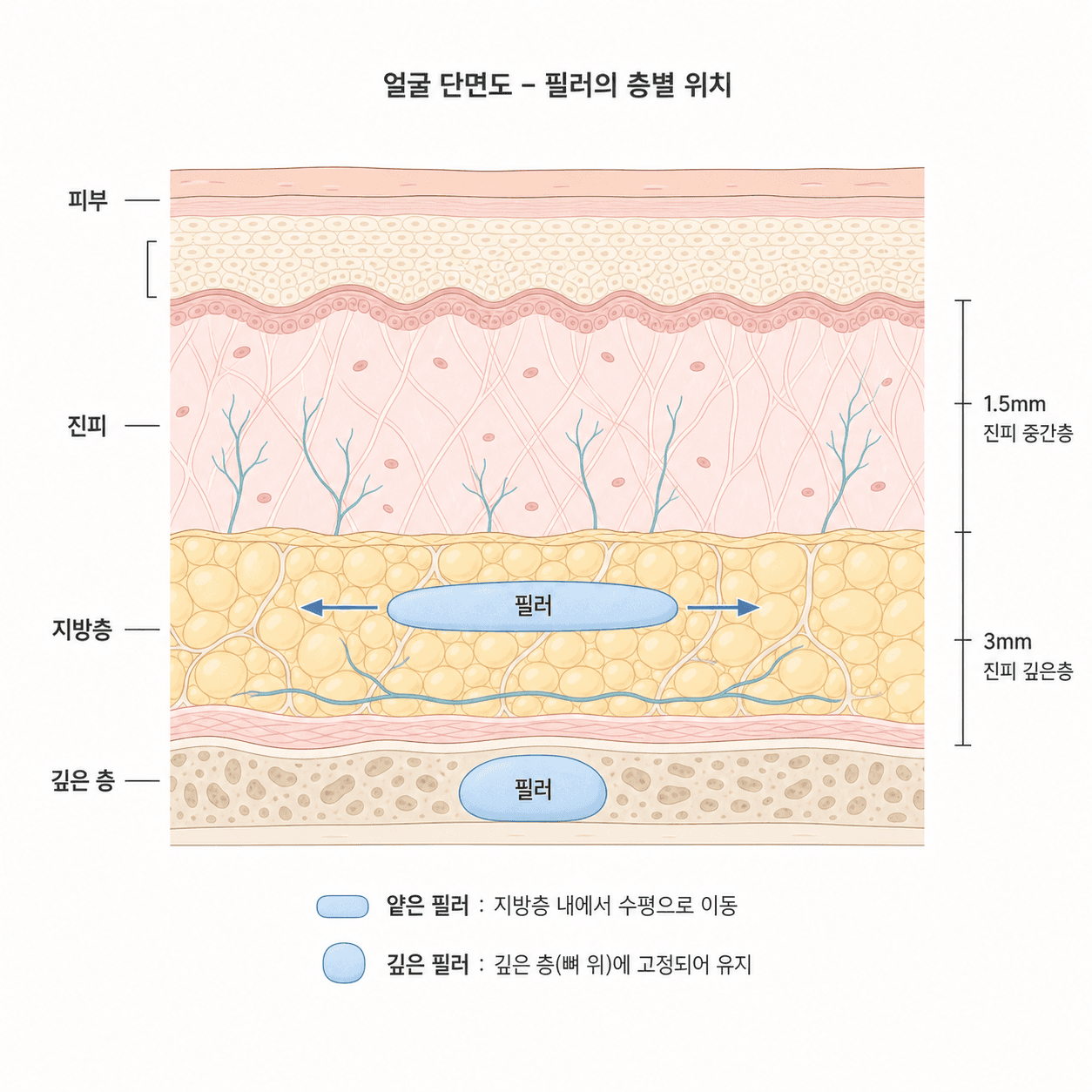
One thing worth carrying forward: how much an area moves in daily life keeps mattering after the aftercare window closes. Muscle-rich, mobile regions such as around the mouth and the lips lean toward movement more than areas that move less, which is why plans there tend to be more conservative in both plane and volume from the start.
That also explains why the same syringe behaves differently in different faces. Placement that sits deep and supported near bone tends to hold position; product placed superficially has more room to travel. A large volume delivered at high pressure in one go displaces more than the same amount layered across several passes. None of that is something you can adjust afterward, which is the honest reason aftercare is a smaller lever than the consultation.
Hyaluronic acid also draws water, and the fibrous septa between subcutaneous layers are permeable enough to let product spread along them. That is why filler that has moved often turns up as a soft, painless lump somewhere you were never injected, rather than as an obvious shift at the injection site.
Which Changes Mean Call, and Which Just Mean Wait
The most useful pair of clues is when a change appeared and where it sits. Swelling arrives soon after treatment, spreads broadly, and settles. Movement tends to show up later, and it shows up somewhere the needle never went.
These are worth raising with the clinician who treated you rather than watching for another month:
A bulge or lump somewhere nothing was injected
A line that keeps spreading or looks less defined as time passes
One side standing out asymmetrically once swelling has gone
Separately from migration, a short list calls for urgent attention rather than a wait-and-see approach: severe or worsening pain, a change in skin color over the treated area, or any change in vision. Contact the clinic that treated you immediately or seek urgent care.
There is also a reason not to sit on a suspicion. Hyaluronic acid filler can be broken down with an enzyme, so product that has moved can be adjusted rather than waited out. Whether that is the right step depends on the area and the situation, which is a decision to make after an examination rather than on your own.
Raising it early is simply easier than raising it late, and it costs you nothing to have an ambiguous lump looked at by the people who know exactly what was placed and where.
How Beautystone Plans a Filler Session Before the First Syringe
At Beautystone, a small clinic a short walk from Hapjeong Station, a filler consultation starts with the area and the goal, then sets the plane and the volume around how much that area actually moves. Where movement is a fair concern, the usual suggestion is to split the volume across sessions rather than placing it all at once.

Dr. Kim Daniel Ha-won goes over the aftercare window in the same conversation, before anything is injected: which reactions are expected, roughly how long each is allowed to last, and what would be worth a call. Agreeing on that in advance is what keeps the first week from turning into daily self-diagnosis in the mirror.
The consultation is also where the tool gets checked against the complaint. If what bothers you is a hollow, filler is what fills it. If what bothers you is sagging, a thread lift holds a lifted position for longer, and filler placed to chase sagging tends to disappoint. Getting that distinction right before a syringe is opened prevents a whole category of regret that no aftercare can fix.
Being a small clinic is what makes it practical to plan around one person rather than a fixed protocol. Wherever you go, look for someone who examines the area and explains the plane and the volume before picking up a syringe.
Results and reactions vary from person to person, and this article is general information rather than advice about your own case. For anything specific to your area, goal, or history, ask the clinician who will actually treat you.
Frequently asked questions
When can I go back to the gym after lip filler?
Heavy exercise is worth skipping in the first days, because it combines sustained pressure, heat, and movement at the point when product is least settled. Light walking is a different matter from an intense session. For a specific date, ask the clinic that treated you, since the area and the volume placed both change the answer.
Is it safe to sleep on my side after filler?
Sleeping with the treated area pressed into a pillow is the version worth avoiding early on, since steady pressure is one of the forces that can displace product. Sleeping on your back for the first nights is the simplest way around it. If that is impossible for you, mention it at the consultation so the plan accounts for it.
Should I massage a lump if the area feels uneven?
Not on your own. Firm massage is one of the forces associated with movement, so pressing a firm spot can work against the result you are trying to protect. A firm feel early on often softens as filler settles. If it does not, or if the lump sits somewhere nothing was injected, have the clinic that treated you look at it.
Does filler move more in the lips than in the cheeks?
Mobile, muscle-rich areas such as the lips and around the mouth lean toward movement more than areas that move less, which is why plans there are usually more conservative in plane and volume. That is a tendency rather than a rule, and the plane the product went into and how much went in at once still carry more weight than the area alone.
Content





skin
Why Does Fractional CO2 Take Longer to Heal?

Contouring & Volume
How Many cc Does Forehead Filler Need?

skin
Why Is My Skin Oily but Tight in the Fall?

Hair Removal
Underarm Laser Hair Removal Cost: Do the Math

Tattoo removal
Laser Before a Cover-Up: How Many Sessions?

skin
큐어젯 다운타임, 다음 날 출근과 화장은 언제부터 될까요?