

Laser Hair Removal for Men's Legs: 5 Sessions?
Laser hair removal on men's legs is a course, not one visit. What five sessions means, what to do about moles and tattoos, and how to plan a Seoul trip.
Published
Updated

Author
Wi Young-jinChief Director, Myeongdong
Seoul National University College of Medicine · Seoul National University Hospital Specialist
→
Yes, a Seoul trip is a reasonable place to start laser hair removal on your legs, as long as you treat it as the first session of a course rather than the whole job. Plan for several sessions spread over months, judge progress by how much hair grows back, and get the moles and any tattoos on your legs accounted for before the first pulse.
If you're searching for men's leg hair removal, you probably have thick, dark hair on your thighs and calves, you're tired of shaving or waxing it, and you've seen five sessions quoted as the number. The worry underneath is fair: paying for a big area abroad, then ending up with patchy regrowth after one trip, or a burn or dark mark that follows you home.
In this article, we'll cover how many sessions legs really take and what five means, what happens to moles and tattoos on the legs, which laser fits your skin and hair, the side effects and risks, and how to fit all of it around flights, shorts and sun.
How many laser sessions do men's legs really need?
More than one, and nobody can honestly name your number before seeing your legs. Five is a useful point to stop and compare regrowth, not a finish line.
Here's what the studies done on legs actually show. In a split-leg study, 30 Asian patients with skin types III to IV and black hair received three sessions at 6- to 8-week intervals and were followed up for 12 months.
In that study, hair reduction was 76.85% on the diode laser leg and 74.53% on the intense pulsed light (IPL) leg.
Another split-leg study of 25 patients compared two diode laser methods and found comparable hair reduction of 86-91% in hair counts six months after the fifth treatment.
Those were diode and IPL devices under study conditions, so read them as a picture of what legs can do, not a forecast for yours. The wider evidence is more cautious.
A Cochrane review of laser and light hair removal found a short-term effect of approximately 50% hair reduction with alexandrite and diode lasers up to six months after treatment.
The same review found that long-term hair removal was not documented with any treatment.
That review included eleven randomized trials, none of which were of high methodological quality, so it's a rough guide rather than the final word.
What does a good outcome look like, then? A long-term follow-up study of 100 patients who no longer needed hair removal at least 2 years after alexandrite laser treatment concluded that hair reduction together with thinning satisfied patients without total removal of hairs.
That study only included people who had already reached that point, so it shows what success looks like rather than how often it happens. Still, it's the right picture to hold: fewer, finer hairs you stop thinking about, not skin that never grows a hair again.
What moves the count up or down on your legs:
Hair: dark, coarse hair gives the laser more pigment to work with than fine or light hair.
Skin tone and recent sun: darker or freshly tanned skin calls for more careful settings.
Zones: thighs, knees and shins are worth looking at separately, because hair thickness can differ between them.
History: earlier hair removal that didn't clear the hair is useful information for choosing the laser.
For your situation: if your skin is light to medium, the hair is dark and you haven't been in strong sun lately, starting the course on this trip makes sense. If you're arriving with a deep tan or heading to a beach straight after Seoul, a later trip is the better place to begin.

What happens to the moles and tattoos on my legs?
They should stay out of the laser's path, and it's worth sorting that out before the first session, because it's easier to agree on before the session than in the middle of it.
Moles are pigment, and so is the target in your hair. In a prospective study of 34 women having diode laser hair removal, 47.9% of the moles on their legs showed changes under dermoscopy (a magnified skin exam) by the sixth session, compared with 9.8% of moles on their untreated arms.
The authors note that these changes can't always be told apart from melanoma, and they advise avoiding moles during laser treatments that target melanin.
That study included only women and one kind of laser, but its advice is written for any laser that targets melanin. Two things follow for you. First, photograph the moles on your legs in daylight before the course, so there's a record to compare against later. Second, if a mole changes during or after the course, have a dermatologist check it rather than assuming it's the laser.
Tattoos raise a similar question. A clinical review of laser complications lists tattoo pigment among the tissue targets that absorb laser energy at specific wavelengths.
A published case report describes a second-degree burn within a tattoo after hair removal with intense pulsed light, a light device that works differently from a laser.
So if you have a tattoo on a calf or thigh, say so when you book, and ask how the hair on and around it will be handled before anyone starts.

Does a tan or very coarse leg hair change the laser setting?
Yes, a fresh tan and very coarse hair both change which wavelength suits your legs, and our GentleMax Pro guide explains how its 755 nm and 1064 nm wavelengths differ.
A review of cosmetic treatments for darker skin calls the long-pulsed 1064 nm Nd:YAG laser the gold standard in darker-skinned patients for laser hair removal.
The same review notes that patients with Fitzpatrick skin types IV to VI are at a higher risk for developing hypo- or hyperpigmentation following these procedures.
The Fitzpatrick scale rates skin by how it reacts to sun; types IV to VI run from medium brown to deeply pigmented. Light marks (hypopigmentation) and dark marks (hyperpigmentation) are the risk the wavelength choice is meant to keep low.
Deeper isn't automatically better, though. In a lab study on pig skin under relatively high fluence, the 1064 nm laser provided more active fibrous formations than the 755 nm laser, while higher risks for tissue damage occurred at the same time.
So depth is something to match to where the hair sits. When a man tells me earlier hair removal didn't clear his leg hair, or the hair is very coarse, I take that as a sign the follicles are likely deeper too, and I mix in 1064 nm.
A randomized study on leg hair found that combining the alexandrite and Nd:YAG lasers gave no additional benefit over either one alone and came with more side effects.
Put together, the choice runs like this. Light skin, dark hair and no recent tan points toward the alexandrite side. Medium-brown to deep skin, or a fresh tan, points toward 1064 nm. Very coarse hair that resisted earlier treatment is where a mix is considered, with that trade-off.
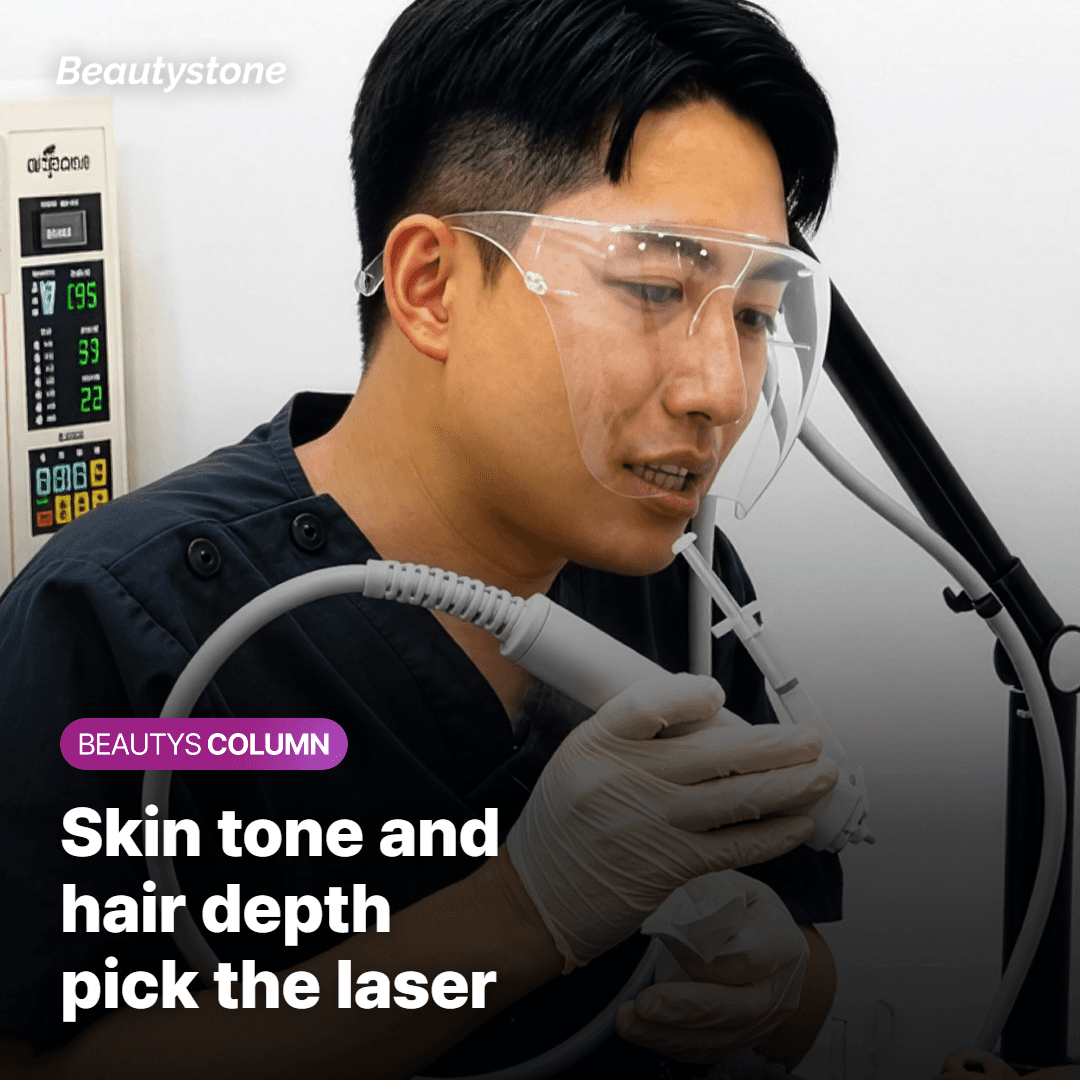
Does leg laser hair removal hurt? Side effects and risks
You'll likely feel it, usually as a quick sting of heat with each pulse, and most of the risks sit at the skin's surface, which is why sun and preparation matter as much as the laser.
The Cochrane review lists pain, skin redness, swelling, burned hairs and pigmentary changes as infrequently reported adverse effects.
A 2025 chart review of patients with East Asian skin reported paradoxical hypertrichosis, where new or thicker hair appears after laser treatment, in 33.3% of men compared with 9.0% of women, mainly on the back, upper arms and shoulders.
Those areas aren't your legs, but if you're also thinking about your back or shoulders, our guide to laser hair removal for men covers how that risk is planned for area by area.
A few things are in your hands:
Don't wax, pluck or epilate in the run-up to treatment. The laser finds the follicle through the pigment in the hair inside it, and pulling the hair out removes that target. Ask when you book when to shave.
Keep strong sun off your legs before treatment. A tan adds pigment to the surface the settings are trying to protect. Mention any self-tanner too.
Protect the treated skin afterward. Sunscreen or clothing over the treated area is non-negotiable.
Redness and swelling can show up after a session. If you see blistering, crusting that spreads, redness that keeps getting worse, or you develop a fever, don't wait it out. Seek medical care right away.

Within your travel schedule: flights, shorts and sun, and after you fly home
Unless you've had sedation that day, there's no reason to put off the treatment because of your flight home.
Sightseeing and photos are a separate question. How your legs look that evening depends on your skin and the settings, so ask about your own skin when you book rather than counting on a promise from an article. If shorts are part of the plan, cover the treated skin or use sunscreen whenever you're outdoors.
The sun is the bigger travel variable. If Seoul is one stop on a longer trip with beach days, mention where those days fall. Sun before treatment changes the setting, and sun after it is what aftercare asks you to avoid.
One visit still counts. Hair removal is a series, so one trip starts the course rather than finishing it. It makes the most sense if you'll be back in Seoul or plan to continue at home. Either way, ask for a note of which wavelength was used on which part of your legs, so whoever treats you next isn't starting from zero.
After you fly home, if something looks off, you can send photos of the area to our WhatsApp. If it's a clear warning sign such as blistering, spreading redness or fever, see a doctor where you are first.

The Bottom Line: judge your legs by regrowth, not by a session count
Legs take a course of sessions, and five is a checkpoint for comparing regrowth, not a promise.
Studies on legs report a wide range of results; the realistic goal is fewer, finer hairs.
Moles and tattoos should stay out of the laser's path; photograph moles before you start.
Skin tone, recent sun and hair coarseness decide the wavelength, and deeper isn't automatically better.
Like any laser treatment, it comes with trade-offs, and the right plan depends on your skin, your hair and your travel dates.
Here's one thing to check at a consultation anywhere. Before the first session, ask to see three things written down: which wavelength will be used on your thighs and on your shins, which moles and tattoos will be skipped, and the date to compare regrowth under the same light. If those three are clear, the session count becomes something you can track rather than guess.
If you're planning a trip, you can message Beautystone in Seoul's Hapjeong area, one subway stop from Hongik University Station on Line 2, on WhatsApp before you book. A first message can be as short as: "I'm in Seoul from (arrival date) to (departure date) and want laser hair removal on my (thighs, lower legs or full legs). My skin is (light, medium or deep), I was last in strong sun on (date), and I have (no, a few or several) moles and (no or a) tattoo on my legs." Attach daylight photos of your legs.





skin
Rejuran 2cc Cost: Enough for the Full Face?

Lifting
Titanium Lift Cost: 40KJ Jawline or Full Face?

skin
Rejuran vs. Belotero Revive: Which Hurts Less?

Contouring & Volume
Jaw Botox Side Effects: Hard to Chew or Smile?

skin
How Long Does PIH Take to Fade on Its Own?

Body
Onda for Upper Arm Fat: How Microwaves Work