

What 'permanent hair removal' really means, and the signs deciding 6 vs 10 leg sessions.
Published
Updated

Author
Wi Young-jin · Chief director
Seoul National University College of Medicine · Seoul National University Hospital Specialist
→
When you visit a clinic for leg hair removal consultation, you'll often hear conflicting advice: "A 6-session package means permanent hair removal," while others say, "Everyone is different, so you should expect at least 8 sessions." Since it's the exact same procedure on the same area, this differing advice on the recommended number of sessions can leave many people unsure of what to expect.
To cut to the chase, leg hair removal typically requires a series of 6 to 10 sessions on average, depending on your hair growth cycle, hormone levels, skin tone, and hair color. Medicinally speaking, "permanent hair reduction" is a much more accurate term than "permanent hair removal."
This content is a compilation of information on treatments offered at Beautystone.
Laser hair removal does not destroy all hair follicles at once
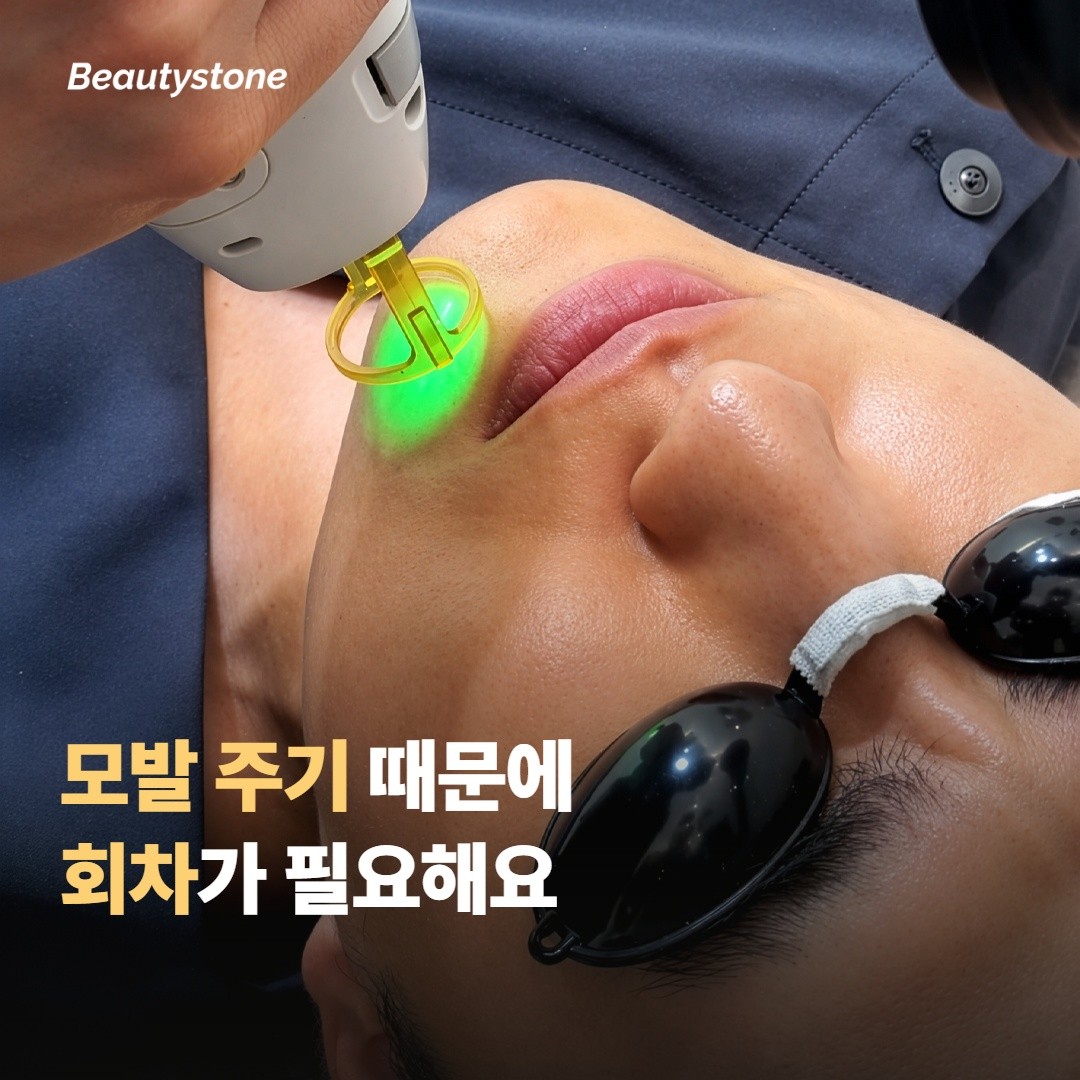
Laser hair removal works by damaging hair follicles with the heat generated when melanin* (the pigment found in your skin and hair, which absorbs the laser energy) absorbs the laser light. Instead of destroying all hair follicles at once, it effectively targets only the hair follicles that are in the anagen (growth) phase at that specific time.
Dermatological associations recommend an average of 2 to 6 treatments, typically performed at 4 to 6-week intervals. They advise that a hair reduction of about 10% to 25% is expected after the first session, with hair becoming finer and lighter as sessions accumulate. Since the proportion of active hair follicles on the legs is much more consistent than on the face, the results per session are relatively predictable.

Results take time due to the hair growth cycle
Hair goes through a continuous three-stage cycle: anagen (growth) → catagen (regression) → telogen (resting). Lasers are highly effective only during the anagen phase, when the hair is rich in melanin* and connected to the dermal papilla. Hair follicles in the telogen phase will show almost no response during that same session.
The percentage of hair in the growth phase varies by treatment area:
Area | Growth Phase Ratio (Anagen) | Recommended Sessions | Interval |
|---|---|---|---|
Legs | Approx. 20–30% | 6–10 sessions | 6–8 weeks |
Underarms | Approx. 30% | 5–8 sessions | 4–6 weeks |
Bikini Line | Approx. 30% | 5–8 sessions | 4–6 weeks |
Face (Female) | Approx. 60–70% | 8–12 sessions | 4 weeks |
On the legs, only about 20% to 30% of the hair follicles are targeted in a single session. This is why you need to accumulate 6 to 10 sessions at intervals of 6 to 8 weeks in the same area to ensure you sufficiently target the follicles as they enter their anagen phase.
Why some finish in 6 sessions, while others need 10 or more
Those who find 6 to 8 sessions sufficient:
Individuals with thick, dark hair (rich in melanin for highly efficient energy absorption)
Individuals with relatively light skin tones
Individuals with stable hormone levels
Individuals with a uniform distribution of thick hair on their legs
Those who require 10 or more sessions:
Individuals with fine, light-colored hair (less melanin, resulting in weaker energy absorption)
Individuals with darker skin tones—requiring more safe, conservative parameters, which increases the total number of sessions
Individuals experiencing significant hormonal fluctuations (such as PCOS, thyroid conditions, etc.)
Individuals with uneven hair distribution or texture (e.g., inner or back areas of the legs)
In clinical observations, an average hair reduction of about 82% was noted on the legs after around 6 sessions, with a 4 to 8-week interval showing the most stable pattern of results. However, it doesn't always end permanently with just one series. Many clients return for touch-up sessions 1 to 2 years later if certain hair follicles reactivate due to hormonal or environmental changes.

"Permanent hair removal" is medically more accurate when described a degree lighter
As mentioned earlier, leg hair removal is a series-based treatment tailored to the hair growth cycle, and the outcome is much closer to permanent hair reduction. Academic literature also advises avoiding terminology that guarantees a lifetime of being completely hair-free, even though long periods of no hair growth are common. From a medical advertising regulations perspective, using definitive terms like "permanent hair removal" is discouraged.
Realistically, the most reliable approach is to complete a series of 6 to 10 sessions and then have a touch-up session once every year or two. Shaving between sessions (never wax or pluck) and diligent sun protection will help stabilize and enhance your results.

Cases where you must consult with clinical staff before the procedure
If you are pregnant or breastfeeding
Active inflammation or herpes simplex in the treatment area
Taking photosensitizing medications (Isotretinoin, certain antibiotics)
If you have tattoos or semi-permanent makeup in the treatment area
If you have been diagnosed with hormone-related conditions like thyroid disorders or PCOS
Keloid skin type
If any of these apply to you, it is safer to set conservative treatment parameters or adjust your schedule. It is vital to accurately disclose your medications and underlying conditions during your initial consultation.
GentleMax Pro Plus hair removal treatment details
This month: GentleMax Pro Plus
Frequently Asked Questions
Q. Does leg hair removal last a lifetime after a single series?
A. Medical academies use the term permanent hair reduction. While many clients remain hair-free for several years after completing their sessions, hormonal fluctuations or the passage of time can occasionally reactivate some hair follicles. It is very common to have a maintenance touch-up once every 1 to 2 years.
Q. Can I shave between my sessions?
A. Yes, shaving is perfectly fine. However, please avoid methods that pluck hair from the root, such as waxing, tweezing, or threading, as this reduces the effectiveness of your next laser session. The laser targets the melanin in the hair follicle, which is absent if the hair root has been pulled out.
Q. Can I try the laser on just one leg first?
A. Some first-time clients choose to start on just one leg to check their skin's sensitivity and response. However, to evaluate the overall effectiveness of the series, both sides are typically treated together. A great approach is to perform a light patch test during your first visit before continuing with the full series.





Contouring & Volume
Hip Dip Filler Before and After: 4 Checks

Body
Potenza Treatment Interval: Why 4 Weeks?

Lifting
Ultherapy Before and After: Why Wait 90 Days?

Contouring & Volume
Belotero Revive Cost: 2cc Price vs. 3 Sessions

skin
Lip Hyperpigmentation Laser: Does It Work?

Contouring & Volume
Men's Forehead Filler: Hollow or Just Lines?