

Are all tattoo lasers the same? Three myths about removing large, colorful irezumi tattoos.
Published
Updated

Author
Wi Young-jin · Chief director
Seoul National University College of Medicine · Seoul National University Hospital Specialist
→
When you look into tattoo removal, phrases like "in one session" and "any color" come up a lot. So it's easy to assume even a large, multicolored tattoo like an irezumi* will wipe off about the same anywhere you go.
Irezumi*: A traditional Japanese tattoo style. It tends to be large and multicolored, with the ink set deep and dense in the skin.
The short answer: clearing up a few myths about removal shows exactly why it matters to go to someone skilled. A tattoo is ink set in layers that the body clears out over several sessions, so with color, depth, and skin type each changing the response, it isn't as simple as it sounds.
In this article
Why not all tattoo-removal lasers are the same
Why "just a few sessions" is a claim to be careful with
Where the risk of side effects comes down to skill
Why an irezumi calls for a long-game approach
Myth 1: All Lasers Are Basically the Same?
It's easy to assume lasers are all alike, but the way and speed they break up pigment vary quite a bit by type. How finely the pigment shatters depends on the wavelength and pulse duration. Research suggests picosecond* lasers shatter multicolored tattoo ink into far finer fragments than nanosecond lasers, and their photoacoustic action causes less surrounding heat damage. PicoWay is one of these picosecond-class devices.
Picosecond*: An extremely short laser pulse measured in trillionths of a second. It's well suited to breaking pigment into fine fragments.
With a tattoo that mixes many colors, like an irezumi, this difference feels even bigger, because each color responds best to a different wavelength.
Aspect | Nanosecond laser | Picosecond laser |
|---|---|---|
Pulse duration | One-billionth of a second | One-trillionth of a second |
Pigment breakup | Mostly thermal | Mostly photoacoustic, finer |
Multicolor response | More limited | Relatively favorable |

Myth 2: A Few Sessions Erase It All?
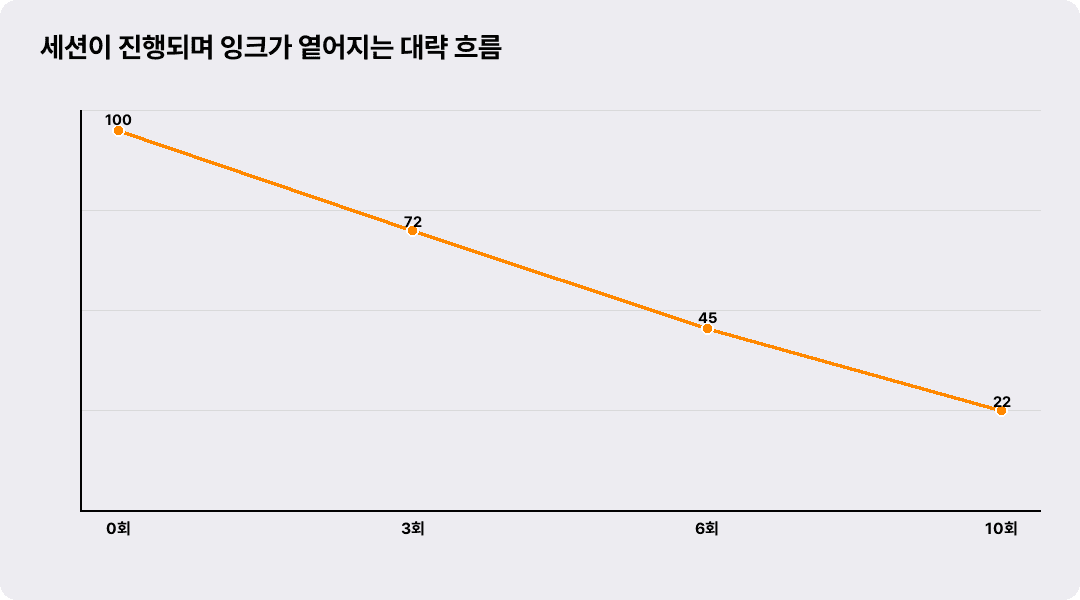
Many people expect it to be over in a session or two, but the larger and more colorful the tattoo, the longer the course tends to run. Instead of a vague guess, there's a way to estimate with an objective measure. The Kirby-Desai scale*, which scores six factors (skin type, location, color, ink amount, scarring, and ink layering) to relate to the number of sessions needed, has been correlated with an average of about 10 sessions, ranging from 3 to 20.
Kirby-Desai scale*: A scoring system proposed to estimate the rough number of sessions a tattoo removal may take.
The higher the score, the more sessions it tends to take, and an irezumi tends to score high. Below is a rough sense of how the ink fades as sessions go on.

Myth 3: It's Safe, So Anywhere Will Do?
Tattoo removal is a relatively safe procedure, true, but that doesn't mean it's free of side effects. It's been reported that light-colored tattoos can undergo paradoxical darkening* (turning darker after treatment), permanent side effects like scarring or pigmentation can appear, and the risk runs higher on darker skin tones.
Paradoxical darkening*: When a light or flesh-toned tattoo turns darker after laser treatment instead of fading.
These risks come down to the judgment of matching wavelength and energy to the color, depth, and skin type, along with the experience to space out the sessions. So even with the same device, who handles it and how affects both the outcome and safety.

Why Beautystone in Hapjeong
Beautystone keeps to an order that looks at the state of your tattoo before the speed of erasing it. After examining the color, depth, and skin type, we estimate the likely number of sessions with the Kirby-Desai scale, then set the PicoWay picosecond laser differently for each color while a board-certified dermatologist watches the response firsthand. We're a small clinic within walking distance of Hapjeong Station in Seoul, so even an irezumi with a long course is easier to pace together.

So How Should You Approach an Irezumi?
As we've noted, tattoo removal comes down to the device, the person handling it, and the plan. With a large, colorful tattoo like an irezumi, it's safer to split the settings by color and set a longer course, watching the response as you go, rather than trying to finish it in one shot.
In the following cases, it's safer to hold off or talk it through first.
If you're pregnant or breastfeeding
If there's active inflammation or infection at the treatment area
If you're prone to keloids or your wounds heal slowly
If you've tanned recently or your skin is light-sensitive
This article is general information, so whether and how to proceed is best decided with a provider who has examined your skin in person.

PicoWay Tattoo Removal treatment details
Frequently asked questions
Q. Does a picosecond laser remove every color equally well?
A. Picosecond lasers tend to do better with multiple colors, but each color responds to a different wavelength, so the settings have to be split accordingly. The experience to adjust the approach by color matters as much as the type of device.
Q. Roughly how many sessions does an irezumi take?
A. It varies widely by size, color, and depth, so it's hard to pin down a number. Estimating a range with the Kirby-Desai scale during a consultation helps with planning.
Q. Can tattoo removal leave a scar?
A. Depending on your skin type and the settings, there can be a risk of pigment changes or scarring. That's why the spacing between sessions and aftercare matter, and you should check the precautions that suit your skin with the provider who treated you.
Q. Can you continue removing a tattoo that was started elsewhere?
A. Often, yes, but it's best to first look at how it's responded so far and the remaining color and depth, then reset the plan. A consultation confirms the current state before deciding how to continue.




Contouring & Volume
Hip Dip Filler Before and After: 4 Checks

Body
Potenza Treatment Interval: Why 4 Weeks?

Lifting
Ultherapy Before and After: Why Wait 90 Days?

Contouring & Volume
Belotero Revive Cost: 2cc Price vs. 3 Sessions

skin
Lip Hyperpigmentation Laser: Does It Work?

Contouring & Volume
Men's Forehead Filler: Hollow or Just Lines?