

Do thread lifts pull your face tight? Three short-thread myths for smile lines, cleared up.
Published
Updated

Author
Wi Young-jin · Chief director
Seoul National University College of Medicine · Seoul National University Hospital Specialist
→
When you hear that someone's had a thread lift, the first picture that comes to mind is often a face pulled sideways into a stiff, unnatural expression. So even if your smile lines or sagging cheeks bother you, you hold back, worried you'll end up looking overdone.
But the short threads placed around the smile lines or the front of the cheek are quite different from the big lift you're probably picturing. Rather than pulling the whole face, they gently support a sagging area right where it's dropped.
Here's the thing: most worries about thread lifts come from lumping every version of the procedure together. Because results hinge on thread length, placement, and how much sagging you have, it helps to clear up the myths one by one before you can tell whether it fits your face.
In this article
How short threads differ from the big, face-pulling lift
Why thread lift results aren't semi-permanent
How to weigh filler versus threads for smile lines
When short threads are actually a good fit, once the myths clear
Myth 1: Thread Lifts Pull Your Face Tight?
It's a common assumption. There is a technique that runs long threads deep into the sides of the face to lift broadly, but the short threads used for smile lines and the front cheek are closer to the opposite. Several strands go into the shallow layer just under the skin, guiding the direction of the sag and gently propping up the tissue that's dropped.
So it's less about a tight, pulled expression and more about softly easing back the downward drift. While the short threads hook and support the tissue, they also stimulate collagen to build up around them.
Of course, if sagging is already well advanced, short threads alone may fall short. In that case, it can make more sense to consider longer cog threads* or another lift alongside them.
Cog*: The tiny barbs along a thread's surface. They catch the tissue and hold it upward.

Myth 2: One Session Lasts Semi-Permanently?
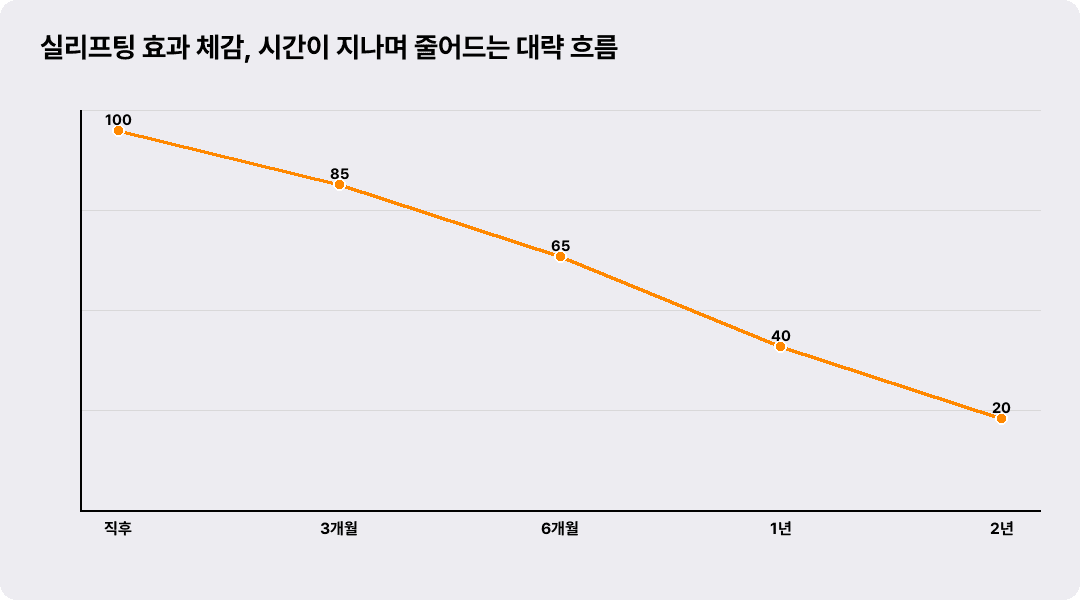
Quite a few people expect the effect to last semi-permanently, but short threads are usually made from material the body gradually absorbs over time. A thread lift works by using threads to support and anchor the sagging tissue while encouraging collagen to build up around it, and results are generally described as lasting about one to three years.
In particular, research has observed that as dissolvable threads break down, the initial lifting effect gradually tapers off over time. So rather than a one-and-done procedure, it's better understood as one where you watch how things unfold, collagen stimulation included, and decide on the next timing. Below is a rough sense of how the effect eases off over time.

Myth 3: Filler Is the Answer for Smile Lines?
It's easy to think of filler first when it comes to smile lines, but the two take different approaches. Filler adds volume by filling in the sunken groove, while short threads support the dropped tissue upward to redirect it. Smile lines often form as cheek fat slides downward and folds, so filling alone may plump the crease yet leave the sagging drift behind.
In fact, clinical research has reported a technique where the barbs on the thread's surface catch the cheek fat and SMAS* layer and pull upward to soften the smile-line groove. So rather than filler or threads being the single right answer for smile lines, it often comes down to whether your folds stem from lost volume, from sagging, or a mix of both, assessed separately or considered together.
SMAS*: A fascia layer beneath the facial skin that supports the muscle and fat. It comes up often when addressing sagging.
In the following cases, it's safer to hold off or talk it through first.
If you're pregnant or breastfeeding
If there's active inflammation or infection at the treatment area
If you're prone to keloids or your wounds heal slowly

Why Beautystone in Hapjeong
Before recommending any procedure, Beautystone tends to start by pinpointing where your smile lines actually come from. Whether lost volume is the main driver, or cheek sagging is layered on top, decides whether filler or short threads is the better fit. We're a small clinic within walking distance of Hapjeong Station in Seoul, so we can read each person's fold pattern and map out the approach and sequence together.
Once the Myths Clear, When Short Threads Fit
As we've noted, short threads aren't a procedure that yanks the face tight, they support it locally. So if sagging is only just beginning, or the front cheek above the smile line has dipped and drooped a little, short threads can settle things in a natural way.
On the other hand, if the cheeks and jawline have dropped with real heaviness, short threads alone may not be enough, so it's better to look at other options too. Right after the procedure you may feel some tightness, swelling, or bruising, but these usually settle over a few days, and the pace varies from person to person. This article is general information, so whether and how to proceed is best decided with a provider who has examined your face in person.

Frequently asked questions
Q. Will a short thread lift look obvious?
A. Because the threads go into a shallow layer and work locally, it isn't a dramatic pulling change, so once the swelling settles it usually isn't very noticeable. That said, threads placed too shallow can show or be felt, so judging the insertion depth matters.
Q. Can I get filler and short threads together?
A. When smile lines involve both volume loss and sagging, the two are sometimes considered together. Which to do first, or whether to combine them, depends on your situation, so it's best decided with your provider.
Q. Do I need to repeat it once the effect fades?
A. Some collagen-stimulating effect can linger even after the threads dissolve, but if sagging progresses again, you'd revisit the timing for another round. It's best understood as a procedure that doesn't hold semi-permanently.
Q. How long does recovery take?
A. Swelling and bruising often settle within a few days, though the pace varies from person to person. If you have an important event coming up, it's wise to leave some buffer when you schedule.


Contouring & Volume
Hip Dip Filler Before and After: 4 Checks

Body
Potenza Treatment Interval: Why 4 Weeks?

Lifting
Ultherapy Before and After: Why Wait 90 Days?

Contouring & Volume
Belotero Revive Cost: 2cc Price vs. 3 Sessions

skin
Lip Hyperpigmentation Laser: Does It Work?

Contouring & Volume
Men's Forehead Filler: Hollow or Just Lines?