

Can Oligio X soften forehead wrinkles and lift heavy brows? How it works and what to expect.
Published
Updated

Author
Wi Young-jin · Chief director
Seoul National University College of Medicine · Seoul National University Hospital Specialist
→
One of the most common questions we hear from patients in their 30s and 40s is some version of this: "My forehead lines are getting deeper and my brows feel heavier than they used to — can something like Oligio X actually help, or do I need surgery?" It's a fair question, because the forehead is a tricky area. It's constantly moving, the skin is thin, and the brow sits right on top of it, so even a small loss of firmness can make you look tired or older than you feel.
Here's the honest answer: Oligio X can help soften forehead wrinkles and support a mild brow lift for the right candidate — but it's a firming and tightening treatment, not a substitute for surgery, and it won't freeze the muscle movement that creates expression lines. Understanding what it can and can't do is the key to deciding whether it's worth your time.
In this article, we'll cover what Oligio X is, how monopolar RF works on the forehead specifically, whether it can actually lift a heavy brow, when results tend to show up, how many sessions most people need, the risks and downtime to weigh, and who's a good candidate. Let's walk through it.
What Is Oligio X?
Oligio X is a monopolar radiofrequency (RF) device made by Wontech, used to tighten skin and stimulate collagen without surgery or incisions. If you've heard of Thermage, Oligio sits in the same category — monopolar RF — and Oligio X is the newer platform in that line, designed with a dual-mode system that lets the provider adjust how energy is delivered depending on the area and skin depth.
The "monopolar" part matters. In a monopolar system, RF energy travels from the handpiece through the skin to a grounding pad, which lets the heat reach deeper into the dermis than some other RF designs. That depth is what makes it a reasonable option for the forehead, where you're trying to affect the deeper support structure of the skin, not just the surface.
A quick reality check on what Oligio X is and isn't:
It is: a collagen-stimulating, skin-tightening treatment with little to no downtime.
It isn't: a wrinkle-freezing injectable like Botox, or a surgical brow lift.
It works best on: mild to moderate laxity and static lines — not deeply etched folds or significant sagging.
Keeping that distinction clear from the start saves a lot of disappointment later. Individual results vary, and the forehead responds differently from person to person.
How Does Oligio X Work on the Forehead?
Monopolar RF works by heating the deeper layers of the skin to a controlled temperature. When collagen fibers in the dermis reach that target range, they contract, which gives an immediate mild tightening effect. More importantly, that controlled heat triggers a wound-healing response that prompts your body to build new collagen over the following weeks and months.
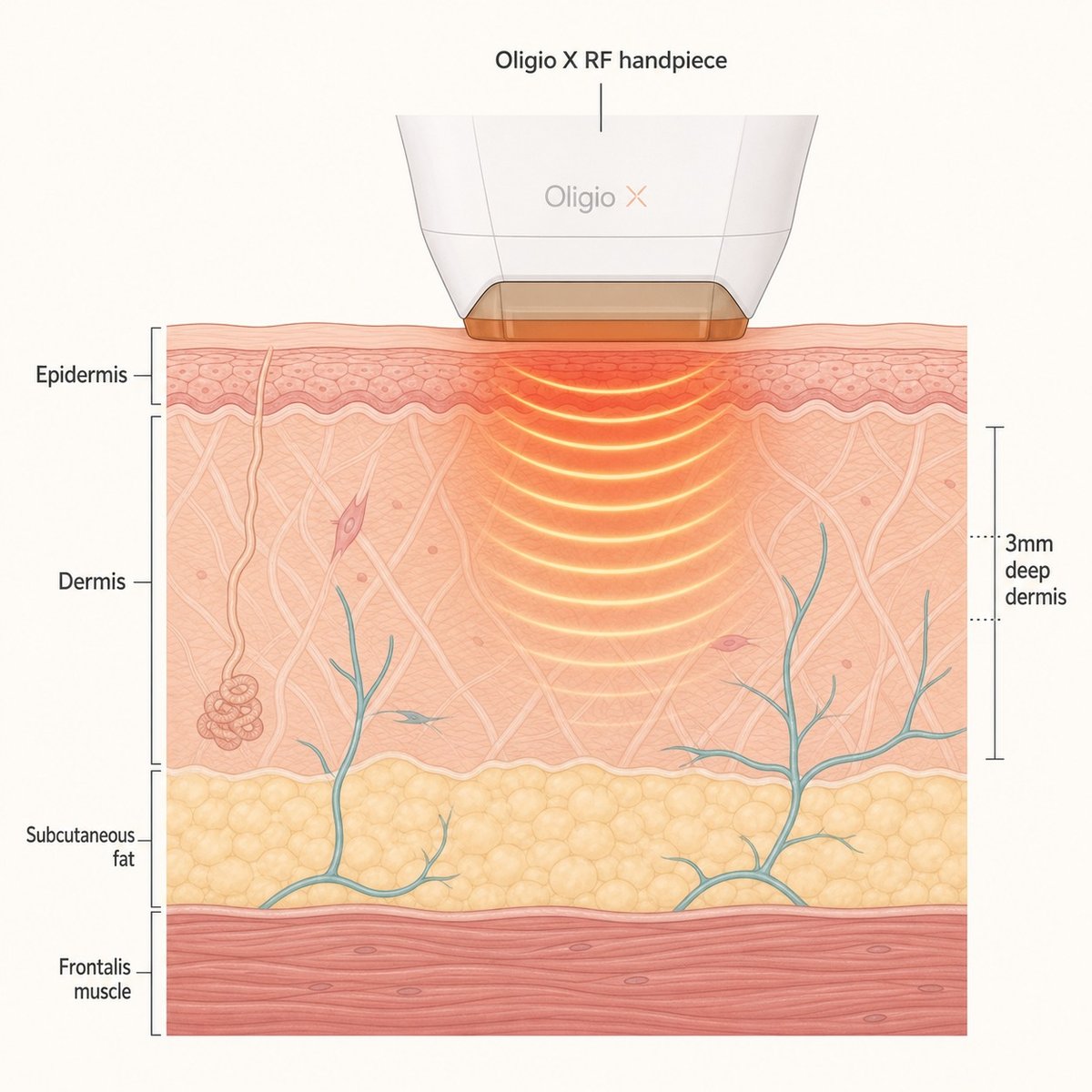
On the forehead, this plays out in two ways. First, tightening the skin can soften static lines — the faint horizontal lines you see even when your face is relaxed. Those are partly caused by thinning, lax skin, so improving firmness can make them look less pronounced. Second, because the treatment can be extended toward the brow and temple area, the added tightening may provide a subtle lifting effect that makes heavy brows sit a touch higher.
Here's the important caveat: RF doesn't touch the dynamic lines — the ones that appear when you raise your eyebrows or frown. Those are created by muscle movement, and that's Botox territory, not RF. This is why some people combine the two: RF for firmness and static lines, a neuromodulator for the expression lines. Your provider can help you figure out which of your forehead concerns fall into which category.
A quick note on regulatory status: monopolar RF devices in this category are generally cleared, not approved — "cleared" is the term for devices, while "approved" applies to drugs. Clearance and specific labeled uses vary by market, so it's worth asking your provider what applies where you're being treated.
Can It Actually Lift a Heavy Brow?
Partly, and it depends on how heavy we're talking. For mild brow heaviness caused by early skin laxity, RF tightening can create a modest lift that reads as "more awake" rather than dramatically different. Many patients describe it as looking rested, not overhauled.
But if your brow droop is significant — the kind where skin folds over the lash line or you're constantly raising your forehead just to keep your eyes open — a non-surgical RF treatment likely won't be enough on its own. In those cases, a consultation may point you toward other options, whether that's a combination approach or a conversation about surgical alternatives with an appropriate specialist.
There's also an anatomy piece worth understanding. Studies suggest that radiofrequency-based skin tightening can produce measurable improvements in skin laxity through collagen remodeling, but the degree of lift depends heavily on your starting skin quality, your age, and how much laxity is present. Someone in their late 30s with early heaviness tends to see clearer benefit than someone with advanced descent. Individual results vary, and no energy device can replicate what surgery does.
When Do Results Show Up?
This is where patience matters, because Oligio X is not an instant-gratification treatment. There are usually two phases.
The immediate phase: Right after treatment, you may notice a slight tightening from the collagen contraction. It's subtle and often fades a bit over the first week as the initial swelling settles. Don't judge the result by day one.
The collagen-building phase: The real change comes gradually. New collagen forms over roughly 8 to 12 weeks, and improvements in firmness and line softening tend to become most visible around the two-to-three-month mark. In many cases, results continue to develop and can last several months to longer, depending on your skin and lifestyle.
A rough timeline of what to expect:
Day of: Mild tightening, possible redness, minimal disruption to your day.
First 1–2 weeks: Any redness or tenderness settles; the immediate effect softens.
4–8 weeks: Collagen remodeling ramps up; firmness starts becoming noticeable.
2–3 months: Typically the peak of visible improvement in skin tightness and static lines.
Because the effect builds and eventually plateaus, many people schedule maintenance sessions down the line rather than expecting a single treatment to hold forever. Everyone's skin is different, so your timeline may not match these ranges exactly.

How Many Sessions Will I Need?
For many patients, a single well-performed Oligio X session produces meaningful improvement, and that's often the starting point your provider will recommend — treat once, then assess the result at the two-to-three-month mark once collagen has had time to build.
That said, the number that's right for you depends on a few things: how much laxity you started with, your age, your collagen-building capacity, and your goals. People with more significant forehead laxity may benefit from a repeat session, and many patients return for maintenance every 12 to 18 months as natural collagen decline continues. It's less about hitting a fixed number and more about maintaining a result over time.
This is genuinely a case where a personalized plan beats a one-size-fits-all package. A consultation lets a provider assess your skin and set realistic expectations before you commit to anything.
Side Effects, Risks, and Downtime
One of the reasons monopolar RF is popular is that its downtime is usually minimal — but "minimal" isn't "none," and it's important to know what's normal and what isn't.
Common and usually temporary: Redness, mild swelling, and a warm or tender feeling in the treated area are common right after treatment and typically settle within a few hours to a couple of days. Some people notice slight sensitivity on the forehead for a short while. These reactions are expected and usually fade on their own.
Less common: Temporary bruising, small blisters, or changes in skin sensation can occur. In rare cases, RF treatments carry a risk of burns or, very rarely, temporary changes in the fat layer beneath the skin, which is why provider skill and correct settings matter so much on a delicate area like the forehead.
When to seek help: If you develop worsening or spreading redness, significant blistering, increasing pain, or any sign of infection like fever, contact your provider or seek medical care right away. These are not typical, and they warrant prompt attention.
Who should be cautious or avoid it:
Anyone who is pregnant or breastfeeding.
People with active skin infections, open wounds, or inflammation in the treatment area.
Those with certain implanted electronic devices, such as a pacemaker — always disclose this to your provider.
Anyone with a history of keloid scarring or specific skin conditions your provider flags.
As with any procedure, the safest results come from an experienced provider who evaluates your skin first. Never assume a treatment marketed as low-risk is risk-free.
Who's a Good Candidate?
Oligio X for the forehead tends to make the most sense if you fall into a few groups.
You're likely a good fit if:
You have mild to moderate forehead laxity or early brow heaviness — something to firm and maintain, not reverse dramatically.
Your main concern is static lines and skin firmness, not deep expression lines.
You want to avoid surgery and downtime, and you have realistic expectations about a gradual, natural-looking change.
You're in your late 20s through 50s with reasonable skin quality — though there's no strict age rule.
You may want a different approach if: your forehead lines are almost entirely from muscle movement (a neuromodulator may serve you better), or your brow droop is advanced enough that only surgery will produce the change you want. A good consultation is honest about which category you fall into.
If cost is a factor in your decision, that's completely reasonable — pricing varies by clinic and treatment area, and you can find current details at our pricing page or check current offers.
The Bottom Line
Here's the short version if you want to skip to the recap:
Oligio X is a monopolar RF treatment that tightens skin and stimulates collagen — it can soften static forehead lines and support a mild brow lift for the right candidate.
It doesn't affect expression lines caused by muscle movement, and it's not a replacement for surgery when there's significant brow droop.
Results build gradually over 8 to 12 weeks, usually peaking around two to three months, not overnight.
Many people see meaningful improvement from a single session, with maintenance every 12 to 18 months.
Like any procedure, it comes with trade-offs — some redness and swelling, a gradual timeline, and results that vary from person to person. Individual results vary, and it's not a one-size-fits-all solution.
Ultimately, the choice depends on your skin, your goals, and your budget. If you're considering Oligio X for forehead wrinkles or a heavy brow, a consultation is the best way to find out whether it fits you. Beautystone is a dermatology clinic in Seoul's Hapjeong area — see current offers at /en/promotion.
Frequently asked questions
Q. Does Oligio X hurt?
A. Most people describe it as tolerable rather than painful. You'll feel warmth and brief deeper heating sensations as the energy is delivered, and providers often use a numbing cream and cooling to keep you comfortable. Sensitivity varies from person to person, and the forehead can feel a bit more sensitive than some other areas, so tell your provider if anything feels too intense.
Q. How long do Oligio X results last on the forehead?
A. Results typically build over 8 to 12 weeks and can last several months to longer, depending on your skin, age, and lifestyle. Because natural collagen decline continues over time, many people schedule maintenance sessions roughly every 12 to 18 months to hold their result. Individual results vary.
Q. Can Oligio X replace a surgical brow lift?
A. No. Oligio X is a skin-tightening treatment that can create a subtle lift for mild brow heaviness, but it can't match what surgery does for significant brow droop. If your brow descent is advanced, a consultation may point you toward other options. It works best as a firming and maintenance treatment, not a surgical substitute.
Q. How soon can I wear makeup after Oligio X?
A. Because downtime is usually minimal, many people apply makeup the same day or the next day once any redness settles. That said, if you have lingering redness or sensitivity, it's better to wait until your skin feels calm. Always follow the specific aftercare your provider gives you, since recommendations can vary by skin type.




Contouring & Volume
Glabella Botox Side Effects: Droopy Eyelids

Contouring & Volume
Juvelook Volume Not Working After 3 Sessions?

Contouring & Volume
Hip Dip Filler Before and After: 4 Checks

Body
Potenza Treatment Interval: Why 4 Weeks?

Lifting
Ultherapy Before and After: Why Wait 90 Days?

Contouring & Volume
Belotero Revive Cost: 2cc Price vs. 3 Sessions