

Can GentleMax Pro Plus treat fine facial fuzz on women? Effectiveness, limits, and sessions.
Published
Updated

Author
Wi Young-jin · Chief director
Seoul National University College of Medicine · Seoul National University Hospital Specialist
→
One of the most common questions we hear from women in our clinic is some version of this: "I get laser for my legs and underarms, but will it actually do anything for the light fuzz on my face?" It's a fair question, and the honest answer is more nuanced than most ads admit. That soft, pale hair on your upper lip and cheeks — often called vellus hair or "peach fuzz" — behaves very differently under a laser than the coarse, dark hair on your body.
So before you book anything, it's worth understanding what laser hair removal is realistically good at, where it hits its limits, and why facial fuzz is one of the trickier cases. We use the GentleMax Pro Plus, and even a strong device has rules it can't rewrite.
In this article, we'll cover how laser hair removal actually works, why fine light hair is harder to treat, what GentleMax Pro Plus can realistically do for facial vellus hair, how many sessions to expect, the side effects and safety points to know, and how to decide whether it's the right call for you. If you'd like to talk it through, a consultation is the best place to start.
How Does Laser Hair Removal Actually Work?
Laser hair removal works by targeting melanin — the pigment that gives hair its color. The laser sends out a pulse of light, the melanin in the hair shaft absorbs that light and converts it to heat, and that heat travels down to damage the follicle so it produces less hair over time. It's a process called selective photothermolysis, and the key word is selective: the laser is aiming for pigment.
This is why the classic "ideal candidate" for laser hair removal has dark, coarse hair against lighter skin. More pigment in the hair means more light absorbed, more heat delivered, and a better response. The contrast between hair and skin also matters, because the device needs to target the hair without overheating the surrounding skin.
The takeaway here is simple: laser hair removal is fundamentally a pigment-seeking treatment. Anything that reduces the amount of pigment in the hair — like hair that's fine, light, or blonde — makes the target harder to hit. Hold onto that idea, because it's the whole reason facial vellus hair is a different conversation from body hair.
Why Is Fine, Light Facial Hair Harder to Treat?
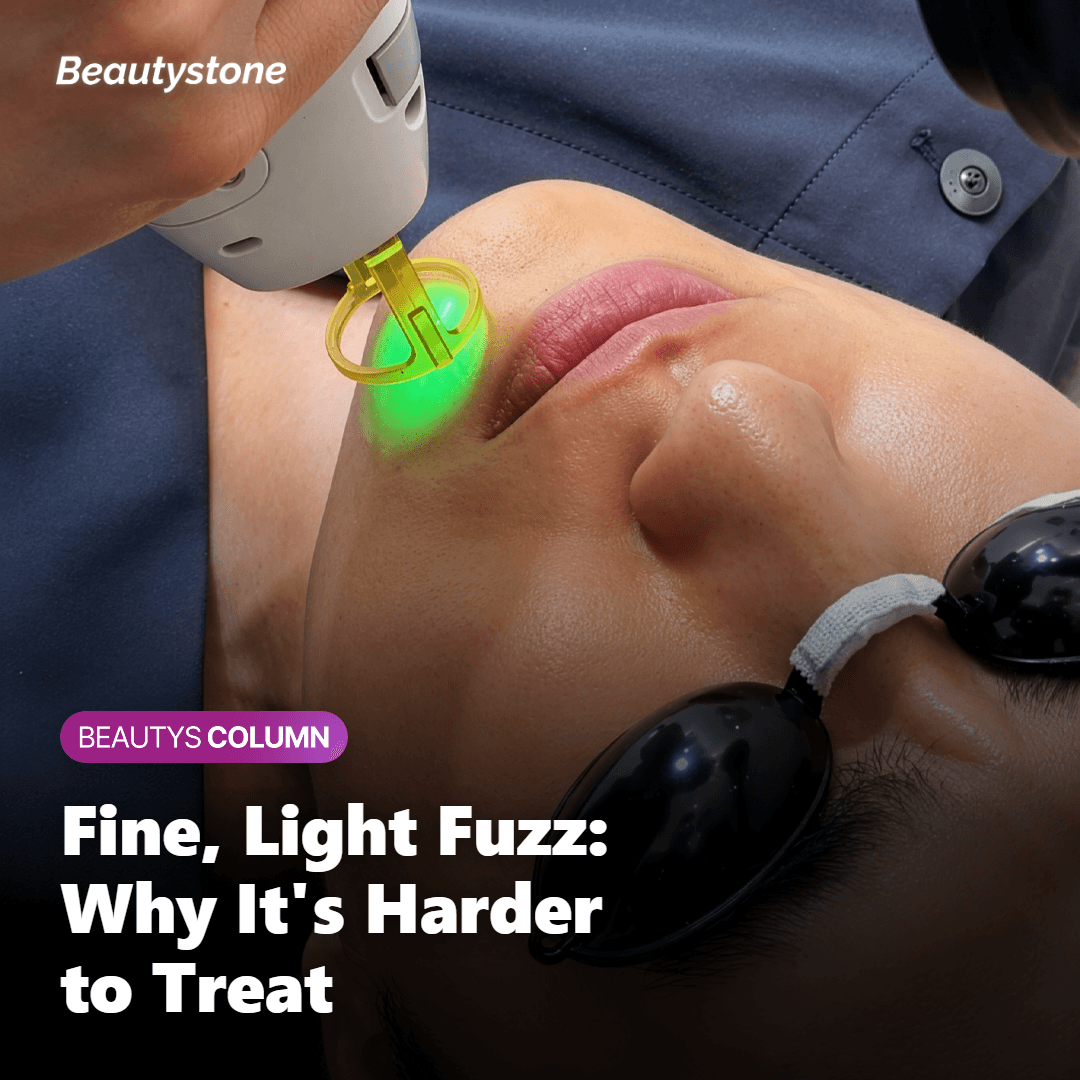
Vellus hair — the soft "peach fuzz" on cheeks and the upper lip — is the opposite of an ideal laser target. It's thin, often lightly pigmented, and shallow-rooted. Each of those traits works against the way a laser is designed to function.
Because there's so little melanin in fine, light hair, the shaft absorbs less of the laser's energy. Less absorption means less heat reaches the follicle, which means a weaker response. Coarse dark hairs act like a good antenna for the light; pale vellus hairs are a poor one. That's not a flaw in the machine — it's physics.
A few things that make facial fuzz especially tricky:
Low pigment: Light or blonde vellus hair gives the laser very little to target, so results tend to be modest and less predictable.
Fine caliber: Thin hairs hold less heat than thick ones, so the follicle damage is often gentler and less lasting.
Facial hormones: Hair on the face is influenced by hormones, so new hair can appear over time regardless of past treatment.
Paradoxical response: In rare cases, treating fine facial hair on certain skin types has been associated with stimulating hair growth rather than reducing it — something an experienced provider will screen for.
None of this means laser is useless for facial fuzz. It means the expectations have to be calibrated. If someone promises to erase every last hair, that's a red flag, not a selling point.

What Can GentleMax Pro Plus Realistically Do for Vellus Hair?
The GentleMax Pro Plus is a dual-wavelength laser system, which is part of why it's a reasonable choice for facial work. It combines two wavelengths — an Alexandrite laser and an Nd:YAG laser — and that flexibility lets a provider tailor the settings to different hair and skin types rather than relying on a single one-size-fits-all beam.
For facial vellus hair, here's an honest picture of what that means. On the fuzz that carries at least some pigment — say, slightly darker hairs mixed into the upper lip area — a well-configured device can reduce density and slow regrowth, so the area looks smoother and the fuzz grows back finer. On truly pale, blonde, or nearly translucent hair, results tend to be limited, because there simply isn't enough pigment to work with.
It's also worth being clear about language, because this is where marketing tends to overreach. Laser is best described as long-term hair reduction, not removal for good. Realistically, it can reduce the amount and thickness of hair and stretch out the time between regrowth — but calling it a way to get rid of every hair forever overstates what any laser can do. Individual results vary, and a candid provider will tell you upfront whether your specific hair is a good fit before taking your money.
How Many Sessions Will You Need?
Hair grows in cycles, and a laser can only meaningfully affect follicles that are in the active growth phase at the moment of treatment. Since only a portion of your hair is in that phase at any given time, a single session can't catch all of it — which is why laser hair removal is always a series, not a one-and-done.
For facial areas, sessions are typically spaced a few weeks apart to line up with the facial hair cycle, which turns over faster than body hair. As a general frame, many people need a course of several sessions to see a clear reduction, followed by occasional maintenance visits down the line. Fine, light facial hair often sits on the higher end of that range and may need touch-ups over time, precisely because the low pigment makes each pass less efficient.
A few factors that shape your session count:
Hair color and thickness: Darker, coarser hair responds in fewer sessions; pale, fine fuzz usually needs more.
Hormonal activity: Facial hair driven by hormones may keep producing new growth, so maintenance is common.
Skin type: Your provider adjusts settings and spacing based on your skin, which affects the pace of your plan.
Your goal: "Noticeably softer and lighter" takes fewer sessions than "as reduced as possible."
Because these variables differ so much from person to person, the only honest way to estimate your specific session count is an in-person assessment. Anyone quoting a fixed number sight-unseen is guessing.
Side Effects, Risks, and Safety Points
Laser hair removal on the face is generally well tolerated, but it isn't risk-free, and the face is a more sensitive area than the legs or underarms. Knowing what's normal — and what isn't — helps you go in with clear eyes.
Redness and mild swelling around the treated follicles are common right after a session and usually settle within a few hours to a couple of days. A slight stinging sensation during the pulses is also typical. If redness or swelling worsens, spreads, or lasts well beyond a few days, contact your provider.
Less common effects can include temporary changes in skin pigment — either darkening or lightening of the treated area — which is more of a consideration for deeper skin tones and is one reason wavelength selection matters. Blistering or burns are uncommon when the device is set correctly for your skin, but they're the reason facial laser should be done by a trained provider rather than a discount pop-up.
Before booking, it's worth flagging a few situations to your provider:
Recent sun exposure or a tan, which raises the risk of pigment changes and burns.
Pregnancy — most clinics defer elective laser treatments until after.
Certain medications (like some acne treatments or photosensitizing drugs) that affect how your skin reacts to light.
A history of cold sores, since facial treatment near the mouth can trigger a flare.
Active skin infections, open breakouts, or inflammatory conditions in the area.
One safety point above all: if you develop spreading redness, blistering, fever, or worsening pain after a session, seek medical care right away. Those are not part of a normal recovery. Sun protection afterward isn't optional either — freshly treated skin is more vulnerable to UV, so daily sunscreen is a must.
Is Laser Worth It for Facial Fuzz — and Who's a Good Candidate?
So is it worth doing? That depends entirely on your hair and your expectations. If your facial fuzz carries some pigment and you're comfortable with meaningful reduction rather than total clearance, laser can be a genuinely satisfying option. If your hair is very pale or blonde, the payoff may be too small to justify the sessions, and honest providers will say so.
It also helps to know the alternatives exist. Dermaplaning, threading, and prescription topical options each handle facial fuzz differently, and none is universally "best." For some people, a low-effort at-home routine is a better fit than a course of laser; for others, the durability of laser reduction wins out. There's no one-size-fits-all answer here.
A good candidate for laser on facial vellus hair generally has hair with at least some pigment, realistic goals, and no contraindications like recent tanning or pregnancy. The clearest way to find out which camp you're in is to have someone look at your actual hair under proper lighting rather than guessing from a phone photo. If you're weighing cost against benefit, you can see current options at our promotions page, with full details on pricing.
The Bottom Line
Here's the short version if you want the recap:
Laser hair removal targets pigment, so fine, light facial vellus hair is inherently harder to treat than coarse, dark body hair.
GentleMax Pro Plus is a dual-wavelength system that can reduce density and slow regrowth on fuzz with some pigment, but results on very pale hair tend to be limited.
Think in terms of long-term hair reduction over a series of sessions, not removal for good — facial fuzz often needs more sessions and occasional maintenance.
Side effects are usually mild and short-lived, but facial laser should be done by a trained provider, with sun protection afterward.
Like any treatment, this comes with trade-offs, and what works well for one person may underdeliver for another. Individual results vary.
Ultimately, the choice depends on your hair, your goals, and your budget. If you're considering laser for facial vellus hair, a consultation is the best way to find out whether GentleMax Pro Plus is a good match for you specifically. Beautystone is a dermatology clinic in Seoul's Hapjeong area — see current offers at /en/promotion.
Frequently asked questions
Q. Does laser hair removal work on light facial peach fuzz?
A. It can, but with limits. Laser targets pigment, so fine, light vellus hair gives it very little to work with. If your fuzz carries some pigment, a device like GentleMax Pro Plus can reduce density and make regrowth finer. On very pale or blonde hair, results tend to be modest. The most reliable way to know is an in-person assessment of your actual hair.
Q. How many sessions does facial vellus hair need?
A. There's no fixed number, because it depends on your hair color, thickness, hormones, and skin type. Fine, light facial hair usually needs more sessions than coarse body hair, spaced a few weeks apart, plus occasional maintenance over time. A provider can give you a realistic estimate only after seeing your hair in person.
Q. Does laser on the face hurt?
A. Most people describe a mild stinging or snapping sensation during the pulses, and the face can feel more sensitive than the body. Redness and slight swelling afterward are common and usually settle within a few hours to a couple of days. If discomfort or swelling worsens or lingers, contact your provider.
Q. Is facial laser hair removal permanent?
A. It's best described as long-term hair reduction, not permanent removal. Laser can reduce the amount and thickness of hair and stretch out regrowth, but especially with hormone-influenced facial hair, new growth can appear over time. That's why maintenance sessions are common. Anyone promising to get rid of every hair forever is overstating what a laser can do.


Contouring & Volume
Hip Dip Filler Before and After: 4 Checks

Body
Potenza Treatment Interval: Why 4 Weeks?

Lifting
Ultherapy Before and After: Why Wait 90 Days?

Contouring & Volume
Belotero Revive Cost: 2cc Price vs. 3 Sessions

skin
Lip Hyperpigmentation Laser: Does It Work?

Contouring & Volume
Men's Forehead Filler: Hollow or Just Lines?