

Onda heats deep layers with microwaves; InMode refines the dermis with RF: which suits you.
Published
Updated

Author
Wi Young-jin · Chief director
Seoul National University College of Medicine · Seoul National University Hospital Specialist
→
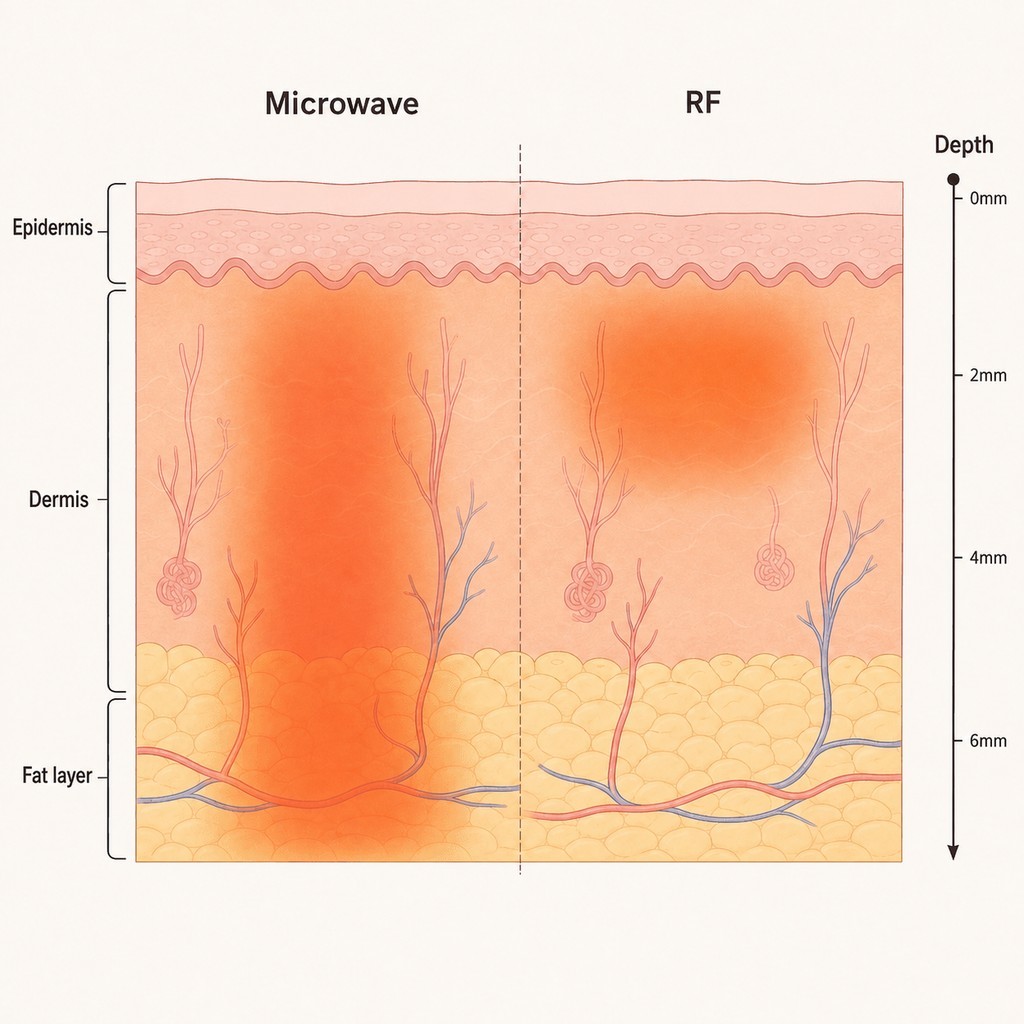
When getting a lifting consultation, you often hear, "How about ONDA, and how about InMode?" since the two names are frequently mentioned together. Both are non-surgical, non-invasive lifting procedures, making them seem similar at first glance. However, the type of energy used and the depth of action are completely different, meaning they suit different skin concerns. To put it simply, ONDA is a deep-acting treatment that uses microwaves to heat from the dermis to the fat layer all at once, while InMode is a surface-reinforcing treatment that heats the core of the dermis with RF* to lift and refine pores and texture simultaneously.
RF*: Radio frequency. An energy method that generates heat by using the resistance of skin tissue, commonly used in treatments like Thermage and InMode.
Rather than competing with each other, they are two different options tailored to which layer of your skin needs attention first. It isn't always simple, as many people experience both deep sagging and surface texture issues, which is why the question "Which one is better?" doesn't have a single answer.
This content compiles treatment information from Beautystone Hapjeong.
In this article, you will learn about:
The difference in energy between ONDA and InMode
The type of skin concerns that ONDA is better suited for
The type of skin concerns that InMode is better suited for
The ideal flow when combining both treatments
ONDA and InMode — Starting with different energy sources
ONDA is a treatment that delivers 2.45GHz microwaves simultaneously to the dermis* and subcutaneous fat, using that thermal energy to stimulate collagen contraction and new collagen production. It features a unique cooling system to protect the epidermis while concentrating energy in the deeper layers. A clinical report indicates that 2.45GHz microwave devices contract collagen fibers in the dermis and subcutis, showing an improvement in submental (double chin) sagging scores from an average of 3.6 to 2.3 at 12 weeks after two sessions spaced 30 days apart.
Dermis*: The second layer of skin right below the epidermis. It houses collagen and elastin, which are responsible for skin elasticity.
InMode is an RF (radiofrequency) system that warms the dermis using bipolar or unipolar RF handpieces (such as Forma, Morpheus8, etc.). It stimulates collagen while refining pores, texture, and superficial sagging, placing it in a similar category to other RF treatments like Thermage and Oligio. The RF method heats the dermis to rebuild collagen, causing immediate collagen contraction right after the treatment, followed by a gradual increase in dermal collagen density over time, making the results beautifully cumulative rather than instant.
Here is a quick summary of the key differences:
ONDA uses microwaves to heat deep layer tissues (fat and lower dermis) all at once.
InMode uses RF to heat the central dermis, addressing pores and skin texture at the same time.
Even though they are both categorized under non-invasive lifting, the different energy modalities mean they cater to different skin profiles.
Where ONDA shines — Deep sagging and volume loss
Because microwaves reach down to the lower dermis and fat layer simultaneously, ONDA is beautifully suited for the following skin concerns:
Those with noticeable sagging in deeper layers, such as submental fat, double chins, and sagging cheeks.
Those who have lost definition in their facial contours due to weight loss or age-related changes.
Those who want to address deep sagging concerns in a single, comprehensive treatment.
Those in their 40s and beyond, whose collagen levels are starting to thin naturally.
Those whose primary concern is sagging itself, rather than surface texture or pores.
In particular, if you have both double chin fat and sagging skin, ONDA—which concentrates heat in the deeper layers—is generally more efficient for contouring than superficial RF treatments. However, because the results build gradually over 4 to 12 weeks rather than appearing instantly, it is standard to evaluate the final outcome at the 8-to-12-week mark. Treatments are typically done in single sessions or multi-session packages of 2 to 3 treatments. It is safest to consult with a medical professional to determine the ideal frequency and intervals based on your unique skin starting point.

Where InMode shines — Surface texture, pores, and superficial sagging
Since InMode RF heats the core of the dermis, it is beautifully suited for the following skin profiles:
Those concerned with a combination of pores, skin texture, and superficial sagging.
Those with visible superficial sagging in areas like the cheekbones, cheeks, and forehead.
Those in their early 30s to early 40s who still have relatively abundant collagen levels.
Those looking for a treatment with minimal downtime.
Those who want to refine multiple skin layers by combining different handpieces (such as Forma and Morpheus8) in a single session.
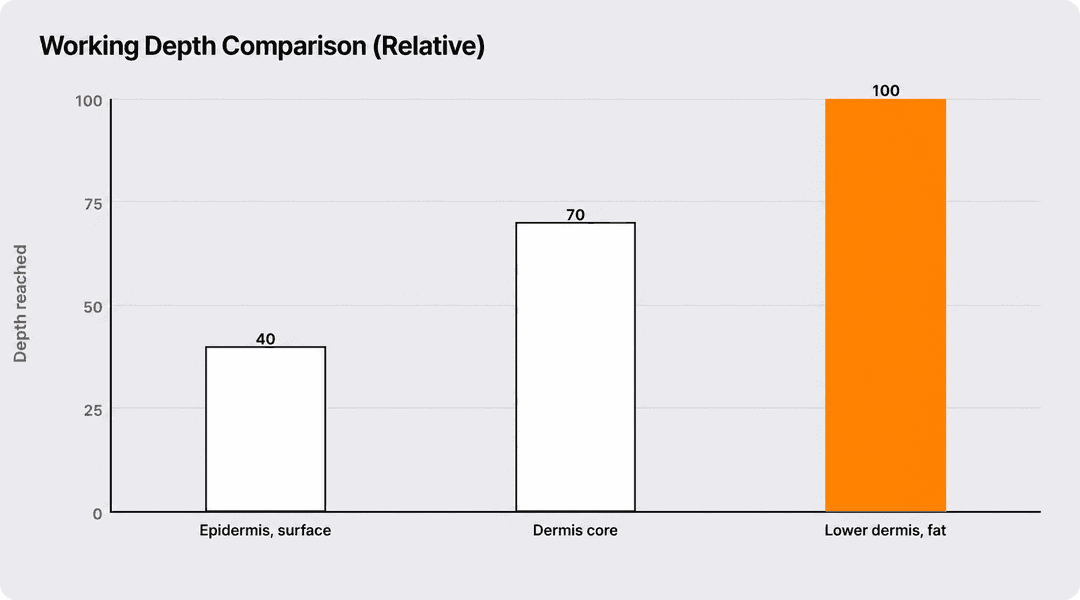
With non-invasive RF lifting, you will feel a slight tightening immediately after the session, and the results become more defined around the 6-month mark as collagen continues to rebuild. Thus, InMode also provides a balanced progression of immediate tightening and cumulative improvements over 4 to 6 weeks. However, because it primarily targets superficial heating, if your sole concern is deep-layer sagging like a double chin or submental fat, ONDA might be a better fit. InMode is the natural choice for those looking to address both surface texture and early sagging. The diagram below relatively compares the treatment depth of both procedures.
How Beautystone Hapjeong designs your treatment plan
Since ONDA and InMode work at different depths, they can complement each other beautifully for those experiencing both deep sagging and surface texture issues. However, getting both on the same day is generally not recommended. It is standard practice to receive one, let the skin fully recover, and then supplement with the other. At Beautystone Hapjeong, instead of picking a treatment first, we prioritize evaluating your skin thickness, fat layers, and surface texture to design a customized plan. A board-certified dermatologist will personally assess which layer of concern takes priority. If deep sagging is the main issue, we typically begin with ONDA; if surface texture is key, we start with InMode, guiding you step-by-step. Our clinic is conveniently located within walking distance of Hapjeong Station, making it easy to return for your scheduled intervals.

Which one is right for you? Key indicators
Even though both are non-invasive lifting choices, the best option depends on your specific skin concerns. Look out for these signs to help you choose:
ONDA is the natural choice if:
Your primary concern is sagging in the deeper layers, such as under the chin, double chin, or sagging lower cheeks.
Your facial contours have softened or sagged after dieting and weight loss.
You are more concerned with firming and lifting than surface texture or pores.
You are in your 40s or above and have a naturally thinning collagen layer.
InMode is the natural choice if:
You want to address pores, skin texture, and superficial sagging all at once.
You want to improve skin tone and refine surface texture at the same time.
You are in your early 30s to early 40s and still have a relatively dense collagen layer.
Your main concern is early sagging around the cheekbones, front cheeks, and forehead.
Cases requiring prior consultation with medical staff:
If you are pregnant or breastfeeding.
If you have a pacemaker or other implanted medical devices (RF and microwave treatments are generally contraindicated).
If you have active inflammation, severe acne, or herpes outbreaks in the treatment area.
If you have a history of keloid scarring.
If you have undergone other deep, invasive procedures in the same area within the past 3 months.
Rather than deciding based on price alone, analyzing your skin thickness, submental fat, and surface layer with a consulting doctor will lead to much safer, more satisfying results.

Frequently Asked Questions
Q. Which treatment has longer-lasting effects?
A. It varies by individual, but generally, ONDA maintains its results for about 6 to 12 months due to deep-layer collagen stimulation, while InMode lasts about 4 to 9 months as it heats the mid-dermis. However, results depend heavily on your baseline collagen regeneration, daily UV protection habits, and weight changes. Since the benefits become more stable with consistent sessions, it is best to evaluate the long-term results at the 6-to-12-month mark rather than comparing them after a single treatment.
Q. Which treatment is less painful?
A. Both procedures utilize topical numbing creams or built-in cooling systems to manage discomfort. InMode targets the central dermis and is often described as a prickly sensation, whereas ONDA works deeper and is accompanied by a deep, heavy warmth. Heat tolerance varies from person to person, so if you are sensitive to pain, please let us know during your consultation so we can adjust the energy levels for a more comfortable experience.
Q. It's my first time trying either—where should I start?
A. It naturally depends on whether your priority is deep sagging or surface texture. Generally, we recommend starting with ONDA if your concern is submental sagging or a double chin, and starting with InMode if you want to address pores, texture, and superficial tightening. For beginners, it is safest to observe the results of a single session and decide on the next step around the 8-to-12-week mark.
Q. Can I get both treatments on the same day?
A. We generally do not recommend it. Although both are non-invasive and generate minimal downtime, receiving them together on the same day can place excessive heat stress on the skin and delay recovery. A safer, more effective approach is to let the skin fully heal from one treatment and follow up with the other after 4 to 6 weeks. Please consult with our medical team to map out your personalized timeline.





Contouring & Volume
Hip Dip Filler Before and After: 4 Checks

Body
Potenza Treatment Interval: Why 4 Weeks?

Lifting
Ultherapy Before and After: Why Wait 90 Days?

Contouring & Volume
Belotero Revive Cost: 2cc Price vs. 3 Sessions

skin
Lip Hyperpigmentation Laser: Does It Work?

Contouring & Volume
Men's Forehead Filler: Hollow or Just Lines?