

Why Potenza repeats every 3 to 4 weeks, how many sessions people plan, and when it shows.
Published
Updated

Author
Wi Young-jin · Chief director
Seoul National University College of Medicine · Seoul National University Hospital Specialist
→
Most people researching Potenza get stuck on the same two questions. Is one session enough, and if not, how many, spaced how far apart? Price matters, of course, but what you really want to know is how many appointments stand between you and the result you had in mind.
Here is the short answer first: Potenza drives radiofrequency heat into the dermis through fine needles so the skin rebuilds collagen, and the effect accumulates most reliably when sessions are spaced roughly three to four weeks apart. It is not a treatment you get done in one sitting. It works by repeating on a rhythm that gives skin time to recover and lay down collagen, and once the logic of that interval makes sense, planning becomes much easier.
This is general information from Beautystone, a small skin clinic in Hapjeong, Seoul. Whether a treatment suits you, and how it should be done, is a decision for the clinician who examines you.
What you will learn
Why Potenza is not a one-and-done treatment
How it differs from other radiofrequency treatments
How the interval and the number of sessions get set
What recovery looks like and when the result shows
Why one Potenza session is not the end of it
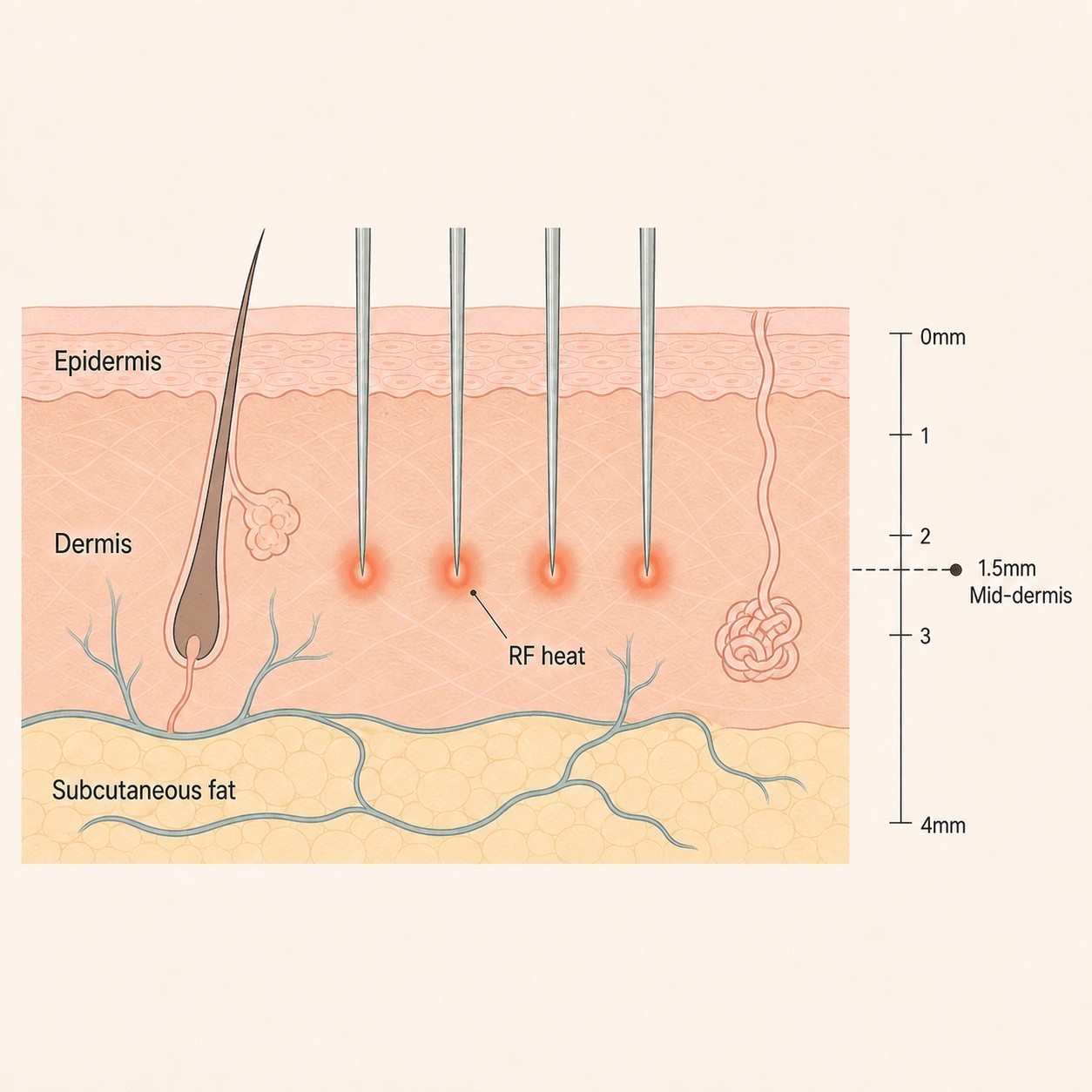
Potenza sends fine needles down into the dermis, delivers radiofrequency heat there, and that small controlled insult wakes the skin's repair response. As the account of how micro-injury starts the wound-healing cascade, releasing growth factors and activating the fibroblasts* that make collagen and elastin describes, one round of stimulation does not finish the collagen. It fills in slowly across the following weeks.
Fibroblasts*: the cells in the dermis that produce collagen and elastin. Heat or micro-injury activates them, and they build new collagen that firms the skin.
Which is why the result stacks up when you repeat on the rhythm at which skin recovers and produces collagen, rather than treating once and stopping. The explanation that skin needling works through gradual collagen induction, producing change over weeks to months points at the same mechanism. Potenza is an FDA-cleared radiofrequency microneedling device, "cleared" being the correct term for a device rather than "approved", which applies to drugs.
How it differs from other radiofrequency treatments
Radiofrequency that warms a broad area from the surface and radiofrequency delivered inside the dermis on a needle are two different propositions. Because the heat comes off the needle tip, Potenza can concentrate stimulation at a chosen depth.
What differs | Potenza (RF microneedling) | Surface radiofrequency |
|---|---|---|
How heat is delivered | Into the dermis through fine needles | Broadly, from the skin surface |
What it mainly addresses | Pores, scarring, firmness | Overall firmness and contour |
How it feels | Needle sensation plus heat | Mostly a spreading warmth |
How it repeats | Split across several sessions | Varies with the area treated |
Neither is better in the abstract. It depends on whether what bothers you sits inside the dermis, like pores and scarring, or is broad laxity. Potenza suits you when there is a particular depth you want worked on.

Why we set the schedule after we see your skin
Beautystone is a small skin clinic in Hapjeong, Seoul, and rather than leading with a package of so many sessions, we set the interval and the count around how quickly your skin recovers and how deep the concern runs. Someone treating pores and someone treating firmness need different needle depths and a different rhythm, so the consultation starts by sorting out the priority. Being small and a short walk from Hapjeong Station means we can read how your skin responded at each visit and adjust the next date. Ask what the whole course costs rather than a single session, since the number of visits is what actually moves the total. If you are visiting from abroad, plan for the fact that any follow-up you need may have to happen with a provider where you live.

How the session runs and how the interval is set
The session begins with numbing cream and a wait, then the area is worked through section by section with the microneedle radiofrequency handpiece. Actual treatment time runs around 20 to 30 minutes depending on the area. The interval is usually set at three to four weeks to match the cycle over which skin recovers and produces collagen, and a plan of roughly three to five sessions is common, depending on how pronounced the concern is.
Collagen layers up as the sessions go, so the change you can feel, mapped session by session, looks something like this.
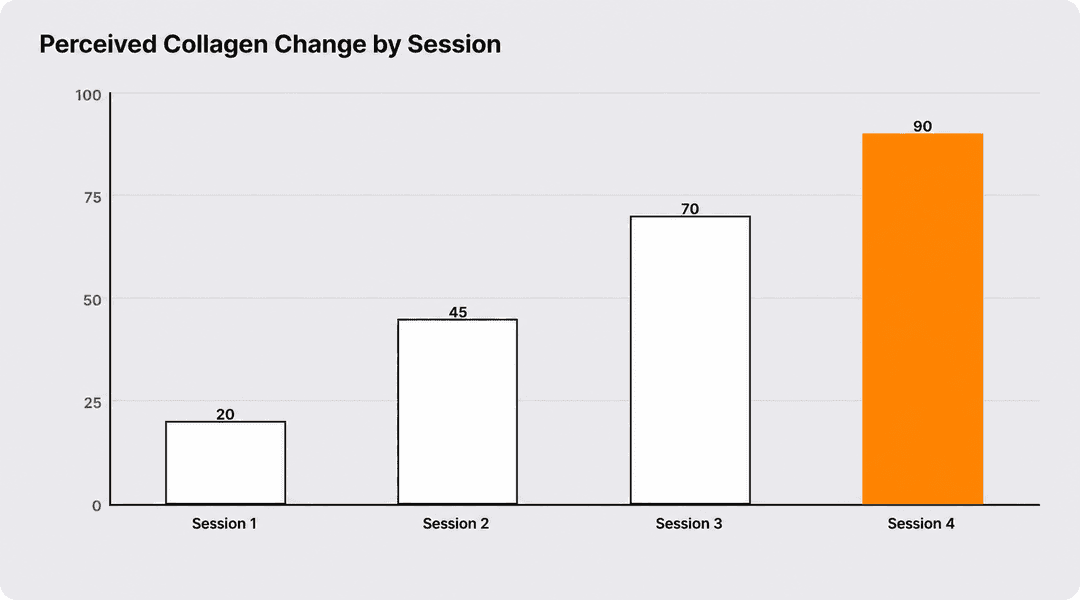
Rather than filling a fixed quota, it is steadier to read your skin's response at each visit and set the next date from there. Squeeze the interval too tight and skin has not had time to recover; stretch it too far and the momentum you were building breaks.

Recovery, and when the result shows
Straight after a session the skin may look a little red with fine needle marks visible, and that usually settles within one to three days. Keep care simple that day, gentle moisturiser and sun protection, and it is reassuring to take two to three days off saunas and hard exercise, anything that drives heat and blood flow up sharply.
The result rests on new collagen*, so it reads more clearly some weeks later than it does immediately.
New collagen*: collagen the skin produces after micro-injury and heat stimulation. It is not finished within days but fills in gradually over weeks, improving pores and firmness as it goes.
So rather than judging after a single session, it is worth waiting until the whole plan is done and reviewing at around two to three months. Collagen remodelling continues for months after treatment, so there is still improvement coming even after the last session. How long it holds depends on your skin and your care, and topping up every six to twelve months afterwards is common. Individual results vary. This article is general information, so the interval and number of sessions that suit you are a decision for the clinician who examines you.

Frequently asked questions
Q. Do I really need several Potenza sessions?
A. One session can produce a subtle change, but because collagen layers up over time, the result is steadier when it is split across several. If what bothers you is mild, fewer may do, so settle the number that suits you in consultation.
Q. Would tighter spacing get me results faster?
A. Squeezing the interval does not speed the result up. Skin needs time to recover and build collagen, and packing sessions too close together mainly accumulates irritation. Three to four weeks generally matches the recovery and collagen-building cycle.
Q. Can I wear makeup straight afterwards?
A. Fine needle marks are visible, so it is better to skip colour cosmetics on the day of treatment. The next day is generally fine, and until then keep to gentle moisturiser and sun protection. If redness is still there, giving it another day or two is reassuring.
Q. When should I judge the result?
A. Collagen takes time to build, so it is worth reviewing at around two to three months after you finish the whole plan. Improvement continues gradually for months after the last session, so try not to reach a verdict early.


