

After scar treatment, here is when to cleanse, exercise, and get back to normal safely.
Published -
Updated -

Author
Wi Young-jin · Chief director
Seoul National University College of Medicine · Seoul National University Hospital Specialist
→
If you've just had scar treatment and you're standing in the bathroom wondering whether splashing water on your face is even allowed right now -- you're not alone. It's one of the most common questions people ask before leaving the clinic.
The short answer? It depends. Scar treatment isn't one procedure. It covers everything from laser resurfacing to microneedling RF to surgical scar revision, and the recovery timeline tracks what was actually done to the skin. In this article, we'll cover what's happening in your skin right after treatment, the cleansing rules by stage, the exercise rules by stage, sun protection (which most people underestimate), warning signs worth knowing, and what to ask your provider before you leave.
What's Happening in Your Skin Right After Treatment
The first few days after scar treatment are when your skin is most vulnerable -- and the reason is worth understanding, not because the details are complicated, but because knowing them makes the aftercare rules feel less arbitrary.
Most scar procedures work by creating a controlled injury to remodel the existing tissue. Laser resurfacing removes or heats the outer skin layers to trigger collagen remodeling. Microneedling RF (devices like Secret RF or Potenza) delivers radiofrequency energy through fine needles to stimulate deeper collagen without removing the surface. Surgical scar revision physically excises and resutures the scar.
In all three cases, the treated zone is essentially an open wound in its first hours -- the skin's barrier is compromised and the inflammatory cascade that kicks off healing is active. That barrier disruption is why cleansing matters so much in the early stage: introducing a cleanser the skin can't handle, or rubbing skin that's still fragile, risks infection, reopening trauma, or disrupting the healing process.
Studies suggest that hydrated, well-protected wounds in the early days tend to heal with less secondary scarring than dry or irritated ones. The goal is balanced moisture -- not soaking, not over-drying.
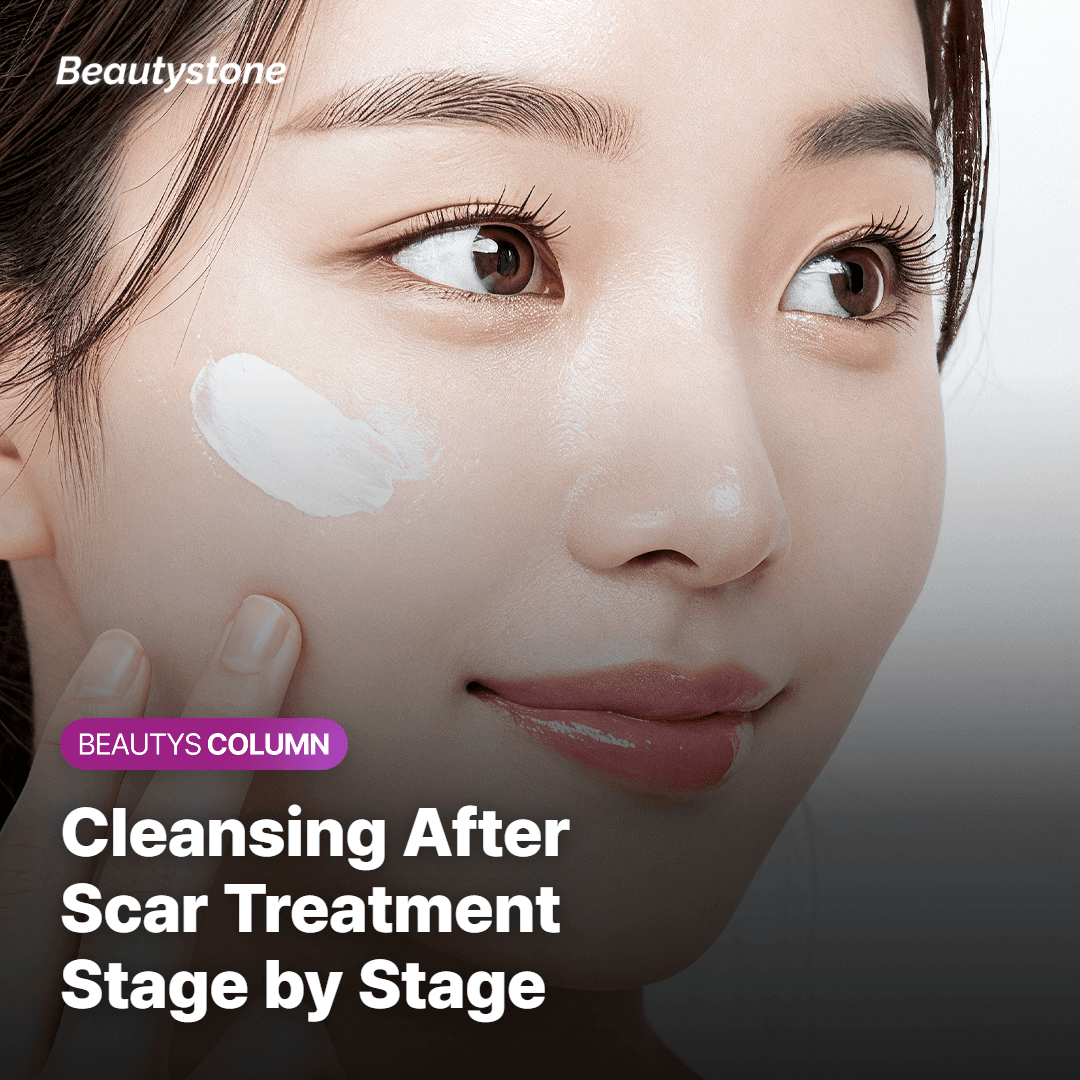
Cleansing After Scar Treatment: A Stage-by-Stage Guide
Exactly when you can wash normally isn't a fixed number -- your provider's instructions take priority. But here's the general framework by procedure type.
Day of procedure (day 0-1): For most procedures, the treated area is covered with a dressing -- often a wound healing patch or occlusive film. Don't wash that area. A gentle, scentless wipe is acceptable for surrounding skin only.
First 48-72 hours: Depending on the procedure, your provider may allow gentle cleansing with lukewarm water -- no scrubbing, no foam cleanser, no exfoliant. Pat dry with clean gauze; don't rub. For microneedling RF, light cleansing often starts here. For ablative laser resurfacing, the timeline may extend longer.
Days 3-7: Gentle foam or gel cleanser typically resumes for most procedures. Avoid anything containing AHAs, BHAs, benzoyl peroxide, or retinol. Skin may still be peeling slightly -- let it come off naturally. The temptation to scrub flaky skin is real; resist it.
Weeks 2-4: A normal cleansing routine usually resumes by week two for non-ablative procedures. For surgically revised scars, timing depends on suture removal and your surgeon's guidance. Research indicates consistent gentle wound care in the first few weeks supports favorable scar outcomes.
The rule that cuts across all stages: if a product stings on uninjured skin, it doesn't belong on a healing scar.
Exercise After Scar Treatment: What to Avoid and When
The exercise question trips people up because the answer seems overly conservative -- and then they push it, and something doesn't heal the way it should. Here's why the caution is genuine.
When you exercise, body temperature rises, circulation increases, and you sweat. Each of those affects healing skin.
Heat increases inflammation. The early post-procedure period already has active inflammation, and adding thermal load can amplify it -- leading to more redness, more swelling, and potentially disrupting early tissue remodeling.
Sweat introduces bacteria. The skin barrier is compromised right after most scar procedures. Sweat contacting a semi-open wound raises infection risk.
Increased circulation affects bruising. For procedures involving needles, elevated blood pressure from cardio can extend bruising.
Day of procedure: Rest. No exercise at all.
Days 1-3: Light walking at most. Avoid anything that raises your heart rate meaningfully. No gym.
Days 4-7: Light stretching and walking for most non-ablative procedures. Sweating should still be minimal. If you're using a dressing, it needs to stay intact and dry.
Weeks 2-3: Gentle cardio -- moderate walking, easy cycling -- is often acceptable by week two. Avoid high-intensity training, contact sports, or anything with impact near the treated area. Surgical scar revision timelines extend further based on healing confirmation from your provider.
Week 4 and beyond: Full exercise usually resumes. Exception: if you're treating a scar near a joint (knee, elbow, shoulder), high-load movements that stretch the scar tissue may be limited longer while collagen remodels.
Individual results vary. Your provider's discharge instructions take precedence over any general guide.

Sun Protection After Scar Treatment
People know they need sunscreen after scar treatment. What they underestimate is how long and rigorously they need it.
Post-inflammatory hyperpigmentation (PIH) -- dark marks after skin trauma -- is one of the most common outcomes scar treatment clients complain about, and it's largely preventable with consistent UV protection. Healing skin is significantly more prone to darkening from even moderate UV exposure.
Sunscreen is non-negotiable for at least 6-8 weeks after most scar procedures, and many providers recommend it indefinitely over treated areas. SPF 50+ PA+++ or higher, every day, whether or not it's sunny. Reapply every two hours outdoors.
The DermNet guidance on hypertrophic and keloid scars notes that UV exposure can stimulate excess collagen production in scars prone to thickening -- the opposite of what treatment is trying to achieve. For these scar types, sun protection isn't cosmetic precaution; it may directly affect the outcome.
Physical (mineral) sunscreen with zinc oxide or titanium dioxide tends to be better tolerated in the first two weeks, when skin may still be sensitive to chemical UV filters. After that, use whatever formulation you'll actually apply consistently.
Side Effects and Warning Signs
Redness, mild swelling, warmth, and tenderness around the treated area are expected in the first 48-72 hours for most scar procedures. Peeling typically starts around days 3-5 for surface procedures and resolves within about a week. Mild itching as skin regenerates is normal.
Here's what isn't normal and warrants attention:
Redness that spreads beyond the treatment zone and worsens after day two.
Pain that gets worse over several days rather than improving.
Purulent discharge or a wound that looks infected (cloudy fluid, progressive swelling, malodor).
Fever above 38 degrees C / 100.4 F in the days following treatment.
If you notice spreading redness, fever, worsening pain, or signs of infection, seek medical care right away -- don't wait for a scheduled follow-up visit.
What to Ask Before You Leave the Clinic
A good aftercare conversation happens before you walk out, not after you get home and start second-guessing things. Here are the questions worth asking your provider after any scar procedure:
When can I rinse this area, and with what? Get a specific recommendation, not just a category.
When does the dressing come off, and do I replace it?
What does normal healing look like day by day?
When can I start light exercise, and what counts as light?
When should I start sunscreen on this area, and which type?
Is there a follow-up visit, and what does it include?
These questions take two minutes and replace a lot of anxiety later.
The Bottom Line
Post-scar treatment aftercare isn't complicated once you understand why the rules exist.
Cleansing resumes in stages: lukewarm water around 48 hours, gentle cleanser by days 3-7, normal routine by week two for most non-ablative procedures.
Exercise resumes gradually: light walking after day three, gentle cardio by week two, full exercise typically by week four -- with longer timelines for surgical revision or joint-area scars.
Sun protection isn't optional: SPF 50+ every day for at least 6-8 weeks. PIH is preventable.
Warning signs that need immediate care: spreading redness, fever, worsening pain, or signs of infection.
Like any procedure, results depend on how the skin heals and how well the aftercare is followed. Your provider's instructions matter more than any general guide -- ask your specific questions before you leave.
If you're considering scar treatment, a consultation is the best way to find out which option fits your skin and schedule. Beautystone is a dermatology clinic in Seoul's Hapjeong area -- see current offers at /en/promotion.
Frequently Asked Questions
Q. When can I wash my face after scar treatment?
A. The timeline depends on what procedure you had. For most non-ablative procedures like microneedling RF, gentle lukewarm rinsing often resumes around 48 hours, with a mild cleanser by days 3-7. Ablative laser and surgical scar revision take longer. Your provider's specific discharge instructions take priority over any general guide.
Q. How long after scar treatment before I can exercise?
A. Rest on the day of the procedure, light walking from about day three, gentle cardio by week two for most non-ablative treatments, and full exercise typically by week four. Timelines are longer after surgical revision, and procedures near joints may restrict high-load movement for longer while collagen remodels.
Q. Do I really need sunscreen every day after scar treatment?
A. Yes -- and for longer than most people expect. Healing skin is significantly more prone to post-inflammatory hyperpigmentation (dark marks) from UV exposure. SPF 50+ every day for at least 6-8 weeks is standard, and many providers recommend ongoing sun protection over treated areas indefinitely.
Q. What are the warning signs that something has gone wrong after scar treatment?
A. Redness spreading beyond the treatment zone, pain that worsens after day two, fever above 38 degrees C, and signs of active infection are not normal. If you notice these, seek medical care right away rather than waiting for a scheduled follow-up.


men's
After Scar Treatment: Wash and Exercise Guide

Contouring & Volume
Jaw Botox: How to Choose the Right Clinic

skin
Ellanse Cost: Duration Beats Price Per Visit

Lifting
Alltite RF: Two Effects, Two Timelines

Contouring & Volume
Why Juvelook Volume Quotes Vary by Clinic

men's
Nose Pore Treatment: Aftercare Timing Guide