

'Doctor, can I leave the scab?' — Yesterday's Q
'Doctor, can I leave the scab?' — Yesterday's Q
'Doctor, can I leave the scab?' — Yesterday's Q
Why hydrocolloid dressings like Duoderm prevent scars, and how depressed scars start from scabs.
Published -
Updated -

Author
Wi Young-jin · Chief director
Seoul National University College of Medicine · Seoul National University Hospital Specialist
→
"Doctor, can't we just leave the scab alone?"
— A question I got yesterday too
I'll give you the conclusion first.
When a wound forms a scab,
it's actually a shortcut to scarring.
I'll explain why in this article.
What makes DuoDERM different from a regular bandage,
actually
DuoDERM is a hydrocolloid
moist wound dressing product.
Simply put, it absorbs the exudate
coming from the wound while also
keeping the area moist.
Unlike a regular bandage (gauze bandage),
DuoDERM absorbs the exudate
and turns into a gel, covering the wound surface.
So it doesn't form a scab.
That's the key.
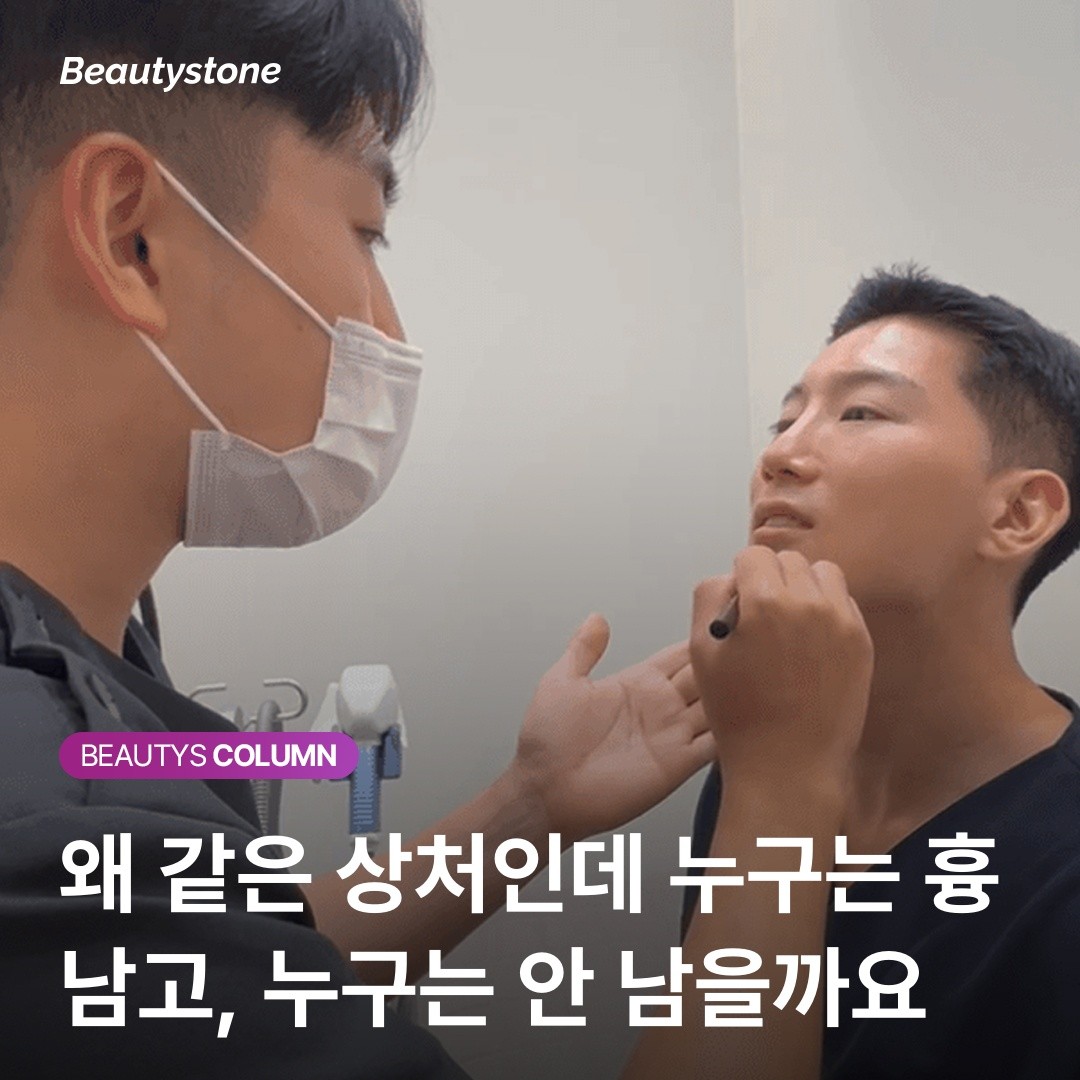
Why do some people scar from the same wound,
while others don't?
"If you maintain moist wound dressing with DuoDERM,
re-epithelialization can proceed without scab formation,
greatly reducing the risk of depressed scars and
hyperpigmentation."
— Dr. Wi Young-jin (Beautystone Clinic, Hongdae)
A scab forming means
re-epithelialization is progressing in a dry environment
and having a hard time.
If you keep the environment moist,
re-epithelialization proceeds smoothly without a scab,
greatly lowering the risk of depressed scars
and hyperpigmentation.
I see this kind of case so often
that I wrote it down separately.
Last month, a 46-year-old woman came in,
and after squeezing a small boil on her face
she let it scab over and just left it alone.
She said, "My mom told me not to peel scabs,
so I left it as it was."
But when the scab came off,
there was a slightly sunken mark
with some dark pigmentation left behind.
The tricky part is,
the scab itself isn't bad.
The problem is that when re-epithelialization happens under a scab,
the cells avoid the dry surface
and burrow into deeper layers.
So it does heal,
but new skin forms one layer below
the original surface.
That's the beginning of a depressed scar.
On the other hand, if you create a moist environment with DuoDERM,
epithelial cells move quickly over a flat surface
at nearly 0.5 mm per hour.
There are differences depending on the study,
but compared with a dry environment, the speed of re-epithelialization
is reported to be about twice as fast.
Because it closes quickly and smoothly,
melanocytes are less stimulated,
and the risk of hyperpigmentation also decreases.
That 46-year-old patient I mentioned earlier
had another boil squeezed in a different area,
so this time I had her apply DuoDERM right away
within the first 24 hours.
She changed it once every 3 to 4 days,
and when I checked two weeks later, there was almost no mark left.
Even she said, "Is this really the same person's skin?"
Dr. Wi Young-jin's key summary
A scab is not a "sign of healing"
it's a "sign that healing is happening in a dry environment."
If you want to avoid scars,
starting moist wound dressing within the first 24 to 48 hours
after the wound appears is the most decisive step.
So when exactly should I
apply DuoDERM?
Situation | Is DuoDERM appropriate? | Point |
Right after squeezing acne/boils | Highly appropriate | Start within 24 hours |
Superficial wound from scratching or abrasion | Appropriate | Apply after bleeding stops |
Wound that already has a thick scab | Unclear | Limited effect |
Suspected infection (pus, warmth, pain) | Not appropriate | See a doctor first |
Deep, large puncture or laceration | Not appropriate | Sutures or specialized treatment needed |
But it's not always a good thing.
DuoDERM is not a cure-all for every wound.
If you apply it blindly to a wound where infection is suspected,
you can actually trap bacteria inside,
which may make the condition worse.
If the skin around the wound becomes red and swollen
and there's warmth or throbbing pain,
seeing a doctor comes before DuoDERM.
That said, for simple wounds after squeezing
or superficial abrasions,
it's still the easiest and most effective
tool for preventing scars.
3 things patients really ask me a lot,
and I'll answer honestly
Q1. When I put DuoDERM on, it swells up and turns white. Do I
need to remove it, or leave it on?
This is a bit tricky, but the whitening and swelling
is a normal reaction as DuoDERM absorbs the exudate
and turns into a gel.
It's not a problem;
it means it's doing its job well.
But if the swollen area reaches the edge of the patch
or exudate starts leaking out from the edges,
then you should replace it.
Usually, one sheet lasts about 2 to 4 days.
The amount of exudate differs from person to person,
so it's hard to give an exact number of days.
Q2. A sheet of DuoDERM costs several thousand won,
so do I need to keep it on that long to avoid scarring?
To be honest,
the first week is the most important.
The 24 to 48 hours right after a wound forms
is when re-epithelialization is most active.
If you maintain a moist environment well during this period,
you don't need to obsessively keep applying it after that.
Usually, a small boil-extraction site
needs only about 2 to 3 patches.
In terms of cost, that's under 10,000 won.
Compared to the cost of filling in
a depressed scar with laser treatment later,
this is much more economical.
Q3. It itches after I put on DuoDERM,
is that an allergy?
This is something many people misunderstand,
but don't automatically connect itching with an allergy.
During wound healing,
a little itching while re-epithelialization is happening
is a normal reaction.
But if, when you remove the patch, you see a red rash
in the exact shape of the patch,
or if blisters have formed,
there's a chance of contact dermatitis.
In that case, remove it right away and switch to a different
type of dressing or ointment.
I hope today's article was helpful.
In the next article, I'll explain the 24 hours after squeezing acne,
and the scar-prevention routine I tell patients in the clinic."
I'll go over it.
Why does one person scar from squeezing in the same spot
while another stays clear?
I'll show you with concrete cases.
This has been Wi Young-jin.
Read together
Pitted scars, gone with one CureJet treatment? Why that claim is dangerous
"Will one CureJet session fill in all pitted scars?" The reality, as told by a doctor
Frequently asked questions
Q. When I put on DuoDerm, it turns white and swells up. Should I remove it, or should I leave it on?
A. If the swollen area reaches the edge of the patch or starts to leak fluid over the edge, it’s time to change it.
Q. DuoDerm costs several thousand won per sheet, but do you have to keep it on that long for it not to leave a scar?
A. Honestly, the most important thing is the first week. The 24 to 48 hours right after a wound forms are when re-epithelialization is most active.
Q. I put on DuoDerm and it’s itchy. Is it an allergy?
A. It’s normal to feel a little itching when re-epithelialization occurs during the wound-healing process.
Q. When is the most effective time to apply Duoderm after getting a wound?
A. Applying it within the first 24 to 48 hours of getting a wound is absolute key. This is when re-epithelialization is most active, so creating a moist environment at this stage helps it heal smoothly without scabbing, reducing the risk of indented scars and hyperpigmentation.
"Doctor, can't we just leave the scab alone?"
— A question I got yesterday too
I'll give you the conclusion first.
When a wound forms a scab,
it's actually a shortcut to scarring.
I'll explain why in this article.
What makes DuoDERM different from a regular bandage,
actually
DuoDERM is a hydrocolloid
moist wound dressing product.
Simply put, it absorbs the exudate
coming from the wound while also
keeping the area moist.
Unlike a regular bandage (gauze bandage),
DuoDERM absorbs the exudate
and turns into a gel, covering the wound surface.
So it doesn't form a scab.
That's the key.
Why do some people scar from the same wound,
while others don't?
"If you maintain moist wound dressing with DuoDERM,
re-epithelialization can proceed without scab formation,
greatly reducing the risk of depressed scars and
hyperpigmentation."
— Dr. Wi Young-jin (Beautystone Clinic, Hongdae)
A scab forming means
re-epithelialization is progressing in a dry environment
and having a hard time.
If you keep the environment moist,
re-epithelialization proceeds smoothly without a scab,
greatly lowering the risk of depressed scars
and hyperpigmentation.
I see this kind of case so often
that I wrote it down separately.
Last month, a 46-year-old woman came in,
and after squeezing a small boil on her face
she let it scab over and just left it alone.
She said, "My mom told me not to peel scabs,
so I left it as it was."
But when the scab came off,
there was a slightly sunken mark
with some dark pigmentation left behind.
The tricky part is,
the scab itself isn't bad.
The problem is that when re-epithelialization happens under a scab,
the cells avoid the dry surface
and burrow into deeper layers.
So it does heal,
but new skin forms one layer below
the original surface.
That's the beginning of a depressed scar.
On the other hand, if you create a moist environment with DuoDERM,
epithelial cells move quickly over a flat surface
at nearly 0.5 mm per hour.
There are differences depending on the study,
but compared with a dry environment, the speed of re-epithelialization
is reported to be about twice as fast.
Because it closes quickly and smoothly,
melanocytes are less stimulated,
and the risk of hyperpigmentation also decreases.
That 46-year-old patient I mentioned earlier
had another boil squeezed in a different area,
so this time I had her apply DuoDERM right away
within the first 24 hours.
She changed it once every 3 to 4 days,
and when I checked two weeks later, there was almost no mark left.
Even she said, "Is this really the same person's skin?"
Dr. Wi Young-jin's key summary
A scab is not a "sign of healing"
it's a "sign that healing is happening in a dry environment."
If you want to avoid scars,
starting moist wound dressing within the first 24 to 48 hours
after the wound appears is the most decisive step.
So when exactly should I
apply DuoDERM?
Situation | Is DuoDERM appropriate? | Point |
Right after squeezing acne/boils | Highly appropriate | Start within 24 hours |
Superficial wound from scratching or abrasion | Appropriate | Apply after bleeding stops |
Wound that already has a thick scab | Unclear | Limited effect |
Suspected infection (pus, warmth, pain) | Not appropriate | See a doctor first |
Deep, large puncture or laceration | Not appropriate | Sutures or specialized treatment needed |
But it's not always a good thing.
DuoDERM is not a cure-all for every wound.
If you apply it blindly to a wound where infection is suspected,
you can actually trap bacteria inside,
which may make the condition worse.
If the skin around the wound becomes red and swollen
and there's warmth or throbbing pain,
seeing a doctor comes before DuoDERM.
That said, for simple wounds after squeezing
or superficial abrasions,
it's still the easiest and most effective
tool for preventing scars.
3 things patients really ask me a lot,
and I'll answer honestly
Q1. When I put DuoDERM on, it swells up and turns white. Do I
need to remove it, or leave it on?
This is a bit tricky, but the whitening and swelling
is a normal reaction as DuoDERM absorbs the exudate
and turns into a gel.
It's not a problem;
it means it's doing its job well.
But if the swollen area reaches the edge of the patch
or exudate starts leaking out from the edges,
then you should replace it.
Usually, one sheet lasts about 2 to 4 days.
The amount of exudate differs from person to person,
so it's hard to give an exact number of days.
Q2. A sheet of DuoDERM costs several thousand won,
so do I need to keep it on that long to avoid scarring?
To be honest,
the first week is the most important.
The 24 to 48 hours right after a wound forms
is when re-epithelialization is most active.
If you maintain a moist environment well during this period,
you don't need to obsessively keep applying it after that.
Usually, a small boil-extraction site
needs only about 2 to 3 patches.
In terms of cost, that's under 10,000 won.
Compared to the cost of filling in
a depressed scar with laser treatment later,
this is much more economical.
Q3. It itches after I put on DuoDERM,
is that an allergy?
This is something many people misunderstand,
but don't automatically connect itching with an allergy.
During wound healing,
a little itching while re-epithelialization is happening
is a normal reaction.
But if, when you remove the patch, you see a red rash
in the exact shape of the patch,
or if blisters have formed,
there's a chance of contact dermatitis.
In that case, remove it right away and switch to a different
type of dressing or ointment.
I hope today's article was helpful.
In the next article, I'll explain the 24 hours after squeezing acne,
and the scar-prevention routine I tell patients in the clinic."
I'll go over it.
Why does one person scar from squeezing in the same spot
while another stays clear?
I'll show you with concrete cases.
This has been Wi Young-jin.
Read together
Pitted scars, gone with one CureJet treatment? Why that claim is dangerous
"Will one CureJet session fill in all pitted scars?" The reality, as told by a doctor
Frequently asked questions
Q. When I put on DuoDerm, it turns white and swells up. Should I remove it, or should I leave it on?
A. If the swollen area reaches the edge of the patch or starts to leak fluid over the edge, it’s time to change it.
Q. DuoDerm costs several thousand won per sheet, but do you have to keep it on that long for it not to leave a scar?
A. Honestly, the most important thing is the first week. The 24 to 48 hours right after a wound forms are when re-epithelialization is most active.
Q. I put on DuoDerm and it’s itchy. Is it an allergy?
A. It’s normal to feel a little itching when re-epithelialization occurs during the wound-healing process.
Q. When is the most effective time to apply Duoderm after getting a wound?
A. Applying it within the first 24 to 48 hours of getting a wound is absolute key. This is when re-epithelialization is most active, so creating a moist environment at this stage helps it heal smoothly without scabbing, reducing the risk of indented scars and hyperpigmentation.


Latest post
Latest post

Hair Removal
레이저 제모 1회에도 남는 몫이 있어요 — 밀도를 모자이크로 보는 법

Tattoo removal
Why Extremity Tattoos Are Slower to Remove

Tattoo removal
Tattoo Removal Cost: Why Quotes Vary by Area

Tattoo removal
Unused Tattoo Removal Sessions: What Happens?

Lifting
Forehead Thread Lifting: How Far Can It Go?

skin
Skin Booster Prices: What to Check in a Quote
1:1 Custom Approach
1:1 Consultation Whatsapp
🌸 Beautystone Clinic attends the Meditox Bangkok Cadaver Workshop 🌸
1:1 Custom Approach