

Jaw Botox wearing off? Know the signs and find the right time to retreat for jaw slimming.
Published -
Updated -

Author
Wi Young-jin · Chief director
Seoul National University College of Medicine · Seoul National University Hospital Specialist
→
If you've had masseter Botox and noticed your jaw is starting to look square again, you're not alone. The slimmer, more oval contour you got right after treatment is real — but it's also temporary. Botulinum toxin gradually leaves the system, the masseter muscle wakes back up, and the familiar angularity returns. In this article, we'll cover what's actually happening when that happens, the signs to watch for, and how to decide when a retreatment is the right call.
What Is Masseter Botox and How Does It Work?
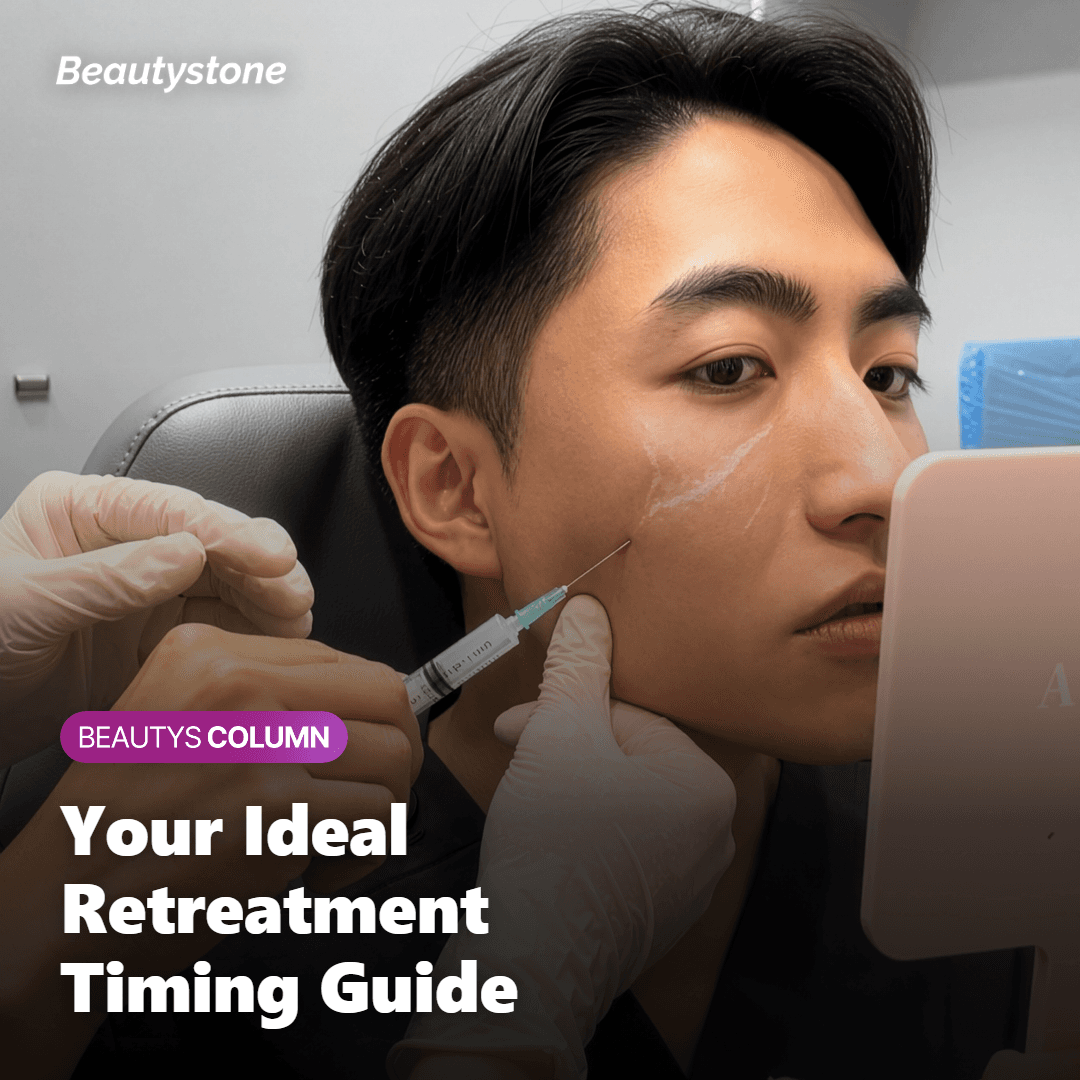
Masseter Botox — also called jaw slimming or jawline Botox — involves injecting botulinum toxin (Botox) into the masseter muscle, the thick chewing muscle that runs along the sides of the jaw. When the muscle is less active, it gradually reduces in size (a process called atrophy), which softens the square look of the lower face.
The results aren't immediate. Most people start noticing visible slimming around four to six weeks post-injection, with peak results typically appearing around months two and three. After that, the nerve-muscle connection slowly regenerates, and the masseter starts recovering its full strength.
This is normal physiology — not a treatment failure.
Why Does the Square Jaw Come Back?
Botulinum toxin doesn't permanently alter the muscle. It works by temporarily blocking the nerve signal that tells the masseter to contract. Once the body metabolizes the toxin and the nerve junction repairs itself, the muscle regains function.
Because the masseter is one of the most-used muscles in the body — you're working it every time you chew, clench, or grind — recovery can happen on the faster end compared to muscles that get less daily use. Research published at PMC11860558 highlights how masseter volume and activity patterns influence both the initial response and the timeline of recovery after botulinum toxin injection.
The upshot: the jaw coming back isn't a sign something went wrong. It's the expected result of a temporary treatment wearing off over time.
Signs Your Jaw Botox Is Wearing Off
You don't need a clinic visit to notice these early signals:
Jaw tension while chewing: You start feeling the muscle engage more noticeably — especially with tough or chewy foods.
Visible widening: The lower face looks broader or squarer in photos or the mirror compared to your peak results.
Morning jaw stiffness: That tight, clenched feeling in the morning — which may have eased after your initial treatment — starts coming back.
Face contour softens: The sharper oval shape from the slimming effect becomes less defined.
These signs typically show up somewhere between four and eight months after treatment. Individual results vary based on your baseline muscle size, chewing habits, and whether you grind your teeth at night.

Side Effects and Safety Considerations
Masseter Botox has a solid safety track record when performed by a trained injector, but it's not without trade-offs.
Common and temporary: Mild redness, swelling, or soreness at the injection site — usually resolves within one to three days.
Chewing strength: Some people notice temporarily reduced bite force, especially with hard foods. This typically isn't disruptive to daily life and reverses when the effect wears off.
Asymmetry: If the injector doesn't account for natural differences between your left and right masseter, mild asymmetry can occur. An experienced provider minimizes this risk.
Antibody resistance: Retreating too soon — before the toxin has fully cleared — may increase the risk of your body developing neutralizing antibodies, which can reduce how well future treatments work. This is one of the key reasons spacing matters.
If you experience significant pain, difficulty swallowing, or spreading weakness, seek medical care right away — though these serious reactions are rare with properly placed masseter injections.
Who shouldn't get masseter Botox:
Pregnant or breastfeeding
Neuromuscular conditions (myasthenia gravis, ALS, Lambert-Eaton syndrome)
Known allergy to botulinum toxin or any product component
Currently on blood thinners (discuss timing with your provider)
How Soon Is Too Soon to Retreat?
The short answer: most providers recommend waiting a minimum of four to five months, with six months being a common standard for ongoing treatments.
Retreating earlier than four months carries real risks. The toxin may still be partially active, meaning you're stacking doses before the previous one clears — which raises the antibody resistance concern noted above. It also doesn't give the masseter enough time to recover to a stable baseline, making it harder to assess whether you actually need retreatment or just a little more patience.
On the flip side, waiting too long isn't a problem in the medical sense — it just means you'll experience more of the original muscle volume returning before your next session. Some people prefer this; others prefer more continuous maintenance.
Finding Your Ideal Retreatment Window
There's no single number that works for everyone. Here's a practical framework for thinking about it:
Factor | What It Suggests |
|---|---|
Time since last injection | At least 4-5 months minimum; 6 months is most common |
Muscle recovery signal | You can feel the masseter engaging clearly while chewing |
Visual change | Jaw looks noticeably squarer — roughly 50-70% back to your pre-treatment look |
Provider assessment | Palpation confirms sufficient muscle recovery before adding more toxin |
One important pattern worth knowing: people who treat consistently over several cycles often find their intervals gradually extend. That's because repeated cycles of reduced muscle use can lead to cumulative reduction in masseter volume over time. In practice, this means earlier treatments may need to be closer together, while later maintenance may be needed less frequently.
The Bottom Line
Here's the summary:
Jaw Botox wearing off and the square jawline returning is expected — not a sign anything went wrong.
The masseter muscle typically recovers over four to eight months, with individual variation based on muscle size and daily chewing habits.
Wait at least four to five months before retreating, with six months being the most common standard.
Watch for chewing tension, visible widening, and morning jaw stiffness as your cue to book a consultation.
Like any aesthetic procedure, the results depend on your anatomy, your goals, and how consistently you maintain treatment. Retreating too soon can increase risks; waiting until the jaw has visibly returned is generally the safer, more effective approach.
Ultimately, the timing is a conversation between you and your provider — not a fixed rule. If you're considering masseter Botox or wondering whether it's time for a touch-up, Beautystone is a dermatology clinic in Seoul's Hapjeong neighborhood. See current offerings at /en/promotion or check pricing at /en/price.
Frequently asked questions
Q. How long does jaw Botox last?
A. Most people see results lasting four to six months, though individual results vary. Factors like baseline masseter size, chewing habits, and whether you grind your teeth can all affect how quickly the effect fades. People who treat consistently over multiple cycles sometimes find results lasting longer over time as the muscle gradually reduces in volume.
Q. Can I get masseter Botox retreatment sooner than six months?
A. Most providers recommend waiting a minimum of four to five months. Retreating earlier — especially before the toxin has cleared — may increase the risk of your body developing antibodies that reduce future treatment effectiveness. It also doesn't give the muscle enough time to reach a stable baseline for accurate assessment.
Q. Does jaw Botox hurt?
A. Most people describe it as a brief pinch or pressure — not significantly painful. The masseter is a thick muscle and the injection is straightforward. Your provider may offer a topical numbing cream beforehand if you're sensitive.
Q. Will masseter Botox affect my ability to chew?
A. You may notice slightly reduced bite force in the weeks after treatment, especially with very tough or chewy foods. This is usually mild and temporary. It resolves as the effect wears off. If you have any concerns about your chewing function, let your provider know before your appointment so they can tailor the dose appropriately.


Tattoo removal
손가락 문신은 작으니까 금방 지워질 거라 생각하셨나요?

Tattoo removal
문신제거 견적이 병원마다 다른 이유, 크기 기준부터 달라서예요

Tattoo removal
10회 결제했는데 그 전에 다 지워지면 돈이 아깝지 않을까요?

Lifting
Forehead Thread Lifting: How Far Can It Go?

skin
Skin Booster Prices: What to Check in a Quote

Contouring & Volume
InMode Cost: Why One Area, Three Line Items