

How Botox contours: masseter for the jaw, gastrocnemius for calves, and its daily impact.
Published
Updated

Author
Wi Young-jin · Chief director
Seoul National University College of Medicine · Seoul National University Hospital Specialist
→
🔗 Read More
What is Botox? — 1.1 The History of Botox · 1.2 How It Works
Types — 2.1 Brand Comparison (Botox, Dysport, Nabota, Coretox)
Treatment Areas — 3.1 Wrinkles (Forehead, Between Brow, Eye Area, Mouth Area)
Things to Know — 4.1 Duration of Results · 4.2 Side Effects · 4.3 Frequently Asked Questions
To get straight to the point, jaw and calf Botox treatments do not remove fat or shave down bones. Instead, they are designed to reduce the volume of specific muscles. When these muscles are temporarily relaxed, they gradually shrink and lose volume over time. While the formulation of the Botox is exactly the same as what is used for wrinkles, the targeted muscles and expected results are completely different.
Jaw Botox — Working on the Masseter Muscle
The target for jaw Botox is the chewing muscle, known as the masseter muscle*. If you place your hands on the sides of your jawline and clench your teeth tightly, you can feel that firm bump popping up—that is your masseter muscle.
Masseter Muscle*: The strong chewing muscle connecting the cheekbone to the lower jaw angle. If it becomes enlarged, it can make the jawline look square, making it the primary treatment area for jaw Botox.
There are several reasons why the masseter muscle might enlarge. Some people are genetically predisposed to having larger jaw muscles, while teeth grinding, clenching, or frequently chewing hard foods can also be the cause. Clinically, injecting Botox into the masseter muscle is reported to reduce muscle thickness by an average of up to 31%, with results typically lasting 3 to 6 months.
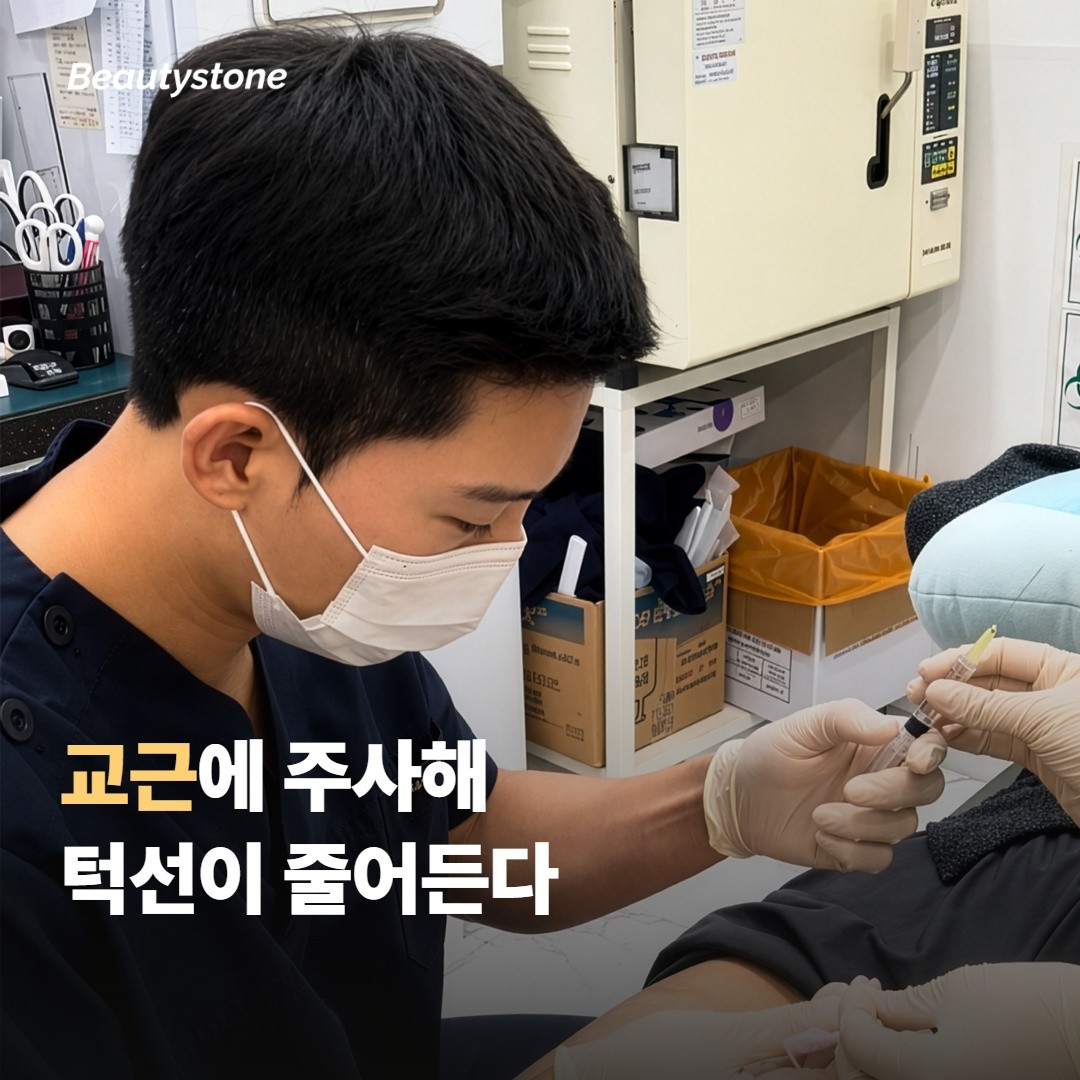
One important thing to note is that the results take a little time to appear. Rather than seeing an immediate change right after the injection, you will notice your jawline gradually slimming down over a period of 1 to 3 weeks. Since this treatment doesn't change your bone structure, jaw Botox alone may have limited results if your jawline is naturally wide due to bone shape.
Calf Botox — Reducing the Gastrocnemius Muscle
If your calves look thick primarily due to muscle development, calf Botox can be highly effective. This is particularly true if you have a well-developed gastrocnemius muscle* at the back of your calves. If a firm bulge pops out when you lift your heels up, it is very likely a muscular concern.
Gastrocnemius Muscle*: The two-headed muscle situated on the surface of the back of the lower leg. It is active when standing on your tiptoes or jumping, and when enlarged, it can make the calf look thick and bulky.
On the other hand, if your calf volume is caused by fat rather than muscle, Botox will not be effective. This is why a thorough and accurate evaluation to determine whether the issue is muscle- or fat-based before your treatment is so essential.
Injecting Botox into the gastrocnemius muscle reduces the frequency and intensity of muscle contractions, leading to gradual slimming over several months. Typically, the 7/10 to 8/10 section, where the nerve distribution in the gastrocnemius is most active, is recommended as the optimal injection site. Just like jaw Botox, the transformation is not overnight; it usually takes 2 to 4 weeks to see visible results, which generally last around 6 months.
Salivary Gland Botox — When an Enlarged Parotid Gland Makes the Face Look Round
Contouring Botox can be used not only for muscles but also for salivary glands. The parotid gland is the largest salivary gland, located just in front of and below the ear. When it becomes enlarged due to regular drinking, teeth grinding, or genetics, it can make the sides of your jawline look bulky and give the face a rounder appearance. This is a case where the culprit is not the masseter muscle, but the salivary gland, even though it mimics a square jaw.
By injecting Botox into the parotid gland, the acetylcholine signals to the salivary gland are blocked, reducing saliva secretion and gradually shrinking the gland itself over time. The results typically develop slowly over 2 to 4 weeks and last for about 3 to 6 months. Having only one side treated rarely causes side effects like dry mouth because the other salivary glands (submandibular and sublingual glands) compensate for it beautifully.
If you are concerned about your jawline but your chewing muscles aren't particularly thick, it is highly recommended to check for an enlarged salivary gland first. Targeting the correct area makes all the difference in achieving the best results.

A Larger Dosage is Typically Required
Contouring Botox requires significantly more dosage than standard wrinkle Botox. Jaw Botox often requires 40 to 60 units or more for both sides combined, and calf Botox requires even more. As the dosage increases, the cost will naturally rise, and although rare, the possibility of developing resistance to the treatment may need to be considered.
Typically, we recommend adjusting your next dosage based on "how effective the results were" rather than simply focusing on "how many units were injected."

Will It Affect My Daily Activities?
After receiving jaw Botox, you might temporarily feel a slight weakness when chewing. Some people find chewing hard foods a bit more awkward than usual, while others don't notice any difference at all. For most, this won't interfere with eating normal meals; any mild weakness is usually most noticeable 2 to 3 weeks after the treatment and gradually improves. Interestingly, clients who struggled with teeth grinding or TMJ discomfort often report a wonderful relief in pain.
For calf Botox, you might feel a different sensation during activities like climbing stairs or running. Because the gastrocnemius muscle is heavily involved in explosive movements, you might notice this more during short sprints, jumping, or hiking. However, everyday activities like light walking, yoga, or exercising on flat surfaces are rarely affected. If you are an athlete or a passionate runner, we recommend scheduling your treatment during your off-season or having an in-depth discussion with your doctor beforehand.
Frequently Asked Questions
Q. What should I do if I don't see any results from jaw Botox?
First, we'll double-check the size and location of your masseter muscle. It could be that the dosage was a bit low, or the injection did not target the thickest part of the muscle precisely. A follow-up evaluation after 1 to 2 weeks is the standard recommendation.
Q. Does calf Botox affect my athletic performance?
Since the masseter function is temporarily reduced, you might feel a difference during high-intensity workouts or long-distance running. If maintaining peak athletic performance is crucial to you, planning the treatment during your off-season is highly recommended.
Q. Will my muscles return to their original size once the effects wear off?
Yes, as the Botox naturally breaks down over time, muscle function fully restores, and as the muscles become active again, they will return to their original size. Most patients opt for regular, periodic treatments to maintain their beautifully slimmest results.


![[Wi Young-jin Column] Botox droop: 19-min consult patterns](https://framerusercontent.com/images/0v9Uk6mK3YIdpWJqkstER6nDqM.jpg?width=1080&height=1080)


Lifting
XERF for a Thin Face: Depth vs. Hollowing?

Lifting
Thread Lift Swelling: What's Normal in 5 Days?

Lifting
Thermage Cost: 4 Lines to Check on a Quote

Contouring & Volume
Xeomin Cost: Why Do 50-Unit Quotes Differ?

skin
Back Acne That Won't Clear? It Might Be Fungal

Tattoo removal
Bad Brow Tattoo: Cover It Up or Fade It First?