

One sends focused ultrasound to the deep support layer, the other stacks heat from three laser wavelengths. Here's how to tell which your face needs.
Published -
Updated -

Author
Wi Young-jin · Chief director
Seoul National University College of Medicine · Seoul National University Hospital Specialist
→
You tilt your phone up for a video call, and the face on the screen doesn't quite match the one in your bathroom mirror. The jawline reads softer. The cheeks sit a little lower than you remember. You blame the camera angle for a while, and then one day you stop blaming the angle. If that's roughly where you are, you're not alone.
Two names come up constantly once you start looking: Ultherapy, which most people have already heard of, and Titanium Lifting, which sounds like something gets implanted. Neither one involves an incision, and neither one leaves material behind. What separates them is how the energy gets in and how far down it travels, and that difference is what should decide which one you book.
In this article, we'll cover what's actually sagging when a jawline blurs, how each device delivers its energy, how the two compare on sensation and downtime, which signals point toward which treatment, and what to expect once you're back outside.
What's Actually Sagging, and How Deep?
The signal you notice matters less than the layer it's coming from.
Most people describe some version of the same three observations:
The jawline blurs. The border that used to separate face from neck reads soft, and the lower cheek looks like it's spilling past it.
The mid-cheek drifts down. Volume that used to sit high settles lower, and the fold running from nose to mouth corner starts reading deeper than it did.
The profile goes first. The transition between chin and neck loses its edge, and side-on photos start bothering you before straight-on ones do.
Any one of those is enough reason to start asking about lifting. The more useful question is how far down the slack begins, because a surface that's lost its snap and a support layer that's given way don't respond to the same kind of energy. That's the whole fork in the road here. Treatment names are the second decision, not the first.
Ultherapy: Focused Ultrasound Aimed Deep
Ultherapy uses focused ultrasound, and its whole design argument is depth.
The energy is aimed at the SMAS, short for the superficial musculoaponeurotic system, the fibrous support sheet that lies over your facial muscles and holds the soft tissue above it in position. When people talk about sagging that starts deep, that's the layer they mean.
The device works at set depths, roughly 4.5 mm, 3.0 mm, and 1.5 mm, so a provider can put the energy into the layer that's actually loose instead of treating every face the same way. When ultrasound energy reaches those deeper structures, research describes collagen and elastic fibers going through a remodeling response and reorganizing.
Which brings up the part people underestimate: patience is baked into the treatment. Rebuilding collagen isn't fast, and the lifting change typically emerges gradually over the two to three months after a session rather than the week of it. Individual results vary, and how much you see depends heavily on where you started.
Titanium Lifting: Three Wavelengths, Steady Heat
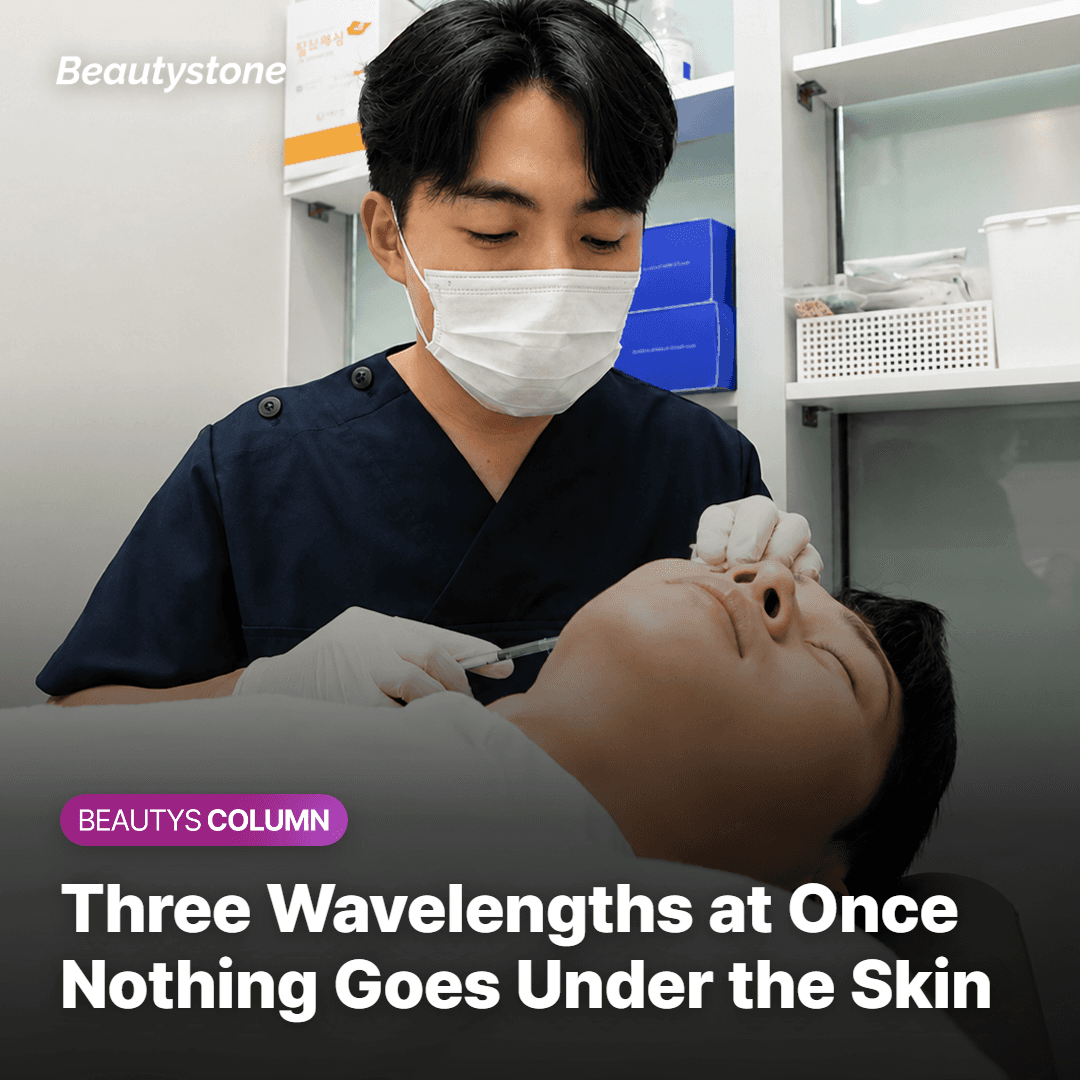
First, the question that comes up in almost every consultation: no, nothing titanium goes under your skin. It isn't a thread lift, no material is implanted, and the name is describing the device rather than anything that ends up in your face.
What it does instead is fire three diode laser wavelengths simultaneously, at 755 nm, 810 nm, and 1064 nm, layering heat into the dermis, the tissue beneath the surface where collagen and elastic fibers sit. Energy-based devices in this family generate heat by targeting water inside the skin, and that heat drives collagen denaturation and remodeling while a cooling system shields the surface.
That cooling head is the reason the session feels the way it does. With the surface being chilled continuously as the laser passes over it, most people land somewhere near warm massage rather than anything they'd call painful.
The dermal side of the mechanism has some early support behind it: lasers in the 800 nm range have been reported to switch on the cell signaling involved in collagen production. Keep it in perspective, though. That finding came out of an animal model, and tissue in a lab doesn't necessarily behave the way the skin on your face does.
How the Two Compare, Side by Side
Same destination, different route. Here's where the practical differences actually land:
What you are comparing | Ultherapy | Titanium Lifting |
|---|---|---|
How it feels | More sensation. A prickling or tapping feeling that varies a lot by area. | Mostly warmth. Closer to a heated massage than to anything sharp. |
When you notice it | Gradual. The lifting change builds as collagen fills in over the following weeks and months. | Skin often feels smoother right away, but the lifting part still builds slowly. |
Downtime | Short, though redness and puffiness can linger for a few days. | Very little. Usually a temporary flush that settles on its own. |
Session length | Varies with how much area is being covered. | Tends to wrap up relatively quickly. |
When to hold off | Pregnancy or breastfeeding, active inflammation in the treatment area. | Pregnancy or breastfeeding, active inflammation in the treatment area. |
Neither column is the winning one. They're two different trade-offs: Ultherapy asks for more tolerance during the session and a few quieter days afterward, and gives you a change that comes from deeper down. Titanium Lifting asks for very little and gives you something gentler and more gradual. Which trade you'd rather make is a personal call, not a clinical one.
Which Signals Point to Which?
Start with your own face, not the treatment menu.
Ultherapy tends to be the first conversation when:
Pushing your jawline up gently with your fingers changes the line noticeably.
Mid-cheek descent has gone far enough that it's affecting how deep the nose-to-mouth fold reads.
A few days of looking a bit flushed is acceptable, and you'd rather see one clear change than a slow accumulation of small ones.
Titanium Lifting tends to come up first when the complaint is less about position and more about quality: skin that reads dull or slack rather than fallen, and a calendar that has something on it tomorrow you'd rather not explain.
Plenty of people show both sets of signals at once, and running the two at spaced intervals rather than picking a side is common enough to be worth asking about directly. That's usually what a consultation is for. Someone looks at your face, presses on it, and works out whether what you're seeing is a surface texture issue or something coming from the SMAS, then sorts you into one treatment, the other, or a combination spread over time.
From there the session itself is fairly undramatic. Numbing cream goes on or gets skipped depending on the plan, and afterward it's mostly a matter of checking whether any redness or heat is still hanging around before you head out. Follow-up gets scheduled with the collagen timeline in mind, which is another way of saying nobody should be asking you to judge the result the next morning.

Side Effects, Downtime, and When to Wait
Both treatments skip surgery, but neither is a consequence-free afternoon.
After Ultherapy: downtime is short, though redness and puffiness can stick around for a few days depending on the area and the settings used.
After Titanium Lifting: there's very little to sit out, and what does show up is usually a temporary flush that fades on its own.
Some situations call for pushing either treatment back rather than working around them:
You're pregnant or breastfeeding.
There's active inflammation or an open wound in the area being treated.
You're prone to keloid scarring, or you've had another laser or filler treatment recently.
There's also the escalation rule that applies to any energy-based treatment. If you notice spreading redness, fever, or pain that's getting worse instead of better, seek medical care right away rather than waiting to see whether it settles.
Everyone's skin is different, and the settings that suit one face aren't automatically right for the next one. Your provider should be the one deciding how much energy your skin can take, and that's a conversation worth having before you're on the table rather than after.
The Bottom Line
Ultherapy sends focused ultrasound down to the SMAS support layer. Titanium Lifting stacks heat from three diode wavelengths into the dermis.
Neither one implants anything, and Titanium Lifting isn't a thread lift no matter what the name suggests.
Ultherapy trades more sensation and a few flushed days for depth. Titanium Lifting trades intensity for a session you can walk straight out of.
Both work through collagen, so the lifting part arrives gradually either way, and results vary from person to person.
Like any procedure, this one comes with trade-offs, and no device does everything. Ultimately, the choice depends on which layer your sagging is starting from, how much visible recovery your week can absorb, and what you want the change to look like when it arrives.
If you're weighing the two, a consultation where someone actually looks at and presses on your skin will tell you more than any comparison chart can. Beautystone is a dermatology clinic in the Hapjeong area of Seoul, a short walk from Hapjeong Station, and it keeps devices that reach different depths on hand. That matters mostly because it means the honest answer is allowed to be neither one on its own, if your skin turns out to be signaling from two layers at the same time.
Frequently asked questions
Q. Can I have Ultherapy and Titanium Lifting both?
A. Yes, and spacing them out is the usual approach. When sagging has reached the SMAS layer and skin quality has slipped at the same time, a common plan is Ultherapy for the deeper support and Titanium Lifting for surface texture. Whether they go in the same visit or get separated by a gap depends on how your skin looks that day, so it's a call to make with your provider rather than in advance.
Q. Does Titanium Lifting help if I'm not really sagging yet?
A. That's arguably where it fits best. Because it delivers heat into the dermis to prompt collagen remodeling, it tends to respond well when the complaint is dull or slack-feeling skin rather than tissue that has clearly dropped. If the sagging has already worked its way down to the SMAS layer, Ultherapy is usually the more sensible starting point.
Q. How soon after Ultherapy can I do Titanium Lifting?
A. If there's no irritation and your skin has settled, the two can sometimes fall within the same week. If redness or swelling is still visible, waiting a few more days until it calms down is the safer move. The exact spacing depends on which area was treated and how strong the settings were, so confirm it at your follow-up rather than assuming a number.
Q. Is Titanium Lifting the same thing as a thread lift?
A. No. Nothing is inserted and no thread material is used. Titanium Lifting is a non-invasive device that fires several laser wavelengths at once to deliver heat into the skin, so the mechanism is completely different from a thread lift even though the name leads people to assume otherwise.


Contouring & Volume
Why Juvelook Volume Quotes Vary by Clinic

men's
Nose Pore Treatment: Aftercare Timing Guide

skin
How Many Sessions Does Eyeliner Removal Take?

Hair Removal
Laser Hair Removal While Pregnant or Nursing

Hair Removal
레이저 제모 1회에도 남는 몫이 있어요 — 밀도를 모자이크로 보는 법

Tattoo removal
Why Extremity Tattoos Are Slower to Remove