

Why Botox prices vary by area, the right units per spot, and when to judge results.
Published
Updated

Author
Wi Young-jin · Chief director
Seoul National University College of Medicine · Seoul National University Hospital Specialist
→
When looking into Botox, you likely often see price lists such as "$40 for forehead, $300 for masseter." Many people get confused about why there is such a difference for what seems to be the same treatment, and why the results vary so much by area.
Even with the same Botox*, the outcome varies depending on exactly where the product is injected. When placed in expression muscles, it smooths out wrinkles, whereas injecting it into volume-reduction muscles like the jaw slims down your facial contours. Therefore, the required units, injection depth, and recommended treatment intervals are customized differently for each area.
Botox (Botulinum Toxin)*: A protein that temporarily blocks nerve signals to the muscles. When used on expression muscles like the forehead or between the brows (glabella), it smooths wrinkles. When used on bulkier muscles like the masseter (jaw) or calves, it reduces their size.
In this article, you will learn about:
The difference in goals for Botox in expression muscles vs. volume muscles
Why the number of units differs by area
The ideal intervals and evaluation timing for each area
Common side effects and 24-hour precautions
Expression muscles and volume muscles have different goals
Botox targeting the forehead, glabella, and around the eyes aims to minimize movement by temporarily blocking signals from nerves to muscles. Vertical frown lines, fine laugh lines around the eyes, and horizontal forehead lines from raising your eyebrows are all caused by the repetitive pulling of these expression muscles.
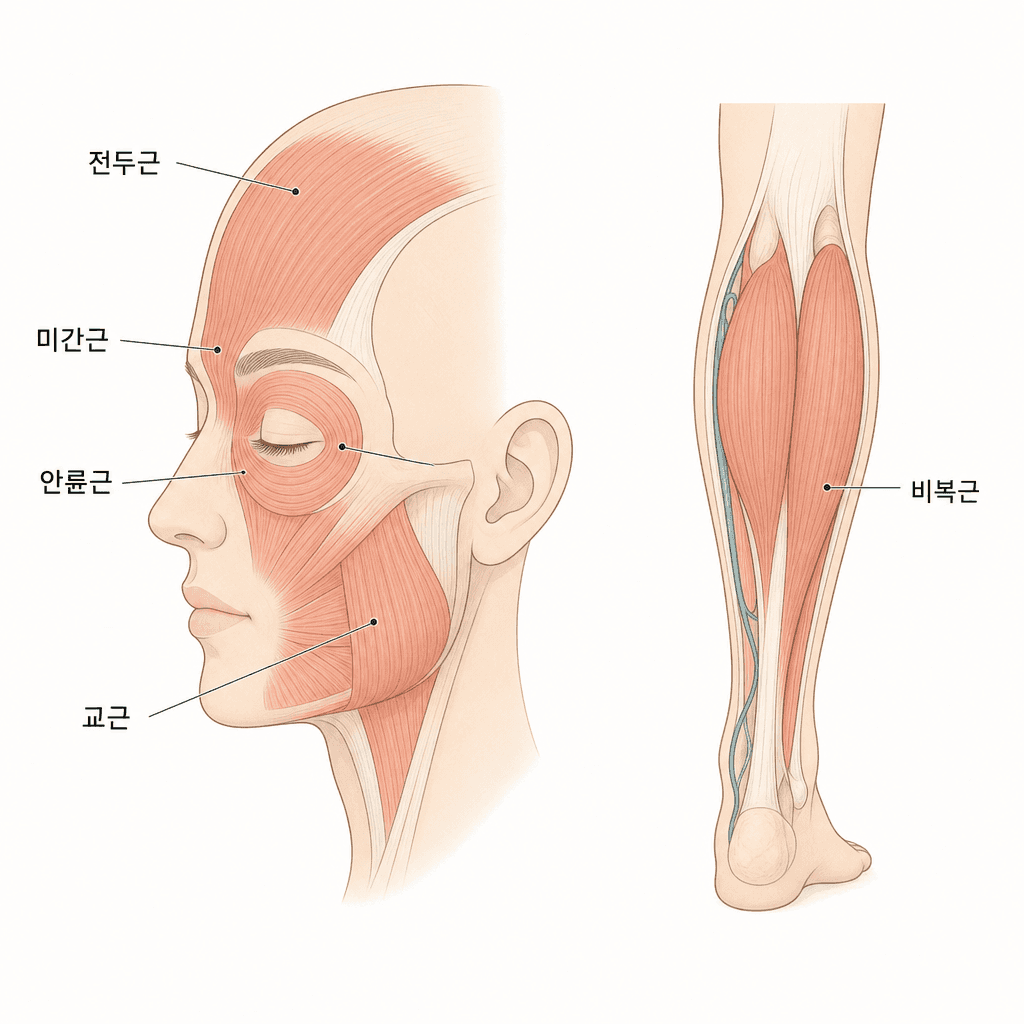
Conversely, Botox injected into the jaw (masseter) and calves aims to reduce muscle volume. The jaw muscles (masseter) of those who chew with a lot of force, or the calf muscles of those who stand all day, tend to become firm and hypertrophied over time, resulting in a heavier silhouette.
Since the treatment goals differ, how we evaluate the outcomes differs too. For the forehead, we check how well the wrinkles have smoothed out after 2 weeks, while for the jaw, we look at the reduction in facial slimness after 1 to 2 months.

The number of units is the key to pricing differences
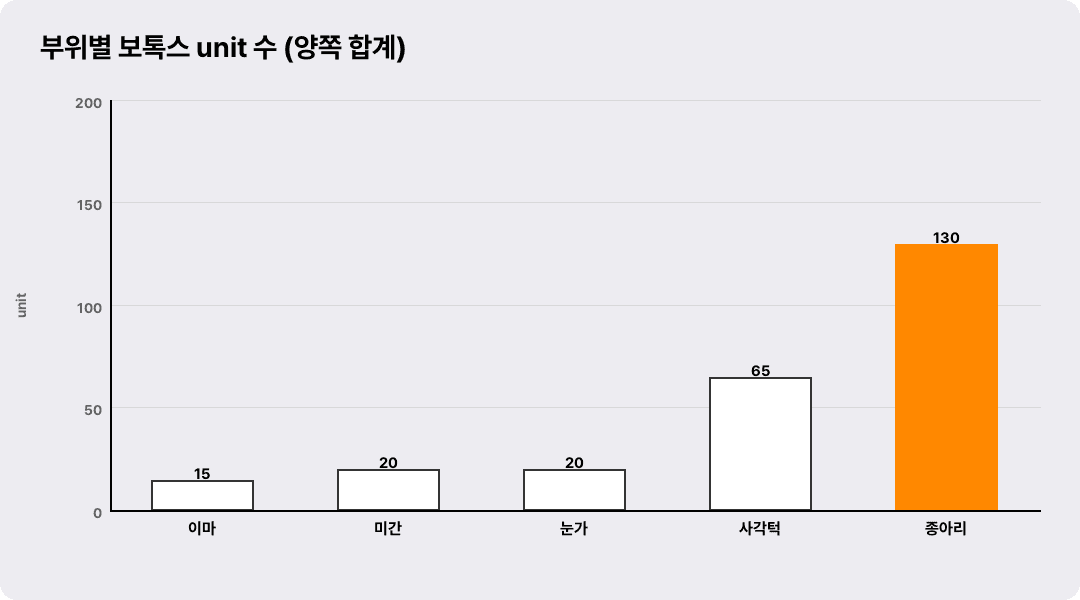
Many people ask why the prices vary so much for the same Botox. The answer lies in the units. Botox is priced and administered by units, not by the vial. Because the size of the muscle we need to target varies by area, the required units naturally differ as well.
The significant price difference between the forehead and the jaw is because the jaw requires 2 to 4 times more units. Calves are even larger muscles, so it is quite common to use over 100 units combined. Thus, it is natural that larger treatment areas cost more.
One point to be cautious of is jaw or calf Botox advertised at excessively low prices. If the treatment is done with fewer units than the recommended amount, the effects will wear off quickly, and there is a higher risk of asymmetry.
Treatment intervals must be customized for each area
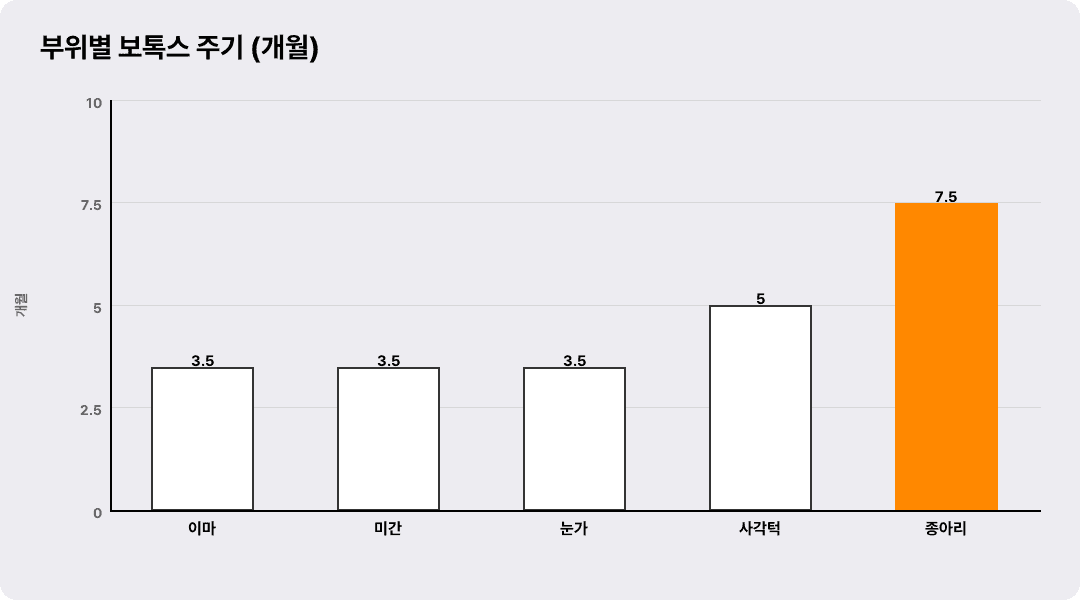
Saying "Botox should be done every 6 months" doesn't apply to every area. The rate at which the effects wear off differs between expression muscles and volume muscles, and how long a single treatment lasts also depends on the area.
Forehead, Glabella, Eyes — Typically once every 3 to 4 months (because they are frequently used expression muscles, they recover faster)
Jaw (Masseter) — Typically once every 4 to 6 months (intervals are shorter for the first 3 sessions, then become longer)
Calves — Typically once every 6 to 9 months (as these are larger muscles, recovery is slower)
Particularly for jaw Botox, many patients share reviews saying, "The effect seemed to wear off after just 1 month." It hasn't actually worn off; rather, because it takes time for the muscle to shrink, contour changes only become visible around the 2-month mark. It is best to evaluate the results at 1 to 2 months.

Our approach: assessing the area and your facial habits before recommending treatment
At Beautystone Hapjeong, rather than rushing into a Botox treatment, we first examine which muscles are more developed and analyze your daily facial expressions to determine the right unit dosage with you. Even for the same jaw area, the recommended units differ depending on your chewing strength, and even for the forehead, the injection points vary based on your habit of raising your eyebrows. It is not a one-stop-shop treatment, but a professional medical care plan where we monitor the changes together at each session to adjust the next unit dosage.

Side effects to watch out for vary by area
Even with the same Botox, the potential side effects to keep in mind differ depending on the area. Knowing these in advance makes it easier to judge what is a normal feedback response after treatment.
Area | Precautions |
|---|---|
Forehead | Drooping eyebrows. If injected too high up, the muscles that raise the eyebrows may weaken, making the eyes feel heavy. |
Glabella | Drooping upper eyelid (ptosis). If the product diffuses toward the muscle that raises the upper eyelid, one eye may temporarily look droopy. |
Jaw (Masseter) | Asymmetry of the smile. If the product spreads to muscles other than the masseter, one side of the mouth may raise less when smiling. |
Calves | Temporary walking discomfort. As muscle strength temporarily decreases, your legs might feel slightly heavy when walking up and down stairs during the first 1 to 2 weeks. |
Most of these are temporary reactions that naturally resolve within 2 to 6 weeks. However, to be safe, it is best to avoid lying down or getting a massage for 24 hours after the treatment. This helps prevent the product from spreading to unintended muscles.
We recommend keeping a record of the ideal unit dosage and product that works best for you. Writing it down like "20 units for glabella, 60 units for jaw" makes it much easier to adjust the dosage during your next session if the previous effect felt weak. Please note that this article is for general informational purposes. The exact units suitable for your facial habits and muscle development should be determined in consultation with your medical team.

Frequently Asked Questions
Q. I'm getting Botox for the first time. Can I start with my forehead?
A. If you have a very expressive face, starting with the forehead is generally less burdensome than the glabella or jaw. The units used are small, and even as it wears off, it looks very natural. However, for the forehead, the experience of the injector is crucial to avoid heavy-looking eyebrows. If it is your first time, it is best to decide during a consultation where we can look at your natural facial habits together.
Q. It feels like the effect wore off after just a month. Could the product be fake?
A. It depends on the area. While a 3 to 4-month duration is typical for the forehead and glabella, it is completely normal not to see much change in the jaw within the first month. The results for jaw Botox are best evaluated at the 2-month mark. Reviewing your treatment history and unit records at our clinic will make it easy to figure out why the effect felt short-lived.
Q. I am planning a pregnancy. Is it okay to get Botox beforehand?
A. Botox is not recommended during pregnancy. If there is a possibility of pregnancy, please let our medical team know before your procedure. We generally advise against treatments starting 3 months before planning to conceive. We can comfortably align your personal schedule and treatment timing together during your consultation.
Q. The effect used to be great, but now it wears off so quickly. Have I developed resistance?
A. While short-lived effects due to antibody formation can happen, in most cases, it is because the treatment interval was too short or the units injected were insufficient. For the jaw, it is general practice to maintain a 4 to 6-month interval for the first 3 sessions, and then gradually extend it as the duration of the effect increases. If the duration continues to shorten, it is a good idea to bring your previous treatment records and consult with our medical team.


![[Wi Young-jin Column] Frontalis Design, Forehead Botox Without Heavy Eyes](https://framerusercontent.com/images/IIiy5UpcmLMDvtamZAhCafz9OuI.jpg?width=1080&height=1080)


Contouring & Volume
Hip Dip Filler Before and After: 4 Checks

Body
Potenza Treatment Interval: Why 4 Weeks?

Lifting
Ultherapy Before and After: Why Wait 90 Days?

Contouring & Volume
Belotero Revive Cost: 2cc Price vs. 3 Sessions

skin
Lip Hyperpigmentation Laser: Does It Work?

Contouring & Volume
Men's Forehead Filler: Hollow or Just Lines?