

Why Dr. Wi Young-jin at Beautystone Clinic Only Uses the GentleMax Pro Plus
Published -
Updated -

Author
Wi Young-jin · Chief director
Seoul National University College of Medicine · Seoul National University Hospital Specialist
→
Why GentleMax Hair Removal
Is Scientifically Proven
to Work — 3 Key Reasons

Hello.
I'm Dr. Wi Young-jin from Beautystone Clinic.
"Isn't laser hair removal
basically all the same?"
This is one of the most common questions
I hear in the clinic.
There are so many devices out there,
but many patients aren't sure
why the results differ.
Especially from those
who've had treatments elsewhere
and didn't see
the results they expected.
Today, I'd like to explain
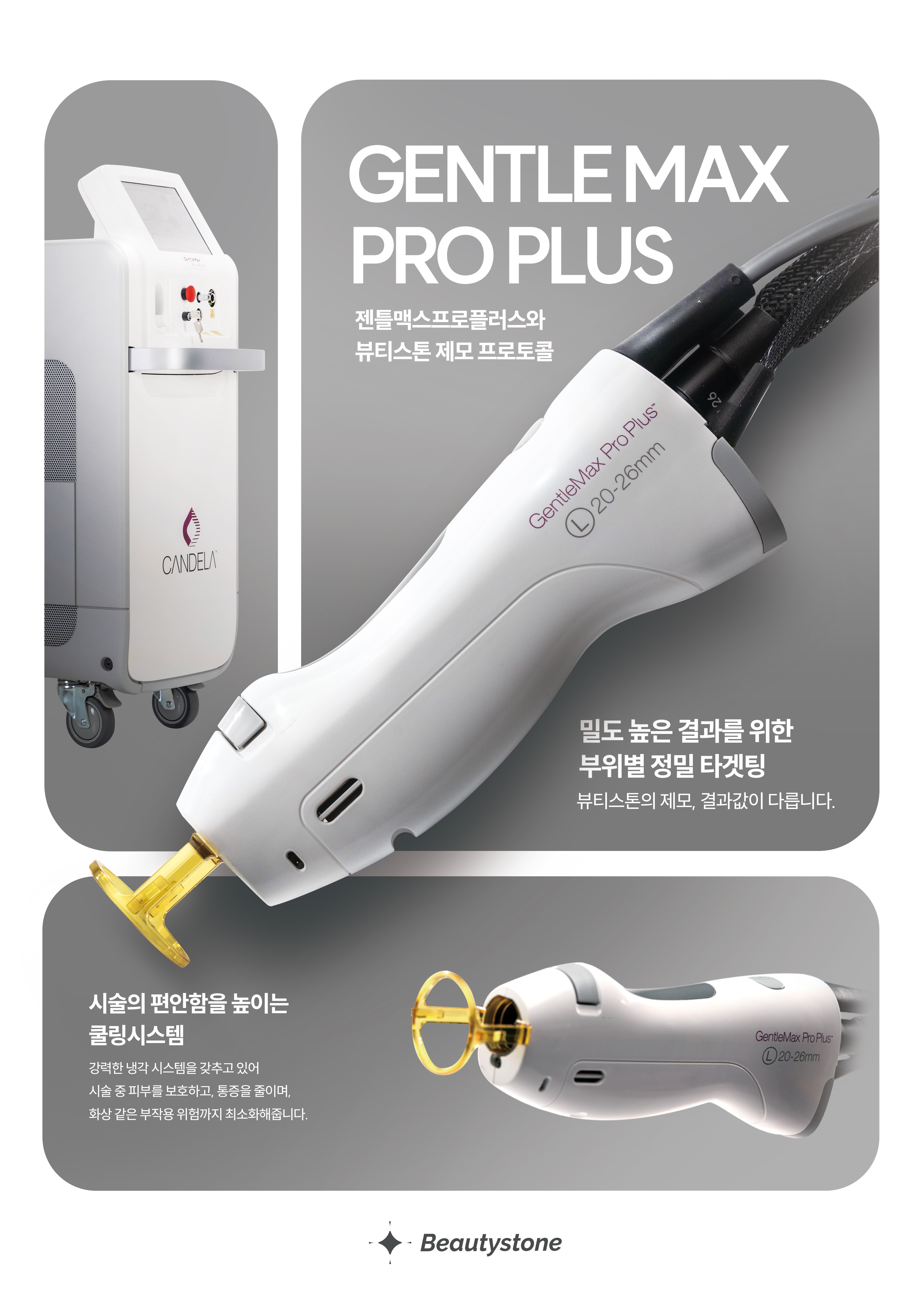
why I chose the GentleMax Pro Plus —
and where the claim
"GentleMax hair removal works"
actually comes from.
What makes laser hair removal devices different?
Laser hair removal devices are largely
categorized by the wavelength they use.
Apogee, one of the well-known devices,
uses only the
755nm Alexandrite wavelength.
GentleMax Pro Plus, on the other hand,
offers both 755nm Alexandrite
and 1064nm Nd:YAG wavelengths
in a single device.
According to dermatology society guidelines,
the Alexandrite wavelength
offers higher hair follicle absorption
for lighter skin tones,
while Nd:YAG is the preferred choice
for darker or tanned skin
in terms of safety.
In other words, single-wavelength devices
work well for the right skin type —
but can't deliver consistent results
across the full range of skin tones
we see in Korean patients.
From my own experience using both devices,
patients with slightly darker skin
or those with frequent outdoor sun exposure
showed a noticeable difference in results
when wavelength flexibility was available.
Why GentleMax Hair Removal Works
— The Key Is the DCD Cooling System
Another factor that determines
pain and safety in laser hair removal
is the cooling method.
GentleMax Pro Plus has
a built-in DCD cooling system.
Just before the laser fires,
it instantly cools the skin surface
to reduce heat stress.
This allows effective energy delivery
while lowering the risk
of burns or PIH.
A common case I see in the clinic —
patients coming in after treatment elsewhere
with redness or skin discoloration.
In most cases,

it came down to insufficient cooling
or using the wrong wavelength
for their skin type.
That said, having DCD
doesn't mean every skin reaction
can be 100% prevented.
I want to be upfront about that.
Dr. Wi Young-jin's Clinical Notes:
Many patients near Hongdae · Seoul
come in with a wide variety of skin tones.
Many college students come from the Sinchon·Ewha area
who've spent the whole summer outdoors
and arrive with tanned skin
for their hair removal treatment.
In these cases, Alexandrite's
single-wavelength device
can over-react to the pigmentation,
so I switch to Nd:YAG
for the procedure.

Being able to assess the skin's response in real time
and switch wavelengths on the spot —
that's what I consider
the most practical advantage
of the GentleMax Pro Plus.
That said, no single wavelength
removes hair completely in one session.
Due to the hair growth cycle,
an average of 5–8 treatments is needed.
It's best to know this
before you come in.
✦ Further Reading
▶
GentleMax Pro Plus: Principles, Effects & Side Effects A to Z
▶
Folliculitis After Beard Hair Removal — It's These 3 Mistakes!
▶
Skin Botox Results Timeline: When Do You Start to See Changes?▶
Skin Botox Results Timeline: When Do You Start to See Changes?▶
Skin Botox Results Timeline: When Do You Start to See Changes?Why We Measure Skin Thickness with an Expensive Ultrasound Device
Skin Botox Results Timeline: When Do You Start to See Changes?How Long Should You Keep a DuoDerm On? A Complete Guide to Replacement Timing
Skin Botox Results Timeline: When Do You Start to See Changes?Skin Botox Results Timeline: When Do You Start to See Changes?
GentleMax Pro Plus hair removal treatment details
This month: GentleMax Pro Plus
Frequently asked questions
Q. Aren't all laser hair removal devices pretty much the same?
A. The results can vary depending on the wavelength. Apogee uses a single 755nm wavelength, while GentleMax Pro Plus employs two wavelengths—755nm and 1064nm Nd:YAG—in one device.
Q. Do we need to use different wavelengths depending on the skin tone?
A. Yes. For lighter skin tones, the Alexandrite wavelength offers high absorption in the hair follicles, while the Nd:YAG wavelength is safer for darker or tanned skin. The practical advantage is that we can switch wavelengths during the procedure.
Q. What is the role of the DCD cooling system?
A. Immediately before the laser makes contact, the skin surface is momentarily cooled to minimize heat irritation. While this significantly reduces the risk of burns and pigmentation, it does not prevent 100% of all potential reactions.
Q. Will all the hair be permanently removed in just one session?
A. Please keep in mind that a single session cannot completely remove hair at any wavelength. It typically takes an average of 5 to 8 sessions depending on your hair growth cycle, and individual results may vary.
Content
![Brazilian laser pain and device choice [GentleMax]](https://framerusercontent.com/images/BIbaAzlIw35Asz5UV3L6tLao4.jpg?width=1080&height=1080)



skin
Why Does Fractional CO2 Take Longer to Heal?

Contouring & Volume
How Many cc Does Forehead Filler Need?

skin
Why Is My Skin Oily but Tight in the Fall?

Hair Removal
Underarm Laser Hair Removal Cost: Do the Math

Tattoo removal
Laser Before a Cover-Up: How Many Sessions?

skin
큐어젯 다운타임, 다음 날 출근과 화장은 언제부터 될까요?