

Took a few months off from laser hair removal? Here's how to figure out how many sessions you still need — and whether your previous sessions still count.
Published -
Updated -

Author
Wi Young-jin · Chief director
Seoul National University College of Medicine · Seoul National University Hospital Specialist
→
One of the most common questions we hear at Beautystone is: "I took a few months off from laser hair removal — do I have to start all over again?" It's a fair question, and the answer is a little more nuanced than a simple yes or no. In this article, we'll cover what actually happens to your follicles during a break, how to recalculate your remaining sessions, and what to realistically expect when you restart.
Do Your Previous Sessions Still Count?
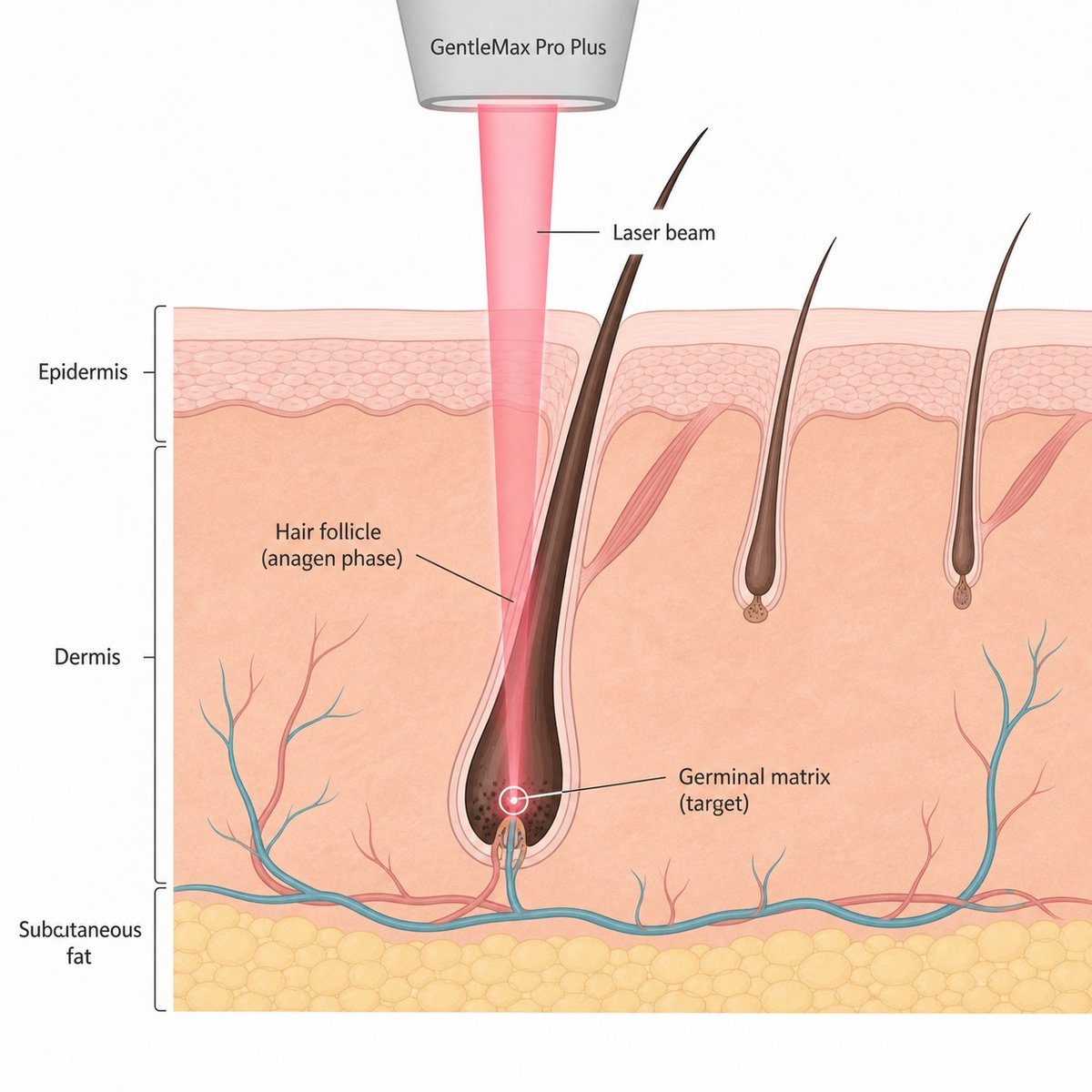
The short answer? Yes — and no. The hair follicles that were successfully destroyed during your earlier sessions are gone for good. Laser hair removal works by targeting the pigment in actively growing hairs (the anagen phase), and once a follicle is permanently disabled, it stays that way. A break doesn't reverse that progress.
What does change is the pool of follicles still waiting to be treated. During the months you were away, some of the follicles that were in their resting phase (telogen) have cycled back into active growth. That means more hairs are now targetable — which is actually useful — but it also means the remaining-session math needs to be recalibrated.
What Happens to Hair Follicles During a Break
Your hair doesn't all grow at the same time. At any given moment, follicles are scattered across three distinct phases:
Anagen (growth phase): The only stage where laser treatment is effective — the follicle contains enough melanin to absorb the laser energy.
Catagen (transition phase): The follicle is shrinking and detaching from the blood supply. Laser has minimal effect here.
Telogen (resting phase): The follicle is dormant. Laser can't meaningfully target it.
When you paused, you essentially pressed pause on a moving target. The follicles that were in telogen during your last session have since cycled back into anagen — which is why you may notice more visible regrowth after a long break than you'd expect based on your session count alone.
The key point: hair that was already eliminated is not returning. What you're seeing is dormant follicles waking up, not previously treated ones regrowing.

How to Recalculate Your Remaining Sessions
There's no universal formula, but here's a practical framework for thinking about your remaining session count after a break of three months or more:
Under 3 months off: You're likely still within a normal extended cycle. Pick up where you left off — no significant recalibration needed.
3–6 months off: Expect a modest uptick in visible hair, particularly in areas with dense follicle populations like the underarms or bikini line. You may need one or two additional sessions compared to your original estimate.
6–12 months off: A meaningful proportion of resting follicles will have cycled back into the active phase. Your provider will likely reassess your response and adjust your remaining session count — typically adding two to three sessions, depending on the area and your hair type.
Over 12 months off: You've essentially allowed a full hair-cycle reset in many areas. A consultation is strongly recommended before resuming, as the appropriate starting point varies significantly by skin tone, hair color, and treatment area. Individual results vary.
Keep in mind that session counts are always estimates — they depend on your individual follicle density, hair cycle timing, and how your skin has responded to previous treatments. Your provider's assessment after a break is more reliable than any general rule.
Does the GentleMax Pro Plus Change Anything?
The GentleMax Pro Plus is a dual-wavelength system — it combines a 755 nm Alexandrite laser with a 1064 nm Nd:YAG laser. This matters when restarting after a break because the wavelength your provider selects can shift depending on how your skin and hair have changed.
If you've spent time outdoors and your skin is now slightly more tanned than during previous sessions, your provider may lean more heavily on the 1064 nm wavelength, which is safer for darker skin tones. Conversely, if you're starting fresh in the fall or winter with lighter skin, the 755 nm Alexandrite may be more efficient for lighter, finer hairs.
The practical implication: don't assume your previous settings will carry over automatically. A brief reassessment at your first appointment back is standard practice and worth the time.
Side Effects and Safety When Restarting
Restarting after a break doesn't introduce new risks compared to your initial sessions — but it's worth refreshing a few fundamentals:
Sun exposure: Avoid tanning and direct sun exposure for at least two weeks before your session. Tanned skin significantly increases the risk of post-inflammatory hyperpigmentation (PIH), particularly with the Alexandrite wavelength.
Shaving: Shave the treatment area 24 hours before your appointment. Do not wax, thread, or use depilatory creams in the weeks before — these remove the root, which the laser needs to target.
Skin sensitivity: After a long break, some people experience slightly more redness and swelling than they remember from earlier sessions. This is normal and typically resolves within 24–48 hours. Apply a cold compress and keep the area out of direct heat.
Topical products: Avoid retinol and active exfoliants for at least five to seven days before treatment.
If you notice spreading redness, blistering, or symptoms that worsen after 48 hours rather than improving, seek medical care right away. These are uncommon but worth watching for.
What a Realistic Restart Looks Like
Here's a general idea of what to expect in the weeks and months after you pick back up:
Session 1 (restart): Your provider reassesses your response and may adjust the device settings. You may see slightly more shedding in the two weeks that follow than you remember — that's the newly active follicles responding to treatment.
Weeks 2–4: Treated hairs shed. New growth from untreated follicles may appear — this is expected, not a sign that the session didn't work.
Sessions 2–3 (6–8 weeks apart): Each session continues to reduce the active follicle pool. Most people notice a measurable reduction in density by this point.
Maintenance phase: Once you've completed your revised session plan, occasional touch-up sessions (typically once a year or less) may be needed to address any follicles that cycled in late.
Individual results vary depending on hair color, follicle density, and skin type. Lighter, finer hair responds less predictably to laser than coarse, dark hair.

The Bottom Line
Here's what you need to know if you're restarting laser hair removal after a several-month break:
Hair that was already eliminated doesn't come back — your previous sessions aren't wasted.
Dormant follicles can cycle back into the active phase during a long break, which is why your remaining session count may need to be adjusted upward.
The longer the break, the more likely you'll need a provider reassessment before jumping back in.
Your device settings may need to be revisited based on current skin tone and hair status.
Like any procedure, results aren't guaranteed and individual outcomes vary. A consultation is the most reliable way to get an accurate picture of where you stand and what your revised plan should look like.
Beautystone is a dermatology clinic in Seoul's Hapjeong area. If you're considering restarting your sessions, you're welcome to check current offers at /en/promotion.
Frequently asked questions
Q. If I skip several months between sessions, do I have to start over from zero?
A. Not entirely. Hair follicles that were already disabled don't regenerate. However, follicles that were in their resting phase during your earlier sessions may have since become active, so your provider will likely reassess your response and adjust how many sessions remain.
Q. Does laser hair removal work differently when you restart after a long break?
A. The technology works the same way — it targets melanin in actively growing hair. What changes is the mix of follicles available to treat. After a long break, more previously-dormant follicles will have cycled into the active phase, which can mean a few additional sessions are needed to reach the same end result.
Q. How long after a break should I wait before resuming sessions?
A. There's no minimum waiting period — you can resume whenever you're ready, as long as you follow pre-treatment guidelines (no tanning, shave 24 hours before, avoid retinol for a week). If you've been away for more than six months, schedule a quick consultation first so your provider can reassess your hair cycle status and adjust the plan.
Q. Will the hair I already treated grow back?
A. Follicles that were successfully destroyed by laser don't grow back. What you may notice after a long break is regrowth from follicles that were dormant (and therefore untreated) during your earlier sessions — not a return of hair from treated follicles. These are the ones your remaining sessions will target.
Content


![[Wi Young-jin Column] If your underarms got darker after hair removal, why? The paradox of the 755nm laser](https://framerusercontent.com/images/dAMLPxjkmTXEJ7vv8Ax4rmg74c.jpg?width=1080&height=1080)
![[Wi Young-jin Column] Laser hair removal pain: honest answer](https://framerusercontent.com/images/xHLG3kqosZTbFX3uSJdf8F44eOs.jpg?width=1080&height=1080)


skin
Why Does Fractional CO2 Take Longer to Heal?

Contouring & Volume
How Many cc Does Forehead Filler Need?

skin
Why Is My Skin Oily but Tight in the Fall?

Hair Removal
Underarm Laser Hair Removal Cost: Do the Math

Tattoo removal
Laser Before a Cover-Up: How Many Sessions?

skin
큐어젯 다운타임, 다음 날 출근과 화장은 언제부터 될까요?