

Subtle at first, better at one month, and collagen stays after PDLLA fades. Here's why.
Published
Updated

Author
Wi Young-jin · Chief director
Seoul National University College of Medicine · Seoul National University Hospital Specialist
→
🔗 Quick Links
What is Juvelook? — 1.1 The History of Juvelook
Full Lineup — 2.1 The Face Trio (Juvelook, Volume, Skin) · 2.2 Area-Specific (Eye, Glam)
Treatment Combinations — 3.1 CureJet Combo (Needle-free Scar Treatment) · 3.2 Microneedling Combo (Deep Scars) · 3.3 Potenza Combo (RF + Pumping Tip)
Comparison & Choice — 4.1 Juvelook vs Rejuran · 4.2 Rejuran HB vs Juvelook Subdermal Injection
To sum it up right away, Juvelook prompts your skin to do two things at once. Hyaluronic acid is responsible for creating immediate hydration and subtle volume, while PDLLA works gradually over several months to stimulate new collagen production. The core of Juvelook's magic is that these two timelines work together from a single treatment.
Immediate Visible Change — The Role of HA
The change you see in the mirror immediately after your treatment is almost entirely the effect of Hyaluronic Acid (HA)*. HA is a natural moisturizing component already found in our skin, and the medical-grade version is processed to adjust its molecular weight and viscosity so that it can be injected.
Hyaluronic Acid* (HA): A viscoelastic polysaccharide that attracts moisture up to hundreds of times its own weight. When injected into the dermis, it holds water in place to create temporary volume and a smooth texture.
The HA within Juvelook instantly smooths your skin texture and gives it a soft, subtle glow right after the procedure. However, HA itself is naturally broken down by enzymes (hyaluronidase) over time and fades within a few months. Before it disappears, the collagen created by the PDLLA settles in to ensure the beautiful results continue.

Gradual Transformation — The Role of PDLLA
PDLLA (Poly-D,L-Lactic Acid) is a biodegradable synthetic polymer. It is a highly safe ingredient that has long been used in surgical sutures and absorbable medical devices, and it slowly decomposes within the skin over a period of about 12 to 24 months. While it break downs, it continuously performs one key task — providing controlled stimulation* to the skin to switch on collagen production signals.
Controlled Stimulation*: A micro-stimulus that makes our body recognize, "There is something here that needs to be cleared up." Since it is not a major damage like a wound, no scarring occurs, and only fresh new collagen is generated.
According to a recent comprehensive review of PDLLA mechanisms in dermatology, this stimulation process works in three distinct phases:
Macrophage Transition: Immune cells (macrophages) that detect the PDLLA shift from an inflammatory M1 state to an M2 state, which leads recovery and regeneration. During this process, anti-inflammatory signals (IL-10) increase.
Stem Cell Activation: Activated by signals secreted by M2 macrophages, adipose-derived stem cells (ASCs) awaken to produce the essential growth factors (TGF-β, FGF2) needed for new collagen synthesis.
Fibroblast Collagen Production: Fibroblasts receive these signals and synthesize brand-new Type 1 and Type 3 collagen. At the same time, the enzymes that break down collagen (MMPs) are reduced. This allows the newly created collagen to build up securely without being degraded.
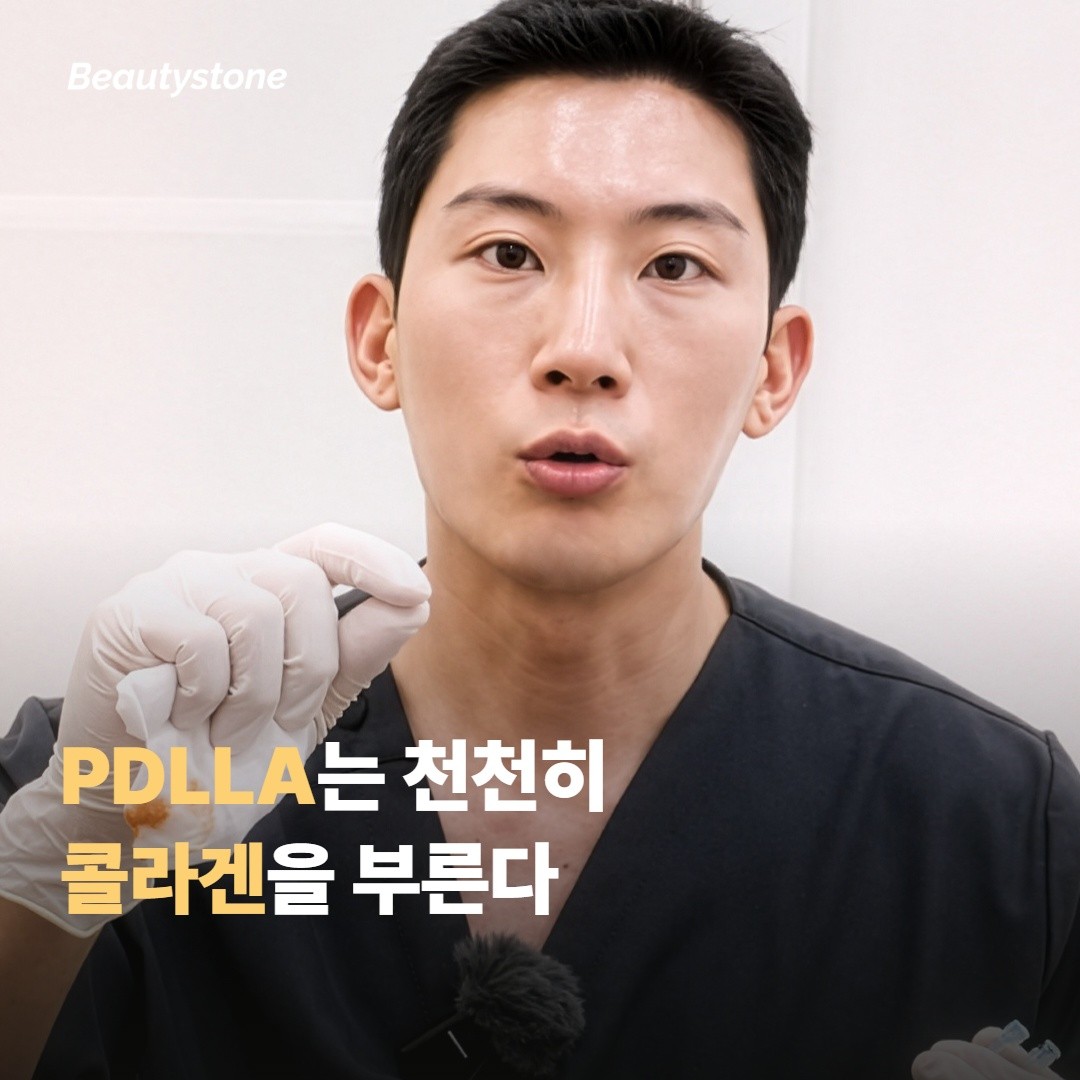
Why Do the Effects Last 12 to 24 Months?
While it might sound like magic that a single session can last 1 to 2 years, the principle behind it is quite simple. The PDLLA particles do not dissolve all at once; they break down very slowly. Throughout this decomposition process, the three phases of stimulation remain continuously active. In other words, your skin is in a state of producing new collagen bit by bit every single day for over a year.
Animal studies have also reported that collagen production peaked 8 weeks post-PDLLA injection, showing significantly higher expression of Type 1 collagen compared to hyaluronic acid alone. While using HA alone means the effects fade once it dissolves, combining it with PDLLA results in a naturally thicker, healthier skin structure that stays.
This difference is what sets Juvelook apart from traditional dermal fillers. Regular fillers occupy space to add volume and then return your skin to its original state once they are gone. Juvelook, on the other hand, beautifully transforms your skin's underlying structure before it leaves.

Safety and Guidelines
PDLLA is entirely biocompatible and naturally breaks down into carbon dioxide and water before harmlessly leaving the body. Because it is not a permanent substance, it offers an excellent safety profile for aesthetic procedures. However, if the injection depth or location is incorrect, nodules (small lumps) or surface unevenness can occur. This happens when particles clump together in one area, causing localized overproduction of collagen.
To minimize this risk, Vaim has designed a specialized lineup with customized particle sizes for different treatment areas. Juvelook Eye, developed for the delicate eye area, features smaller particles that dissolve faster to minimize nodule risks. Meanwhile, Juvelook Volume uses larger particles designed to work in the deeper layers of the skin. We will cover particle sizes in detail in our next post.

Frequently Asked Questions
Q. Will I see any results immediately after my Juvelook treatment?
Thanks to the HA component, you will notice a subtle boost in hydration and a smoother surface right after the procedure. However, the true, transformative skin changes will begin to reveal themselves 1 to 3 months later as new collagen builds up. Patients often share reviews like, "My skin suddenly looked amazing after a month!"
Q. Does the PDLLA really dissolve completely?
Yes, PDLLA naturally breaks down and safely leaves the body as carbon dioxide and water. It is almost fully absorbed within 12 to 24 months. Unlike permanent fillers, it does not remain in your system forever, which is a major reassurance in terms of safety.
Q. Will my skin go back to exactly how it was once the effect wears off?
It won’t return completely to its original state. The actual collagen structure created through PDLLA stimulation remains beautifully integrated within your skin. However, since natural aging continues over time, many patients choose to receive touch-up treatments every 1 to 2 years to maintain their youthful glow.
Recommended Reading


skin
Skin Booster Marks: How Long Until They Fade?
Tiny red dots and bruising after a skin booster are common but fade on different timelines. Here is what is normal each day and when to call your provider.

skin
Post-Workout Face Wash: Hot or Lukewarm?
Should you wash your face right after a workout, or wait to cool down first? Here's what the research says about timing, water temperature, and technique.

Lifting
다이어트로 체중은 줄었는데 아랫배만 그대로일 때 온다 복부 시술이 답이 될 수 있을까요?
아랫배만 남아 보이는 이유를 피하지방과 내장지방으로 나눠 보고, 온다 복부 시술이 닿는 층과 한계를 정리했어요.

skin
울퉁불퉁 패인 여드름 흉터, 시크릿RF 마이크로니들이 잘 닿는 모양은 따로 있을까요?
여드름 흉터 시술 결과가 갈리는 이유를 흉터 모양에서 찾고, 거울 앞에서 스스로 가늠하는 방법을 함께 담았어요.

Lifting
Hard Lump After Sofwave: Is It Normal?
Feeling a firm, pebble-like lump after Sofwave? Here's what's happening under your skin, how long it usually takes to soften, and the signs worth a call.

skin
Pigment Lasers After a Tan: How Long to Wait?
A tan changes where laser energy lands. Here's how long to wait before pigment treatment, why the delay matters, and how to tell your skin is finally ready.