

Juvelook Volume after 50 needs a different plan than in your 30s. Here's what to expect.
Published -
Updated -

Author
Wi Young-jin · Chief director
Seoul National University College of Medicine · Seoul National University Hospital Specialist
→
If you're in your 50s and your cheeks look flatter than they did a decade ago, you're not alone. Midface volume loss is one of the most common reasons people sit down with us, and Juvelook Volume comes up in almost every one of those conversations.
Here's what most articles skip. The treatment has one name, but it isn't planned the same way for a 35-year-old face and a 55-year-old face. Collagen turnover slows, the deep fat pads that support the cheek thin out, and the skin holding everything in place gets looser. Dose, placement, and the timeline you should expect all move with that.
In this article, we'll cover what Juvelook Volume actually is, how it behaves in mature skin, how planning changes after 50, what a realistic month-by-month timeline looks like, and the side effects worth understanding before you book anything. Beautystone is a dermatology clinic in Seoul's Hapjeong area, and our team is reachable through LINE if you'd rather talk it through with a person.
What Is Juvelook Volume?
The short answer? It's a hybrid injectable — part filler, part collagen biostimulator.
The HA part: hyaluronic acid carries the product and gives soft cushioning you can see early on.
The PDLLA part: poly-D,L-lactic acid microspheres act as a scaffold your own fibroblasts respond to, so collagen builds gradually.
What it isn't: a structural contouring filler. If your goal is a sharply projected chin or a redrawn jaw angle in one visit, this isn't the right tool for that job.
Two products get mixed up constantly, so it's worth separating them. Plain Juvelook is used mainly as a skin-quality booster placed superficially. Juvelook Volume is the hybrid version, placed deeper, and it's the one people mean when they talk about cheek or temple restoration. Availability and regulatory status differ by country, so if you're traveling for treatment, ask exactly which product is going in and at what depth.
How Does It Work in Mature Skin?
Biostimulators don't do the building — your skin does. The injected microspheres create a controlled, low-grade repair response, and fibroblasts lay down new collagen around them over the following weeks. Research on PDLLA-based injectables suggests that this remodeling develops gradually rather than immediately (first study, second study). Individual results vary.
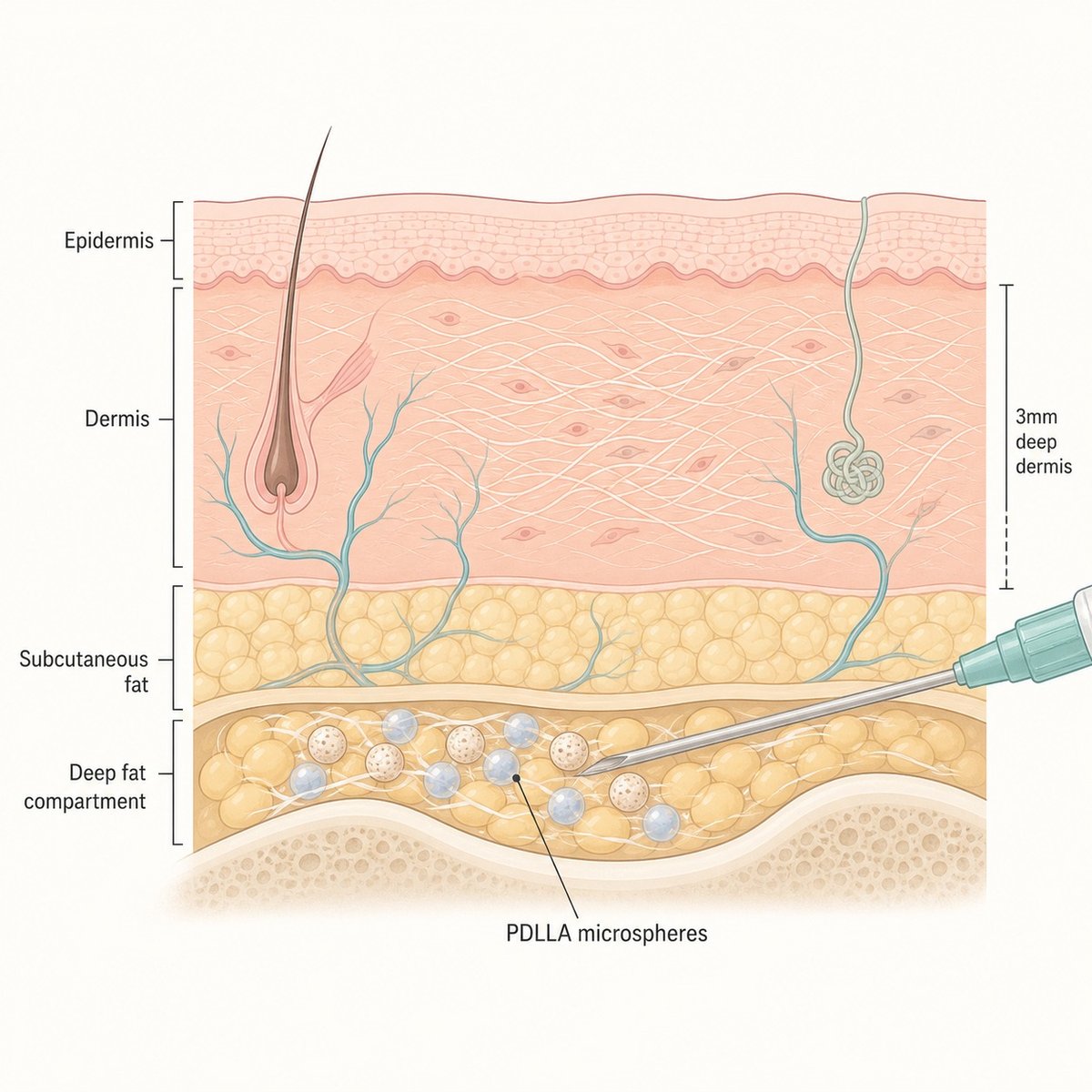
That distinction matters more at 55 than at 35, for a simple reason. Fibroblast activity tends to decline with age, and the estrogen drop around menopause is widely described as accelerating collagen loss in the skin. The same product, at the same dose, is working with a slower crew and less raw material. That isn't an argument against treating — it's an argument for planning differently.
It also explains why mature skin often responds better to support than to fill. Placing product where the tissue can carry it changes how light falls across the cheek. Chasing the deepest shadow directly tends to add weight without adding structure.
Why Your 50s Aren't Your 30s
In your 30s, volume change is usually early deflation. A little flattening under the eye, a shadow starting at the nasolabial fold, but the underlying support is largely intact. One or two conservative placements can be enough to reset how your face catches light.
By your 50s, several things are happening at once. The deep cheek fat compartments thin, the facial skeleton remodels subtly, and laxity means whatever volume remains sits lower than it used to. Treating that like a bigger version of a 30s case is the most common planning error we see.
Here's how the difference plays out in practice:
Planning factor | In your 30s | In your 50s |
|---|---|---|
Main driver | Early deflation, mild descent | Deep fat loss plus skin laxity |
Usual targets | One or two focal areas | Several linked midface areas |
Total dose | Conservative, often one visit | Larger, staged across visits |
Collagen response | Quicker, more predictable | Slower, so patience matters more |
Realistic goal | Prevention and subtle refresh | Rebuilding support, softer shadows |
Notice what isn't in that table: a claim that a single visit will turn back the clock. The honest aim after 50 is restoring support and softening shadows, and that reads as looking rested rather than looking done.

Planning: Dose, Areas, and Sessions
This is where the age difference stops being theoretical.
Total volume: a plan for someone in their 50s typically calls for more product overall, because you're addressing several connected areas instead of one focal hollow.
Placement: deeper, load-bearing positions come first — the anterior cheek and the area over the cheekbone — before anyone works on the nasolabial shadow itself.
Staging: many providers split treatment across two or three sessions spaced roughly four weeks apart rather than doing everything at once. Staging lets the collagen response reveal itself before the next decision is made.
Combination: if laxity is the dominant issue, volume alone won't solve it. Your provider may suggest pairing or sequencing with an energy-based lifting treatment.
One planning point that gets underrated: symmetry expectations. Faces are asymmetric to begin with, and after 50 that asymmetry is usually more visible. A good plan accounts for it instead of pretending both sides need identical amounts.
Bring photos from your 40s to the consultation if you have them. They're more useful than a reference photo of someone else's face, because they show your own architecture before it shifted.

What to Expect: A Realistic Timeline
Ask when you'll see it, and the honest answer is that you'll see it twice.
Day of treatment: some immediate fullness from the hyaluronic acid carrier, plus swelling. What the mirror shows that evening isn't your result.
Days 2 to 7: swelling settles and bruising, if there is any, fades. A lot of people feel like the effect slipped away here. That's expected — the cushion is doing less and the collagen hasn't arrived yet.
Weeks 4 to 8: the collagen contribution starts to register. Skin often reads firmer before it reads fuller.
Month 3 onward: this is when most people judge the outcome, and when a second session usually gets decided.
Longevity is the question everyone asks and the one with the least tidy answer. It depends on how much was placed, where it went, your metabolism, and how much collagen your skin actually builds. Results aren't lifelong, and periodic touch-ups are part of the model rather than a sign that something went wrong. Individual results vary.
Side Effects and Risks
Every injectable carries trade-offs, and mature skin doesn't change that math.
Common and short-lived: swelling, tenderness, redness at entry points, and bruising. These typically settle within several days.
Nodules: biostimulators can occasionally produce palpable lumps, more often when product sits too superficially or when aftercare massage instructions aren't followed. Most are managed conservatively, so tell your provider early instead of waiting it out.
Asymmetry or overcorrection: harder to walk back than with plain hyaluronic acid filler, because the collagen component can't simply be dissolved. This is exactly why staging is worth the extra visits.
Rare but serious: vascular events, where product interferes with a blood vessel. Uncommon, but the reason injector experience and anatomical knowledge are worth paying for.
Red flags that need attention rather than patience: spreading redness, fever, escalating pain, skin that turns pale, white, or dusky, or any change in vision. If you notice any of those, seek medical care right away.
One more that sounds boring and isn't: tell your provider about blood thinners, autoimmune conditions, upcoming dental work, and any history of lumps after previous injectables. That history changes the plan.

The Bottom Line
If you're weighing Juvelook Volume in your 50s, three things are worth carrying into the consultation:
The mechanism is the same, the math isn't. A slower collagen response means more staging and more patience.
Support beats spot-filling. Deeper structural placement first, cosmetic shadows second.
Judge at month three, not week one. The early mirror check misleads in both directions.
Like any procedure, it comes with trade-offs, and individual results vary. Ultimately, the choice depends on your anatomy, your goals, and how much maintenance you're willing to sign up for.
If you're considering it, a consultation is the best way to find out whether this treatment fits your face or whether something else should come first. Beautystone is a dermatology clinic in Seoul's Hapjeong area that regularly sees international patients; you can reach our team through LINE, and current offers are listed at /en/promotion.
Frequently asked questions
Q. Does Juvelook Volume hurt?
A. Most people describe it as pressure with a brief sting rather than sharp pain. Numbing cream is standard before treatment, and your provider can talk you through additional anesthetic options if you're anxious about it. Tenderness for a day or two afterward is common and settles on its own.
Q. How long does Juvelook Volume last in your 50s?
A. Longevity depends on how much product was placed, where it went, and how much collagen your skin builds in response, so ranges quoted for younger patients don't transfer neatly. Results aren't lifelong, and most plans assume periodic maintenance. Your provider can give you a realistic estimate after examining your skin.
Q. How soon will I see a difference?
A. There's an early change from the hyaluronic acid on day one, then a dip as swelling settles over the first week, then a slower change as collagen develops across roughly four to eight weeks. Judging the outcome at month three is fairer than judging it at week one.
Q. When can I wear makeup again?
A. Many providers suggest waiting about 24 hours before putting makeup over the injection points, mainly to reduce infection risk while those entry points close. Saunas, intense workouts, and facial massage are usually off the table for the first few days unless your provider says otherwise.


skin
Fraxel CO2: Why Prices Vary & What to Check

skin
How to Choose an Acne Dermatologist: 5 Signs

Contouring & Volume
Nasolabial Folds: When Lifting Isn't Enough

skin
Sculptra Cost: Why Sessions and Vials Matter

Lifting
After Shurink Universe: Wash, Work Out & Drink

skin
Sofwave Before a Wedding: Timing Guide