

Oligio X results take weeks, not days. Here's the collagen timeline and what shifts it.
Published -
Updated -
Author
Wi Young-jin · Chief director
Seoul National University College of Medicine · Seoul National University Hospital Specialist
→
If you've just had Oligio X and you're studying your reflection expecting an immediate lift — you're not alone. The gap between the treatment room and the mirror can feel confusing, especially when you've invested real money in the session. But here's what's actually going on: Oligio X isn't a procedure that shows up the same day. It's a monopolar radiofrequency (RF) treatment that delivers heat energy deep into the dermis to trigger your skin's own collagen-building machinery, and that process takes weeks to months, not hours.
That's not a flaw — it's how the biology works. The American Academy of Dermatology notes that energy-based treatments targeting the deep dermis promote gradual collagen remodeling rather than surface-level immediate change. In this article, we'll cover why results feel weak right after treatment, what the realistic collagen remodeling timeline looks like, the factors that push your personal timeline earlier or later, side effects to know about, and pricing at Beautystone's Seoul clinic.
What Is Oligio X, and How Does It Work?
Oligio X is a monopolar RF device developed by Wontech, a Korean medical device company. 'Monopolar' means the energy travels through a single electrode on the handpiece, penetrating deeper into the skin compared to bipolar configurations — reaching the dermis rather than staying near the surface.
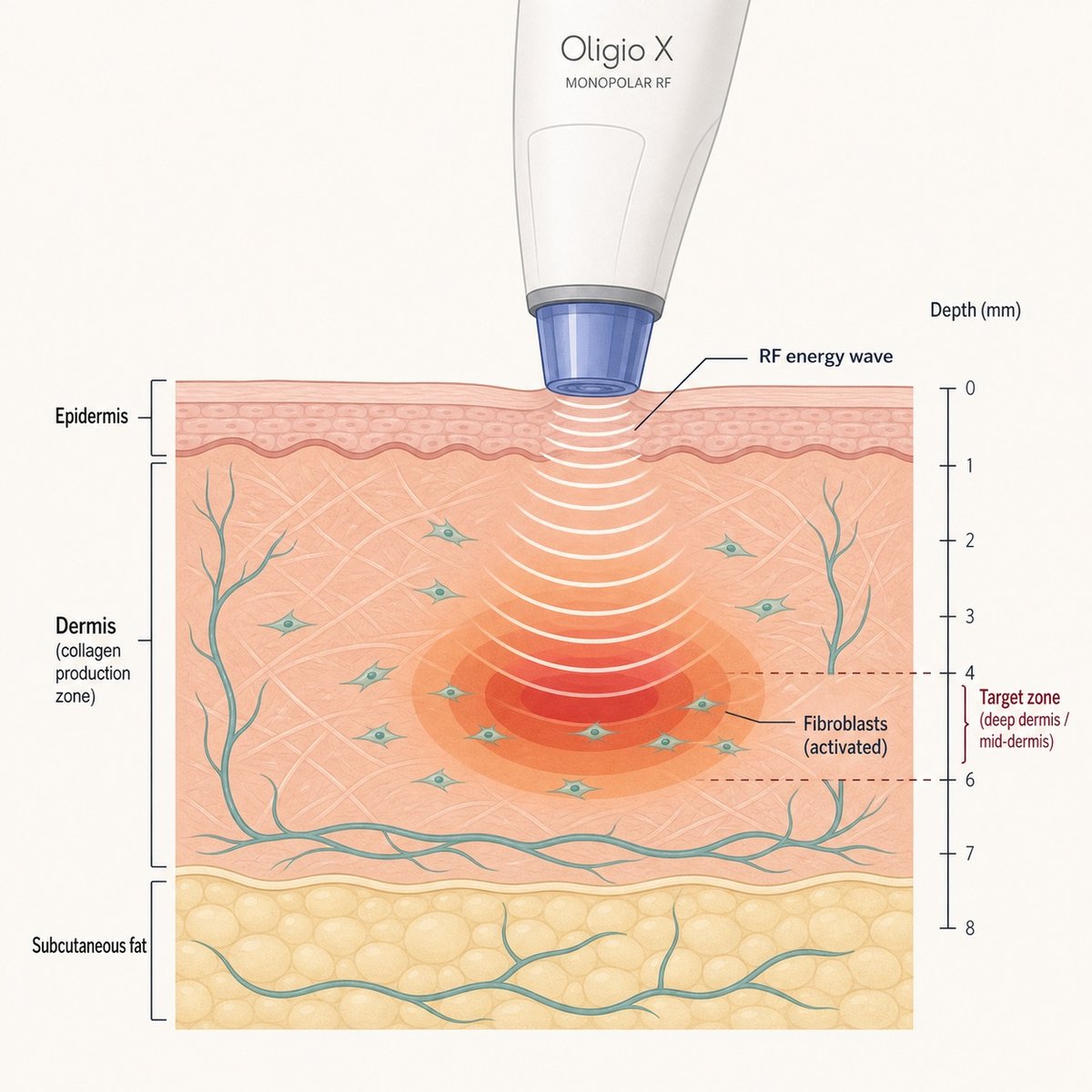
When RF energy reaches the dermis, it generates precise heat that does two things. First, it causes mild controlled injury to existing collagen fibers, triggering the body's wound-healing response. Second, it activates fibroblasts — the cells responsible for building collagen — to ramp up production. Think of it like waking up a factory that's been running at reduced capacity: the machines start working, but inventory doesn't appear on the loading dock overnight.
This is the core reason why Oligio X doesn't produce instant results. It's not underdelivering — it's initiating a biological process that unfolds on its own schedule.
Why Your Results Feel Weak Right After Treatment
The short answer? Your body hasn't had time to build anything yet. Here's what's actually happening in those first few days:
Collagen synthesis takes weeks: After fibroblasts are stimulated, they begin producing procollagen, which then assembles into organized collagen fibers. This process typically takes two to four weeks just to get started, and the fibers continue maturing for months. There's no shortcut.
Post-treatment redness can mask changes: Mild redness and warmth after treatment are normal and typically resolve within a day or two. During this window, it's hard to assess anything accurately — your skin is still settling.
Gradual change is invisible day to day: When skin tightening happens slowly, you won't notice it in real time. Most people only see the difference when they compare before-and-after photos taken two or three months apart. If you're checking the mirror daily, you'll feel like nothing's happening even when it is.
The Realistic Timeline: When Do Results Actually Show?
Individual results vary, but here's what the collagen remodeling timeline typically looks like after Oligio X. Treat the numbers as planning estimates, not guarantees.
When | What's usually happening |
|---|---|
Day of treatment through week 1 | Mild redness, warmth, and occasional tightness at the treatment area. No visible lifting yet — the biological process is just beginning. |
Month 1 | Some people start to notice the skin feeling slightly firmer. This is early collagen production, not the full result yet. |
Months 2 to 3 | The window most people report noticeable improvement. Skin feels tighter, facial contours may look more defined, and jawline laxity can appear reduced. |
Months 3 to 6 | Collagen remodeling continues. Some people see ongoing improvement well into this range, particularly with higher shot counts. This is typically when the peak result is reached. |
What Shifts the Timeline — Person to Person
Why does one person notice results at six weeks while another is still waiting at three months? These are the variables that actually matter:
Age: Younger skin has more active fibroblasts with better baseline collagen turnover. Older skin responds — but may take longer to produce visible change. That said, adults in their 40s and 50s typically still see meaningful results; it just takes patience.
Baseline skin condition: Skin that's dehydrated or has compromised barrier function may respond more slowly to RF stimulation. Good skincare habits before and after treatment support the process.
Shot count: The total energy delivered is proportional to the number of shots. Higher shot counts (300+) treat a broader area and deposit more cumulative thermal energy, which studies suggest correlates with more robust collagen stimulation. Your provider will recommend the right count based on your anatomy and goals.
Post-treatment sun protection: UV exposure after treatment can disrupt collagen synthesis and increase the risk of pigmentation changes. Daily SPF isn't optional after Oligio X — it's the single most effective thing you can do to protect the investment.
Lifestyle factors: Chronic sleep deprivation, heavy alcohol use, and smoking each have documented negative effects on collagen production and skin repair. They won't cancel the treatment, but they can blunt the outcome.
Side Effects and Risks: What to Know
Oligio X is non-invasive, which keeps the risk profile low compared to surgical lifting. But low risk isn't no risk, and here's the honest breakdown.
Common and expected. Redness and warmth at the treatment area are routine and usually resolve within 24 to 48 hours. Mild swelling and a tight sensation are also normal and typically settle within a few days. If they worsen or spread, contact your provider right away.
Less common. Some people notice temporary sensitivity in the treated area or mild bruising. Uneven collagen stimulation occasionally produces slightly asymmetric results that even out over time — this is worth discussing at a follow-up appointment rather than judging too early.
Rare. In rare cases, superficial burns or pigmentation changes have been reported with RF treatments. This risk is minimized by proper device calibration and appropriate shot settings for your skin type. Make sure you're being treated by a provider who customizes parameters rather than using a one-size-fits-all protocol.
Oligio X isn't appropriate for everyone. A conversation with your provider is essential if any of the following apply: you have a pacemaker or implanted metal in the treatment area, you're pregnant or breastfeeding, or you have active inflammation or infection in the treatment area.
Seek medical care right away if you experience fever, spreading redness, or pain that continues to escalate rather than improving after the first 24 to 48 hours.
How Much Does Oligio X Cost?
At Beautystone in Seoul's Hapjeong area, Oligio X (full face) is priced by shot count. Pricing is in Korean won (KRW), as this is a Seoul clinic — no USD conversion is provided since rates fluctuate daily.
Shot count | Price (KRW, VAT included) |
|---|---|
100 shots | ₩429,000 |
300 shots | ₩979,000 |
600 shots | ₩1,749,000 |
930 shots | ₩2,629,000 |
Starting at ₩429,000 for 100 shots, with volume discounts built in at higher counts — the per-shot cost drops meaningfully at 600 and 930 shots. Your provider will recommend a shot count based on your treatment area and goals. Seoul clinic pricing; subject to change. For current pricing and promotions, see /en/price or /en/promotion.
Is Oligio X Worth It, and Who's a Good Candidate?
Oligio X is worth considering if you want gradual, natural-looking skin tightening without surgery or significant downtime. It's a good fit when:
You want to prevent or address early laxity: It tends to work well as a proactive treatment before significant sagging develops, and as a maintenance tool for people who want to slow the appearance of aging.
You can commit to the timeline: If you need results before a major event, Oligio X isn't the right timing choice. If you're thinking three to six months out, it fits well.
You prefer no downtime: Most people return to normal activities the same day.
It may not be the best fit if you're looking for dramatic lifting results comparable to a facelift, or if you want changes in the next few weeks. A provider who gives you a straight answer about what the treatment can and can't achieve is the one worth booking with.
The Bottom Line
Feeling like Oligio X isn't working after your first session is extremely common — and in most cases, it's a timing misread rather than a treatment failure. The procedure delivers real heat energy to your dermis, but collagen remodeling runs on biology's schedule, not yours.
Expect the first noticeable changes around months two to three, with peak results potentially extending to month six.
Daily SPF is non-negotiable after treatment — it's the most effective way to protect the collagen your body is working to build.
Individual results vary based on age, skin condition, shot count, and lifestyle — these are real variables, not disclaimers.
Red flags that need medical attention: fever, escalating pain, or spreading redness after the first 48 hours.
Like any procedure, Oligio X comes with trade-offs — most notably, patience. Ultimately, the choice depends on your skin, your goals, and your timeline. If you're considering Oligio X, a consultation is the best way to get a realistic picture of what to expect. Beautystone is a dermatology clinic in Seoul's Hapjeong area — see current offers at /en/promotion.
Frequently asked questions
Q. How long does Oligio X take to work?
A. Most people start noticing results between one and three months after treatment, with many reporting the clearest improvement around months two to three. Full collagen remodeling can continue for up to six months after a session. If you're not seeing anything by three months, it's worth discussing with your provider — but judging results before that window closes is too early. Individual results vary.
Q. Does Oligio X hurt?
A. Most people describe the sensation as warmth or mild heat rather than sharp pain. The intensity can vary depending on the area being treated and your individual sensitivity. A topical numbing cream is typically applied before the session to increase comfort. Some people feel a tight or tingly sensation during the procedure, which usually passes quickly.
Q. How much does Oligio X cost?
A. At Beautystone in Seoul's Hapjeong area, Oligio X for the full face starts at ₩429,000 for 100 shots, with options up to ₩2,629,000 for 930 shots (VAT included). Higher shot counts offer a lower per-shot cost. Pricing is in Korean won as this is a Seoul clinic. For the latest pricing and any current promotions, visit /en/price or /en/promotion. Seoul clinic pricing; subject to change.
Q. How many Oligio X sessions do I need?
A. That depends on your baseline skin condition, the degree of laxity, and your goals. Some people see meaningful improvement from a single session and maintain with one treatment per year; others benefit from two sessions spaced several months apart. Your provider will assess your skin and give you a recommendation based on your individual anatomy — not a one-size protocol.


Hair Removal
레이저 제모 1회에도 남는 몫이 있어요 — 밀도를 모자이크로 보는 법

Tattoo removal
Why Extremity Tattoos Are Slower to Remove

Tattoo removal
Tattoo Removal Cost: Why Quotes Vary by Area

Tattoo removal
Unused Tattoo Removal Sessions: What Happens?

Lifting
Forehead Thread Lifting: How Far Can It Go?

skin
Skin Booster Prices: What to Check in a Quote