

Oligio X swelling & redness: what's normal, what to do, and when to call your provider.
Published -
Updated -

Author
Wi Young-jin · Chief director
Seoul National University College of Medicine · Seoul National University Hospital Specialist
→
If you've just had an Oligio X treatment and you're staring at a slightly flushed, puffy face in the mirror, you're not alone. Temporary swelling and redness are among the most common post-procedure reactions, and for most people they pass quickly. That said, knowing what's normal — and what isn't — can make the whole recovery window a lot calmer. In this article, we'll cover the day-by-day Oligio X recovery timeline, smart aftercare habits, and the warning signs that deserve a call to your provider.
What Is Oligio X?
Oligio X is a monopolar radiofrequency (RF) lifting treatment. A handpiece delivers RF energy through the skin surface, heating the dermis and the deeper subcutaneous layer to stimulate collagen production and gradually tighten lax tissue. Unlike high-intensity focused ultrasound (HIFU) devices, which target precise focal points, monopolar RF distributes heat more broadly through the skin — which is part of why you feel that characteristic warmth during the session.
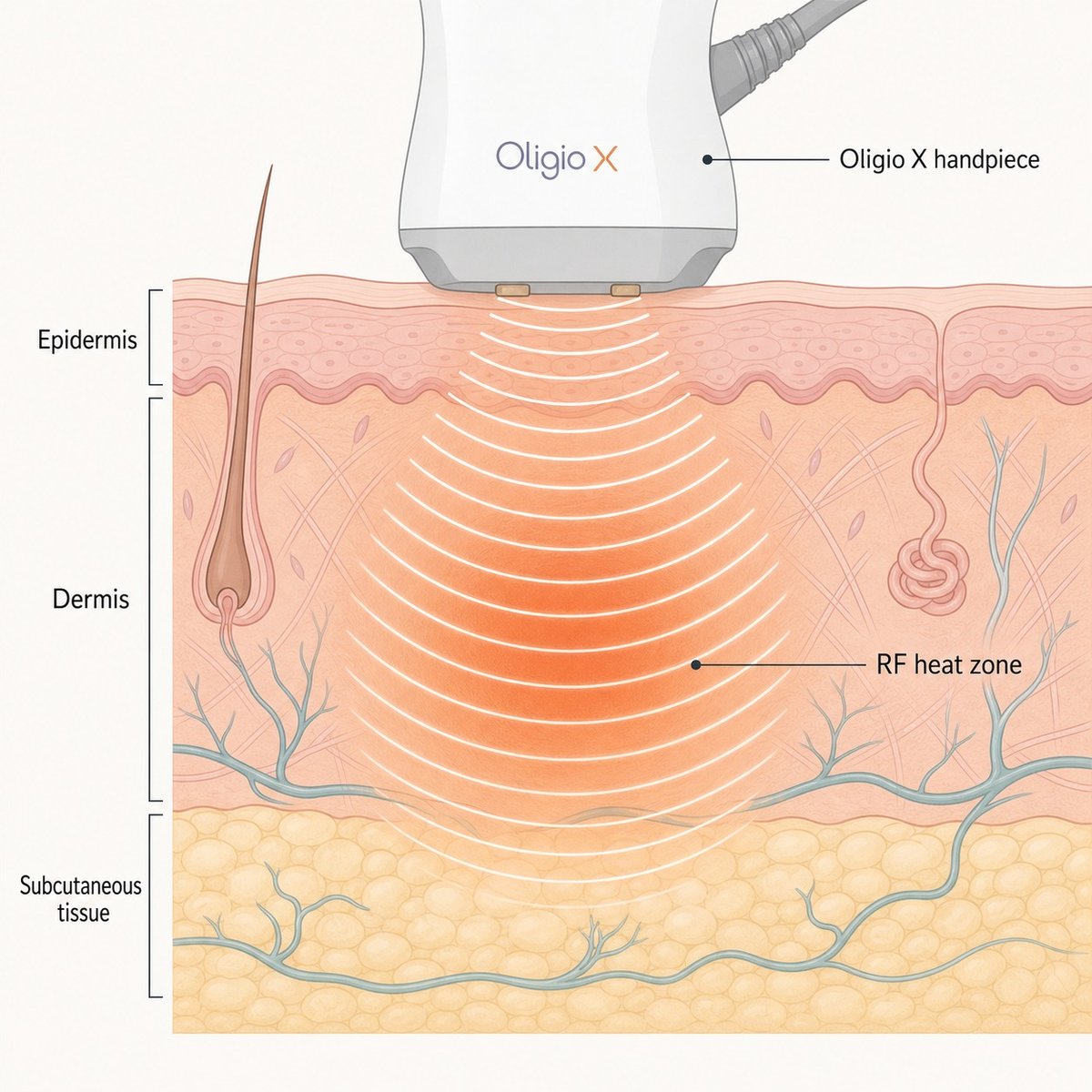
Because the treatment heats living tissue, a mild inflammatory response — redness, warmth, and some puffiness — is the body's expected reaction. Research on RF-based skin treatments suggests this controlled thermal injury is what sets off the collagen-remodeling cascade (see: PMC3583892). Individual results vary depending on energy settings, skin type, and the number of shots delivered.
Day-by-Day Recovery Timeline
Here's what most people experience in the days after an Oligio X session. Keep in mind that individual skin responses vary — some people breeze through with very little downtime, while others notice more pronounced swelling and redness, especially at higher shot counts or energy levels.
Timeframe | Typical Symptoms | Daily Life Impact |
|---|---|---|
Day of treatment | Warmth, flushing, mild puffiness — skin feels tight and sensitive | Most people can go out; a mask or hat helps with comfort in the sun |
Day 1 (next day) | Redness and swelling at their peak; skin may feel tender to the touch | Light makeup can camouflage redness for most skin tones |
Days 2–3 | Redness begins to fade; swelling gradually decreases | Makeup cover-up still useful; most daily activities are fine |
Days 4–7 | Redness largely resolved; puffiness nearly gone in most cases | Back to normal routine; avoid heavy exercise and saunas |
Weeks 1–4 | Skin may feel tighter; early firming effects may become noticeable | Resume exercise and heat exposure gradually |
Months 1–3 | Collagen remodeling continues; lifting and tightening effects typically peak | No restrictions; sunscreen remains essential |
The redness is usually the first thing to fade, often improving noticeably by day two or three. Swelling can linger a little longer, especially around the jawline and cheeks where lymphatic drainage is slower. Individual results vary — a 100-shot session tends to produce milder, shorter-lived reactions than a 600-shot or 930-shot session at higher energy.
Aftercare Do's and Don'ts
How you treat your skin in the first week matters. The right habits won't dramatically speed up healing, but they can keep inflammation from dragging on longer than it needs to.
Do:
Moisturize consistently. A ceramide-rich or barrier-repair moisturizer supports the skin's recovery. Apply gently — no rubbing.
Apply sunscreen every morning. Sunscreen is non-negotiable after any energy-based treatment. UV exposure can worsen redness and increase the risk of post-inflammatory hyperpigmentation (PIH*).*
Keep it cool. If swelling is uncomfortable, a cold pack wrapped in a soft cloth (never ice directly on skin) applied for short intervals can help.
Cleanse gently. Lukewarm water and a fragrance-free, non-foaming cleanser. Pat dry — don't scrub.
Don't:
Skip the sunscreen. Even on overcast days. Even if you're mostly indoors.
Use active ingredients too soon. Hold off on retinol, acids (AHA/BHA), and vitamin C serums for at least five to seven days, or until redness has fully settled.
Hit the sauna, steam room, or hot tub. High heat dilates blood vessels and can intensify swelling. Wait until week two at the earliest.
Do high-intensity workouts. Elevated core temperature and increased blood flow can prolong puffiness. Light walking is fine; HIIT and heavy lifting should wait about a week.
Drink heavily. Alcohol increases blood flow and can exacerbate swelling. Moderation for the first few days is a good rule.
*PIH (post-inflammatory hyperpigmentation): a darkening of skin in areas of previous inflammation. It's more common in deeper skin tones and almost always preventable with consistent sun protection.
Side Effects, Risks, and When to Seek Care
Redness and swelling are expected and usually settle within a week. But some reactions fall outside the normal range. Here's how to tell the difference:
Normal (no action needed):
Pink-to-red flush for one to three days
Mild puffiness that's worse in the morning and improves by afternoon
Skin feels warm or sensitive to the touch for the first day or two
Slight tingling or tightness that fades within a week
Worth monitoring (contact your provider if these persist beyond a week or worsen):
Redness that isn't improving by day five or six
Bruising (uncommon with RF but not impossible near bony prominences)
Small, isolated areas of increased sensitivity that feel different from the surrounding skin
Seek medical care right away if you notice:
Fever or chills — these aren't expected after RF and could signal an infection
Spreading redness beyond the treatment zone, especially if accompanied by warmth and swelling in new areas
Blistering or open skin — rare with monopolar RF at appropriate settings, but it can occur if skin wasn't protected properly
Worsening pain after the first 48 hours, rather than gradual improvement
Serious adverse events after monopolar RF treatments are uncommon when the procedure is performed by trained providers. The most frequently reported complications in the literature — thermal burns and PIH — are largely preventable with correct technique and post-care. Like any procedure, it comes with trade-offs, and your individual risk depends on your skin type, energy settings used, and how closely you follow aftercare instructions.
How Much Does Oligio X Cost?
At Beautystone in Seoul's Hapjeong area, Oligio X is priced by shot count. The entry-level tier starts at ₩429,000 for 100 shots — a good option for first-timers or those focusing on a smaller area like the lower face. If you're treating the full face and neck, higher shot counts (300 to 930 shots) typically deliver more coverage; the 930-shot tier is priced at ₩2,629,000. Launch promotions are occasionally available and can bring the 930-shot option down significantly — check current offers at /en/promotion or see the full price list at /en/price.
Seoul clinic pricing is subject to change. Individual results vary based on skin condition, energy settings, and the number of sessions.
Who's a Good Candidate for Oligio X?
Oligio X tends to work best for people who are starting to notice mild-to-moderate skin laxity — think early jowling, a less defined jawline, or skin that's losing the bounce it had a few years ago. It's not a substitute for surgical lifting, but for people who aren't ready for that step, it's a solid non-surgical option.
You're likely a good fit if:
You're in your late 20s to 50s and noticing gradual skin laxity
You want a treatment with minimal downtime (back to most activities within a week)
Your skin doesn't have active infections, open wounds, or inflammatory conditions in the treatment area
You understand that results build gradually over one to three months and aren't looking for an overnight transformation
Monopolar RF is generally considered safe for most skin tones, which is one advantage over some laser-based treatments. That said, your provider will assess your individual situation, skin type, and medical history at consultation. Everyone's skin is different — what works well for one person may not be the right fit for another.
The Bottom Line
Here's a quick recap of what you need to know about Oligio X recovery:
Redness and swelling are normal and typically peak around day one, then fade over the following three to five days.
Most people can return to their regular routine within a week, though heavy exercise, saunas, and active skincare ingredients should wait.
Sunscreen every day is non-negotiable — it's your best tool for preventing PIH and protecting the collagen your skin is actively rebuilding.
Spreading redness, fever, or blistering aren't normal — seek medical care right away if any of these appear.
Like any procedure, Oligio X comes with trade-offs. The downtime is short for most people, but results take time to appear and aren't permanent — maintenance sessions are typically needed to sustain the effect. Ultimately, the choice depends on your skin, your goals, and your budget.
If you're considering Oligio X, a consultation is the best way to find out whether it's the right fit for you. Beautystone is a dermatology clinic in Seoul's Hapjeong area — you can explore current offers at /en/promotion.
Frequently asked questions
Q. How long does swelling last after Oligio X?
A. For most people, swelling peaks around day one and improves noticeably by days three to five. It's usually minimal enough to cover with makeup from day two onward. Significant puffiness that hasn't improved after a week is worth mentioning to your provider. Individual results vary depending on energy settings and the number of shots used.
Q. When does redness go away after Oligio X?
A. Redness typically peaks on the day of treatment or the morning after, then fades over the next two to three days. Deeper skin tones may notice a longer-lasting flush, and higher-energy sessions can extend this a bit further. If redness is worsening rather than improving after five to six days, contact your provider.
Q. Can I wear makeup after Oligio X?
A. Most providers recommend skipping makeup on the day of treatment to let the skin settle. Starting the next day, light makeup is generally fine for most people. Check with the clinic where you had your treatment for their specific guidance, as it can vary depending on skin sensitivity and energy levels used.
Q. How much does Oligio X cost?
A. At Beautystone in Seoul's Hapjeong area, Oligio X starts at ₩429,000 for 100 shots (basic tier). The 930-shot full-face tier is priced at ₩2,629,000. Launch promotions may lower these prices — check /en/promotion for current offers. Seoul clinic pricing is subject to change.


skin
Ellanse Cost: Duration Beats Price Per Visit

Lifting
Alltite RF: Two Effects, Two Timelines

Contouring & Volume
Why Juvelook Volume Quotes Vary by Clinic

men's
Nose Pore Treatment: Aftercare Timing Guide

skin
How Many Sessions Does Eyeliner Removal Take?

Hair Removal
Laser Hair Removal While Pregnant or Nursing