

Lost weight everywhere but the lower belly? Onda reaches the fat you can pinch, not the deep kind. Here's who it helps, who it doesn't, and what to expect.
Published
Updated

Author
Wi Young-jin · Chief director
Seoul National University College of Medicine · Seoul National University Hospital Specialist
→
If the scale has finally moved but your lower belly looks exactly the same in the mirror, you're not imagining it, and you're not alone. For a lot of people the arms and legs slim down first, while the pouch below the navel seems to shrug off every extra workout. So which is it: more crunches, or a treatment?
Here's the honest starting point. A lower belly that won't budge doesn't have one single cause, and Onda only reaches some of them. Before you book anything, it helps to work out which kind of belly you're actually dealing with. In this guide, we'll cover why the lower belly holds on, how Onda heats fat and how deep it reaches, whose belly it tends to help and whose it doesn't, what sessions and downtime look like, and why we're upfront about being a clinic in Seoul rather than one around the corner from you.
Why Does Only Your Lower Belly Hang On?
Because belly fat isn't one thing. Depending on where it sits, it behaves, and responds, completely differently.
The fat you can pinch between two fingers sits right under the skin. That's subcutaneous fat*, and it's what shapes the outline you actually see. The fat you can't grab, the kind that pushes the whole abdomen forward and feels firm, is visceral fat*, packed in around the organs much deeper inside.
*Subcutaneous fat: the fat layer sitting directly beneath the skin. You can pinch it, and it shapes your visible contour.
*Visceral fat: fat stored deep in the abdomen around the internal organs. You can't pinch it, and it tends to show up as a firm, protruding belly.
These two aren't just in different spots. As research on abdominal fat lays out, subcutaneous and visceral fat differ in where they sit and in how they behave metabolically. That distinction is the whole game, because any device that sends energy in from the surface of the skin can only reach so far down. A belly that's thick and pinchable gives a treatment something to work with. A firm belly that won't pinch is mostly a job for diet and daily habits.
There's a third scenario we see often, too. Someone loses a lot of weight, the fat shrinks, but the skin doesn't tighten back at the same pace, so the lower belly reads as loose rather than full. That's a laxity question, not a fat question, and it points somewhere different entirely.

How Onda Heats Fat, and How Deep It Reaches
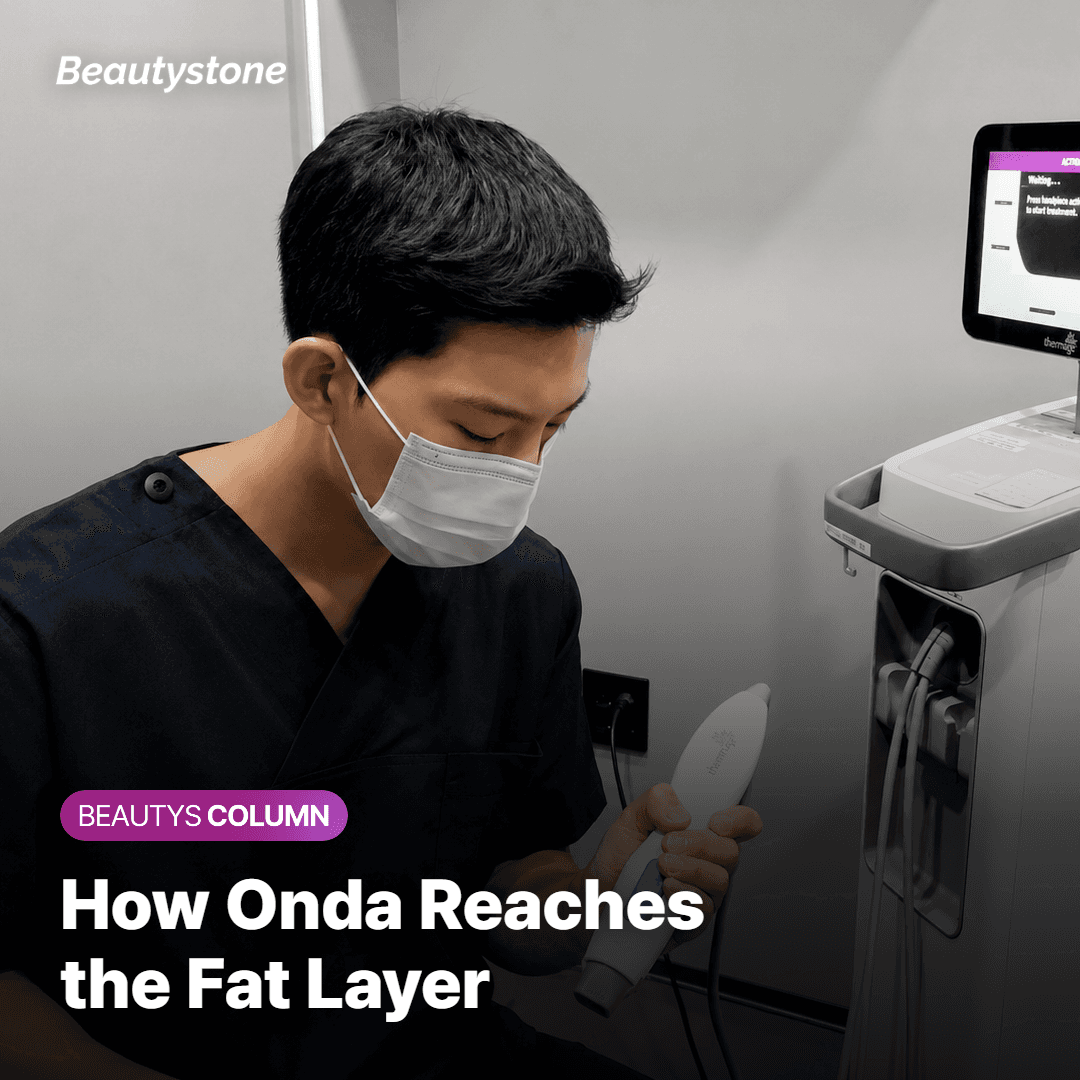
Onda uses microwave energy, specifically the 2.45 GHz band, delivered from the surface to warm the fat layer underneath.
When that energy goes in, molecules inside the fat tissue start to vibrate and generate heat, and that heat acts on fat cells and the fibrous septa running between them. It's a microwave* approach, which makes it a different tool from cooling or radiofrequency.
*Microwave: a type of electromagnetic wave that creates heat by vibrating molecules inside tissue. Different devices aim that heat at different depths and structures.
In one study that ran three abdominal sessions with a 2.45 GHz microwave device and followed people for three months, 19 participants aged 24 to 55 saw their waist circumference fall by an average of 3.80 cm, with the change growing as sessions stacked up. That's a specific set of conditions, though, so treat it as a data point rather than a promise; individual results vary with your body type and where you start.
Different devices aim at different layers, which is why the same phrase, abdominal treatment, can mean very different things. Here's a rough map.
Approach | Layer it mostly targets | What to expect | The catch |
|---|---|---|---|
Microwave* (Onda) | Subcutaneous fat* and lower dermis | Less pinchable fat, firmer skin | It doesn't reach visceral fat |
Cooling | Subcutaneous fat | Localized reduction where it can grip | Even coverage across a wide area is tricky |
Radiofrequency | Dermis to upper subcutaneous | Mostly skin tightening | Little change in fat volume |
Diet and exercise | Fat body-wide | Overall reduction, visceral fat included | You can't pick the spot it leaves from |
Whose Belly Onda Helps, and Whose It Won't
This is the part we're most blunt about in consultation. Onda isn't a weight-loss tool. It's for refining a stubborn pocket that diet and exercise have already taken about as far as they can.
The American Academy of Dermatology frames noninvasive fat treatments the same way: they're meant for trimming leftover fat in people who are already near their goal, not for dropping weight, and it notes that when loose skin is the bigger issue, that usually comes first.
Onda tends to help when:
Your weight is normal but the lower belly stays: the scale is where you want it, yet a thick, pinchable layer still sits below the navel.
Your belly is soft and sagging after pregnancy or weight change: fat and skin firmness are worth looking at together.
Your workouts are consistent but one line won't tidy up: the rest of you is lean, and only the lower-belly line is holding out.
And it tends to disappoint when:
The belly is firm and you can't pinch it: if visceral fat is the main driver, it sits below the layer this energy reaches.
Weight loss is the actual goal: lowering the number on the scale isn't what this treatment does.
Skin laxity is the standout issue: taking away more fat can make loose skin show up more, not less.
Sessions, Downtime, and Side Effects
The abdomen is a bigger canvas than the face, so each session takes longer, and the change tends to stack over several visits rather than land all at once.
Most plans run several sessions about three to four weeks apart, then keep watching for two to three months after the last one. During treatment you'll feel steady, building warmth, and most people describe it as heat rather than pain. Afterward the treated area often stays a little red or warm to the touch, and that usually settles within a few hours to a day.
Same day: shower with lukewarm water, and hold off on hot baths or the sauna.
For two to three days: don't scrub or deep-massage the treated area.
After a week: you're generally fine to return to your usual workout intensity.
Most reactions fade day by day. A few are worth acting on instead of watching: if the warmth keeps intensifying past the first day, if blisters or deep, lingering redness appear, or if pain in one spot steadily grows, contact the provider who treated you. If you notice spreading redness, fever, or worsening pain, seek medical care right away.
Holding onto the result comes back to daily habits. The fat cells cleared during treatment don't grow back, but the ones left behind can expand again if your weight climbs, so weight management afterward is what keeps the change around. And because this is general information, whether Onda actually fits your body is a call to make with the provider who examines you in person.

Why Beautystone in Seoul's Hapjeong Area?
We'll be upfront: Beautystone is a small dermatology clinic in the Hapjeong area of Seoul, not a clinic near you, and that shapes how we run an abdomen consultation.
Before any talk about the device, we start by sorting your belly into a type. How much pinchable fat is actually there, whether laxity is part of the picture, whether the belly is firm and pushed forward, the direction we'd suggest shifts with the answer. If it's not something the treatment can reach, we'll say so on the spot rather than book you in.
We also tend to keep the plan short rather than long at the start, watching how the first couple of sessions respond before committing to the rest. Because it's a small space a short walk from Hapjeong Station, you get compared against the same baseline every visit, which makes the progress easier to read honestly.
The Bottom Line
A stubborn lower belly has more than one cause, pinchable subcutaneous fat, deeper visceral fat, or loose skin, and Onda only reaches some of them.
Onda warms the subcutaneous layer with 2.45 GHz microwave energy; it doesn't touch visceral fat, and it isn't a weight-loss tool.
It tends to help a normal-weight, pinchable lower belly, and to disappoint a firm, visceral one or a mainly loose one.
Results build over several sessions spaced a few weeks apart, and weight management afterward is what makes them last.
Like any procedure, it comes with trade-offs, and results vary from person to person. Ultimately, the choice depends on your body, your goals, and what's actually driving your lower belly.
If you're weighing Onda for your abdomen, a consultation is the most direct way to find out whether it fits. Beautystone is a dermatology clinic in Seoul's Hapjeong area, and you can see current offers on our promotions page.
Frequently asked questions
Q. Will Onda on my abdomen make me lose weight?
A. No, it isn't a weight-loss treatment. It works on a stubborn pocket of the pinchable fat layer, so you'll usually see the change in how clothes fit or in your measurements rather than on the scale. If lowering your actual weight is the goal, diet and exercise come first.
Q. How many sessions before I can see a difference?
A. Most plans run several sessions about three to four weeks apart, and the change tends to build as they add up rather than arrive after one. A lot of the tidying keeps going for two to three months after the last session, so it helps to set that timeline before you start instead of expecting an overnight shift.
Q. My lower belly is firm and I can't pinch it. Will Onda still help?
A. If the belly is firm and pushed forward without much you can grab, visceral fat is likely a big part of it, and that sits below the layer this surface energy reaches, so the change is usually smaller than people hope. We check your belly in person during consultation and split out what the treatment can and can't do.
Q. Can I get Onda for a loose belly after pregnancy?
A. Often fat and skin laxity are both in the mix, so the first step is seeing which one dominates. If loose skin stands out more, addressing firmness first tends to give a more natural result. If you've just given birth or you're breastfeeding, it's usually better to push the timing back, and that gets decided together at your visit.


Contouring & Volume
Calf Botox Timeline: When to Book Session 2?

Contouring & Volume
Thread Lift Cost: Smile Lines vs. Full Face?

Lifting
Oligio X Jawline Results: Why 3 to 6 Months?

Contouring & Volume
Forehead Botox: 3 Things a Good Clinic Checks

skin
CO2 프락셀 색소침착, 흉터 치료 뒤 갈색 자국은 언제 옅어질까요?

skin
켈로이드 주사와 CO2 레이저, 하얗고 딱딱한 흉터도 같이 하면 풀릴까요?