

Why black fades fast but color takes longer with PicoWay, plus session counts by ink color.
Published -
Updated -

Author
Wi Young-jin · Chief director
Seoul National University College of Medicine · Seoul National University Hospital Specialist
→
If you've looked into tattoo removal, you've probably wondered why black supposedly clears easily while blue or red takes so much longer. It's the same tattoo, yet each color fades at its own pace, which makes it hard to guess how many sessions you'll actually need.
The short answer: lasers like PicoWay rely on each color absorbing a different kind of light, so some shades lighten fairly quickly while others need more sessions. Black and deep blue tones tend to respond well, while bright shades like yellow and lime green are trickier. You'll also hear claims floating around like "one session clears it all" or "every color fades the same" — so understanding how color and laser light interact upfront helps you set realistic expectations for sessions and results.
This article gathers treatment information from Hapjeong Beautystone.
What you'll learn here
What part of the ink laser tattoo removal actually targets
How much each ink color fades differently
How session counts shift depending on color
What to check before you start tattoo removal
How laser tattoo removal works: light shatters the ink particles
Laser tattoo removal doesn't melt away the ink sitting in your skin all at once. Instead, strong light breaks the ink particles into tiny fragments. Your body's immune cells then carry those fragments out little by little, and as that process repeats, the tattoo gradually fades. Here's the key: each color absorbs a different wavelength* of light best, so the laser has to match the right wavelength to the color for the ink to break down effectively.
* wavelength: a unit describing the specific length of the laser light. Since each color absorbs a different wavelength best, the laser has to match the wavelength to the ink color for the particles to shatter well.
In fact, when you look at laser guidance noting that black, blue, and gray inks respond well to certain wavelengths and that tattoo removal usually takes several sessions, it becomes clear why different colors behave so differently. PicoWay fires intense energy in an extremely short burst to fragment the ink, so choosing the wavelength that matches each color tends to break the particles down more finely.
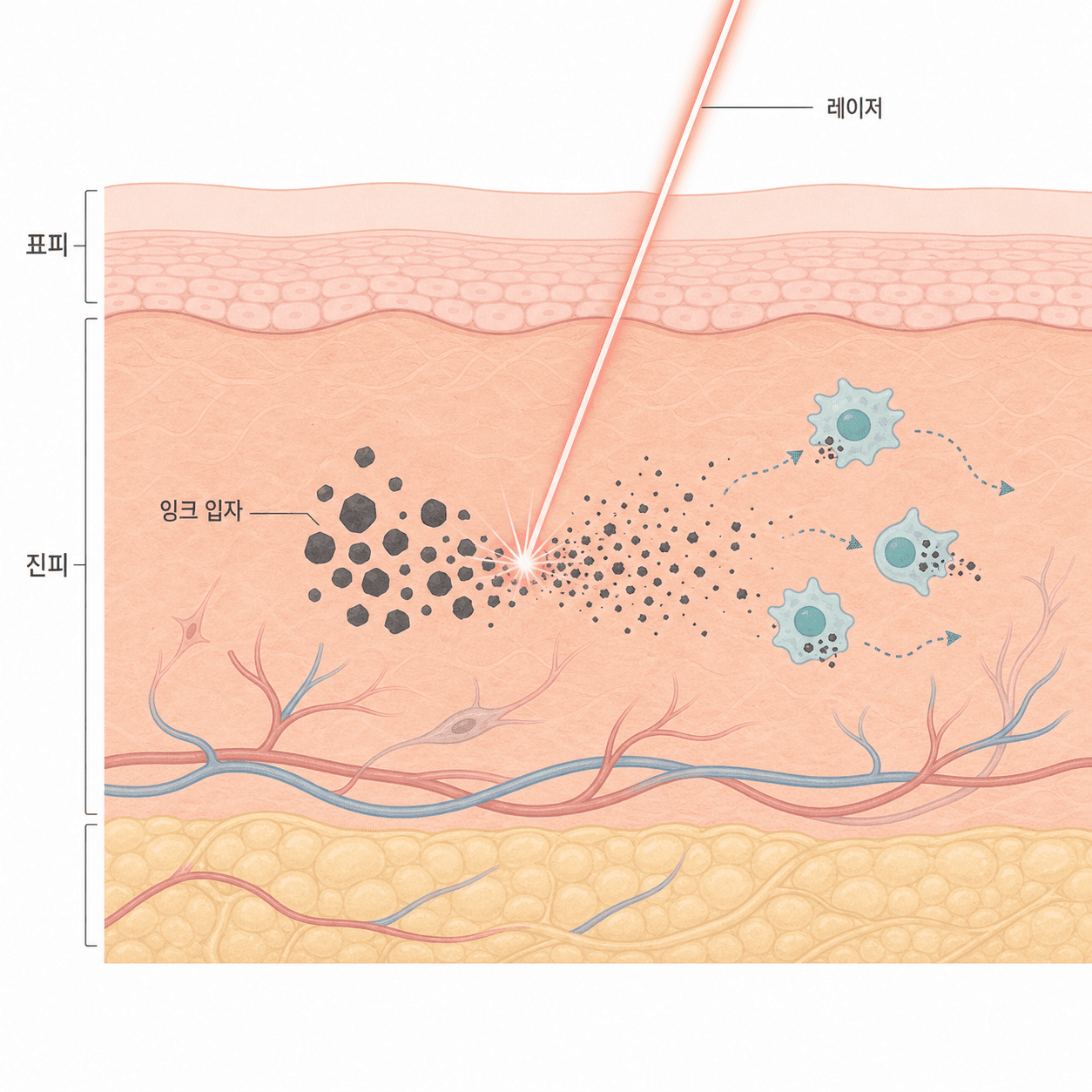
That's why tattoo removal isn't a one-size-fits-all procedure run the same way for every color — designing the right wavelength and session plan for each color is what really matters.

How much each color fades: what's the difference?
Even with the same laser, the response varies a lot depending on the ink color. Break it down by color and the differences look like this.
Ink color | Response level | Expected sessions |
|---|---|---|
Black / dark gray | Responds well | Relatively few |
Deep blue / navy | Responds fairly well | Average |
Red / orange | Moderate | More sessions needed |
Yellow / lime green | Tricky | The most needed |
This table shows general tendencies, so your actual response can vary with the type and depth of the ink and how long ago you got the tattoo. Black fades easiest because it absorbs light evenly across nearly all wavelengths, while bright shades like yellow or lime green absorb only a limited range of light, so they take more sessions. When a single tattoo mixes several colors, each one fades at a different speed — so the black outline may lighten first while the colored areas linger. That's why tattoos with multiple colors tend to take longer before the whole thing clears.

How session counts shift with color
A tattoo doesn't disappear in one go — it fades gradually as sessions add up. Plot how the ink lightens across sessions, and you get roughly this kind of curve.
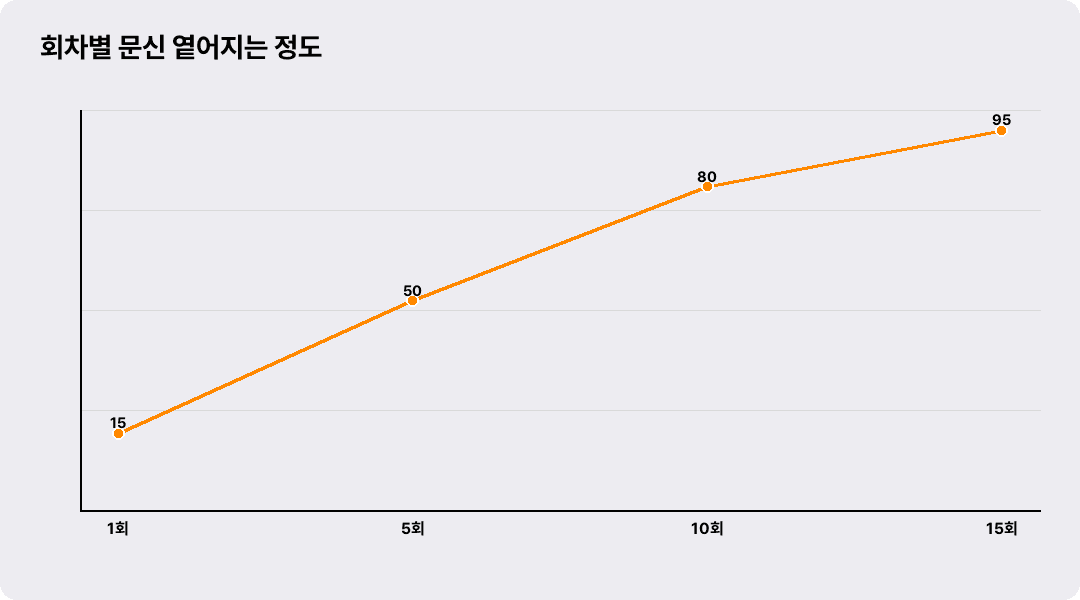
Sessions are usually spaced several weeks or more apart, because the shattered ink particles need time to clear from your body and your skin needs time to recover. Tattoos that are mostly black lighten in relatively few sessions, while ones with bright colors mixed in or with densely packed ink take more. Even for the same color, an older tattoo whose ink has already faded naturally may respond faster, while a more recent tattoo with bolder ink can take longer. If you go through several sessions and see almost no change, it's worth checking the ink type and depth again with your provider.

Why Hapjeong Beautystone?
At Hapjeong Beautystone, rather than running tattoo removal on the same setting regardless of color, we look at the ink color and depth first and then design the wavelength and session plan around them. PicoWay gives us room to choose the wavelength that matches each color, so we set the black outline and the colored areas differently. Since a multicolor tattoo fades at different speeds in different spots, we walk you through the expected session count and the step-by-step changes honestly upfront. As a small clinic within walking distance of Hapjeong Station, we can take the time to watch each person's ink color and response, and tune the next session's settings accordingly.

What's worth checking before tattoo removal
Before you start tattoo removal, checking a few things upfront helps you set realistic expectations for sessions and results. Here's what's worth a look.
Ink color makeup — whether it's mostly black or has color mixed in changes the expected session count a lot
When you got the tattoo — older and newer tattoos have ink in different states, so they respond at different speeds
How deep the ink sits — the deeper and bolder the ink, the more sessions it takes
Skin condition and location — recovery speed and pigment response can vary by area
Rather than declaring that tattoo removal "wraps up in X sessions," checking these factors first and watching the step-by-step changes narrows the gap between expectation and result. This article gathers general information, so whether the procedure suits you and how your sessions should be set are safest decided together with a provider who has examined you in person.

Frequently asked questions
Q. Does black ink really fade faster than other colors?
A. Yes — black absorbs light evenly across nearly all wavelengths, so it tends to respond better than other colors. That's why mostly-black tattoos often lighten in relatively few sessions. That said, if the ink is densely packed or the area is large, even black can need more sessions, so depth and size matter too.
Q. Won't yellow or lime green come off at all?
A. It's not that they won't come off, but bright shades absorb only a limited range of light, so they take far more sessions than black. With the right matching wavelength they do gradually lighten — just plan ahead for it to take longer to clear completely. The expected session count for your color makeup is something you can confirm during a consultation.
Q. How does removal work for a tattoo with several colors?
A. Each color fades at a different speed, so the black outline may lighten first while the colored areas remain. That's why a multicolor tattoo is treated with different settings in different spots and tends to take more sessions before the whole thing clears. Knowing upfront which colors fade first at each stage makes the process easier to follow.
Q. Why do you have to leave several weeks between sessions?
A. Because the ink particles shattered by the laser need time to clear from your body and your skin needs time to recover. If the gap is too short, the strain on your skin grows and results can suffer. Sessions are usually spaced several weeks or more apart, and the exact interval is best decided with your provider based on the area and how your skin is recovering.
Colour explains part of why session counts differ, and the rest comes from the other factors. Beautystone uses the Kirby–Desai assessment during consultation, reviewing skin type, location, ink amount, layering, scarring and colour together, so the expected range reflects your tattoo rather than a colour chart. It is an estimate, and we revisit it as we watch each colour respond over successive sessions.
See how colour fits into the full assessment
Related reads


Hair Removal
레이저 제모 1회에도 남는 몫이 있어요 — 밀도를 모자이크로 보는 법

Tattoo removal
Why Extremity Tattoos Are Slower to Remove

Tattoo removal
Tattoo Removal Cost: Why Quotes Vary by Area

Tattoo removal
Unused Tattoo Removal Sessions: What Happens?

Lifting
Forehead Thread Lifting: How Far Can It Go?

skin
Skin Booster Prices: What to Check in a Quote