

Disappointed by a pigment laser? Four common mistakes explain why toning, Pico, and IPL underperform — and how to match the right device to your skin.
Published -
Updated -

Author
Wi Young-jin · Chief director
Seoul National University College of Medicine · Seoul National University Hospital Specialist
→
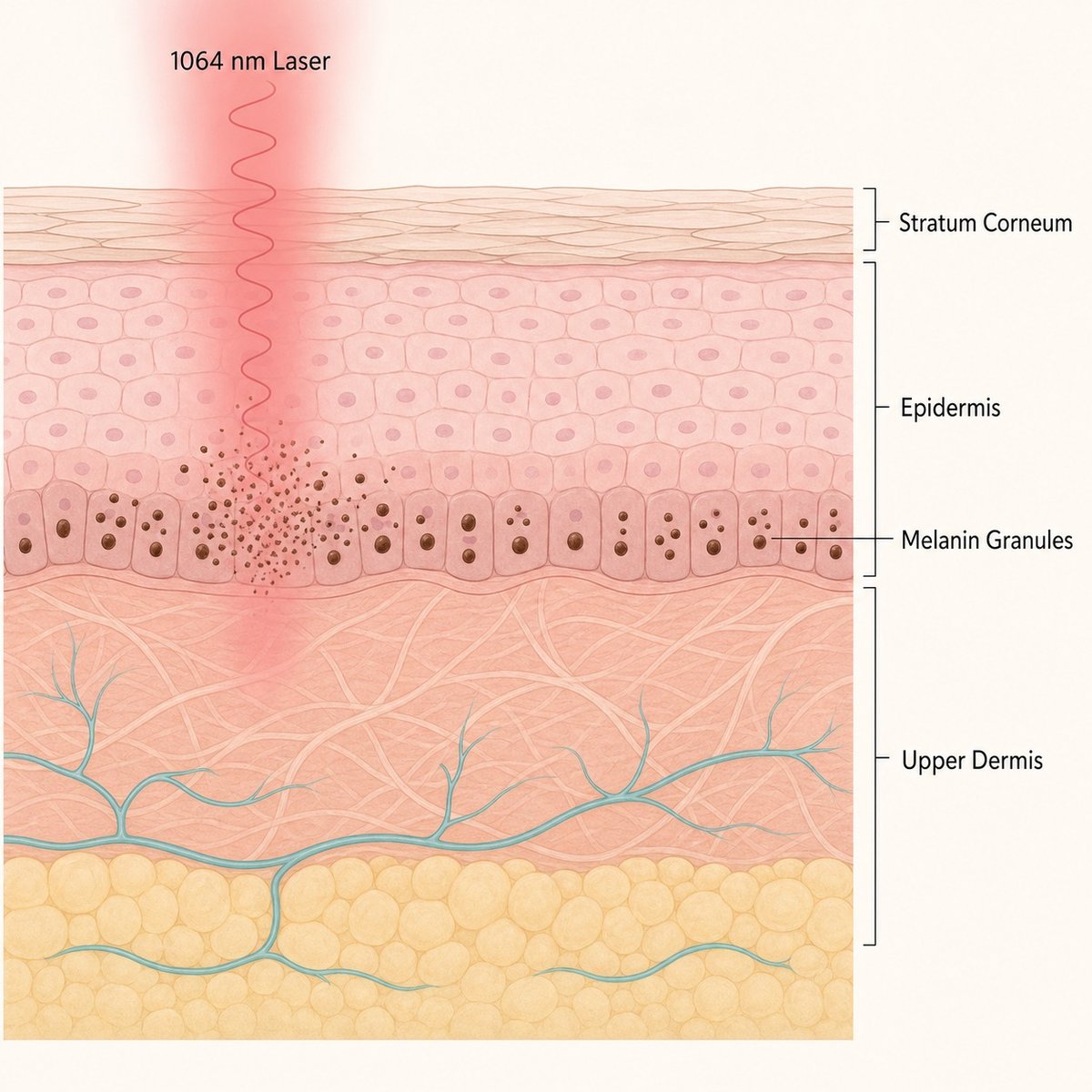
If you have already had a pigment laser and walked away disappointed — or worse, with patches darker than when you started — you probably did not get a bad laser. You most likely got the wrong laser for the pigment you were actually treating.
Laser toning, Pico, and IPL run on completely different physical principles, and each one shines on a different kind of pigment. Below are the four mistakes that most often send people down the wrong path, and how to line up the right device with the marks on your skin.
Mistake 1: Treating Melasma Like Just Another Sunspot
The single most expensive error is assuming all pigmentation is one problem with one fix. It is not. Spots — lentigines, freckles, and post-inflammatory marks — tend to be epidermal, meaning the melanin sits in the upper layers of skin where it is concentrated and relatively easy to reach. These marks are usually discrete, round, and clearly darker than the skin around them, so they respond fairly predictably to a targeted wavelength.
Melasma plays by different rules. It is driven largely by hormones, sun exposure, and genetics, and the pigment it produces tends to sit deeper — sometimes spanning both the epidermis and the dermis, the so-called mixed type. A dermatology reference on melasma notes that the condition is notoriously prone to recurrence, especially when heat and UV are involved. That is exactly why a laser aggressive enough to blast away a stubborn freckle can set off a melasma flare instead of clearing it.
Spots: shallow and localized, discrete edges, respond predictably to focused energy.
Melasma: deeper and often mixed, hormone- and sun-driven, quick to rebound after heat or UV.
Same face, two different targets — and they do not always want the same device.
The fix is a mindset shift before you ever pick a machine. Going gentler on melasma means slower, less dramatic progress, but that trade is usually the right one. Match the approach to the pigment type first; the device follows from that, not the other way around.
Mistake 2: Reaching for IPL Because It Seems to Do Everything
IPL, or intense pulsed light, is not technically a laser at all. It emits a broad spectrum of light across many wavelengths at once, filtered to target chromophores like melanin and hemoglobin. That broadband reach is exactly why it is so tempting: in a single session it can chase pigment and redness together, which makes it a popular photo-rejuvenation tool. When there is enough contrast between a superficial mark and the surrounding skin — solar lentigines, mild freckling, some vascular marks — a skilled provider can calibrate the fluence and cut-off filters to focus on shallow melanin, and IPL does that job well.
The trouble starts when people assume that versatility makes it safe for everything. For melasma it generally does not. The heat IPL generates can stimulate melanocytes and worsen the condition, particularly in mixed or dermal subtypes — which is why many dermatologists steer melasma-prone patients away from it entirely. Its margin for error also narrows sharply on darker skin (Fitzpatrick III–VI), where off-target energy absorption climbs and the risk of post-inflammatory hyperpigmentation rises. And because it leans on superficial chromophore absorption, it simply cannot reach dermal pigment the way a longer-wavelength laser can.
IPL is a reasonable pick for: superficial discrete spots and combined spot-plus-redness concerns on lighter skin.
IPL is the wrong first move for: melasma, mixed or dermal pigment, and darker skin tones.
So if your main concern is melasma, or your skin tone falls into the higher-risk range, choosing IPL first is often the very decision that leaves you darker than before. The session itself is manageable — a moderate snapping sensation, some redness, and a temporary coffee-ground darkening of spots before they flake off over a week or two — but manageable is not the same as suitable.
Mistake 3: Expecting Toning to Erase a Spot Overnight
Laser toning is the opposite personality. It uses a low-fluence Q-switched Nd:YAG laser, typically at 1064 nm, to deliver many low-energy passes across the skin. The point is not to ablate or destroy pigment in one dramatic hit; it is to gradually fragment melanin granules and quiet down melanocyte activity over a course of treatments. That patience is a feature, not a flaw — and misreading it is where a lot of people get frustrated.
What toning does well is stay melasma-compatible. It is widely regarded as the gentlest approach currently in clinical use, because the low energy per pass minimizes the thermal spike that triggers post-treatment darkening or rebound pigmentation. Research indicates repeated sessions can modestly reduce melasma, usually across eight to twelve or more treatments, with results that vary from person to person. What it will not do is clear a dark sunspot in one or two visits. If you expected a stubborn mark gone by next week, the tool was never built for that.
The session experience matches its gentle character: roughly twenty to thirty minutes, mild warmth, and temporary redness that usually fades within hours. Numbing cream is available, but most people find they do not need it. The catch is consistency — outcomes depend on your skin tone, your melasma subtype, and how faithfully you protect from the sun between sessions.
The fix here is expectation-setting, not a different machine. If your goal is a calmer, more even complexion with a low chance of rebound, toning is doing exactly its job — slowly. Judge it over a full course and diligent daily sun protection, not over a single appointment.
Mistake 4: Believing Pico Is Automatically Melasma-Proof
Pico lasers — devices like PicoWay — fire ultrashort pulses measured in picoseconds, trillionths of a second. Their real advantage over older Q-switched machines is how that energy meets pigment: the ultrashort burst shatters melanin with a sound-wave (photoacoustic) effect rather than leaning primarily on heat. For discrete epidermal marks that mechanism is genuinely impressive — sunspots, freckles, and post-inflammatory hyperpigmentation tend to respond well to the precise shatter.
Here is where the marketing outruns the evidence. For melasma, results are far more mixed than the glossy claims suggest. The photoacoustic mechanism does lower heat-related risk compared with purely thermal devices, but it does not remove it. Some protocols have shown benefit for mild melasma, yet individual outcomes vary widely and rebound stays a real concern. Treating a photoacoustic laser as automatically safe for every melasma type is precisely the assumption that gets people burned — sometimes literally.
Where Pico earns its keep is depth and versatility. Its wavelengths — 532 nm for shallower targets, 1064 nm for deeper layers — can reach into the dermis, making it more adaptable than IPL when pigment sits at varying depths. Sessions are typically faster than toning, with a bit more sensation, often described as rubber-band snaps, and a temporary darkening of treated spots that signals the laser is working and usually clears within about a week.
Pico strengths: fast, precise clearing of discrete spots; wavelength flexibility for shallow and deeper pigment.
Pico cautions: melasma benefit is inconsistent, rebound is still possible, and protocol choice matters a great deal.
Getting It Right: How Beautystone Matches the Laser to Your Skin
Notice what all four mistakes share: they start by picking a device and then hoping the pigment cooperates. The order should be reversed. There is no universally best laser — the right one depends on your specific pigmentation pattern, your skin tone, your lifestyle (sun habits above all), and how committed you can be to a full course. Once those are clear, the device almost chooses itself.
If your situation is… | Often the better fit | Main thing to watch |
|---|---|---|
Melasma-dominant, wants low rebound risk | Laser toning | Slow and gradual, 8–12+ sessions |
Discrete sunspots or freckles | Pico laser | Temporary darkening for about a week |
Superficial spots + redness, lighter skin | IPL | Avoid if melasma-prone or darker skin |
Mixed spots and melasma together | Gentle, toning-led and staged | Results vary; provider tailors the plan |
Whatever you choose, the same risks deserve respect. Melasma rebound is the most feared complication in pigment laser work: any heat, from the device or from sun exposure afterward, can trigger melanocytes and bring the pigment back darker than before, which is why strict sun avoidance and daily sunscreen are non-negotiable. Higher-fluence approaches and darker skin types carry a greater risk of hypopigmentation, and treating pigment can paradoxically create new post-inflammatory hyperpigmentation, especially in Fitzpatrick types III–VI. Redness and mild swelling are common and usually settle within a day or two — but if they worsen, spread, or come with fever or blistering, contact your provider right away and seek medical care if symptoms escalate.
If you are dealing with a mix of spots and melasma and are not sure where to start — or you are trying to recover from a laser that did not go the way you hoped — a proper consultation is the best first step, because a provider can read your pigment depth and skin tone before any energy touches your face. Beautystone is a dermatology clinic in Seoul's Hapjeong area; you can see current offers at /en/promotion.
Frequently asked questions
My melasma looks darker since my last laser — what went wrong?
That pattern usually points to rebound, the most feared complication in pigment laser treatment. Heat from the device or from sun exposure afterward can trigger melanocytes and bring melasma back darker than before. It often follows an approach that was too aggressive for melasma, or too little sun protection between sessions. Strict sun avoidance and daily sunscreen are non-negotiable while your skin recovers, and a gentler plan is usually the way forward.
Why does toning take so many sessions when spots seem to clear faster?
Because they are doing different jobs. Toning uses many low-energy passes to gradually fragment melanin and calm melanocyte activity, which is what keeps it melasma-compatible — but that gentleness means results build across roughly eight to twelve or more sessions. Discrete spots treated with a Pico laser or IPL respond to a more concentrated hit and can clear in far fewer visits. Slower is the trade-off for a lower chance of rebound.
I have darker skin and melasma — is Pico a safe bet just because it uses less heat?
Not automatically. Pico's photoacoustic mechanism does reduce heat-related risk compared with purely thermal devices, but it does not eliminate it, and melasma results remain inconsistent with rebound still possible. Darker skin types also carry a greater risk of post-inflammatory hyperpigmentation. It can be a reasonable option under the right protocol, but that is a call for your provider to make after assessing your pigment depth and skin tone.
What is the single most important thing I can do between sessions?
Protect from the sun. Because heat and UV can undo progress and trigger melasma to return, strict sun avoidance and consistent daily sunscreen matter more than the specific device you chose. Dry or sensitive skin for a few days after treatment is normal; keep it calm and shielded, and let each session build on the last rather than fighting fresh sun damage.


Contouring & Volume
InMode Cost: Why One Area, Three Line Items

Hair Removal
수염 레이저 제모 가격, 회당 금액이 같은데 총액이 갈리는 이유는?

skin
Fraxel Results: Why 3 Months Is the Real Test

Lifting
이중턱·턱선리프팅, 다섯 층 중 어디가 문제인지 아세요?

Contouring & Volume
Juvederm Lip Filler: Volbella vs. Ultra

skin
How Long Does Potenza Take to Show Results?