

Radiesse for hollow temples isn't dissolvable. Here's the honest risk picture.
Published -
Updated -

Author
Wi Young-jin · Chief director
Seoul National University College of Medicine · Seoul National University Hospital Specialist
→
If you've ever thought your face reads a little like a peanut — wide across the cheekbones, pinched and scooped above them — you're not alone. Often the cheekbones aren't oversized at all. The temples have simply lost volume, and that hollow makes everything next to it look broader by contrast.
Temple filler is the usual answer, and Radiesse comes up often for it. It lasts a while and does more than just sit there. But it carries one property that changes the risk math, and marketing copy tends to gloss over it: Radiesse can't be dissolved the way hyaluronic acid fillers can.
In this article, we'll cover what Radiesse is, how it works in the temple, what recovery looks like, the side effects and vascular risks worth taking seriously, and who's a reasonable candidate.
What Is Radiesse, and Why the Temples?
Radiesse is an injectable dermal filler made of calcium hydroxylapatite — CaHA — suspended as microspheres in a gel carrier. Its components occur naturally in human bone, which is part of why it's well tolerated.
One regulatory note. Radiesse is FDA-approved as a dermal filler for specific indications, including moderate to severe facial folds and wrinkles. Temple use is off-label in the US — legal and common when a physician judges it appropriate, but not the same as an approved indication.
The temple is one of the first regions where volume loss shows. As the soft tissue thins, you get a scooped shadow between brow and hairline, the cheekbone edge protrudes by comparison, and the silhouette narrows on top while widening in the middle. That's the "peanut" outline.
Here's the reframe that matters: this is usually a contour problem, not a bone problem. If the bone were genuinely too wide, the conversation would be surgical. When the issue is lost volume around it, restoring that volume smooths the transition from forehead to temple to cheek. Radiesse is one tool for that job, not the only one.
How Does Radiesse Work in the Temple?
It works in two stages: immediate volume from the gel carrier, then a slower collagen-stimulating effect from the CaHA microspheres left behind.
On the day, the gel does the lifting — you see contour change right away, though some of it is swelling rather than product. Over the following weeks the carrier is absorbed, and the CaHA microspheres act as a scaffold prompting your tissue to lay down collagen. That second half builds gradually.
Anatomy is what sets the temple apart from the cheek. It's a compact region with layered tissue and blood vessels running through it, including the superficial temporal artery and its branches. Injectors generally work in a deep plane chosen to stay clear of those vessels, and many prefer a blunt cannula over a sharp needle. Technique here isn't a stylistic preference — it's the safety mechanism.
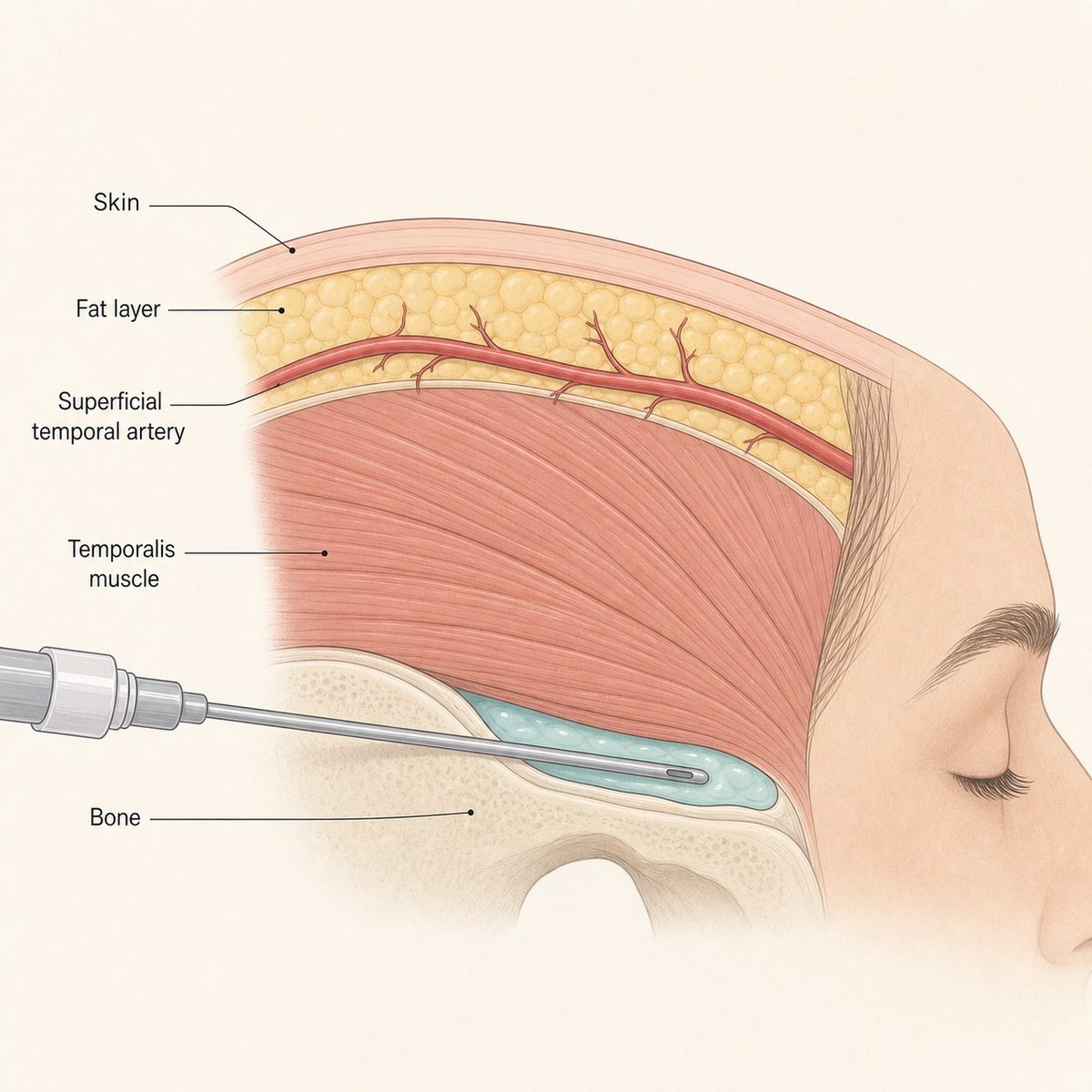
What that means practically:
Placement is deliberate: Product goes in a plane chosen to reduce vascular risk, not wherever the hollow looks deepest.
Volume is conservative: Overfilling the temple reads as odd rather than youthful, and both sides may need different amounts.
The result keeps developing: Since collagen stimulation is part of the mechanism, week one isn't the final picture.
How Long Does Radiesse Last, and What's the Timeline?
Roughly 12 to 18 months is the commonly cited range, generally longer than most HA fillers. That's an average, not a promise — individual results vary with metabolism, how much was placed, and lifestyle factors.
Day of treatment: Topical numbing goes on first; the injection itself is short. You'll leave with visible volume, and often swelling, redness, or small bruises.
First 48 hours: Swelling peaks and bruising darkens before it fades. Most clinics ask you to avoid heat, alcohol, and strenuous exercise.
Days three to seven: Swelling and bruising generally settle, and the contour starts to look like itself rather than a fresh treatment.
Weeks two to six: The carrier is absorbed while the collagen response builds. Some people notice the result refining rather than shrinking.
Months twelve to eighteen: The effect fades as CaHA is broken down and cleared. It softens gradually rather than dropping off a cliff.
One planning note: if you have an event coming up, don't book filler the week before. Individual results vary, and so does how quickly any one person settles.
Side Effects and Risks You Should Weigh
Most are mild, short-lived, and expected. A smaller set are serious and time-sensitive. Know both before you consent to anything.
Common and usually temporary:
Swelling: Very common, most pronounced in the first day or two and settling within about a week.
Bruising: Common in a vascular region like the temple, and usually resolves on its own over several days.
Tenderness, redness, and temporary firmness: Expected around entry points while the product settles, and short-lived.
Swelling and bruising are common and usually settle within a few days. If they worsen instead of improving, contact your provider right away.
Less common but more serious recognized complications:
Nodules: Firm lumps can form under the skin. Managing one is a different conversation with Radiesse than with HA filler, because the dissolving shortcut isn't available.
Contour irregularity: Uneven placement or over-correction can leave a surface that isn't smooth, and thin temple skin shows it readily.
Vascular events: The temple contains arteries, including the superficial temporal artery. If filler enters or compresses a vessel, blood flow can be compromised. Rare, and it's why the region is treated with caution.
Infection: Uncommon with sterile technique, but possible whenever a needle breaks the skin.
The asymmetry that changes everything: Radiesse isn't reversible with hyaluronidase. HA fillers can be broken down within hours by that enzyme — an aesthetic escape hatch, and part of the emergency toolkit if a vascular complication occurs. CaHA doesn't respond to it. Radiesse resorbs gradually as your body clears it, but you can't accelerate that with an injection.
That one fact should shift the whole decision. The first attempt carries more weight, conservative dosing beats aggressive dosing, and the injector's experience isn't a bonus feature — it's the main variable you control.
Red flags — don't wait these out. If you experience vision changes, blanching or dusky discoloration of the skin, severe or escalating pain, or fever or spreading redness, seek medical care right away. These aren't things to monitor overnight or raise at a follow-up next week.
Who's a Good Candidate — and Who Isn't?
Someone with genuine temple volume loss, realistic expectations, and comfort with a product that can't be undone quickly.
Radiesse in the temples may suit you if:
The hollow is the actual issue: Your concern is a scooped contour rather than bone width.
You want longevity: The 12 to 18 month range appeals more than repeating treatment often.
You're comfortable with irreversibility: You've absorbed the hyaluronidase point and you're at peace with it.
It may not be your best option if:
It's your first injectable: Many providers suggest starting with a reversible HA filler so you learn how your face responds before committing to something you can't dial back.
You have relevant medical factors: Certain conditions, blood-thinning medications, active infection near the site, or pregnancy and breastfeeding all warrant a conversation first.
One more filter costs nothing: ask how often the injector treats temples, what plane and instrument they use, and what happens if a vascular complication occurs. A specific answer is a good sign. Vagueness in a high-risk region isn't.
The Bottom Line
Restoring hollow temples can soften a face that reads pinched on top and wide through the middle, and Radiesse is a legitimate option for it. It just isn't a casual one.
Radiesse is CaHA-based: It adds volume immediately and stimulates collagen after, typically lasting 12 to 18 months.
It isn't reversible with hyaluronidase: Unlike HA fillers, there's no same-day undo — it resorbs on your body's schedule, not yours.
The temple carries vascular risk: Nodules, swelling, and contour irregularity are recognized complications, and injector experience matters disproportionately.
Know the escalation signs: Vision changes, blanching, severe pain, or fever and spreading redness mean you seek medical care right away.
Like any procedure, it comes with trade-offs — here, longevity in exchange for flexibility. Individual results vary, and no article can tell you whether your temples call for CaHA, a reversible HA filler, or nothing at all.
Ultimately, the choice depends on your anatomy, your goals, and your tolerance for a result you can't quickly change. If you're considering temple filler, talk to a provider who treats this region regularly about which product fits your face and your risk comfort. Beautystone is a dermatology clinic in Seoul's Hapjeong area; current offers are listed at /en/promotion.
Frequently asked questions
Q. Can temple filler really fix a peanut-shaped face?
A. It can help in many cases, because that outline is often caused by hollow temples making the cheekbones look wider by contrast. Restoring temple volume smooths the curve from forehead to cheek without touching bone. If the underlying bone width is genuinely the issue, filler won't change that. Individual results vary, and only an in-person assessment can tell you which situation you're in.
Q. How long does Radiesse last in the temples?
A. Commonly around 12 to 18 months, which is generally longer than most hyaluronic acid fillers. That's an average rather than a guarantee — how long it lasts for you depends on your metabolism, how much was placed, and lifestyle factors. The effect fades gradually rather than stopping abruptly.
Q. If I don't like the result, can Radiesse be dissolved?
A. No. Radiesse is calcium hydroxylapatite, and hyaluronidase — the enzyme used to break down HA fillers — doesn't work on it. Your body resorbs it gradually over many months, but that process can't be sped up with an injection. This is the single most important thing to weigh before choosing CaHA over a reversible filler.
Q. Why is the temple considered a higher-risk area to inject?
A. The region contains blood vessels including the superficial temporal artery, so there's a vascular risk if filler enters or compresses a vessel. That's why injectors use a deliberate placement plane and often a blunt cannula here. It's also why experience with this specific area should weigh more heavily in your choice of provider than anything else.
Content





skin
Why Does Fractional CO2 Take Longer to Heal?

Contouring & Volume
How Many cc Does Forehead Filler Need?

skin
Why Is My Skin Oily but Tight in the Fall?

Hair Removal
Underarm Laser Hair Removal Cost: Do the Math

Tattoo removal
Laser Before a Cover-Up: How Many Sessions?

skin
큐어젯 다운타임, 다음 날 출근과 화장은 언제부터 될까요?