

Titanium Lifting doesn't fill a nasolabial fold — it lifts the support underneath. Here's what the name gets wrong, how the session feels, and who it fits.
Published -
Updated -

Author
Wi Young-jin · Chief director
Seoul National University College of Medicine · Seoul National University Hospital Specialist
→
Read "titanium lifting" on a treatment menu and your brain fills in the rest: something strong, something structural, something that finally props up the crease running from your nose down to the corner of your mouth. If you've been quietly hoping this is the one that flattens your nasolabial folds, you're not alone — it's the first thing a lot of people ask about.
The short answer? It doesn't work the way the name implies. Titanium Lifting isn't adding anything into the groove. It works on the support structure sitting underneath it, which is a slower and far more modest kind of change than "the crease is gone."
Almost all the disappointment around this treatment traces back to that single gap between the name and the mechanism. In this article, we'll walk through the three myths that come up most often — what's really creating that fold, what's actually inside the handpiece, and what the session feels like — so you can size up what's realistic for your own face.
What's Actually Creating That Fold?
Less the crease itself, more what's sitting above it.
Nasolabial folds tend to deepen because the retaining ligaments — the thin fibrous bands that hold skin and fat in position — loosen over the years, and the cheek fat they were holding up drifts downward. That descending fat gathers along the line where it catches, and the groove starts reading deeper than it used to. Research describes supporting tissue losing elasticity and stretching out, with the sagging fat above it bulging at the point where it comes to rest.
That distinction changes what you should be shopping for. If the fold is mostly a descent problem, a treatment aimed at the support underneath is closer to the cause than one aimed at the line on the surface. It's also why two people whose folds look similar in the mirror can end up with completely different plans.
Myth 1: Titanium Lifting Fills In the Fold
It doesn't. Nothing gets added, and nothing gets left behind.
What the device does is send laser energy down through the dermis toward those retaining ligaments, which prompts collagen denaturation — heat nudges existing collagen out of its original shape so that fresh collagen moves in while the tissue rebuilds. Firmness creeps up across that remodeling window rather than arriving on the table. The underlying principle — laser energy absorbed by water in the skin, causing collagen to denature and then remodel — is described the same way across heat-based lifting devices, and cooling the surface is part of that setup rather than an optional add-on.
So it helps to line up what people walk in expecting against what the mechanism can plausibly deliver. Individual results vary, and the gap between these two columns is where most of the frustration lives.
What people expect | What's realistic |
|---|---|
The fold disappears without a trace | Sagging eases and the texture around it looks tidier |
The groove gets filled the way a filler fills it | Ligaments and dermis regain firmness gradually |
One session and you're finished | Change that shows up at its own pace, person to person |
If your fold is already deep and well settled, this much support improvement may leave you wanting more. That isn't a failure of the device so much as a mismatch, and it's usually the point where other options come into the conversation alongside it.
Myth 2: Something Titanium Goes Under Your Skin
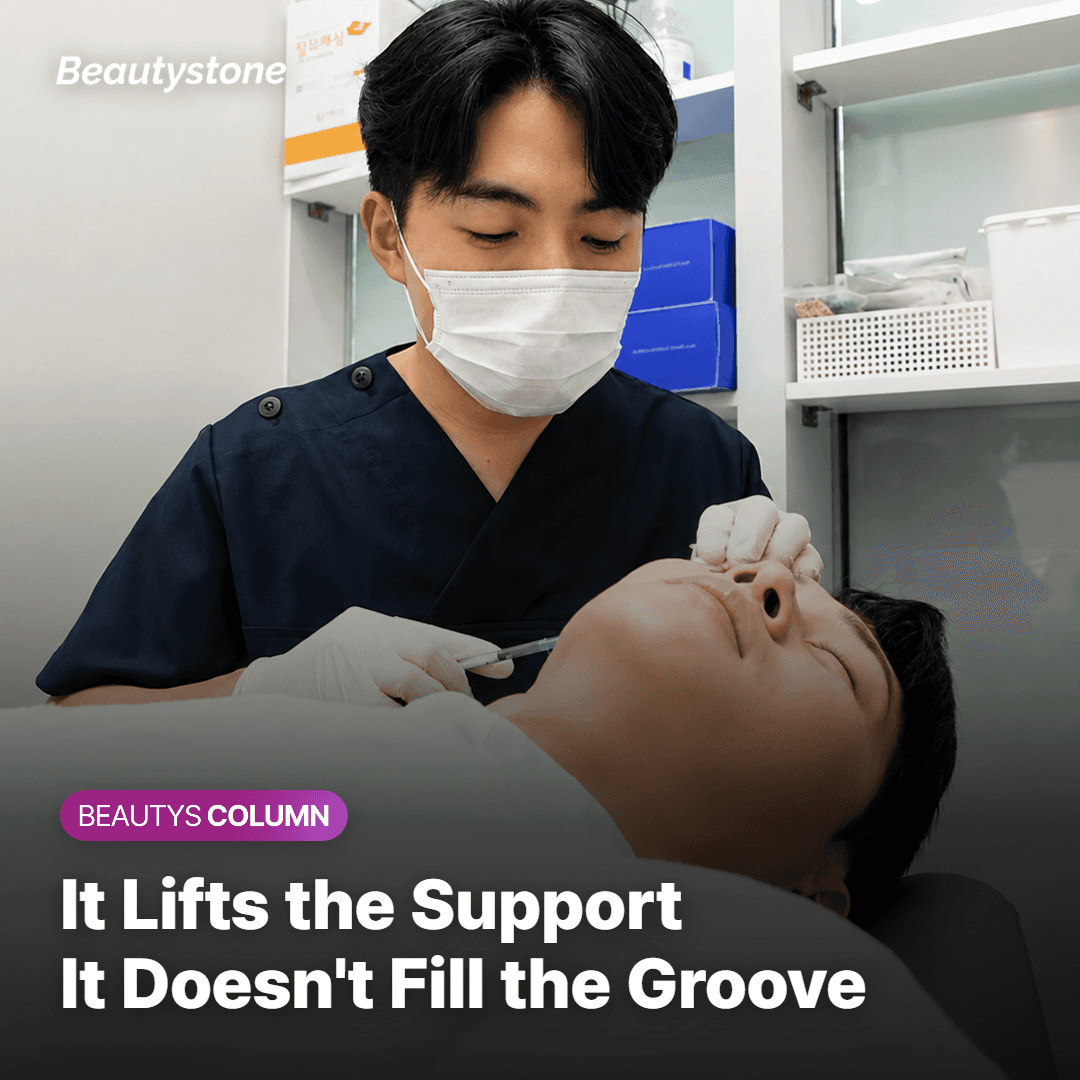
Nothing goes under your skin. Here, titanium is a model name, not a material.
The device is Soprano Titanium, built by Alma Lasers in Israel, and it's a diode laser — a semiconductor that generates light at a specific wavelength. This one runs 755 nm, 810 nm, and 1064 nm at the same time using Alma's own technology, and it reaches Korean clinics through Alma Korea. No needles, no threads, no implants.
That's worth knowing if what's been holding you back is the idea of something sitting inside your face — the tugging people describe after thread work, or the worry about a foreign object you can feel under the skin. A handpiece passes over the surface and delivers energy. Nothing stays.
Myth 3: It Stings, and You're Swollen for Days
For most people, neither half of that holds up.
Sessions are typically run without anesthesia, and a sapphire cooling head stays in contact with your skin while the energy goes in. The usual description is warmth rather than a sting — closer to a warm massage than anything sharp. The appointment itself is short, and some people notice their skin looks slightly different in texture on the way back out.
Keep in mind that the same-day look and the collagen response are two different things. An animal study found that a diode laser in the 800 nm range stimulated signaling for new collagen production in the skin — and that part unfolds quietly over the following weeks, long after you've gone home. What you see in the mirror that afternoon isn't the whole story, and everyone's skin is different about how much of it shows.
Side Effects, Downtime, and Who Should Wait
Non-ablative laser treatments are generally described as leaving very little recovery time — the sort of flush that makeup covers rather than a week spent indoors. Titanium Lifting sits in that category, which is a large part of its appeal.
Here's what tends to come up afterward:
Redness: The treated area can look flushed for a while, and it usually settles quickly.
Warmth: A lingering heat sensation is common right after and tends to fade on its own.
Back to your day: Most people go straight back into normal plans, though it's sensible to leave a buffer before anything you'd rather not look flushed for.
There are also situations where it's better to hold off, or at least raise it with your provider before booking:
If you're pregnant or breastfeeding
If there's active inflammation or infection in the area to be treated
If you're keloid-prone, or your skin tends to heal slowly
And the usual escalation rule applies. If redness spreads instead of settling, or pain keeps getting worse, or you run a fever, contact the clinic that treated you or seek medical care right away.

So Who Actually Gets Something Out of It?
The people who tend to come away satisfied are the ones catching it early.
If the sagging has only just started — the fold and the lines beside your nose softening at the edges rather than carved in — lifting the support underneath can tidy the whole area in a way that reads natural instead of treated. That's the sweet spot for this particular mechanism, and it's a narrower window than the marketing usually suggests.
If your cheeks and jawline have already dropped with real weight behind them, support improvement on its own is likely to underdeliver, and it's worth asking what else could run alongside it. This article covers general information, so the honest version of that answer comes from a clinician who has actually looked at your face.
Beautystone is a small dermatology clinic a short walk from Hapjeong Station in Seoul. Before recommending anything, we'd rather work out first whether your fold is mostly descent or whether something else is layered on top of it, because the direction changes with the answer. Current offers are listed on our promotions page.
The Bottom Line
Three things to carry out of this:
It lifts, it doesn't fill. The mechanism works on the support under a nasolabial fold, not on the groove itself.
Titanium is a model name. Soprano Titanium is a triple-wavelength diode laser — no threads, no metal, nothing left inside your skin.
The session is gentler than people brace for. Usually no anesthesia, cooling in contact throughout, and very little downtime afterward.
Like any procedure, it comes with trade-offs, and a fold that's already deep may need more than this on its own. Ultimately, the choice depends on your skin, your goals, and how much change you're actually after. If you're considering Titanium Lifting for nasolabial folds, a consultation is the most reliable way to find out whether the fit is there.
Frequently asked questions
Q. Will Titanium Lifting get rid of my nasolabial folds?
A. Not in the sense of the crease vanishing. It works on the support underneath rather than filling the groove, so what most people notice is sagging easing off and the area looking tidier. Nasolabial folds and the lines beside the nose usually sit on the same downward drift, so they tend to shift together — but how much you feel depends on how far the sagging has already gone.
Q. Does it hurt?
A. Most people describe warmth rather than pain. Sessions are usually run without anesthesia because a sapphire cooling head stays against your skin the whole time, which is why the common comparison is a warm massage. Sensitivity varies from person to person, so say something to whoever is treating you if it's more than you'd like.
Q. Can I go straight back to work afterward?
A. Usually, yes. Downtime is minimal and most people return to their day the same afternoon. You may look a little flushed or feel warm for a while, and that tends to settle quickly. If you have something coming up that you'd rather not be flushed for, leave yourself a buffer.
Q. What if Titanium Lifting isn't enough on its own?
A. That happens, particularly when the sagging is already well established. Support improvement has a ceiling, and past that point it's normal to look at other treatments alongside it rather than expecting one device to carry everything. What you'd need depends on where your sagging sits and the size of the change you're after, so it's a conversation to have with your provider.


Contouring & Volume
Why Juvelook Volume Quotes Vary by Clinic

men's
Nose Pore Treatment: Aftercare Timing Guide

skin
How Many Sessions Does Eyeliner Removal Take?

Hair Removal
Laser Hair Removal While Pregnant or Nursing

Hair Removal
레이저 제모 1회에도 남는 몫이 있어요 — 밀도를 모자이크로 보는 법

Tattoo removal
Why Extremity Tattoos Are Slower to Remove