

The name sounds like a thread lift, but Titanium Lifting is a diode laser firing three wavelengths at once. Here's how it works and what a session covers.
Published -
Updated -

Author
Wi Young-jin · Chief director
Seoul National University College of Medicine · Seoul National University Hospital Specialist
→
"Titanium" on a treatment menu sounds like hardware. Something goes in, something holds things up, and your face gets propped back where it used to sit. If you've been picturing Titanium Lifting as a thread lift with a more impressive name, you're not alone — it's one of the most common mix-ups we hear about in consultations.
The short answer? Nothing goes in. Titanium Lifting is the shorthand for Soprano Titanium, a diode laser platform built by Alma Lasers, and it works by delivering energy through the surface of your skin. No threads, no filler, and nothing left sitting underneath afterward.
That single gap between the name and the machine is where most of the confusion starts, and it changes what you should reasonably expect from a session. In this article, we'll cover what the device actually is, how a thread lift and a laser differ where it matters, what those three wavelengths are doing under your skin, whether one session can genuinely cover your whole face, and the side effects worth knowing about before you book.
So What Is Titanium Lifting, Exactly?
It's a laser. More precisely, it's a diode laser — a laser that produces light at specific wavelengths using a semiconductor.
The device behind the nickname is Soprano Titanium, made by Alma Lasers, an Israeli device manufacturer. What sets it apart is that it fires three wavelengths — 755 nm, 810 nm, and 1064 nm — at the same time through a single handpiece, which is the company's own patented approach rather than an industry standard.
Everything about the delivery is non-invasive. The handpiece glides over your skin, a sapphire cooling tip chills the surface as it moves, and most people describe the session as closer to a warm massage than anything sharp. Plenty of people also notice their skin looking smoother as soon as they get up from the chair.
Keep in mind, though, that the smooth look you feel on day one and the point where new collagen actually settles are two different timelines. We'll come back to that, because it's where expectations usually go sideways.
What it is: A diode laser platform — not a thread, not an implant, not an injectable.
What it leaves behind: Nothing. The energy does its work and there's no material under your skin afterward.
Anesthesia: Typically none, or numbing cream at most.
How it feels: Warmth, with the cooling tip taking the edge off as the handpiece moves.
Threads vs. Lasers: Where the Name Misleads
Here's the question that comes up almost every time: if it's a laser, why does the name say lifting? Because the word describes the effect the treatment is aiming at, not the material it uses. That's a small distinction on paper and a large one once you're in the chair.
A thread lift is structural. Dissolvable threads are placed under the skin, and they physically support tissue while they're there. Titanium Lifting has no structural component whatsoever — it relies entirely on heat and on how your own skin responds to it over the following weeks.
Side by side, the two treatments diverge in almost every practical way:
Thread lift | Titanium Lifting | |
|---|---|---|
Method | Dissolvable threads placed under the skin | Laser energy applied through the surface |
Anesthesia | Local anesthesia is often needed | Usually none, or numbing cream at most |
How it feels | Pressure as the thread passes through | Mostly warmth, with a cooling tip on the skin |
Immediate change | Noticeable once the swelling settles | Often noticeable right after the session |
Recovery | Bruising and swelling can take a few days | Temporary redness and a warm feeling |
So if a friend recommended one and you were quietly picturing the other, the day itself will feel different from what you planned for — and so will the weeks afterward.
How Three Wavelengths Do the Lifting
By heating tissue at depth and letting your skin rebuild in response. That's the whole mechanism, and it happens in three steps.
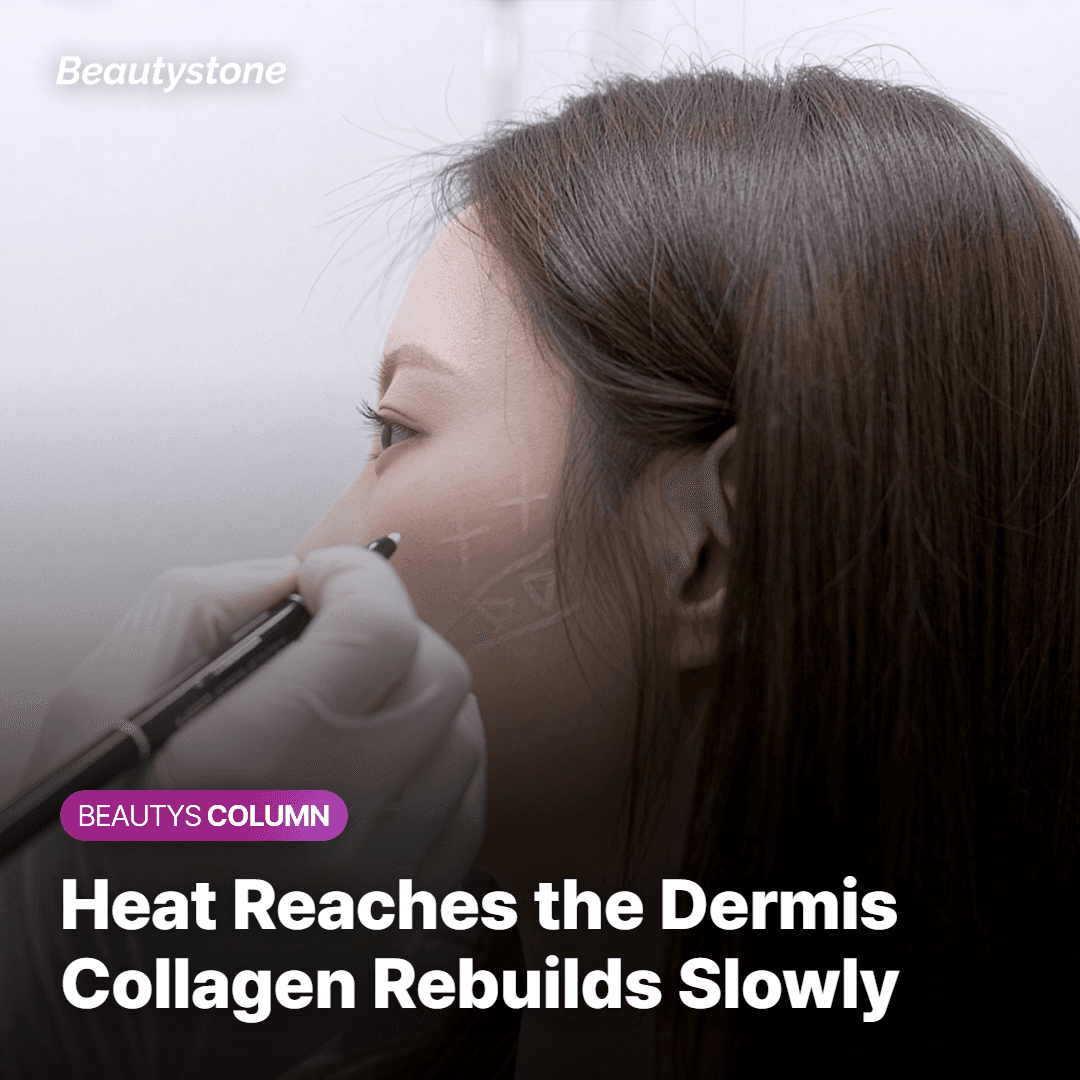
First, laser energy passes through the surface and reaches the dermis — the layer sitting just beneath the epidermis, where your collagen and elastic fibers live — and turns into heat there.
Second, that heat spreads downward toward the retaining ligaments, the fibrous bands that hold facial tissue in position. Those bands have a lot to do with where sagging shows up on a given face, which is why heat that reaches them is treated as meaningful rather than incidental.
Third, the heat changes existing collagen, and that change is what prompts collagen remodeling — older collagen gradually being replaced by new. It's a slow process measured in weeks, not days. Research on infrared devices describes energy being absorbed by water in the skin, generating heat that alters the structure of dermal collagen and prompts new collagen to form.
There's also animal research suggesting that diode lasers in the 800 nm range stimulate signaling in the skin that increases collagen production. That's supporting evidence for the mechanism, not a forecast for your face — individual results vary, and no device spec predicts how much collagen response any one person will get.
Which brings us to the cooling tip, and why it isn't a comfort feature bolted on as an afterthought. Heat has to travel deep enough to matter while leaving the surface unharmed, and cooling the top layer is what makes that possible. On Soprano Titanium the tip is sapphire, and it stays in contact with your skin throughout.
Can One Session Cover the Whole Face?
Usually, yes — and that's one of the more practical arguments in its favor.
Sagging rarely has one address. Most people who bring it up are bothered by the forehead, the eye area, the cheeks, the jawline, and the neck all at once, in some combination they've been quietly ranking for months.
Because the handpiece is moved across the skin rather than placed at fixed points, your provider can work area by area within a single visit. And since there's no anesthesia to plan around and the discomfort stays manageable, it's much easier to design a full sweep of the face than it would be with a treatment that demands recovery time per zone.
Moving from one area to the next doesn't change the mechanism, either. The same heat-and-rebuild process applies wherever the handpiece goes, so repeated passes across different zones build the same kind of collagen stimulus rather than several unrelated ones.
Downtime is the other reason a whole-face plan is realistic here. Beyond some redness that makeup can cover, most people head back into their day without rearranging anything. That said, "manageable" isn't the same as "nothing at all," which is worth reading about before you book.
Side Effects, Downtime, and Who Should Wait
Warmth and some redness are the common reactions, and they typically settle within a day or two without any special care. Most people find the flush fades on its own by the following morning.
If the redness keeps getting worse over several days, or the skin blisters, contact the clinic that treated you right away rather than waiting it out. Worsening is the signal to act on, not the initial warmth.
There are also situations where it makes sense to revisit the timing before going ahead:
You're pregnant or breastfeeding.
There's active inflammation or an infection on the area to be treated.
You're keloid-prone, meaning past scars healed unusually thick and raised.
You've had another laser or filler treatment within the past one to two weeks.
None of these are rules you can apply to yourself from a blog post. They're reasons to raise the subject first — your provider is the one who can weigh your skin and your history and tell you whether waiting is the better call.

What to Check Before You Book
The most useful thing to sort out ahead of time isn't the device. It's what's actually bothering you.
Deep sagging and surface texture are different problems, and they don't respond to the same tools. Some areas are better served by threads, which support tissue structurally; others suit a laser, which works through heat and time. A treatment being newer doesn't make it the right match for the concern you walked in with.
The second thing worth setting up front is your own measuring stick. One session isn't a fair test, because the smooth look on day one and the collagen change over the following weeks arrive on separate schedules, and they arrive at different speeds for different people. Giving it a few weeks before deciding on another round tends to produce a more honest answer than judging it on the way out the door.
At Beautystone, a small clinic in the Hapjeong area of Seoul within walking distance of the station, that's usually where the conversation starts. Rather than recommending a treatment because the machine is new, we'd rather work out first whether what you're seeing is depth or surface, then talk about what fits — even when the answer isn't this one.
The Bottom Line
If you take four things away from all of this, make it these:
It's a laser, not a thread. Titanium Lifting is Soprano Titanium, a diode laser from Alma Lasers, and nothing is placed under your skin.
Three wavelengths, one pass. 755 nm, 810 nm, and 1064 nm fire together, heating the dermis and the retaining ligaments below it.
The face can be covered in one visit. The handpiece moves area by area, so forehead through neck in a single session is realistic.
Two timelines, not one. The immediate smoothness and the collagen change are separate, and the second one takes weeks.
Like any procedure, it comes with trade-offs — warmth and redness on the day, a response that varies from person to person, and situations where waiting is the smarter move. Ultimately, the choice depends on your skin, your goals, and what you're actually trying to change.
If Titanium Lifting is on your shortlist, a consultation is the most direct way to find out whether it suits your face or whether something else does. Beautystone is a dermatology clinic in the Hapjeong area of Seoul, and current offers are listed on the /en/promotion page.
Frequently asked questions
Q. Can Titanium Lifting treat my eye area and cheeks in the same session?
A. Yes. Because the sapphire cooling tip is moved from area to area rather than fixed in one spot, the eye area, cheeks, and jawline are commonly treated one after another within a single visit. Skin thickness and the degree of sagging differ by area, though, so which zones to prioritize is something your provider should decide after looking at your face.
Q. How is Titanium Lifting different from a thread lift, and can I have both?
A. The names sound related, but the methods share nothing. A thread lift places dissolvable threads under the skin, while Titanium Lifting delivers laser energy through the surface with nothing left underneath. Whether they can be scheduled close together depends on your recovery and what you're aiming for, so ask your provider to set the order rather than booking both on your own.
Q. How long do the redness and the warm feeling last afterward?
A. Usually a day or two. Warmth and mild redness are common right after the session, and they typically fade on their own without any particular treatment. If the redness lingers for several days, gets worse, or turns into blistering, contact the clinic that treated you right away.
Q. Can I have Titanium Lifting if I'm pregnant or scar easily?
A. In both cases it's safer to revisit the timing. Laser treatments are commonly postponed during pregnancy and breastfeeding, and a history of thick, raised scars is another reason to talk it through first. Whether it's workable for you specifically is a judgment for a provider who can see your skin and your medical history.


skin
Ellanse Cost: Duration Beats Price Per Visit

Lifting
Alltite RF: Two Effects, Two Timelines

Contouring & Volume
Why Juvelook Volume Quotes Vary by Clinic

men's
Nose Pore Treatment: Aftercare Timing Guide

skin
How Many Sessions Does Eyeliner Removal Take?

Hair Removal
Laser Hair Removal While Pregnant or Nursing