

One session is often enough in your 30s-40s; 50s+ or heavy sagging may need two. Honest guide.
Published
Updated

Author
Wi Young-jin · Chief director
Seoul National University College of Medicine · Seoul National University Hospital Specialist
→
The question we hear most at an Ultherapy Prime consult is simple: "Can I just do one session?" Here is the honest answer first. Even with the same device, the right number of sessions depends on your skin and how far aging has progressed. For many people a single session is plenty; for others, scheduling a second session within 6 to 12 months gives steadier, longer-lasting results. Individual results may vary.
This article is general educational information from Beautystone, a skin clinic in Seoul. It is not medical advice—your own plan should be confirmed with a qualified provider.
The short version: one Ultherapy Prime session does stimulate collagen, but if you are in your late 50s or older, or your sagging is more pronounced, a second session tends to make the result more defined. Results from the first session usually start to show around 2 to 3 months afterward and keep settling in over the following months. Quick note on terminology: Ultherapy is a microfocused ultrasound device that is FDA-cleared for lifting—"cleared" is the correct term for a device, whereas a drug like Botox is "FDA-approved."
What you'll learn in this article
The real difference in results between 1 and 2 sessions of Ultherapy Prime
Whether you are likely a good candidate for a single session
When results show up and the best timing for a second session
How to care for your skin between sessions so results last longer
What results can you expect from one Ultherapy Prime session?
Ultherapy Prime uses microfocused ultrasound to deliver heat deep into the skin (the SMAS and deep dermis). A single session stimulates collagen and elastin, but the change is not instant—it shows up gradually as your skin rebuilds over time.
Microfocused ultrasound (MFU)*: a technology that concentrates ultrasound energy into a narrow point to heat deep skin layers. It is the basis of HIFU-style treatments like Ultherapy Prime.
SMAS*: a thin layer connecting the facial muscles to the skin. It is the deep structure providers target when tightening and lifting.
Looking at how deep the energy reaches makes it easier to see why the result builds up slowly rather than all at once.

A clinical review of how microfocused ultrasound works notes that the treatment stimulates the deep dermis and SMAS at roughly 1.5, 3.0, and 4.5 mm. The heat denatures and contracts existing collagen, which kicks off new collagen production—so the change accumulates over several months instead of appearing overnight. How much you see depends on your own collagen turnover and how far aging has progressed, so individual results may vary.
Are you a good candidate for just one session?
If most of the following describe you, one session tends to hold up well:
You are roughly late 30s to mid-40s
Your sagging is early-stage (your jawline is just starting to soften)
You generally heal well and have thicker skin
You have had little or no prior collagen-stimulating treatment
In these cases, one session usually gives the SMAS enough stimulation to show a clear result within a few months. From there, a maintenance session every 12 to 18 months is a common routine. Results may vary, so use this as a general guide rather than a promise.

When a 2nd session makes the result more stable
On the other hand, if the following apply, a second session within 6 to 12 months tends to give a more stable result:
You are 50s or older with more pronounced sagging
Volume loss below the cheekbones is clearly visible from the side
Past lifting treatments faded faster than you expected
Your skin is on the thinner side and rebuilds collagen slowly
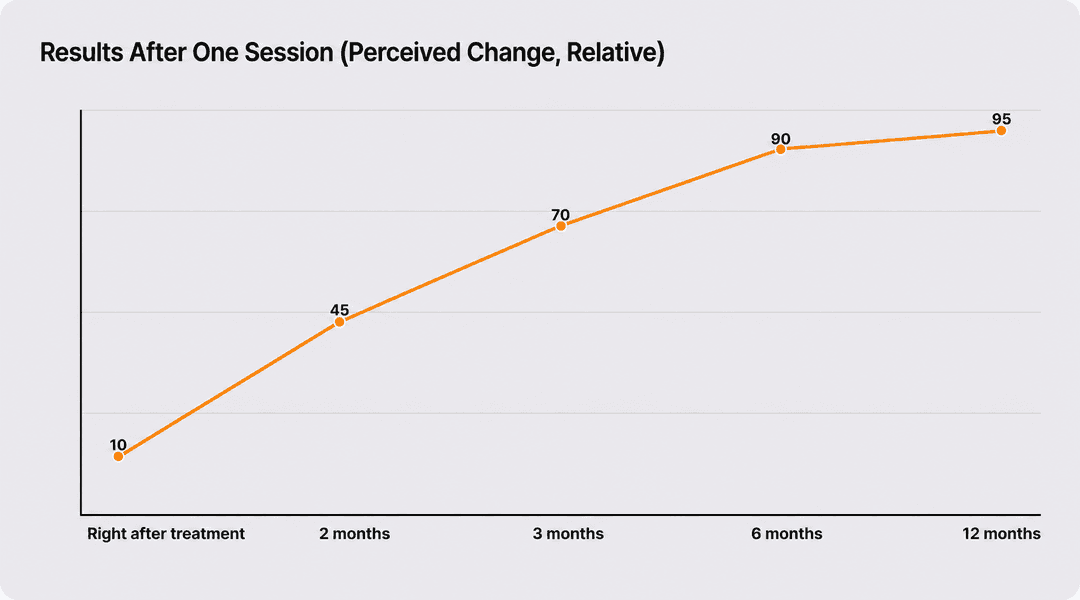
The American Society for Dermatologic Surgery notes that results from collagen-stimulating treatments build gradually over 3 to 6 months and vary with each person's healing. The logic behind a second session is to add another round of stimulation after the first round of collagen has matured (usually around 6 months) so the effect is cumulative. Going too soon—within 3 months—makes it hard to judge, because the first session has not fully shown yet.
Is a second session worth it? Honestly, it depends. The upside is a more defined, longer-lasting lift if your sagging is more advanced. The trade-offs are real, too: added cost, another round of mild discomfort, and a longer overall timeline before you see the final result. For early sagging, a single session plus good maintenance is often enough—so it is reasonable to do one session first, see how your skin responds, and decide on a second only if you need it.
Here is a rough sense of how the result settles over time after one session. This is an average trend only; healing speed varies from person to person.
How we approach the 1-vs-2 decision
The first thing we look at is how quickly your skin rebuilds collagen. Before treating, we check your skin thickness, how far aging has progressed, and your past treatment history, then talk through whether one session is enough or whether a second within 6 to 12 months would serve you better. For first-time patients, we often suggest doing one session, seeing how the result settles, and only then deciding on more—keeping that cumulative timeline in mind.
What does it cost? In the US, Ultherapy commonly runs about $1,000 to $5,000 per session depending on the area treated, the number of lines or "shots," and the provider—so treat any figure as a ballpark and confirm with your own clinic. Many US practices offer financing (for example, Cherry or 0% APR plans) to spread the cost. Pricing in Korea differs, and prices vary widely by country, clinic, and region.
If you are not local to us, the takeaway still applies: look for a qualified provider who actually assesses your skin and recovery before recommending one session or two, rather than defaulting everyone to a package. You do not have to decide everything at once—booking a follow-up to review results is a normal part of the process.
How to care for your skin between sessions so results last
The key to keeping your Ultherapy Prime result is a daily routine that slows collagen loss.
Category | Why it matters |
|---|---|
Sun protection | Daily SPF is the big one. UV speeds up collagen breakdown. |
Sleep & diet | Collagen synthesis needs protein and vitamin C. Skip extreme crash diets. |
Add-on collagen treatments | Pairing with skin-booster sessions after 6 months can compound the result. |
Cut back on smoking & heavy drinking | Both accelerate collagen breakdown. |
The American Academy of Dermatology advises asking your provider about recovery and expected results, and confirming your own skin status, before any cosmetic treatment—it is a key safety step. For efficiency, adding stimulation before your gained collagen drops by about half (typically 12 to 18 months) helps the effect accumulate. Because everyone's pace differs, set your timeline with your medical team.
Last updated June 2026. This article is educational and was not medically reviewed; please confirm specifics with a board-certified provider.

Frequently Asked Questions
Q. What if I don't feel much after my first session?
A. First-session results usually start showing around 2 to 3 months and keep settling over the following months. It is hard to judge before then, so giving it time before reassessing is normal. If results still feel short after enough time, that is when a second session makes sense. Individual results may vary.
Q. Is there a big price difference between 1 and 2 sessions?
A. Yes, adding a session adds cost. But if your skin clearly needs a follow-up within 6 to 12 months, a bundled plan can be more cost-effective than two separate single sessions. The right call depends on your case—and in the US, single Ultherapy sessions commonly run about $1,000 to $5,000, so confirm pricing with your provider.
Q. When should I get my next Ultherapy Prime treatment?
A. A 12-to-18-month cycle is typical. Around the one-year mark your result has stabilized, so adding stimulation soon after is efficient for building collagen. The timing can be adjusted to how fast your skin changes.
Q. Does it hurt?
A. You feel brief, prickly bursts of heat as the microfocused ultrasound reaches the deeper layers, point by point. Most people manage it with numbing cream, and we can add anesthesia for those more sensitive to pain. Discuss comfort and recovery with your provider before treatment. If you ever notice unusual swelling, blistering, prolonged numbness, or signs of a burn, contact your provider promptly or seek urgent care.




Contouring & Volume
Hip Dip Filler Before and After: 4 Checks

Body
Potenza Treatment Interval: Why 4 Weeks?

Lifting
Ultherapy Before and After: Why Wait 90 Days?

Contouring & Volume
Belotero Revive Cost: 2cc Price vs. 3 Sessions

skin
Lip Hyperpigmentation Laser: Does It Work?

Contouring & Volume
Men's Forehead Filler: Hollow or Just Lines?