

Bumps after beard laser? How to tell folliculitis from acne, calm it, and red flags to watch.
Published -
Updated -

Author
Wi Young-jin · Chief director
Seoul National University College of Medicine · Seoul National University Hospital Specialist
→
Read this first
Q. If tiny bumps break out after laser hair removal,is it folliculitis?
A. If they have yellow heads and sit centered on the hair follicles,it very likely is. Do not squeeze or pop them.
Q. Does shaving make folliculitis more likely?
A. Avoid shaving right after hair removal (for the first 3 days or so);it helps prevent folliculitis.

The short answer.
Folliculitis is a small infection and/or inflammation
that develops in the center of a hair follicle. Individual results and healing vary.
What decides it.
In most cases, shaving irritation in the 2 to 3 days after hair removal is the trigger.
What we cover today.
How to tell it apart from acne, and how to time treatment.
What you will learn in this article
How to tell whether bumps after laser hair removal
are actually folliculitis
Why bacteria get in when follicles are weakened
right after hair removal
How to treat and prevent folliculitis that keeps coming back after shaving
Folliculitis After Laser Hair Removal:
Are Tiny Bumps a Sure Sign?
Here is the short answer first: if they are yellow pustules sitting directly on the hair follicles, it is most likely folliculitis.
Folliculitis is a bacterial infection inside the hair follicle—
the tiny pore where hair grows.
There is a reason so many people searching
for "folliculitis after laser hair removal" end up here.
When tiny, millet-like bumps show up a day or two
after a hair removal session,
it is easy to confuse them with regular acne.
Here is the common mix-up: people focus on what the bumps look like,
but where they sit matters more.
Instead of scattering randomly across the skin,
the key tell is whether each bump rises up
centered on an individual hair pore.
If 1 or 2 yellow-headed bumps appear right on the follicles
with mild redness around them,
folliculitis from laser hair removal is the first thing
we would consider.
At this stage, if it does not spread widely and is not very painful,
it often settles within 2 to 3 days
with an oral antibiotic or a topical antibiotic ointment. Timelines vary from person to person.
Acne, by contrast, is mostly about clogged sebum and dead skin cells.
Folliculitis is closer to an inflammation that starts
right around the opening of the pore
where the hair used to be.
It is better to treat it as an infection,
so an oral or topical antibiotic
tends to help. This is general information, not a prescription—your provider should confirm what fits your skin.
Why Does Hair Removal Lead to
Bacterial Folliculitis?
When bacteria get into an empty follicle, inflammation follows.
"Folliculitis happens when laser hair removal
leaves empty space in the follicles,
and bacteria or fungi move in
and cause inflammation.
Because the follicles are sensitive and weakened
after laser treatment, folliculitis is easy to trigger.
To prevent it,
it is best to avoid shaving for a few days.
It is easy to mistake for acne,
but if the bumps rise one by one,
each centered on a hair follicle, it is folliculitis."
— Dr. Wi Young-jin (Beautystone Clinic, a skin clinic in Seoul)
Think of a hair follicle as a tiny room
with the door left wide open.
When the laser works on the hair and follicle,
the space inside becomes briefly sensitive,
which makes it easier for bacteria
or fungi to settle in.
Laser hair removal works by sending heat—absorbed by the pigment in the hair—
into the surrounding follicle. The lasers used for this in the US are FDA-cleared devices ("cleared" is the right term for a device, while a drug like Botox is "FDA-approved").
That thermal reaction
weakens the structure that produces hair,
and until the follicle opening
fully settles,
there is a short window where inflammation can set in.
But here is an important point.
Getting folliculitis
does not mean the laser hair removal itself was done wrong.
It is when shaving, sweat, friction,
and the habit of touching the area pile up after treatment
that even minor irritation can tip over into infection.
In our clinic, the bumps we see most often
show up
between 24 and 72 hours after hair removal.
That is exactly when the laser's heat is still settling,
and it often overlaps with shaving or friction from a collar or mask.
Honestly, this is something
we hear two or three times a week.
Just last week, a man in his late 40s
came in with tiny bumps under his chin.
He was worried, asking, "Is my skin just not suited for hair removal?"
But up close,
it was a textbook pattern—yellow pustules
sitting right on individual follicles.
To be honest, I watched his progress carefully,
because I wanted it to settle quickly.
He paused shaving, used an antibiotic ointment,
and took a short course of medication.
Two days later the redness and pus had eased a lot—though, again, individual results vary.
He said he had not expected it to calm down that fast.
The point is not to squeeze
or pop folliculitis to clear it fast.
The goal is to keep the follicle openings from getting more irritated
and to stop the bacteria from multiplying.
People with a sensitive skin barrier
will react with more redness to the same laser.
And on areas with thick, dense hair—like a beard—
the follicles are packed close together,
so the small bumps of inflammation
can look more obvious.
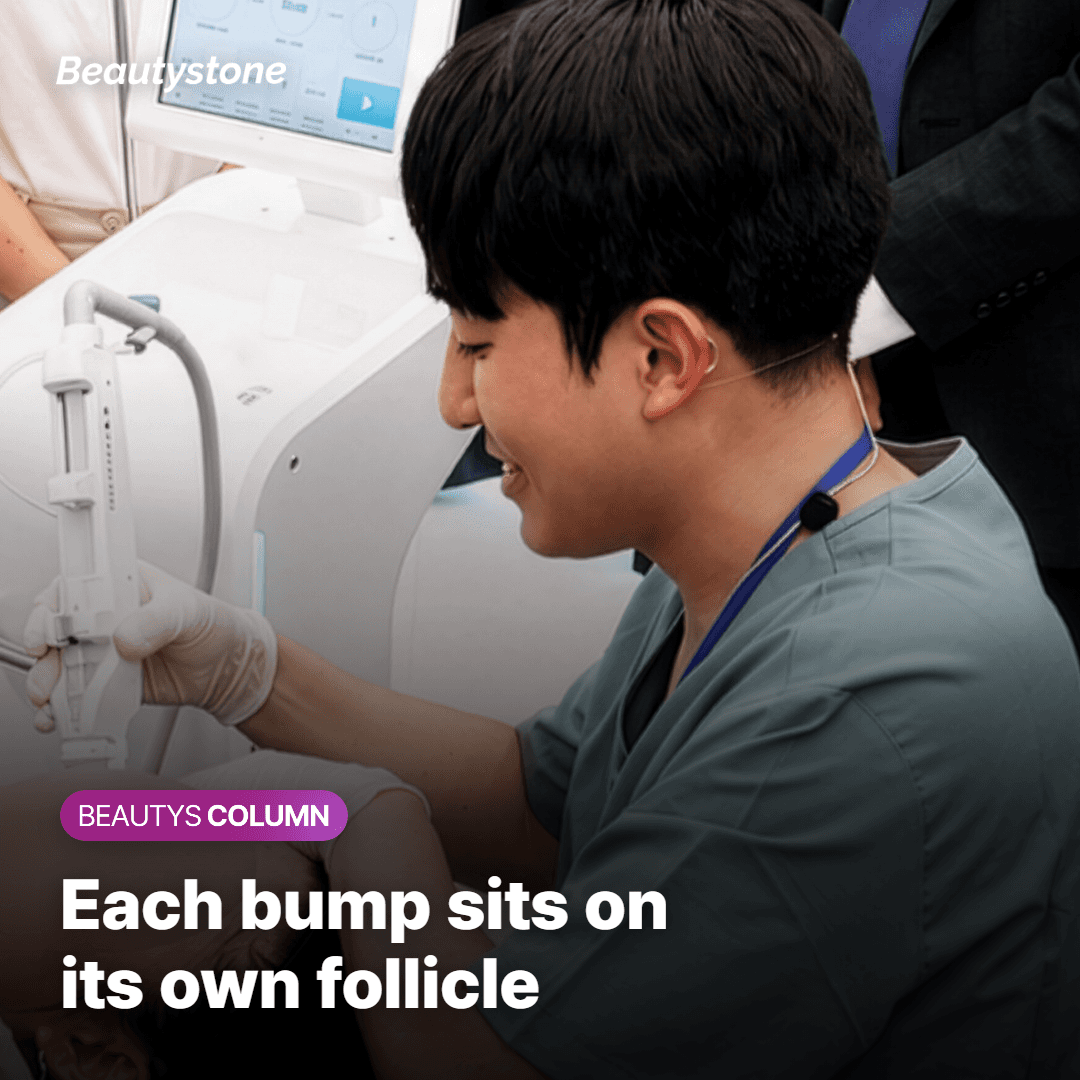
Dr. Wi Young-jin's key takeaway
With bumps after hair removal, look at "where they start"
more than "how many there are."
If they have yellow heads centered on the pores
and respond within 2 to 3 days,
folliculitis is likely.
Keep irritating the area with shaving,
and the inflammation can outrun the healing.
How Can You Prevent
Folliculitis After Shaving?
Cutting back on shaving right after hair removal is the simplest step.
The table below makes the differences clearer.
Folliculitis after shaving often starts when
the razor scrapes and micro-damages the skin surface.
Shaving during the sensitive window after laser hair removal
leaves tiny cuts
that act as easy doorways for bacteria.
Situation | What it looks like | What to do |
|---|---|---|
Folliculitis after laser hair removal | 1 or 2 yellow-headed bumps centered on follicles | Apply ointment or medication; watch it for 2-3 days |
Folliculitis after shaving | Bumps that recur along the path the razor traveled | Stop shaving for now; manage friction and sweat |
Acne | Spread widely across oily areas | Treat with sebum and exfoliation care |
Spreading pus | Redness expanding, with pain | See a provider instead of squeezing it yourself |
Every case is a little different,
but here is the routine I usually recommend.
For the first few days after treatment, shave as little as possible.
If you really must shave,
use a fresh blade and plenty of lubrication.
Also ease off on heavy sweating from exercise, saunas,
and the habit of touching the area.
Folliculitis is partly a bacterial problem,
but the starting point is usually irritation.
Red flags—when to seek care. Most folliculitis is minor, but if the redness is spreading fast, the area is hot and increasingly painful, you have a fever, or pus is expanding rather than settling, do not wait it out at home—see a provider promptly, and seek urgent care if it is worsening quickly.
One thing I have to flag:
if folliculitis keeps coming back, do not just keep
pushing ahead with more laser sessions without talking to your provider.
That said, if you have thick beard hair
and constant razor burn from shaving,
laser hair removal can be a good long-term option
because it cuts down how often you need to shave.
Is it worth it? Honestly, it depends. The upside is fewer shaves and less recurring razor irritation over time; the trade-offs are a series of sessions, the short sensitive window afterward, and the chance of folliculitis if aftercare slips. Results are not guaranteed and vary by skin and hair type—a consult is the best way to judge your own case.
As a rough idea on cost, beard or facial laser hair removal in the US often runs around $75-$250 per session and is usually sold in packages—but this varies a lot by provider and region, so treat it as a ballpark and confirm with your own clinic.
Treatment usually depends on how deep
and how widespread the inflammation is.
If it is small and localized, an ointment can be enough to start.
If there is clear pus or it is spreading,
an oral medication may be added.

Folliculitis:
Three Questions We Hear Most in the Clinic
Q1. Do I really need oral medication
for folliculitis after laser hair removal?
A. If it is just 1 or 2 bumps,
ointment alone is often enough.
But if you see multiple pustules,
a short course of oral antibiotics is the better call.
Q2. How many days should I use folliculitis ointment?
A. Try the prescribed antibiotic ointment along with a steroid ointment.
If the redness is down by day two,
keep going for about 2 more days.
If it instead gets bigger or starts to spread,
do not just keep applying more on your own—
go back for a follow-up.
Watch how fast it responds, not the calendar.
And one last point—
do not skip this one.
Q3. Can I pop folliculitis from laser hair removal?
A. This one is the same answer every time:
no, do not pop or squeeze it.
Popping can tear the skin and leave a scar
or post-inflammatory dark marks.
If you take one thing from today:
with post-removal bumps, look at whether they are centered on the pores
rather than their size, and whether you have been shaving.
In the next article,
we will cover exactly when
it is safe to start shaving again after laser hair removal.
I will walk through real cases showing
how even a single day can change how much the skin gets irritated.
Last updated June 2026. This article is general education from a Seoul skin clinic and is not a substitute for an in-person exam.
Questions? Message us
If you are wondering whether this treatment is right for you, the director reviews cases personally.
Looking forward to sharing these cases with you.
Warmly, Dr. Wi Young-jin.
Recommended Reading
Content





Contouring & Volume
How Many cc Does Forehead Filler Need?

skin
Why Is My Skin Oily but Tight in the Fall?

Hair Removal
Underarm Laser Hair Removal Cost: Do the Math

Tattoo removal
Laser Before a Cover-Up: How Many Sessions?

skin
큐어젯 다운타임, 다음 날 출근과 화장은 언제부터 될까요?

Lifting
Titanium Lifting Side Effects: When to Worry