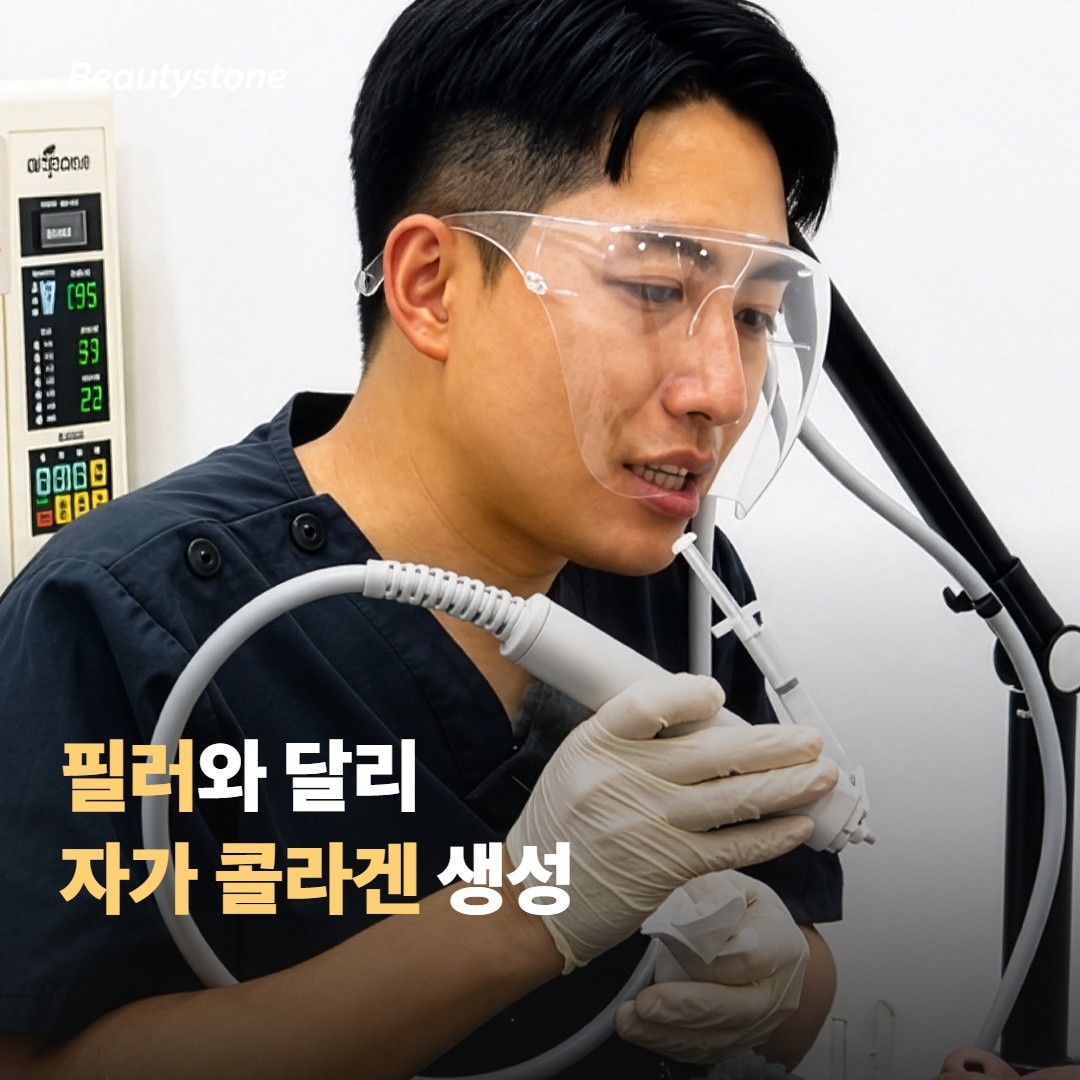
Dr. Wi Young-jin and Dr. Kim Ga-eul, Directors of Hongdae Beautystone Clinic
Hongdae Beauty Doctor Beauty Stone Clinic

Collagen booster (collagen maker): How it creates volume by targeting the subcutaneous fat layer

Collagen booster (collagen maker): How it creates volume by targeting the subcutaneous fat layer

Collagen booster (collagen maker): How it creates volume by targeting the subcutaneous fat layer

For first-timers getting a collagen booster — this is the introductory post of our series where we cover three key boosters (Radiesse, Sculptra, Juvelook Volume) and how they work on two timelines, delivering both immediate results and long-term collagen production.

Collagen Boosters (Collagen Makers): How Injecting into the Subcutaneous Fat Layer Creates Volume

🔗 Go to other posts

The 3-Product Lineup2.1 Radiesse (CaHA) · 2.2 Sculptra (PLLA) · 2.3 Juvelook Volume (PDLLA+HA)

Comparison & Choice3.1 Comparing Effects at 1 Month vs. 1 Year · 3.2 Guide to Choosing the Right Treatment for You

To give you the bottom line first, collagen boosters are not treatments that fill up volume by sitting in place like traditional dermal fillers do. Instead, they are treatments where particles embedded in the subcutaneous fat layer signal our system to produce new collagen. For this reason, the immediate effect is subtle, and the volume builds up gradually over 1 to 3 months. In my clinical practice, the most common question I receive is, "How is this different from fillers?" The key is that they operate on completely different timelines and target layers.

To give you the bottom line first, collagen boosters are not treatments that fill up volume by sitting in place like traditional dermal fillers do. Instead, they are treatments where particles embedded in the subcutaneous fat layer signal our system to produce new collagen. For this reason, the immediate effect is subtle, and the volume builds up gradually over 1 to 3 months. In my clinical practice, the most common question I receive is, "How is this different from fillers?" The key is that they operate on completely different timelines and target layers.


The Layer Where Collagen Boosters Work — The Difference Between the Dermis and Subcutaneous Fat

Standard hyaluronic acid (HA) fillers are typically injected into the mid to deep dermis. The cross-linked HA physically occupies space, producing immediate, visible volume. This is the instant change you see in the mirror right after your procedure.

Collagen boosters, however, go one layer deeper into the subcutaneous fat layer*. The particles embedded here (CaHA, PLLA, PDLLA) are not designed to create instant volume. Rather, they are meant to prompt our bodies to recognize them as foreign material that needs to be processed. This very recognition is what triggers the signal to start producing collagen.

Subcutaneous fat layer*: This is the layer of fat and connective tissue located beneath the dermis. It is responsible for creating facial contours and volume, and it is also the first area to shrink due to aging. Collagen boosters are placed into this layer to help replenish your own natural collagen.

According to a Comprehensive Review of Aesthetic Procedures Using PDLLA, the core mechanism of collagen boosters is summarized as the stimulation of fibroblasts within the dermis and subcutaneous fat layer. In other words, rather than filling volume from the outside, it restarts your body's own collagen-making machinery.

콜라겐 부스터가 작동하는 층 — 진피와 피하지방의 차이


Immediate Effect vs. Long-Term Collagen Stimulation — The Intersection of Two Timelines

When understanding collagen boosters, the most important concept is that two distinct timelines operate simultaneously.

Immediate Effect (Timeline 1) — The carrier (gel, HA, or saline) holding the particles immediately takes up space. While this effect is visible right after the treatment, it will decrease within 1 to 2 weeks as the carrier is absorbed. This explains why many patients report initial swelling that soon subsides.

Long-Term Collagen Stimulation (Timeline 2) — The particles themselves break down very slowly over a period of 6 months to 2 years. During this degradation process, they provide continuous, controlled stimulation* to keep the collagen-generating signals active. As a result, starting around 1 to 3 months, your own natural collagen accumulates, restoring real volume.

Controlled stimulation*: This refers to a subtle micro-stimulus that makes our bodies recognize something is there to be processed. Because it is not a major injury like a deep wound, it triggers new collagen production without leaving scars. This stimulation stays active as long as the collagen booster particles are breaking down.

The most effective combination of these two timelines, as recommended by the Consensus Guidelines on Reconstitution and Aesthetic Application of PDLLA, is in the form of CaHA + HA carrier or PDLLA + HA. In these formulations, the carrier provides upfront volume, while the particles generate long-term collagen.

즉각 효과 vs 장기 콜라겐 자극 — 두 시간축의 만남


Three Types of Collagen Boosters — Same Principle, Different Particles

The three products we will cover in this series all follow the dual-timeline mechanism described above. However, the final outcome varies depending on which particle is used.

  • Radiesse (CaHA) — Calcium hydroxylapatite microspheres. Because the particles are firm and the carrier is robust, it delivers the strongest immediate volume. This is highly effective for building defined contours and structure, almost like bolstering the skeletal frame.

  • Sculptra (PLLA) — Poly-L-lactic acid. While the particles themselves do not act as an instant volumizer, they offer the highest intensity of collagen stimulation. This option yields the most significant volume increase over time.

  • Juvelook Volume (PDLLA + HA) — Poly-D,L-lactic acid + hyaluronic acid. With smooth, spherical particles, it carries a very low risk of nodule formation and creates the most natural-looking volume. This is a popular domestic brand in Korea.

As each product has unique strengths, the choice depends on the specific treatment area, your concerns, and your personal preferences. Comparing these options is the central focus of this series.

세 가지 콜라겐 부스터 — 같은 원리, 다른 입자


Why We Focus on the Subcutaneous Layer & Volume

Collagen boosters range widely from superficial dermis treatments (skin boosters) to deeper subcutaneous procedures. In this series, we focus specifically on instances where they are placed in the subcutaneous layer to restore volume. There are three reasons for this:

  • Subcutaneous fat loss is a core aspect of aging. The hollow, sunken look that appears below the cheekbones, in the lateral cheeks, and the front cheeks starting in our late 30s is primarily due to the shrinking of this fat layer. This is where collagen boosters deliver their greatest value.

  • Using HA fillers alone has its limitations. Filling large areas of volume depletion requires a high volume of filler, which typically needs to be repeated every 6 to 12 months. With collagen boosters, your own natural collagen keeps the volume restored for 1 to 2 years or even longer after a session.

  • These are the areas where practitioners must make decisions most frequently. When patients say "this area looks hollow," they are almost always referring to the subcutaneous layer. Deciding which booster to recommend for each patient is a critical clinical judgment.

In the upcoming posts, we will take a deep dive into each of these three products, followed by a comparative review of results at 1 month and 1 year, along with a comprehensive selection guide.

왜 피하지방층 + 볼륨에 집중하나


Frequently Asked Questions

Q. Which is better, dermal fillers or collagen boosters?

It is not a matter of one being superior; they simply have different timelines and clinical goals. If immediate results are your top priority, HA fillers are the way to go. If you prefer natural collagen that lasts for 1 to 2 years, collagen boosters are ideal. In my practice, I often combine both — using HA fillers for immediate contouring and collagen boosters for long-lasting volume maintenance.

Q. I don't see much of a difference right after the procedure. Is it working?

Yes, it is completely normal for collagen boosters to show very subtle immediate effects. The real, noticeable changes begin to appear after 1 to 3 months. Many patients see the initial mild swelling subside and assume "the treatment didn't work," but that is actually the critical period when new collagen is actively building up beneath the skin.

Q. How many sessions do I need per year?

This depends on the product line. For Radiesse, a single session followed by a touch-up at 6 to 12 months is common. For Sculptra and Juvelook Volume, the standard protocol is a series of 3 sessions spaced 4 weeks apart, followed by maintenance treatments every 1 to 2 years. We will cover this in detail in our comparison posts.


Recommended Reading

Collagen Boosters (Collagen Makers): How Injecting into the Subcutaneous Fat Layer Creates Volume

🔗 Go to other posts

The 3-Product Lineup2.1 Radiesse (CaHA) · 2.2 Sculptra (PLLA) · 2.3 Juvelook Volume (PDLLA+HA)

Comparison & Choice3.1 Comparing Effects at 1 Month vs. 1 Year · 3.2 Guide to Choosing the Right Treatment for You

To give you the bottom line first, collagen boosters are not treatments that fill up volume by sitting in place like traditional dermal fillers do. Instead, they are treatments where particles embedded in the subcutaneous fat layer signal our system to produce new collagen. For this reason, the immediate effect is subtle, and the volume builds up gradually over 1 to 3 months. In my clinical practice, the most common question I receive is, "How is this different from fillers?" The key is that they operate on completely different timelines and target layers.

To give you the bottom line first, collagen boosters are not treatments that fill up volume by sitting in place like traditional dermal fillers do. Instead, they are treatments where particles embedded in the subcutaneous fat layer signal our system to produce new collagen. For this reason, the immediate effect is subtle, and the volume builds up gradually over 1 to 3 months. In my clinical practice, the most common question I receive is, "How is this different from fillers?" The key is that they operate on completely different timelines and target layers.


The Layer Where Collagen Boosters Work — The Difference Between the Dermis and Subcutaneous Fat

Standard hyaluronic acid (HA) fillers are typically injected into the mid to deep dermis. The cross-linked HA physically occupies space, producing immediate, visible volume. This is the instant change you see in the mirror right after your procedure.

Collagen boosters, however, go one layer deeper into the subcutaneous fat layer*. The particles embedded here (CaHA, PLLA, PDLLA) are not designed to create instant volume. Rather, they are meant to prompt our bodies to recognize them as foreign material that needs to be processed. This very recognition is what triggers the signal to start producing collagen.

Subcutaneous fat layer*: This is the layer of fat and connective tissue located beneath the dermis. It is responsible for creating facial contours and volume, and it is also the first area to shrink due to aging. Collagen boosters are placed into this layer to help replenish your own natural collagen.

According to a Comprehensive Review of Aesthetic Procedures Using PDLLA, the core mechanism of collagen boosters is summarized as the stimulation of fibroblasts within the dermis and subcutaneous fat layer. In other words, rather than filling volume from the outside, it restarts your body's own collagen-making machinery.

콜라겐 부스터가 작동하는 층 — 진피와 피하지방의 차이


Immediate Effect vs. Long-Term Collagen Stimulation — The Intersection of Two Timelines

When understanding collagen boosters, the most important concept is that two distinct timelines operate simultaneously.

Immediate Effect (Timeline 1) — The carrier (gel, HA, or saline) holding the particles immediately takes up space. While this effect is visible right after the treatment, it will decrease within 1 to 2 weeks as the carrier is absorbed. This explains why many patients report initial swelling that soon subsides.

Long-Term Collagen Stimulation (Timeline 2) — The particles themselves break down very slowly over a period of 6 months to 2 years. During this degradation process, they provide continuous, controlled stimulation* to keep the collagen-generating signals active. As a result, starting around 1 to 3 months, your own natural collagen accumulates, restoring real volume.

Controlled stimulation*: This refers to a subtle micro-stimulus that makes our bodies recognize something is there to be processed. Because it is not a major injury like a deep wound, it triggers new collagen production without leaving scars. This stimulation stays active as long as the collagen booster particles are breaking down.

The most effective combination of these two timelines, as recommended by the Consensus Guidelines on Reconstitution and Aesthetic Application of PDLLA, is in the form of CaHA + HA carrier or PDLLA + HA. In these formulations, the carrier provides upfront volume, while the particles generate long-term collagen.

즉각 효과 vs 장기 콜라겐 자극 — 두 시간축의 만남


Three Types of Collagen Boosters — Same Principle, Different Particles

The three products we will cover in this series all follow the dual-timeline mechanism described above. However, the final outcome varies depending on which particle is used.

  • Radiesse (CaHA) — Calcium hydroxylapatite microspheres. Because the particles are firm and the carrier is robust, it delivers the strongest immediate volume. This is highly effective for building defined contours and structure, almost like bolstering the skeletal frame.

  • Sculptra (PLLA) — Poly-L-lactic acid. While the particles themselves do not act as an instant volumizer, they offer the highest intensity of collagen stimulation. This option yields the most significant volume increase over time.

  • Juvelook Volume (PDLLA + HA) — Poly-D,L-lactic acid + hyaluronic acid. With smooth, spherical particles, it carries a very low risk of nodule formation and creates the most natural-looking volume. This is a popular domestic brand in Korea.

As each product has unique strengths, the choice depends on the specific treatment area, your concerns, and your personal preferences. Comparing these options is the central focus of this series.

세 가지 콜라겐 부스터 — 같은 원리, 다른 입자


Why We Focus on the Subcutaneous Layer & Volume

Collagen boosters range widely from superficial dermis treatments (skin boosters) to deeper subcutaneous procedures. In this series, we focus specifically on instances where they are placed in the subcutaneous layer to restore volume. There are three reasons for this:

  • Subcutaneous fat loss is a core aspect of aging. The hollow, sunken look that appears below the cheekbones, in the lateral cheeks, and the front cheeks starting in our late 30s is primarily due to the shrinking of this fat layer. This is where collagen boosters deliver their greatest value.

  • Using HA fillers alone has its limitations. Filling large areas of volume depletion requires a high volume of filler, which typically needs to be repeated every 6 to 12 months. With collagen boosters, your own natural collagen keeps the volume restored for 1 to 2 years or even longer after a session.

  • These are the areas where practitioners must make decisions most frequently. When patients say "this area looks hollow," they are almost always referring to the subcutaneous layer. Deciding which booster to recommend for each patient is a critical clinical judgment.

In the upcoming posts, we will take a deep dive into each of these three products, followed by a comparative review of results at 1 month and 1 year, along with a comprehensive selection guide.

왜 피하지방층 + 볼륨에 집중하나


Frequently Asked Questions

Q. Which is better, dermal fillers or collagen boosters?

It is not a matter of one being superior; they simply have different timelines and clinical goals. If immediate results are your top priority, HA fillers are the way to go. If you prefer natural collagen that lasts for 1 to 2 years, collagen boosters are ideal. In my practice, I often combine both — using HA fillers for immediate contouring and collagen boosters for long-lasting volume maintenance.

Q. I don't see much of a difference right after the procedure. Is it working?

Yes, it is completely normal for collagen boosters to show very subtle immediate effects. The real, noticeable changes begin to appear after 1 to 3 months. Many patients see the initial mild swelling subside and assume "the treatment didn't work," but that is actually the critical period when new collagen is actively building up beneath the skin.

Q. How many sessions do I need per year?

This depends on the product line. For Radiesse, a single session followed by a touch-up at 6 to 12 months is common. For Sculptra and Juvelook Volume, the standard protocol is a series of 3 sessions spaced 4 weeks apart, followed by maintenance treatments every 1 to 2 years. We will cover this in detail in our comparison posts.


Recommended Reading

Beauty Doctor Hongdae Beauty Stone Clinic

Recommended post

Recommended post

Latest post

Latest post

이마근은 주름만 만들지 않아요 — 눈도 같이 떠요

Contouring & Volume

이마근은 주름만 만들지 않아요 — 눈도 같이 떠요(핵심!0

같은 용량 같은 자리에 맞아도 사람마다 결과가 다른 이유. 이마근의 ‘주름 + 눈 보조’ 두 역할과 다른 근육과의 관계를 짧게 정리했어요.

이마 보톡스 맞고 눈 작아진 거, 안검하수 아니에요

Contouring & Volume

이마 보톡스 맞고 눈 작아진 거, 안검하수 아니에요

‘이마 보톡스 맞고 눈이 무거워졌어요’ 호소의 정체. 이마근 보조가 사라져서.. 사람마다 근육 개입 차이로 결과가 갈리는 이유.

이마 보톡스 맞기 전, 이마 잡고 눈 떠보세요

Contouring & Volume

이마 보톡스 맞기 전, 이마 잡고 눈 떠보세요(눈 작아질지 체크방법)

이마 보톡스 잘 맞는 법은 ‘맞아봐야 안다’ 가 아니에요. 30초 자가 진단으로 의존 패턴을 가늠하고 용량·위치·텀을 조정하는 임상 표준을 정리했어요.

디스포트가 보톡스보다 빠른데, 왜 의존형엔 신중해야 할까

Contouring & Volume

디스포트가 기존보톡스보다 강함, 장기간 효과 원한다면 추천드립니다.

같은 보툴리눔 톡신 A형이지만 확산 반경 차이가 존재함. 이마근 의존도에 따른 보톡스 vs 디스포트 선택 기준.

스킨 보톡스는 이마 보톡스의 약한 버전이 아니에요

Contouring & Volume

스킨 보톡스는 이마 보톡스의 약한 버전이 아니에요

이마 보톡스를 못 받는 분도 스킨 보톡스는 자유롭게 가능. 같은 보툴리눔 톡신을 진피에 미량으로 분산해 모공·피지·홍조·텍스쳐를 정돈하는 시술 원리.

Contouring & Volume

같은 보톡스인데, 이마랑 사각턱이 왜 다르게 들어가요?

보톡스 가격이 부위마다 차이 나는 이유와 부위별 적정 단위, 평가 시점을 짧게 정리했어요.

1:1 Custom Approach

💬 Eng Available 1:1 consultations available via Whatsapp

🌸 Beautystone Clinic attends the Meditox Bangkok Cadaver Workshop 🌸

1:1 Custom Approach