

Want same-day volume? Radiesse: concentrate for deep cheek/jaw, diluted for neck and hands.
Published
Updated

Author
Wi Young-jin · Chief director
Seoul National University College of Medicine · Seoul National University Hospital Specialist
→
🔗 Read Other Posts
What is a Collagen Booster? — 1.1 How Collagen Boosters Work
3-Product Lineup — 2.2 Sculptra (PLLA) · 2.3 Juvelook Volume (PDLLA+HA)
Comparison & Choice — 3.1 Comparing Effects After 1 Month vs. 1 Year · 3.2 Guide to Choosing the Right Option for You
To give you the bottom line first, Radiesse is the product that provides the greatest immediate volume right after the procedure among the three major collagen boosters. Because the firm calcium particles are embedded within a carrier, the most common review is, "I just had the treatment yesterday, but I can already see the change today." In Korea, it was once commonly referred to as "Ra-di-e-sse", but recently the spelling has been standardized to "Re-di-e-sse", and the application method has been expanding from concentrated formulas to diluted protocols.
To give you the bottom line first, Radiesse is the product that provides the greatest immediate volume right after the procedure among the three major collagen boosters. Because the firm calcium particles are embedded within a carrier, the most common review is, "I just had the treatment yesterday, but I can already see the change today." In Korea, it was once commonly referred to as "Ra-di-e-sse", but recently the spelling has been standardized to "Re-di-e-sse", and the application method has been expanding from concentrated formulas to diluted protocols.
CaHA: Immediate Volume Created with Calcium Components
The main ingredient of Radiesse is CaHA (calcium hydroxylapatite)* microspheres. This is an inorganic substance chemically identical to the primary component of our bones, making it highly biocompatible with minimal risk of an immune reaction. These microspheres are injected suspended within a smooth gel carrier*.
CaHA* (Calcium Hydroxylapatite): A calcium compound chemically identical to the mineral component of our bones. When formulated into microspheres (average 25–45μm) and injected alongside a carrier, the particles settle into the subcutaneous layer to immediately occupy volume while simultaneously stimulating collagen production. Over time, it naturally breaks down into carbon dioxide and water.
Gel carrier*: A medium used to suspend the particles (CaHA, PLLA, PDLLA) of a collagen booster into liquid form so they can pass smoothly through a syringe. The carrier in Radiesse is a firm, cellulose-based gel that delivers an immediate volumizing effect; it is absorbed in about 4 weeks, leaving only the active particles behind.
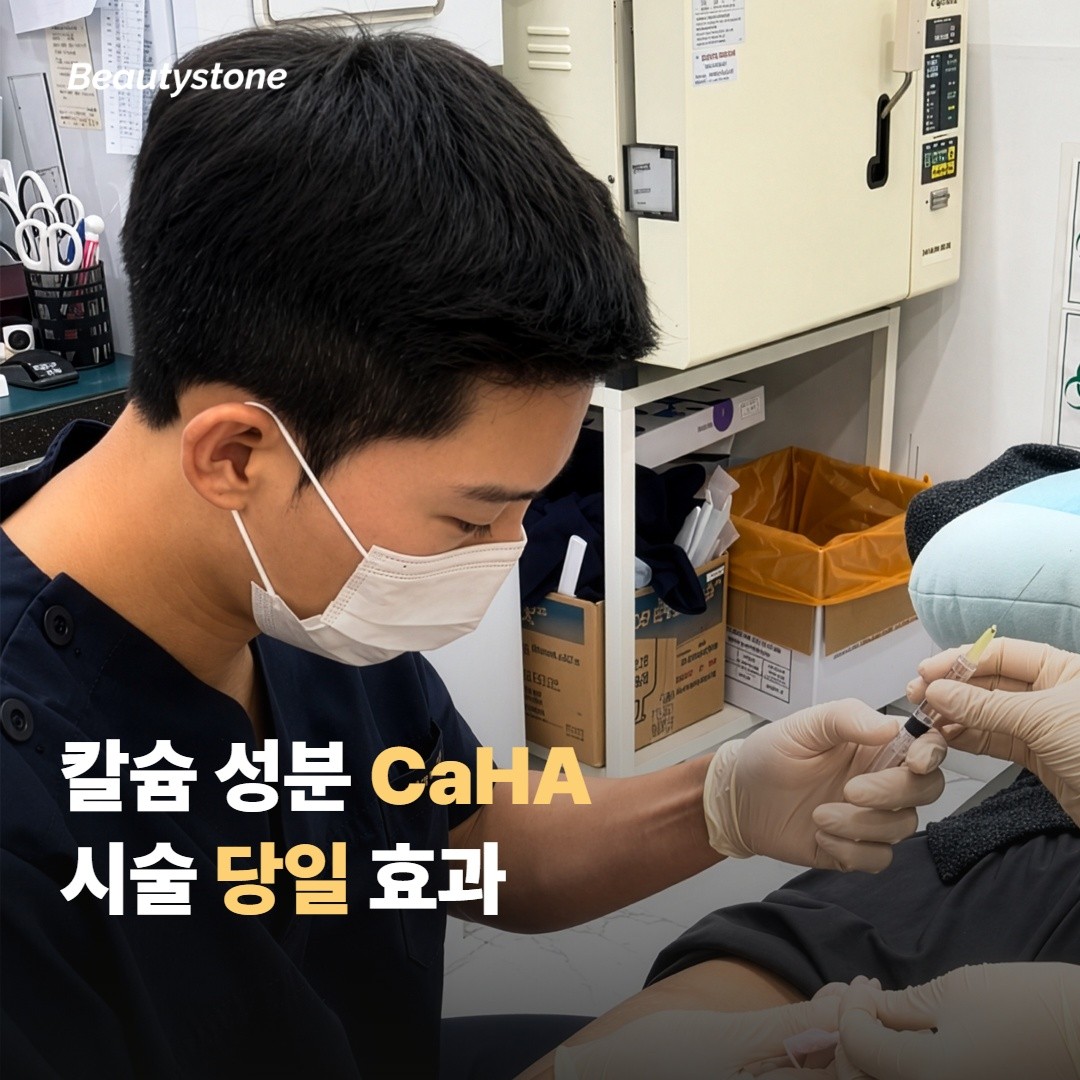
The mechanism of action unfolds in two distinct stages. First, immediately after the procedure, the microspheres and the gel carrier together occupy space to generate instant volume. Unlike other boosters like PLLA or PDLLA, the carrier itself is firm, which makes the immediate effect very pronounced. Second, around the 4-week mark, as the carrier is absorbed and only the particles remain, active collagen synthesis begins in earnest. A comprehensive review of 10 years of clinical experience with CaHA confirmed that collagen continues to form and accumulate for 9 to 12 months post-treatment.
In my clinical practice, I most frequently recommend Radiesse for patients who say, "I have a wedding next week and want to quickly fill in the hollows under my cheekbones." While other boosters require playing the waiting game for 1 to 3 months, Radiesse shows visible changes right from day one.
Changes in Korean Spelling and Application Methods — From "Ra-di-e-sse" to "Re-di-e-sse"
When first introduced to Korean clinics, the spelling "Ra-di-e-sse" was the most common. The two spellings were used interchangeably due to slight variations in transliterating the English brand name "Radiesse." Recently, however, "Re-di-e-sse" has become established as the standardized spelling both officially and clinically. Whether you are searching online or having a consultation, please note that both spellings refer to the exact same product.
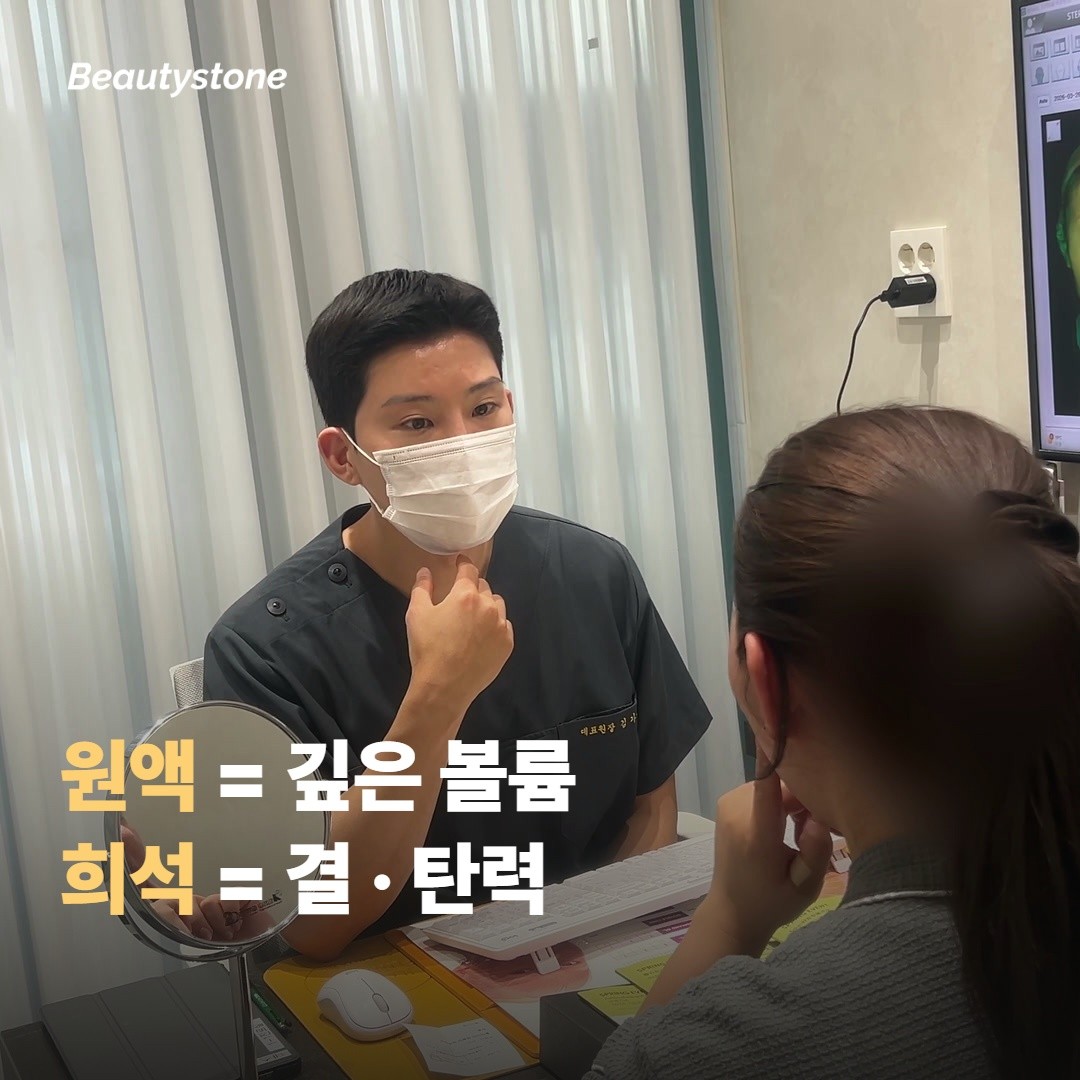
The way the treatment is administered has also evolved. Initially, it was injected as a stock concentration (undiluted), primarily to restore deep volume. Today, a dilution protocol—typically mixing it in a 1:1 or 1:2 ratio with normal saline or lidocaine—is widely used as well. Dilution lowers the particle density, allowing it to be distributed in shallower skin layers. As a result, its scope has expanded to serve as an excellent booster for improving skin texture and elasticity. The guidelines for applying diluted CaHA (Hyperdiluted Radiesse) also highlight that the treatment areas have expanded to include the face, neck, decolletage, and the backs of the hands.
The choice between the concentrated and diluted formula depends entirely on the targeted area and your goals. If you need deep volume restoration, the concentrated formula is ideal; if you are looking for texture and elasticity improvement with subtle volume, the diluted option is the way to go. Even for the same patient, it is standard practice to customize the formula for different areas.

Target Areas — Locations Looking for Immediate Volume
Radiesse is particularly effective for these areas:
Hollows under the cheekbones (mid-cheek hollow) — Offers a strong immediate lifting effect, showing a visible difference on the very day of the procedure
Jawline — Firm particles crisply define and contour the jawline
Deep hollows in the front and side cheeks
Decolletage & Backs of the hands — Improving texture and elasticity using the dilution protocol
Fine neck wrinkles — Utilizing the dilution protocol
Conversely, these are areas where we must proceed with caution:
Shallow, sensitive areas such as around the eyes and mouth — The firm particles carry a risk of surface bumpiness; other boosters are recommended here
Areas with a previous history of nodules
Patients with thin skin — The firm particles may show through the skin
Safety and Limitations
With Radiesse, the particles naturally break down over about a year, leaving only the newly generated collagen behind. Approved by the CE in 2003, the FDA in 2006, and the KFDA in 2007, it has been used in more than 80 countries worldwide, backed by an abundance of safety data.
However, it does have clear limitations. The firmness of its particles is both its greatest strength and its weakness. If a nodule does form, Radiesse is the booster where it is most likely to be felt and seen. This makes injection depth the single most critical factor during the procedure. If injected too shallowly, it causes surface irregularities; if injected too deeply, the volumizing effect is weakened. Therefore, the skill and experience of the injector will heavily dictate your results.
In the next post, we will cover Sculptra, the lineup that boasts the most powerful collagen-stimulating properties. While Radiesse is the champion of instant gratification, Sculptra is the choice that reveals the most significant volume over time.

Frequently Asked Questions
Q. Can I really see the results of Radiesse on the day of the procedure?
Yes, it is the booster that delivers the most significant immediate volume. However, keep in mind that for the first 1 to 2 weeks post-procedure, there will be the carrier absorption phase mixed with some minor swelling. It is best to think of the "initial peak" as appearing in 1 to 2 weeks. Adding the time it takes for active collagen to form, the actual therapeutic peak occurs between 3 and 6 months.
Q. What is the difference between the concentrated and diluted formulas?
The concentrated formula is designed for deep volume restoration (under the cheekbones, jawline), while the diluted formula focuses on skin texture, elasticity, and subtle volume (decolletage, backs of the hands, neck). We tailor the approach for each area even within the same session. The cost also varies depending on the volume and protocol used.
Q. Do nodules occur very frequently?
It is hard to say they occur "frequently," but rather that they are more noticeable and palpable should they arise. Because the injector's depth control is absolutely paramount, choosing an experienced medical professional is the best way to ensure safety. Also, keep in mind that corrective recovery protocols—such as massage, localized steroids, and focused mechanical vibration—are very well-established in the rare event a nodule forms.
Recommended Reading
How many days after a collagen booster treatment can I resume exercising?
Where did Juvelook come from? The Korean product that opened the era of collagen boosters
The effects of Radiesse: Is real collagen actually being produced?




Contouring & Volume
Hip Dip Filler Before and After: 4 Checks

Body
Potenza Treatment Interval: Why 4 Weeks?

Lifting
Ultherapy Before and After: Why Wait 90 Days?

Contouring & Volume
Belotero Revive Cost: 2cc Price vs. 3 Sessions

skin
Lip Hyperpigmentation Laser: Does It Work?

Contouring & Volume
Men's Forehead Filler: Hollow or Just Lines?