

Dull pressure at your temples the day after Shurink? Here's why heat at that spot causes it, how long it usually lasts, and when to call the clinic.
Published
Updated

Author
Wi Young-jin · Chief director
Seoul National University College of Medicine · Seoul National University Hospital Specialist
→
Most people walk out of a Shurink appointment feeling fine. The strange part shows up the next morning: a dull, heavy pressure at the temples, a spot that aches when you press it, and sometimes a throb that spreads along the side of the head until sleeping on that side is uncomfortable.
It's easy to worry about, partly because it's so close to the head and partly because nobody warns you about it during the consultation. In this article, we'll walk through why it happens, how long it usually takes to settle, what actually helps in the first few days, and the signs that mean you shouldn't keep waiting it out.
Why Your Temples Ache After Shurink
Shurink uses focused ultrasound. The energy isn't spread across the surface of the skin; it converges at a depth the operator sets, creating small points of heat deep in the tissue. Collagen at those points contracts first, and over the following weeks the body lays down new fibers around them. That rebuilding takes weeks, not one night, which is why the sensation you feel the next day has nothing to do with the result you'll see later.

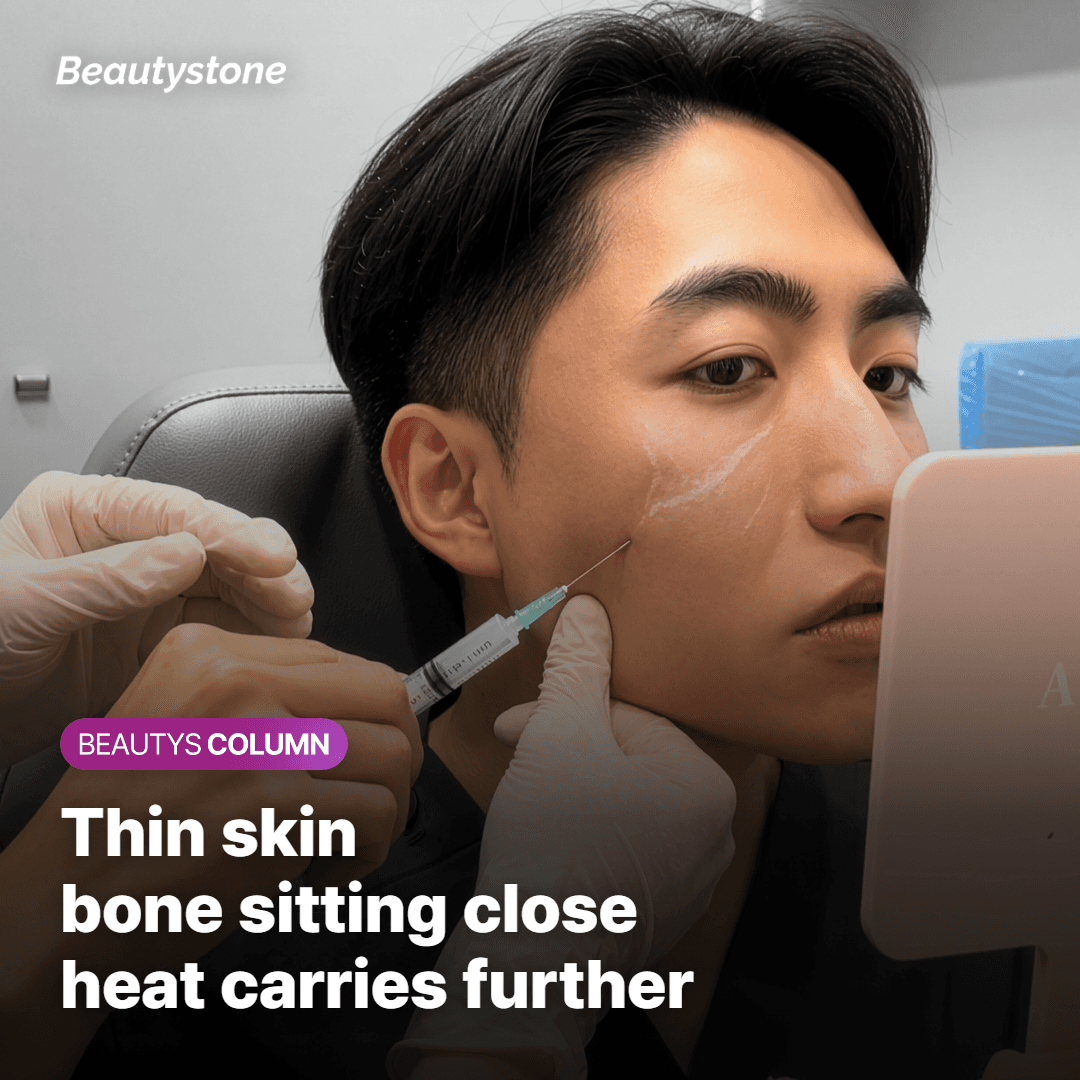
The temple is not built like the cheek. The layer of fat under the skin is noticeably thinner, the bone sits closer to the surface, and the temporalis muscle, one of the muscles you chew with, spreads right across the side of the head. Heat and vibration carry into the surrounding tissue more readily there than anywhere else on the face. That's why the ache can feel like it covers the whole head when only a narrow band along the side is actually responding.
Some of it comes from the muscle itself. Plenty of people clench their jaw or tense their face during the session without noticing, simply to get through the sharp flicks of sensation. A chewing muscle held tight for forty minutes stays tight afterward. If you find that opening your mouth wide feels stiff, or that chewing tires out the side of your head, that muscle is almost certainly part of the picture.
Nerves play a role too. Sensation in the temple travels along branches of the trigeminal nerve, and after heat exposure that skin can turn temporarily more sensitive to touch, or the opposite, slightly numb and muffled. A safety review of ultrasound-based lifting describes these sensory changes as short-lived in the general run of cases, resolving on their own.
How Long the Soreness Usually Lasts
The experience differs from person to person, but the shape of it is fairly consistent. The strongest stretch is the first few days after treatment. It reads as heaviness and pressure rather than a sharp pain, it hurts in a deep way when pressed, and it eases off a little each day without anything special being done about it.
Laid out over a week, day one tends to bring a warm, tight feeling. Days two and three are usually when pressing the spot is most tender and when chewing feels least comfortable. From day four onward most people start forgetting about it for hours at a stretch, and what's left is a mild ache on pressure that can linger another one to two weeks.
Energy setting, number of shots, and the transducer used all feed directly into that timeline. If the session ran from the temples down through the jawline at a high shot count, the reaction usually runs longer. Someone who has had the treatment before and felt almost nothing may feel markedly more this time simply because the plan was denser, and that on its own isn't a sign that anything went wrong.

What Helps in the First Few Days
The useful principle here is subtraction rather than addition. You aren't looking for a product to apply or a step to add; you're looking to stop loading an area that has just absorbed heat. Almost everything that genuinely helps is something you leave out.
Skip saunas, long hot baths, and hard workouts for the first two to three days.
When it feels tight, hold a clean cool cloth against it briefly. Not ice, not for long.
Cut back on chewy food and gum, since that works the temporalis muscle over and over.
Try not to sleep face down with the temple pressed into the pillow all night.
If the ache interferes with your day, take the pain reliever you normally use at the dose on the label.
Deep massage is the common instinct, and it's worth resisting for the first few days. The layer that took the heat is still mid-response, and adding mechanical pressure doesn't speed anything up. If you want to massage the area, wait until the tenderness has mostly gone.
Alcohol is worth easing off on the day of treatment and the day after. Increased circulation makes the warm, throbbing quality far more noticeable, and people often read that as the problem getting worse when it's the same sensation turned up louder. Post-procedure follow-up work generally assumes an early window without that kind of overlap.
Side Effects and Safety Signs to Separate Out
Tightness that fades is a different category from side effects that need following. What separates the two isn't how bad day one felt. It's the direction things move over the days after.
Inside the range of ordinary recovery you'd expect mild redness on the first day, a puffy heavy feeling, tenderness at specific points, and touch sensitivity that gets less noticeable every day. What sits outside it is anything holding steady instead of fading, anything growing stronger, or anything new that wasn't there at the start.
The literature collects adverse events that have been reported for these devices, including transient nerve symptoms and tissue reactions to heat. They aren't common, but they're known risks rather than surprises, and catching one early leaves more options for managing it than catching it late.
When Not to Wait Before Calling
The simplest test is direction. If the ache is lighter each day, watching and waiting is reasonable. If it's running the other way, getting stronger or picking up new symptoms, the watching phase is over.
Three or four days have passed with no improvement, or the pain has increased.
You can feel a dent, or see the two sides no longer match at the temple or cheek.
Opening your mouth is difficult, or chewing hurts sharply for several days running.
Numbness that doesn't lift, or an area of numbness that keeps spreading.
Fever, redness that expands outward, or swelling that feels hot to the touch.
A severe headache unlike anything you've had before, coming on suddenly.
Sitting it out for weeks doesn't buy you anything. Telling the clinic early is the stronger move, because they have the record of where the shots went, how many there were, and at what depth. That's information nobody can reconstruct from a description of the symptoms alone.
The Bottom Line
Temple tightness and a heavy head after Shurink are usually the body responding as expected to heat delivered somewhere the skin is thin, the bone is close, and a chewing muscle sits underneath. Most people feel noticeably better within a few days and stop thinking about it entirely by the two-week mark.
What decides things isn't the intensity of the first day but the direction of the days that follow. Fading is fine to watch. Getting worse, a dent appearing, or numbness spreading is a reason to get in touch.
At Beautystone in Hapjeong, Seoul, we keep the settings from every session on file, which makes a conversation about what you're feeling afterward far more specific than guesswork. If the temple still doesn't feel right, message us rather than waiting for your next appointment.
Frequently Asked Questions
Q. How many days until temple pain after Shurink improves?
A. It varies, but the tightness and heaviness usually ease within a few days, leaving mild tenderness on pressure for another one to two weeks. What matters is whether it's getting lighter each day.
Q. Can I take the pain reliever I already have at home?
A. If it's one you take routinely and you stick to the dose on the label, that's generally fine. If you have a chronic condition or take regular medication, check with your doctor first.
Q. Can I ask them to skip the temple area next time?
A. The treated area can be adjusted to whatever you're comfortable with. The temple is often the anchor point for the lifting vector, though, so it's worth discussing at the consultation how the overall result would change.
Q. Should I leave a longer gap before the next session?
A. If your last round produced a strong reaction, the interval or the energy setting can be adjusted. Describing exactly what you felt helps the plan match what actually happened rather than an average.




Contouring & Volume
Hip Dip Filler Before and After: 4 Checks

Body
Potenza Treatment Interval: Why 4 Weeks?

Lifting
Ultherapy Before and After: Why Wait 90 Days?

Contouring & Volume
Belotero Revive Cost: 2cc Price vs. 3 Sessions

skin
Lip Hyperpigmentation Laser: Does It Work?

Contouring & Volume
Men's Forehead Filler: Hollow or Just Lines?