

Juvelook Cycle: Why a 1-Month Gap Saves Money
Juvelook Cycle: Why a 1-Month Gap Saves Money
Juvelook Cycle: Why a 1-Month Gap Saves Money
Shortening Juvelook to 2 weeks costs 50% more for the same result. Here's why PDLLA needs 4 weeks.
Published -
Updated -

Author
Wi Young-jin · Chief director
Seoul National University College of Medicine · Seoul National University Hospital Specialist
→

JubeLook schedule, you need to keep a one-month interval
to avoid wasting money
As autumn deepens, the clinic
starts getting busy with calls asking about collagen boosters.
'Doctor, I want to see results quickly, but
can't I move it up and get it every 2 weeks?'
There are really a lot of people who ask that.
Today I'll explain the reason step by step.
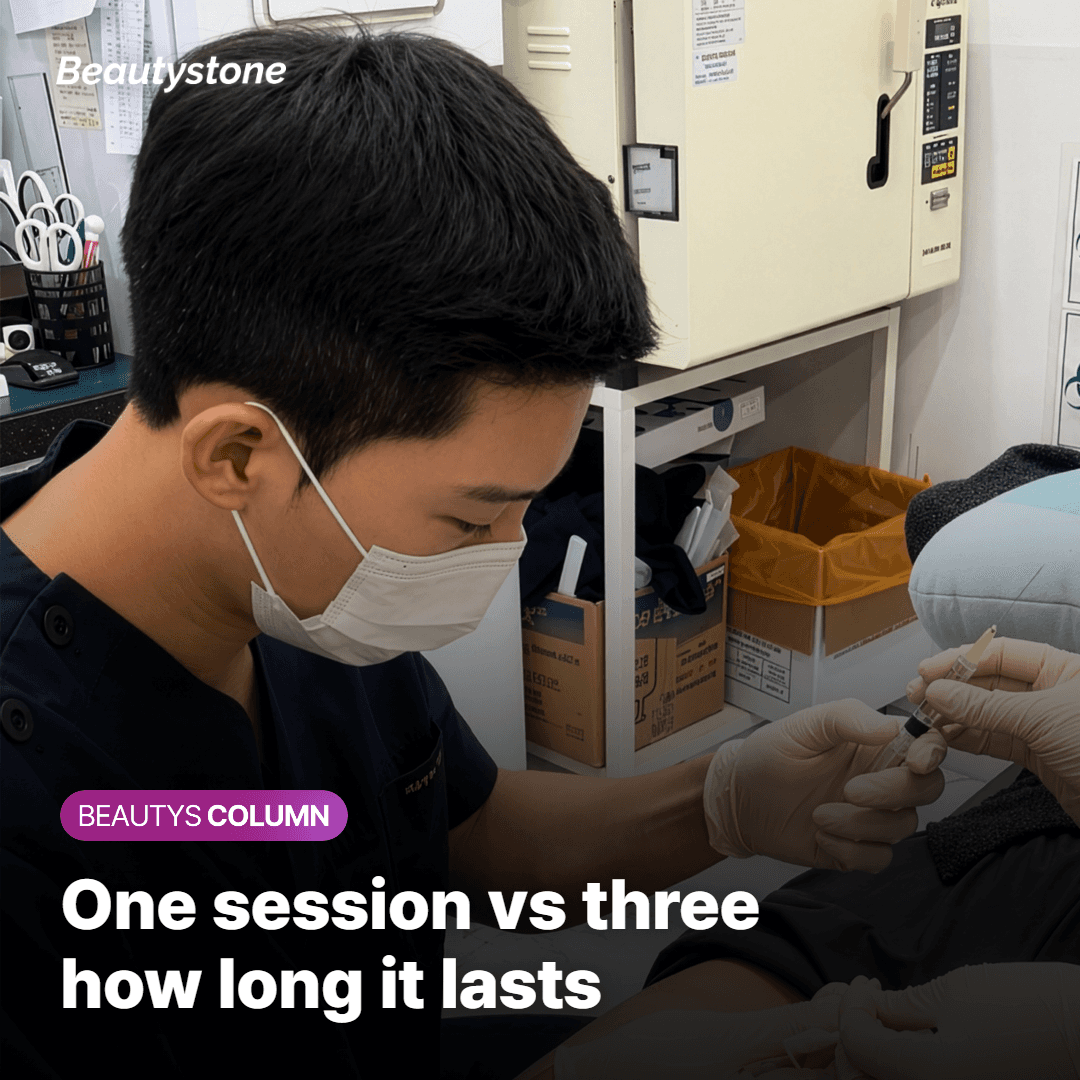
JubeLook schedule,
you think it's the same as other boosters, right?
JubeLook is a collagen booster made of PDLLA (poly-DL-lactic acid),
a biodegradable material that slowly dissolves
inside the skin and
stimulates collagen production.
If Rejuran uses PN (polynucleotide)
to restore damaged skin itself,
JubeLook works by continuously stimulating fibroblasts
for about 4 to 6 weeks while the PDLLA particles
break down in the skin,
and new collagen is produced.
Because the starting point is different, the schedule is calculated differently.

Why 4 weeks? Because the time it takes to make collagen
is already set
Dr. Wi Young-jin's
key insight
JubeLook's basic protocol is
3 sessions at one-month intervals.
That's because it takes about
4 weeks for PDLLA to induce collagen,
and if you shorten that, the effect stays the same
but you end up spending 50% more.
This may be a little surprising, but the JubeLook schedule
isn't set by the doctor; it's set by our body.
Think of it like bread dough that is being fermented.
You can't make it rise in 1 hour
just by adding more yeast.
There are reactions that need time.
PDLLA particles are the same.
After entering the dermis and hydrolyzing,
they wake up fibroblasts, and it takes about 4 weeks
for those cells to produce new collagen.
This cycle has to go around once
before the next stimulus makes sense.
So 3 sessions at one-month intervals
is the basic protocol.
The PDLLA laid down by the first treatment induces collagen
over 4 weeks,
the second one builds on top of that
and starts the next cycle again,
and in the third, the cumulative effect
settles into place.
Many people say this part is a bit surprising.
Last month, a 32-year-old client case was exactly like that.
They had two months left before the wedding,
and strongly requested to get all 3 sessions done quickly
at 2-week intervals.
I recommended one-month intervals, but after the first treatment,
they came back in week 2 and said
'I don't think there's much change.'
I told them honestly then:
the collagen hasn't been produced yet,
and that it would look different when they checked the mirror around week 4.
In the end, they finished all 3 sessions at the normal interval,
and about 6 weeks after the last treatment,
they said, 'I'm glad I didn't rush it then.'
On the other hand, a different 27-year-old client
had moved up the treatment and gotten it every 2 weeks.
At the previous clinic,
they were told, 'If you want, we can do it faster,'
so that's how they got it.
In the end, the effect was almost the same as for someone
who got it at one-month intervals,
but they ended up spending 1.5 times more per session.
They added another injection before the PDLLA from the first one
had fully broken down,
so the fibroblasts that the second particles were supposed to stimulate
were already occupied by the first ones.
Dr. Wi Young-jin's key summary
JubeLook doesn't get better faster
just because you do it sooner.
PDLLA needs 4 weeks to produce collagen,
and if you ignore that cycle,
the effect is the same but you spend more.
3 sessions at one-month intervals. That's the most economical answer.

JubeLook schedule,
we adjust it like this depending on your condition
Condition | Recommended interval | Total sessions |
Late 20s, preventive purpose | 4-week interval | 2-3 sessions |
30s-40s, beginning of loss of elasticity | 4-week interval | 3 sessions + 1 session after 6 months |
50s and older, volume loss | 4-6 week interval | 4 sessions + maintenance treatments |
Maintenance (after completing the initial course) | 6-12 month intervals | 1 session each |
And the massage protocol right after treatment
is just as important as the schedule.
We guide you with the 5-5-5 rule.
From the day of treatment for 5 days,
5 times a day, 5 minutes each time.
The PDLLA particles need to be evenly distributed
without clumping together in one place,
so nodules (small lumps) don't form.
If you don't follow this, you may see the effect after 4 weeks
but come back because of nodules.
Before setting your JubeLook schedule,
the 3 questions we get asked the most
Q1. If I get one treatment and see results,
can I just stop?
A. Honestly, this question comes up all the time.
There are people who say, after one session, 'Oh, I think it got better?'
but that's more likely due to post-procedure swelling
and the volume of the particles themselves.
The real collagen starts being produced after 4 weeks,
and for that new collagen to settle in,
you need accumulation.
If you stop after just one session, after 3 months
you'll be almost back to where you started.
Q2. If I complete all 3 sessions, how long does the effect last?
A. I usually tell people it's about 12-18 months on average,
but it varies quite a lot from case to case.
Well... it depends on your own collagen breakdown speed, UV exposure,
and whether you smoke.
Among my clients, those who spend a lot of time outdoors
and smoke come back after about 10 months,
while those who take good care of themselves
have made it close to 20 months.
So I recommend one maintenance treatment every 6-12 months.
Q3. Can I get it together with other procedures?
How should I schedule it?
A. It differs by case, but this is what I usually do.
Lifting lasers (Shurink, Ulthera)
should be spaced at least 2 weeks after JubeLook treatment.
Heat energy can affect the PDLLA particles.
Botox can be done on the same day,
and fillers are fine right away if the area is different.
One thing I do need to mention is that
the risk of nodules
is the most common side effect of PDLLA treatment,
so if you don't follow the massage protocol,
the results will be unstable no matter what combination of procedures you do.
If you take only one thing away today,
— JubeLook isn't about getting it done faster,
it's about getting it done in line with the 4-week cycle,
which is the most economical.
In the next post,
'How to do the 5-5-5 massage right after a JubeLook treatment
so that nodules don't form'
I'll explain it.
I'll show you with cases how the results 4 weeks later change
depending on the massage details, even for the same client.
This has been Wi Young-jin.
Further reading
The 'golden time' that maximizes Rejuran's effect — the true recommended interval doctors talk about
Frequently asked questions
Q. If I get one injection and it works, can I just stop there?
A. Real collagen production starts after about 4 weeks, and for that new collagen to settle in, you need cumulative treatments. If you only get it once and stop there, after 3 months it will almost be back to how it was before.
Q. How long do the effects last if I receive all 3 sessions?
A. I usually say it takes about 12 to 18 months on average, but this can vary quite a bit from case to case.
Q. Can I have it done together with other treatments? How should I schedule the intervals?
A. Lifting lasers (Shurink · Ulthera) should be spaced at least 2 weeks after Juvelook treatment.
Q. If I want to get a lifting laser treatment like Shurink or Ulthera along with Juvelook, how much time should I leave between the sessions?
A. It is best to wait at least 2 weeks after a Juvelook treatment before getting a lifting laser. Applying heat before the PDLLA particles have settled can cause overlapping irritation, so please consult with our medical team regarding the order of your treatments.
JubeLook schedule, you need to keep a one-month interval
to avoid wasting money
As autumn deepens, the clinic
starts getting busy with calls asking about collagen boosters.
'Doctor, I want to see results quickly, but
can't I move it up and get it every 2 weeks?'
There are really a lot of people who ask that.
Today I'll explain the reason step by step.
JubeLook schedule,
you think it's the same as other boosters, right?
JubeLook is a collagen booster made of PDLLA (poly-DL-lactic acid),
a biodegradable material that slowly dissolves
inside the skin and
stimulates collagen production.
If Rejuran uses PN (polynucleotide)
to restore damaged skin itself,
JubeLook works by continuously stimulating fibroblasts
for about 4 to 6 weeks while the PDLLA particles
break down in the skin,
and new collagen is produced.
Because the starting point is different, the schedule is calculated differently.
Why 4 weeks? Because the time it takes to make collagen
is already set
Dr. Wi Young-jin's
key insight
JubeLook's basic protocol is
3 sessions at one-month intervals.
That's because it takes about
4 weeks for PDLLA to induce collagen,
and if you shorten that, the effect stays the same
but you end up spending 50% more.
This may be a little surprising, but the JubeLook schedule
isn't set by the doctor; it's set by our body.
Think of it like bread dough that is being fermented.
You can't make it rise in 1 hour
just by adding more yeast.
There are reactions that need time.
PDLLA particles are the same.
After entering the dermis and hydrolyzing,
they wake up fibroblasts, and it takes about 4 weeks
for those cells to produce new collagen.
This cycle has to go around once
before the next stimulus makes sense.
So 3 sessions at one-month intervals
is the basic protocol.
The PDLLA laid down by the first treatment induces collagen
over 4 weeks,
the second one builds on top of that
and starts the next cycle again,
and in the third, the cumulative effect
settles into place.
Many people say this part is a bit surprising.
Last month, a 32-year-old client case was exactly like that.
They had two months left before the wedding,
and strongly requested to get all 3 sessions done quickly
at 2-week intervals.
I recommended one-month intervals, but after the first treatment,
they came back in week 2 and said
'I don't think there's much change.'
I told them honestly then:
the collagen hasn't been produced yet,
and that it would look different when they checked the mirror around week 4.
In the end, they finished all 3 sessions at the normal interval,
and about 6 weeks after the last treatment,
they said, 'I'm glad I didn't rush it then.'
On the other hand, a different 27-year-old client
had moved up the treatment and gotten it every 2 weeks.
At the previous clinic,
they were told, 'If you want, we can do it faster,'
so that's how they got it.
In the end, the effect was almost the same as for someone
who got it at one-month intervals,
but they ended up spending 1.5 times more per session.
They added another injection before the PDLLA from the first one
had fully broken down,
so the fibroblasts that the second particles were supposed to stimulate
were already occupied by the first ones.
Dr. Wi Young-jin's key summary
JubeLook doesn't get better faster
just because you do it sooner.
PDLLA needs 4 weeks to produce collagen,
and if you ignore that cycle,
the effect is the same but you spend more.
3 sessions at one-month intervals. That's the most economical answer.
JubeLook schedule,
we adjust it like this depending on your condition
Condition | Recommended interval | Total sessions |
Late 20s, preventive purpose | 4-week interval | 2-3 sessions |
30s-40s, beginning of loss of elasticity | 4-week interval | 3 sessions + 1 session after 6 months |
50s and older, volume loss | 4-6 week interval | 4 sessions + maintenance treatments |
Maintenance (after completing the initial course) | 6-12 month intervals | 1 session each |
And the massage protocol right after treatment
is just as important as the schedule.
We guide you with the 5-5-5 rule.
From the day of treatment for 5 days,
5 times a day, 5 minutes each time.
The PDLLA particles need to be evenly distributed
without clumping together in one place,
so nodules (small lumps) don't form.
If you don't follow this, you may see the effect after 4 weeks
but come back because of nodules.
Before setting your JubeLook schedule,
the 3 questions we get asked the most
Q1. If I get one treatment and see results,
can I just stop?
A. Honestly, this question comes up all the time.
There are people who say, after one session, 'Oh, I think it got better?'
but that's more likely due to post-procedure swelling
and the volume of the particles themselves.
The real collagen starts being produced after 4 weeks,
and for that new collagen to settle in,
you need accumulation.
If you stop after just one session, after 3 months
you'll be almost back to where you started.
Q2. If I complete all 3 sessions, how long does the effect last?
A. I usually tell people it's about 12-18 months on average,
but it varies quite a lot from case to case.
Well... it depends on your own collagen breakdown speed, UV exposure,
and whether you smoke.
Among my clients, those who spend a lot of time outdoors
and smoke come back after about 10 months,
while those who take good care of themselves
have made it close to 20 months.
So I recommend one maintenance treatment every 6-12 months.
Q3. Can I get it together with other procedures?
How should I schedule it?
A. It differs by case, but this is what I usually do.
Lifting lasers (Shurink, Ulthera)
should be spaced at least 2 weeks after JubeLook treatment.
Heat energy can affect the PDLLA particles.
Botox can be done on the same day,
and fillers are fine right away if the area is different.
One thing I do need to mention is that
the risk of nodules
is the most common side effect of PDLLA treatment,
so if you don't follow the massage protocol,
the results will be unstable no matter what combination of procedures you do.
If you take only one thing away today,
— JubeLook isn't about getting it done faster,
it's about getting it done in line with the 4-week cycle,
which is the most economical.
In the next post,
'How to do the 5-5-5 massage right after a JubeLook treatment
so that nodules don't form'
I'll explain it.
I'll show you with cases how the results 4 weeks later change
depending on the massage details, even for the same client.
This has been Wi Young-jin.
Further reading
The 'golden time' that maximizes Rejuran's effect — the true recommended interval doctors talk about
Frequently asked questions
Q. If I get one injection and it works, can I just stop there?
A. Real collagen production starts after about 4 weeks, and for that new collagen to settle in, you need cumulative treatments. If you only get it once and stop there, after 3 months it will almost be back to how it was before.
Q. How long do the effects last if I receive all 3 sessions?
A. I usually say it takes about 12 to 18 months on average, but this can vary quite a bit from case to case.
Q. Can I have it done together with other treatments? How should I schedule the intervals?
A. Lifting lasers (Shurink · Ulthera) should be spaced at least 2 weeks after Juvelook treatment.
Q. If I want to get a lifting laser treatment like Shurink or Ulthera along with Juvelook, how much time should I leave between the sessions?
A. It is best to wait at least 2 weeks after a Juvelook treatment before getting a lifting laser. Applying heat before the PDLLA particles have settled can cause overlapping irritation, so please consult with our medical team regarding the order of your treatments.


Latest post
Latest post

Hair Removal
레이저 제모 1회에도 남는 몫이 있어요 — 밀도를 모자이크로 보는 법

Tattoo removal
Why Extremity Tattoos Are Slower to Remove

Tattoo removal
Tattoo Removal Cost: Why Quotes Vary by Area

Tattoo removal
Unused Tattoo Removal Sessions: What Happens?

Lifting
Forehead Thread Lifting: How Far Can It Go?

skin
Skin Booster Prices: What to Check in a Quote
1:1 Custom Approach
1:1 Consultation Whatsapp
🌸 Beautystone Clinic attends the Meditox Bangkok Cadaver Workshop 🌸
1:1 Custom Approach