

1064nm Laser Hair Removal: Why Beard Hair Differs
1064nm Laser Hair Removal: Why Beard Hair Differs
1064nm Laser Hair Removal: Why Beard Hair Differs
1064nm Laser hair removal uses infrared to reach deep roots—see why Beard hair removal differs.
Published -
Updated -

Author
Wi Young-jin · Chief director
Seoul National University College of Medicine · Seoul National University Hospital Specialist
→

1064 Hair Removal Effect,
Why It Differs for Deep Hair Like Beards
Last Wednesday,
a man in his early 30s came to the clinic, stressed because his shaving shadow was very dark.
"At another place, I had Alexandrite
done 6 times, but
my beard didn't really reduce."
This line, in fact,
I hear several times a month in the clinic.
And inside this question,
the core of the 1064 hair removal effect is all there.
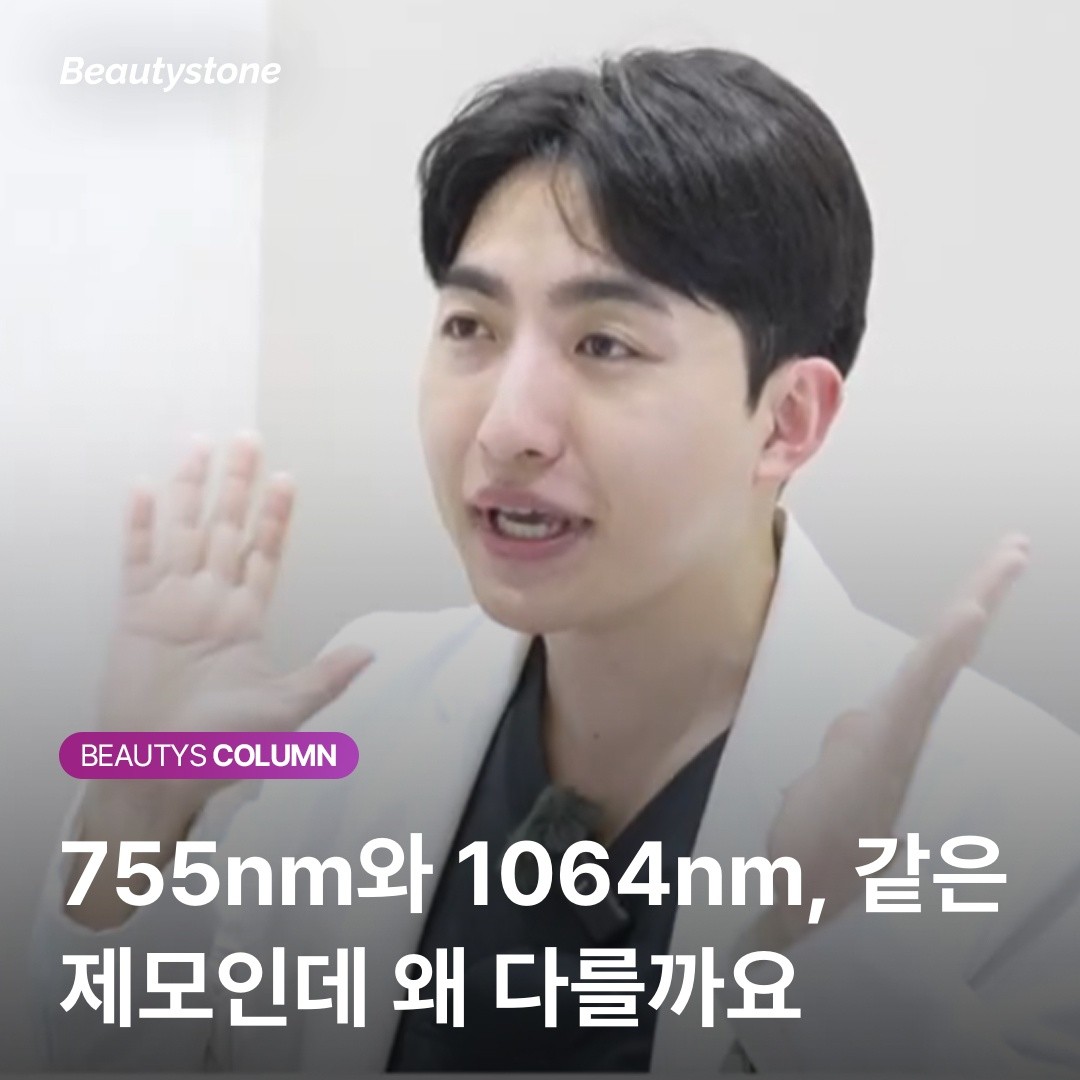
755nm and 1064nm,
same hair removal, so why are they different?
1064nm is the wavelength of an Nd:YAG laser,
and 755nm is the wavelength of an Alexandrite laser.
Both are common devices used for hair removal.
If 755nm has a high melanin absorption rate
and responds quickly to shallow, fine hair,
1064nm has a lower absorption rate but
reaches much deeper layers.
The recently popular
GentleMax Pro Plus
combines these two wavelengths in one device
and lets you choose which one to use by area.

Why does 1064nm reach so deep into
beards? The principle makes it clear
Key point of this article
1064nm is invisible infrared light,
so it goes deeper, like orthopedic knee treatment.
That is why it is more effective than 755nm for hair removal on deep-rooted hair like male beards.
When you hear this,
you may be a little surprised.
Last month, a 30-year-old man came in,
and because the beard under his chin was so dense,
he said he was bothered by the bluish
shadow even after shaving.
When he had 4 sessions at another clinic,
"It did shrink a bit, but the key point is
the shaving shadow is still there"
was how he put it.
1064nm is a wavelength in the
invisible infrared range.
The wavelength used in orthopedics for treating
deep soft tissue in the knee
is in a similar range,
and the reason is the same.
The longer the wavelength, the deeper
it penetrates into the tissue.
Male beard follicles are usually
about 4-5 mm deep,
which is clearly deeper than leg hair (2-3 mm)
or underarm hair.
755nm effectively reaches about
2 mm or so,
but 1064nm can deliver heat
down to a depth of 5 mm.
What surprised me a bit
in this 30-year-old man's case was that,
when he came back after the second session,
he said, "Shaving definitely feels lighter."
To be honest,
I expected it would take about 4 sessions
before he really felt the difference,
but using 1064nm as the main wavelength
and pushing the output a bit more
than 755nm made a big difference.
For areas with deep roots like beards,
just changing the wavelength
can make the effect per session noticeably different.
Director Wi Young-jin's key summary
Even when you get the same hair-removal device,
the reason the effect differs by area
is often not the device itself, but
the choice of wavelength.
For beards, bikini areas, and thick, deep hair,
you need to increase the share of 1064nm
to feel the result session by session.
On dual-wavelength devices,
how you mix them by area
determines the effect.

So if I get 1064 hair removal,
does that mean I'm done?
If you look at this at a glance,
it becomes clearer.
Area / concern | Recommended wavelength | Expected sessions |
Male beard / jawline | 1064nm main | 6-10 sessions |
Bikini / underarms | 1064nm or dual | 5-8 sessions |
Arms / legs (fine hair) | 755nm main | 5-7 sessions |
Darker skin tone | 1064nm recommended | Varies by area |
To briefly go over the session-by-session timeline,
in sessions 1-2, it's just, "Oh, did it reduce a bit?"
by sessions 3-4, thickness and density noticeably decrease,
and after session 5
you move into the maintenance phase.
But it's not all
good news.
1064nm feels a bit more heavy
than 755nm in terms of pain,
and because the output settings are tricky, even with the same device
results vary a lot depending on the practitioner.
That said, for deep-rooted areas like beards and bikinis,
it's well worth putting up with that drawback.
If you've read this far,
this is probably what you're wondering
Q1. I heard that if you have a dark skin tone,
you can't get hair removal. Is 1064nm possible?
This is a bit tricky,
and I can't say, "It is absolutely possible,"
but compared with 755nm, it is much safer
for you to receive.
Because 755nm has a high melanin absorption rate,
the risk of burns and hyperpigmentation increases
on tanned or dark skin tones.
1064nm has a relatively low
melanin absorption rate, so it affects the epidermis less
and makes it easier to target only the follicle.
Last month, a 26-year-old came in,
and because she was outdoors a lot, her skin tone was quite dark,
and she said she had given up on
hair removal.
We started conservatively with
1064nm output,
and she has been progressing well through session 3
without pigment issues.
Q2. I got a 6-session package, but if the effect is insufficient,
how much extra will it cost?
The variation really depends
on the area and hair thickness.
For male beards, it is realistic to start
with an average of 8-10 sessions.
Some people are satisfied with 6 sessions,
but if you want a level where you don't need to shave,
you often need about 4 more sessions.
Fine hair like on the legs and arms
is mostly cleared with 5-7 sessions.
For maintenance, we recommend
1-2 sessions per year.
Additional session costs are set as a per-session rate
depending on the area size,
so before starting a package, it's best to
get a thorough consultation about the expected number of sessions for your area,
which helps reduce mistakes.
Q3. They say folliculitis often happens after the procedure,
does 1064nm cause that too?
To be honest, it has more to do with
the area and aftercare than with the wavelength.
In areas with a lot of sebum and deep follicles,
like beards and bikini areas, folliculitis can appear
within 2-3 days after treatment, regardless of the wavelength used.
As heat energy concentrates in the follicle,
a temporary inflammatory response appears.
It usually calms down in a few days,
but if you squeeze it by hand
or take a sauna or hot shower on the same day, it lasts longer.
For 2-3 days after treatment, just stick to lukewarm cleansing and sunscreen,
and most people get through it
without any trouble.
If you take away just one thing today,
— even with the same hair-removal device, whether the wavelength
reaches deep into the root is what makes the difference.
In the next post, I'll explain 'the difference between men whose beard hair removal is
fully covered by a 6-session package and those who need to go up to 10 sessions.'
Even among men in their 30s, depending on follicle density and depth,
I'll show how the number of sessions changes
with cases.
This has been Wi Young-jin.
GentleMax Pro Plus hair removal treatment details
This month: GentleMax Pro Plus
Read more
Ulthera 300-shot effect, do it only on the cheekbones [Seoul National University specialist]
Cheekbone Ulthera, will it be effective only if you do the whole face?
If you just got Botox, the effect won't show up right away! It differs by area
Frequently asked questions
Q. I heard that hair removal isn't possible for dark skin tones, but is 1064 nm an option?
A. "I can’t say it’s definitely possible," but it can be received much more safely than 755nm.
Q. I purchased the 6-session package, but if the results aren’t enough, how much does the additional cost come to?
A. There is a huge variation depending on the area and hair thickness.
Q. I’ve heard that folliculitis often develops after the procedure. Is that also the case with 1064 nm?
A. To be honest, the area and the treatment method matter more than the type of wavelength.
Q. What is the typical sequence of changes we can expect with each subsequent session of 1064nm hair removal?
A. For the 1st and 2nd sessions, you will notice a slight change. By the 3rd and 4th sessions, the thickness and density of the hair will visibly decrease, and you will enter the maintenance phase after the 5th session. For areas with deep hair roots like beards, we usually recommend starting with an average of 6 to 10 sessions.
1064 Hair Removal Effect,
Why It Differs for Deep Hair Like Beards
Last Wednesday,
a man in his early 30s came to the clinic, stressed because his shaving shadow was very dark.
"At another place, I had Alexandrite
done 6 times, but
my beard didn't really reduce."
This line, in fact,
I hear several times a month in the clinic.
And inside this question,
the core of the 1064 hair removal effect is all there.
755nm and 1064nm,
same hair removal, so why are they different?
1064nm is the wavelength of an Nd:YAG laser,
and 755nm is the wavelength of an Alexandrite laser.
Both are common devices used for hair removal.
If 755nm has a high melanin absorption rate
and responds quickly to shallow, fine hair,
1064nm has a lower absorption rate but
reaches much deeper layers.
The recently popular
GentleMax Pro Plus
combines these two wavelengths in one device
and lets you choose which one to use by area.
Why does 1064nm reach so deep into
beards? The principle makes it clear
Key point of this article
1064nm is invisible infrared light,
so it goes deeper, like orthopedic knee treatment.
That is why it is more effective than 755nm for hair removal on deep-rooted hair like male beards.
When you hear this,
you may be a little surprised.
Last month, a 30-year-old man came in,
and because the beard under his chin was so dense,
he said he was bothered by the bluish
shadow even after shaving.
When he had 4 sessions at another clinic,
"It did shrink a bit, but the key point is
the shaving shadow is still there"
was how he put it.
1064nm is a wavelength in the
invisible infrared range.
The wavelength used in orthopedics for treating
deep soft tissue in the knee
is in a similar range,
and the reason is the same.
The longer the wavelength, the deeper
it penetrates into the tissue.
Male beard follicles are usually
about 4-5 mm deep,
which is clearly deeper than leg hair (2-3 mm)
or underarm hair.
755nm effectively reaches about
2 mm or so,
but 1064nm can deliver heat
down to a depth of 5 mm.
What surprised me a bit
in this 30-year-old man's case was that,
when he came back after the second session,
he said, "Shaving definitely feels lighter."
To be honest,
I expected it would take about 4 sessions
before he really felt the difference,
but using 1064nm as the main wavelength
and pushing the output a bit more
than 755nm made a big difference.
For areas with deep roots like beards,
just changing the wavelength
can make the effect per session noticeably different.
Director Wi Young-jin's key summary
Even when you get the same hair-removal device,
the reason the effect differs by area
is often not the device itself, but
the choice of wavelength.
For beards, bikini areas, and thick, deep hair,
you need to increase the share of 1064nm
to feel the result session by session.
On dual-wavelength devices,
how you mix them by area
determines the effect.
So if I get 1064 hair removal,
does that mean I'm done?
If you look at this at a glance,
it becomes clearer.
Area / concern | Recommended wavelength | Expected sessions |
Male beard / jawline | 1064nm main | 6-10 sessions |
Bikini / underarms | 1064nm or dual | 5-8 sessions |
Arms / legs (fine hair) | 755nm main | 5-7 sessions |
Darker skin tone | 1064nm recommended | Varies by area |
To briefly go over the session-by-session timeline,
in sessions 1-2, it's just, "Oh, did it reduce a bit?"
by sessions 3-4, thickness and density noticeably decrease,
and after session 5
you move into the maintenance phase.
But it's not all
good news.
1064nm feels a bit more heavy
than 755nm in terms of pain,
and because the output settings are tricky, even with the same device
results vary a lot depending on the practitioner.
That said, for deep-rooted areas like beards and bikinis,
it's well worth putting up with that drawback.
If you've read this far,
this is probably what you're wondering
Q1. I heard that if you have a dark skin tone,
you can't get hair removal. Is 1064nm possible?
This is a bit tricky,
and I can't say, "It is absolutely possible,"
but compared with 755nm, it is much safer
for you to receive.
Because 755nm has a high melanin absorption rate,
the risk of burns and hyperpigmentation increases
on tanned or dark skin tones.
1064nm has a relatively low
melanin absorption rate, so it affects the epidermis less
and makes it easier to target only the follicle.
Last month, a 26-year-old came in,
and because she was outdoors a lot, her skin tone was quite dark,
and she said she had given up on
hair removal.
We started conservatively with
1064nm output,
and she has been progressing well through session 3
without pigment issues.
Q2. I got a 6-session package, but if the effect is insufficient,
how much extra will it cost?
The variation really depends
on the area and hair thickness.
For male beards, it is realistic to start
with an average of 8-10 sessions.
Some people are satisfied with 6 sessions,
but if you want a level where you don't need to shave,
you often need about 4 more sessions.
Fine hair like on the legs and arms
is mostly cleared with 5-7 sessions.
For maintenance, we recommend
1-2 sessions per year.
Additional session costs are set as a per-session rate
depending on the area size,
so before starting a package, it's best to
get a thorough consultation about the expected number of sessions for your area,
which helps reduce mistakes.
Q3. They say folliculitis often happens after the procedure,
does 1064nm cause that too?
To be honest, it has more to do with
the area and aftercare than with the wavelength.
In areas with a lot of sebum and deep follicles,
like beards and bikini areas, folliculitis can appear
within 2-3 days after treatment, regardless of the wavelength used.
As heat energy concentrates in the follicle,
a temporary inflammatory response appears.
It usually calms down in a few days,
but if you squeeze it by hand
or take a sauna or hot shower on the same day, it lasts longer.
For 2-3 days after treatment, just stick to lukewarm cleansing and sunscreen,
and most people get through it
without any trouble.
If you take away just one thing today,
— even with the same hair-removal device, whether the wavelength
reaches deep into the root is what makes the difference.
In the next post, I'll explain 'the difference between men whose beard hair removal is
fully covered by a 6-session package and those who need to go up to 10 sessions.'
Even among men in their 30s, depending on follicle density and depth,
I'll show how the number of sessions changes
with cases.
This has been Wi Young-jin.
GentleMax Pro Plus hair removal treatment details
This month: GentleMax Pro Plus
Read more
Ulthera 300-shot effect, do it only on the cheekbones [Seoul National University specialist]
Cheekbone Ulthera, will it be effective only if you do the whole face?
If you just got Botox, the effect won't show up right away! It differs by area
Frequently asked questions
Q. I heard that hair removal isn't possible for dark skin tones, but is 1064 nm an option?
A. "I can’t say it’s definitely possible," but it can be received much more safely than 755nm.
Q. I purchased the 6-session package, but if the results aren’t enough, how much does the additional cost come to?
A. There is a huge variation depending on the area and hair thickness.
Q. I’ve heard that folliculitis often develops after the procedure. Is that also the case with 1064 nm?
A. To be honest, the area and the treatment method matter more than the type of wavelength.
Q. What is the typical sequence of changes we can expect with each subsequent session of 1064nm hair removal?
A. For the 1st and 2nd sessions, you will notice a slight change. By the 3rd and 4th sessions, the thickness and density of the hair will visibly decrease, and you will enter the maintenance phase after the 5th session. For areas with deep hair roots like beards, we usually recommend starting with an average of 6 to 10 sessions.


Latest post
Latest post

Hair Removal
레이저 제모 1회에도 남는 몫이 있어요 — 밀도를 모자이크로 보는 법

Tattoo removal
Why Extremity Tattoos Are Slower to Remove

Tattoo removal
Tattoo Removal Cost: Why Quotes Vary by Area

Tattoo removal
Unused Tattoo Removal Sessions: What Happens?

Lifting
Forehead Thread Lifting: How Far Can It Go?

skin
Skin Booster Prices: What to Check in a Quote
1:1 Custom Approach
1:1 Consultation Whatsapp
🌸 Beautystone Clinic attends the Meditox Bangkok Cadaver Workshop 🌸
1:1 Custom Approach