

Laser toning fades lentigines at first, then stops — pigment sits too deep for toning to reach.
Published -
Updated -

Author
Wi Young-jin · Chief director
Seoul National University College of Medicine · Seoul National University Hospital Specialist
→
Lentigo Laser Toning
Why It May Not Fade Even After 10 Sessions
As winter comes to an end, the clinic begins to
fill with people bringing in dark, spot-like pigmentation.
"I’ve had more than ten toning sessions, but
this one dark spot just won’t fade,"
is something we hear very often.
Today, I’ll walk you through the reason step by step.
One-line conclusion.
Lentigo is pigment with melanin embedded at the base of the epidermis,
so toning alone has clear limitations.
The key deciding factor.
Is the depth of the pigment deeper than the depth reached by toning?
What we’ll cover today.
Why toning is a blind spot for lentigo,
and which procedures deliver faster results.

What exactly is lentigo,
and why doesn’t it fade with toning?
Lentigo is a pigmented lesion in which melanin is embedded
at the base of the epidermal-dermal junction.
Unlike freckles or general pigmentation
that sit more superficially on the epidermis,
lentigo involves melanocyte proliferation in the basal layer,
where they settle and remain in place.
That is why the gentle depth used in toning,
which only stimulates the upper epidermis,
does not deliver enough energy to reach the pigment.
This is a point many people misunderstand,
because not every dark spot is the same type of pigment.
Freckles may lighten after 4 to 6 toning sessions,
while lentigo shows little to no change over the same number of treatments.
That is the reason.

Lentigo Laser Toning,
why is it a blind spot?
Key insight from Dr. Wi Young-jin
Can lentigo really be removed with laser toning alone?
If you treat it too gently, like the epidermis, the melanin remains,
and if you treat it too aggressively, like the dermis,
PIH and indentation can follow.
Lentigo is a blind spot for toning.
People often say that frequent toning makes everything fade, right?
Lentigo is the opposite.
Even if you increase the number of sessions,
there comes a point where it stops lightening.
This is a little tricky,
because toning itself is not a wrong treatment.
Korean skin tones contain a lot of melanin,
so the principle of low energy and multiple sessions is the right approach.
If the energy is raised above the threshold,
rebound pigmentation (PIH) can occur,
and the skin may look duller for more than a month.
But if you only break it up gently like the epidermis,
the melanin in the basal layer remains.
Lentigo is exactly the blind spot caught in between those two extremes.
If you treat it too gently, the melanin remains,
and if you treat it too aggressively, like the dermis,
PIH and indentation can follow.
Lentigo is a blind spot for toning.
My friends often ask about this too when the topic comes up.
"It seemed a little lighter after 5 sessions,
but from session 8 onward, it stayed the same."
This pattern is the most common progression
we see with lentigo.
That happens because the threshold for melanin breakdown hasn’t been reached.
If stimulation stays below that threshold,
increasing the number of sessions will not create change.
Dr. Wi Young-jin’s key summary
Lentigo is not a pigment problem that is solved simply by adding more toning sessions.
If there is no change after 5 to 10 sessions, it is better to change the procedure itself rather than keep repeating the same one.

Which procedure is right for removing lentigo?
Then where do I fit in?
It depends on the depth of the pigment
and how much downtime you can tolerate.
Let’s look at the table first.
Condition | Recommended procedure | Recovery burden |
Mild lentigo + have not tried 4–6 toning sessions | Try toning / pico toning first | None |
Darker lentigo, plateauing with toning | CO2 fractional / Er:YAG | Scabbing for 5–7 days |
Many lesions, mostly small spots | CO2 spot removal + whitening treatment | Scabbing for 3–5 days |
With melasma | Toning for melasma, superficial treatment for lentigo only | Treat separately by area |
For lentigo, a method that lightly removes the surface
and clears down to the pigment-containing base tends to deliver faster results.
It takes longer than freckles,
and you should allow a few days of recovery.
For one month after the scab falls off,
sun protection must be extremely strict.
If you miss this step, PIH can make the area dark again.
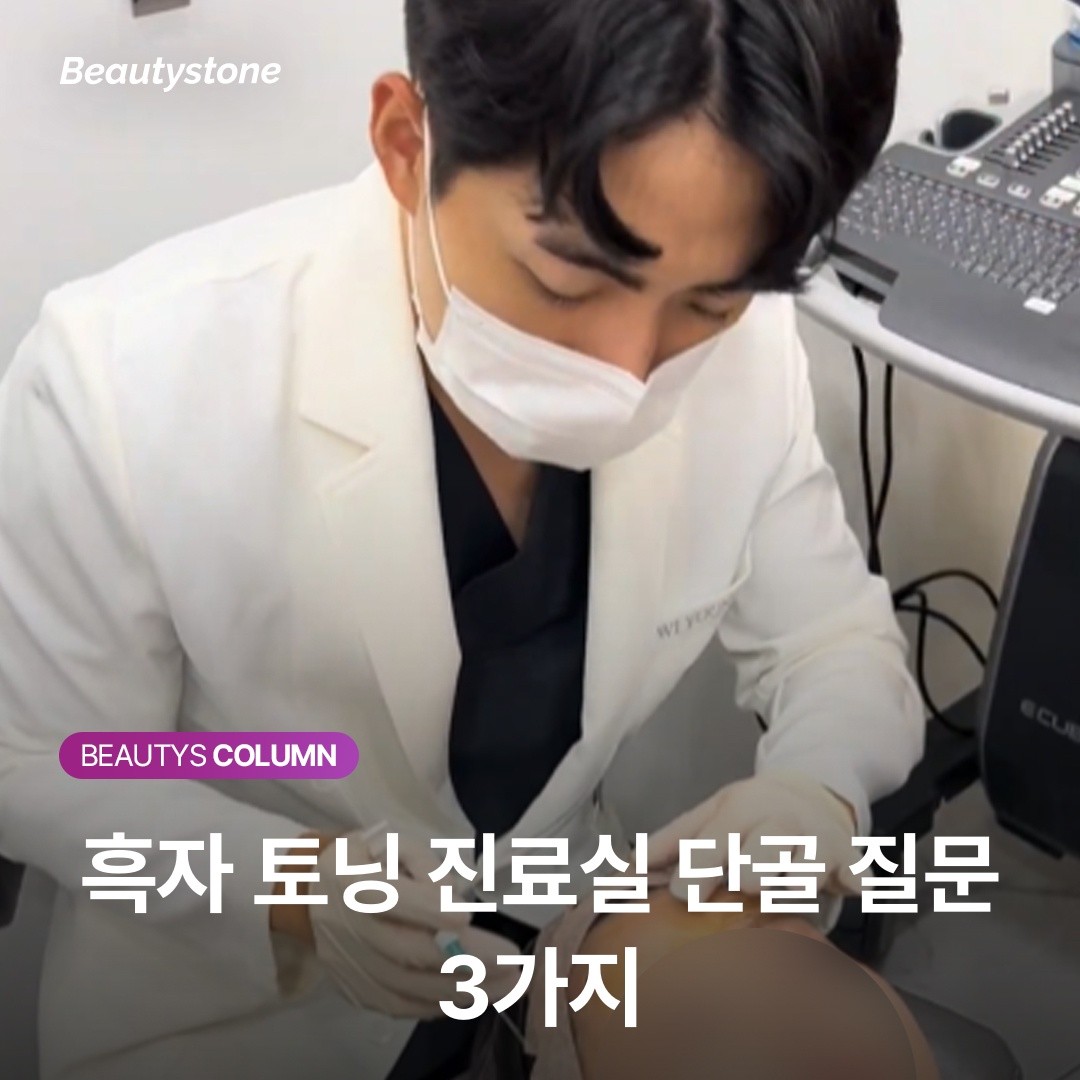
Three common questions in lentigo toning consultations
Q1. If lentigo does not improve after a few toning sessions,
should I switch to another procedure?
A. If you look at community posts,
this is something people ask very often,
and I see similar cases among friends as well.
If you’ve had 4 to 6 toning sessions
and the lentigo area shows almost no change,
that is the time to change the procedure itself.
One patient continued all the way to 12 sessions,
but the last 6 sessions showed no difference on photos.
If you can see the point where improvement stops,
that is the sign of the limit.
Q2. How much does it cost
to remove lentigo in one treatment?
A. This varies a bit from case to case,
and the cost can differ quite a lot depending on the number and size.
Some people with just one or two small spots
can be cleared in a single session,
while others with spots spread across the whole face
may need to be treated over two or three sessions.
The exact cost is best determined after an in-person evaluation,
so we explain it during the consultation.
Q3. If it turns dark again after lentigo treatment,
is that a side effect?
A. The answer is the same regardless of the case.
Darkening within 2 to 4 weeks after the procedure
is not a side effect, but PIH (rebound pigmentation),
and it will fade with time.
However, if you do not protect against UV exposure, it can stay that way.
If you apply sunscreen diligently for a month,
more than 90% of cases settle to a tone lighter than the original.
The key point today is that not every dark spot is the same pigment.
That is the main takeaway.
In the next article, I’ll explain how to manage the first month of PIH after lentigo treatment
so the color does not set in,
and what to watch for.
There are important details that sunscreen alone cannot cover.
This has been Dr. Wi Young-jin.
Frequently asked questions
Q. If dark spot toning doesn’t show any effect after a few sessions, should I switch to another procedure?
A. If you’ve had 4 to 6 toning sessions and the pigmented spots are showing little to no improvement, then it’s appropriate to change the treatment itself at that point.
Q. How much does it cost to remove dark spots in one session?
A. The difference can vary quite a bit depending on the number and size.
Q. If the dark spot turns black again after treatment, is that a side effect?
A. Darkening that occurs 2–4 weeks after the procedure is not a side effect, but PIH (post-inflammatory hyperpigmentation), and it will gradually fade over time.
Q. If I have both lentigines (flat brown spots) and melasma, can they be treated and removed all at once?
A. We usually treat them separately. For melasma, toning is recommended, while for solar lentigo (dark spots), a gentle resurfacing treatment to shave the superficial layer is safer. Using a single method for both risks making one of the conditions darker.
Content



skin
Why Does Fractional CO2 Take Longer to Heal?

Contouring & Volume
How Many cc Does Forehead Filler Need?

skin
Why Is My Skin Oily but Tight in the Fall?

Hair Removal
Underarm Laser Hair Removal Cost: Do the Math

Tattoo removal
Laser Before a Cover-Up: How Many Sessions?

skin
큐어젯 다운타임, 다음 날 출근과 화장은 언제부터 될까요?