

Why collagen drops fast in menopause, the basics to cover first, and boosting options.
Published -
Updated -

Author
Wi Young-jin · Chief director
Seoul National University College of Medicine · Seoul National University Hospital Specialist
→
When you reach menopause, there are suddenly more and more moments when your skin feels quite different from before. One day, you might suddenly notice your cheeks looking sunken and your jawline losing its definition, or even your go-to skincare products just sitting on top of your skin. Because it can be confusing to tell whether this is simple aging or changes unique to menopause, many people feel lost about where to start.
To give you a brief answer, the main driver of menopausal skin changes is the rapid loss of collagen due to declining hormone levels. Therefore, rather than immediately seeking out expensive treatments, a more stable approach is to first focus on basic care that slows down this rate of loss, and then add necessary reinforcement. The starting point is identifying which stage your skin is currently in.
This content compiles treatment information from Beautystone Hapjeong.
In This Article, You Will Discover
Why skin collagen decreases rapidly during menopause
The essential basic care to focus on before seeking expensive clinical treatments
How treatments that reinforce collagen compare and differ
What to look for and check before starting your skincare journey
Why Does Skin Change So Quickly During Menopause?
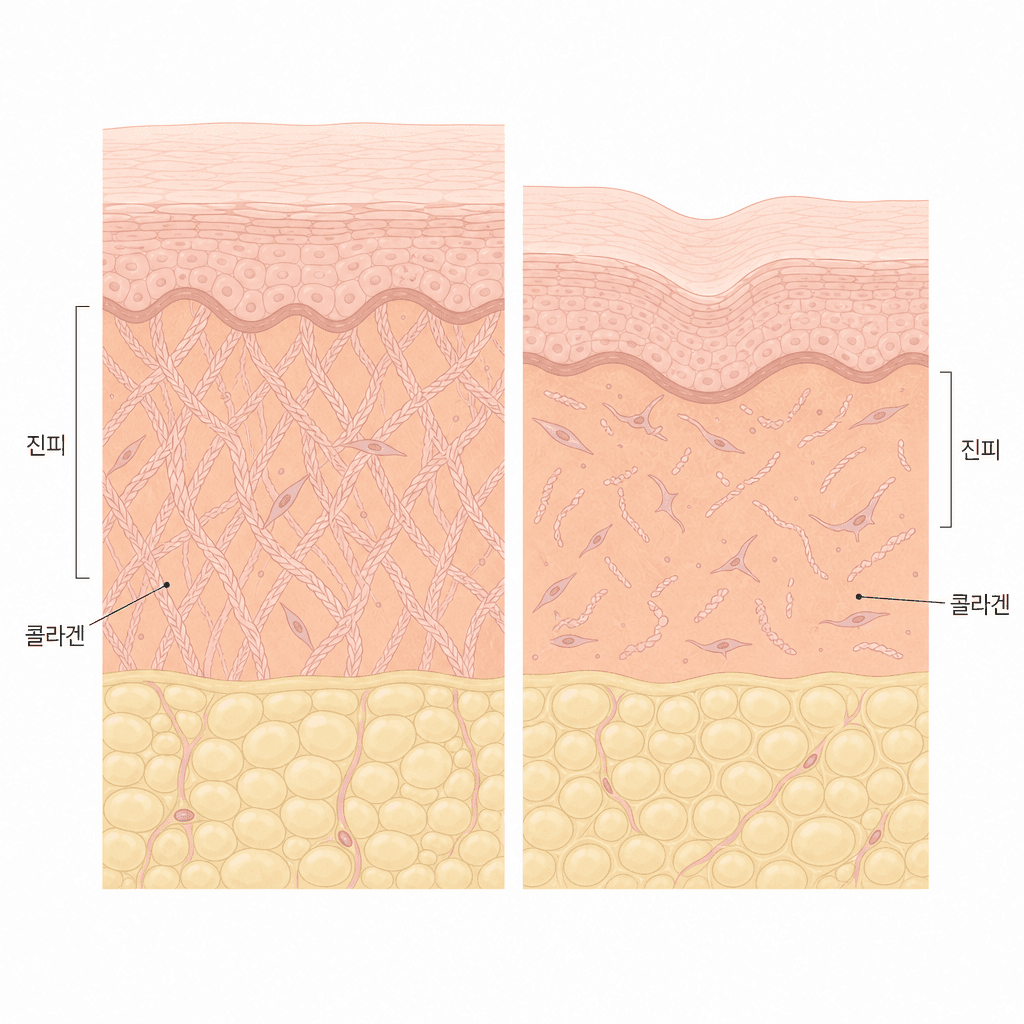
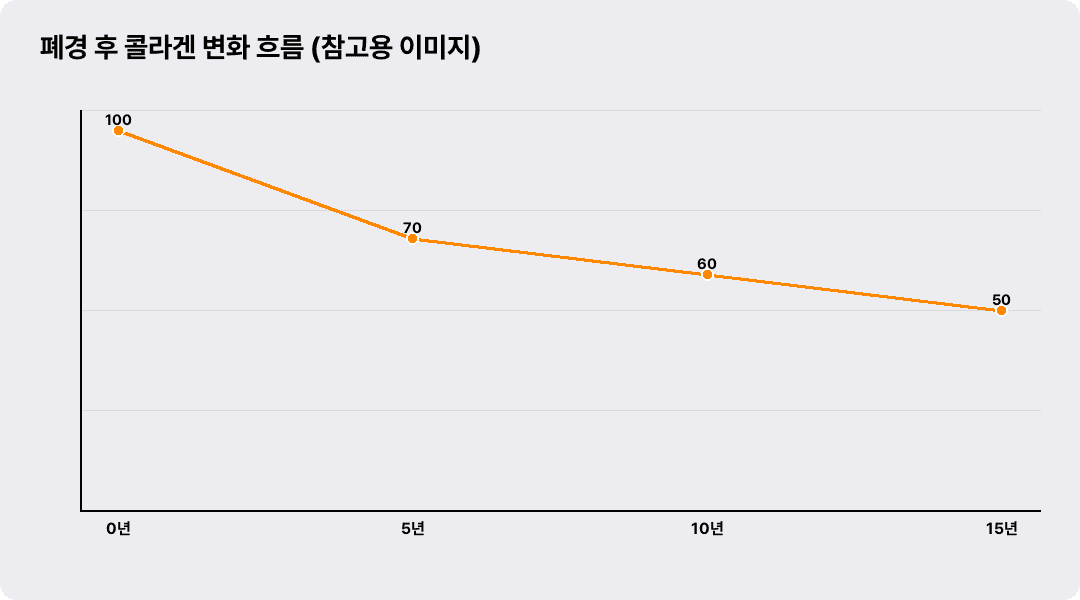
At the heart of menopausal skin changes lies estrogen. Estrogen plays a vital role in supporting the skin's collagen production. When this hormone declines before and after menopause, the rate of collagen production drops while existing collagen breaks down more quickly. In fact, according to studies examining skin collagen changes after menopause, type 1 and type 3 collagen can decrease by up to 30% within the first five years of menopause.
Collagen*: A protein that fills the skin's dermis to support its elasticity and thickness. When it decreases, the skin looks thinner and more saggy.
Estrogen*: A female hormone. It is involved in maintaining skin collagen and moisture. When it decreases around menopause, skin elasticity drops rapidly.
Consequently, even at the same age, many feel their skin changes most rapidly right after menopause. The changes during this period are not simply from "getting older" but have a clear hormonal background, so understanding this flow can significantly ease your worries.
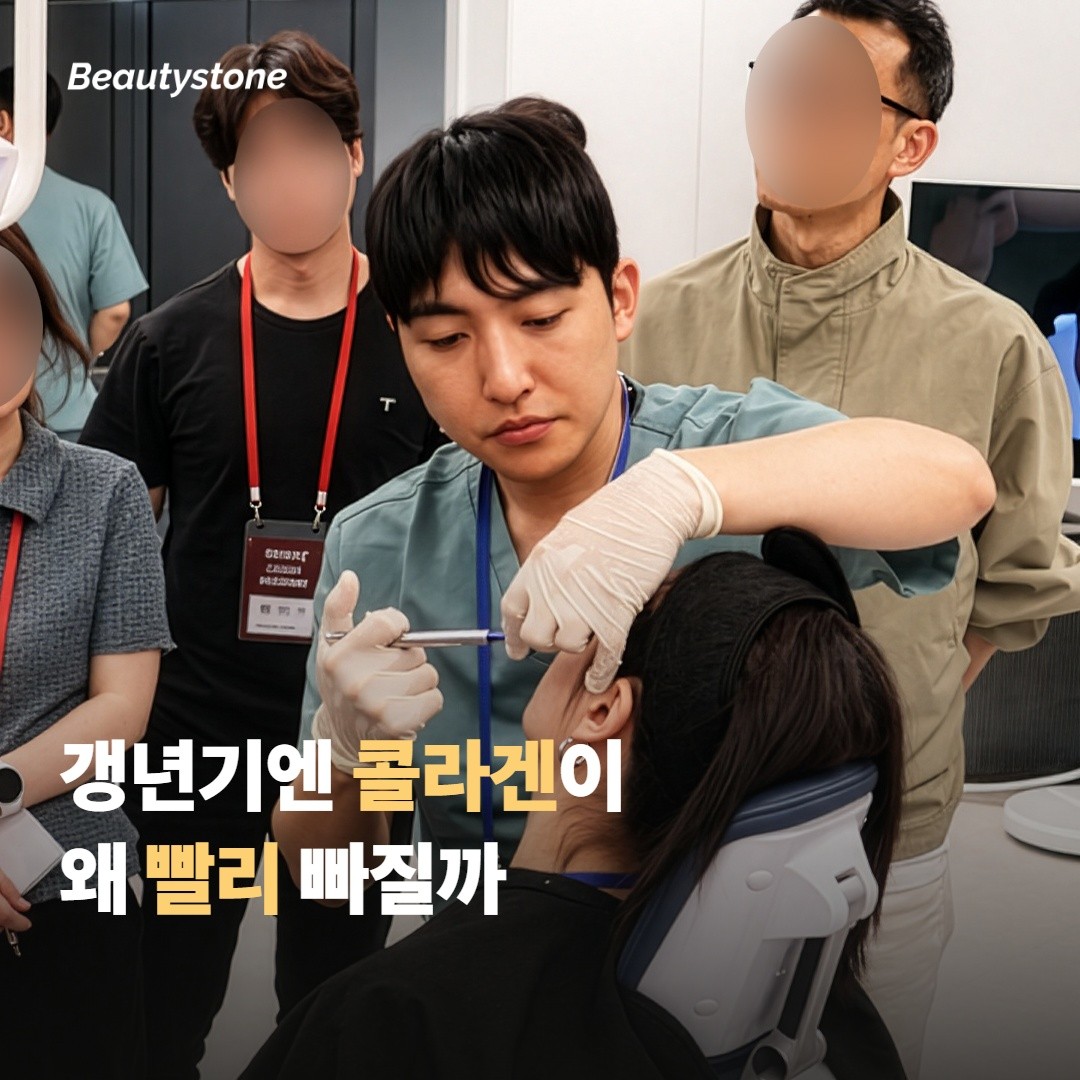
What Are the Basics to Take Care of Before Expensive Treatments?
The period when collagen is being lost is when basic care becomes even more crucial. The very first thing to secure is sun protection. UV rays break down remaining collagen even faster, making sun protection a priority over any clinical treatment for menopausal skin. On top of this, it is best to reinforce the thinned skin barrier with thorough hydration and consistently introduce ingredients that stimulate collagen synthesis.
If these basics are not in place, it is difficult to keep up with the rate of collagen loss, even if you stimulate production through clinical treatments. Therefore, menopausal skin care should be approached with a strategy of "how to slow down the loss" rather than "what to add," building a stable foundation before layering on necessary procedures.

How Are Collagen-Boosting Treatments Categorized?
If sagging or loss of volume remains prominent even after solidifying basic care, you can consider treatments that stimulate collagen. These are generally divided into ultrasound and radio frequency (RF) lifting, which stimulate deep layers with heat energy, and collagen boosters, which inject active ingredients to induce collagen synthesis. Indeed, as demonstrated in studies showing that High-Intensity Focused Ultrasound (HIFU) increases collagen synthesis, thermal stimulation is well-documented to help replenish collagen.
Category | Collagen Boosters | Ultrasound & RF Lifting |
|---|---|---|
Mechanism | Injecting ingredients to induce collagen synthesis | Stimulating deep layers of the skin with heat energy |
Primary Target | Skin volume and texture from within | Sagging and elasticity |
Timeline for Visible Results | A few weeks to a few months | A few weeks to a few months |
However, rather than delivering a dramatic overnight transformation, any of these treatments work gradually to help refill the collagen being lost. Since the ideal combination depends on your skin thickness, degree of sagging, and current basic skin condition, it is highly recommended to decide on the best approach during a personal consultation.

Why Beautystone Hapjeong?
Menopausal skin cannot be addressed with a single treatment; it requires a tailored design that pairs basic care to slow down collagen loss with restorative treatments. At Beautystone Hapjeong, we never rush to recommend collagen boosters or lifting devices. Instead, we first evaluate your current skin stage and basic care habits before deciding together on what to prioritize. As a cozy clinic located within walking distance of Hapjeong Station, we offer a paced approach, allowing you to steadily adjust and care for your skin over multiple sessions rather than trying to fix rapid menopausal changes all at once.
What Should You Check Before Starting Your Care?
For menopausal skin care, establishing the proper order of basic care and clinical reinforcement is key. Checking a few points beforehand will clarify your priorities.
Sun Protection Habits — This is the absolute foundation for preserving your remaining collagen, taking priority over any clinical treatment.
Current Skin Stage — Identify which symptom is most prominent among thinning, sagging, or dryness.
Basic Care Status — The timing of clinical reinforcement depends highly on whether your hydration and sun protection habits are properly established.
Expected Timeline — Visible improvement from collagen synthesis develops gradually over several weeks to months.
Underlying Conditions & Medications — Please let us know during your consultation if you are undergoing any hormone-related therapies or taking medications.
Because the rapid changes of menopause are driven by a distinct biological trigger of hormonal shifts, clinical reinforcements work much better when you first establish basic care to slow down the process. To ensure your safety, it is always best to consult directly with a medical professional to determine which treatments and care plans are appropriate for you.

Frequently Asked Questions
Q. Are lifting treatments always the absolute answer for menopausal skin?
A. While clinical treatments provide excellent reinforcement, basic care like sunscreen and proper moisturizing must come first. Only when habits that slow down collagen loss are established can the benefits of clinical treatments be fully maintained. Depending on your current skin stage, basic care alone may sometimes be sufficient.
Q. Is it impossible to recover the 30% of collagen lost after menopause?
A. While it is difficult to restore it back to exactly how it was, you can certainly slow down further loss with UV protection and partially replenish it through collagen-stimulating treatments. A realistic approach is to focus on slowing the process down and gradually rebuilding, rather than trying to reverse it all at once.
Q. Which should I get first, collagen boosters or lifting treatments?
A. If sagging skin and loss of elasticity are your main concerns, lifting treatments that stimulate deeper layers with heat are often a good starting point. If inner volume and skin texture are your primary worries, collagen boosters are frequently recommended first. Since the optimal path depends on your specific skin condition, it is best to decide after a detailed consultation.
Q. Will my skin improve if I undergo hormone replacement therapy (HRT)?
A. Hormone therapy is decided based on your overall health and medical needs, not solely for skin health. While it can influence skin changes, this matter must be discussed with your gynecologist or specialist, as it is not a decision to be made purely from an aesthetic standpoint.
Related Reading


Hair Removal
레이저 제모 1회에도 남는 몫이 있어요 — 밀도를 모자이크로 보는 법

Tattoo removal
Why Extremity Tattoos Are Slower to Remove

Tattoo removal
Tattoo Removal Cost: Why Quotes Vary by Area

Tattoo removal
Unused Tattoo Removal Sessions: What Happens?

Lifting
Forehead Thread Lifting: How Far Can It Go?

skin
Skin Booster Prices: What to Check in a Quote