

Potenza RF microneedling prices aren't flat fees — they vary by tip type, needle depth, and session count. Here's what's actually driving the quote you get.
Published
Updated

Author
Wi Young-jin · Chief director
Seoul National University College of Medicine · Seoul National University Hospital Specialist
→
One of the most common questions we hear is: "Why did my friend pay X but I was quoted something completely different?" With Potenza RF microneedling, that gap almost always traces back to three things: the tip type, the needle depth setting, and the number of sessions recommended. In this article, we'll cover exactly how those variables shape your quote — so you can walk into a consultation knowing what to ask.
What Is Potenza RF Microneedling?
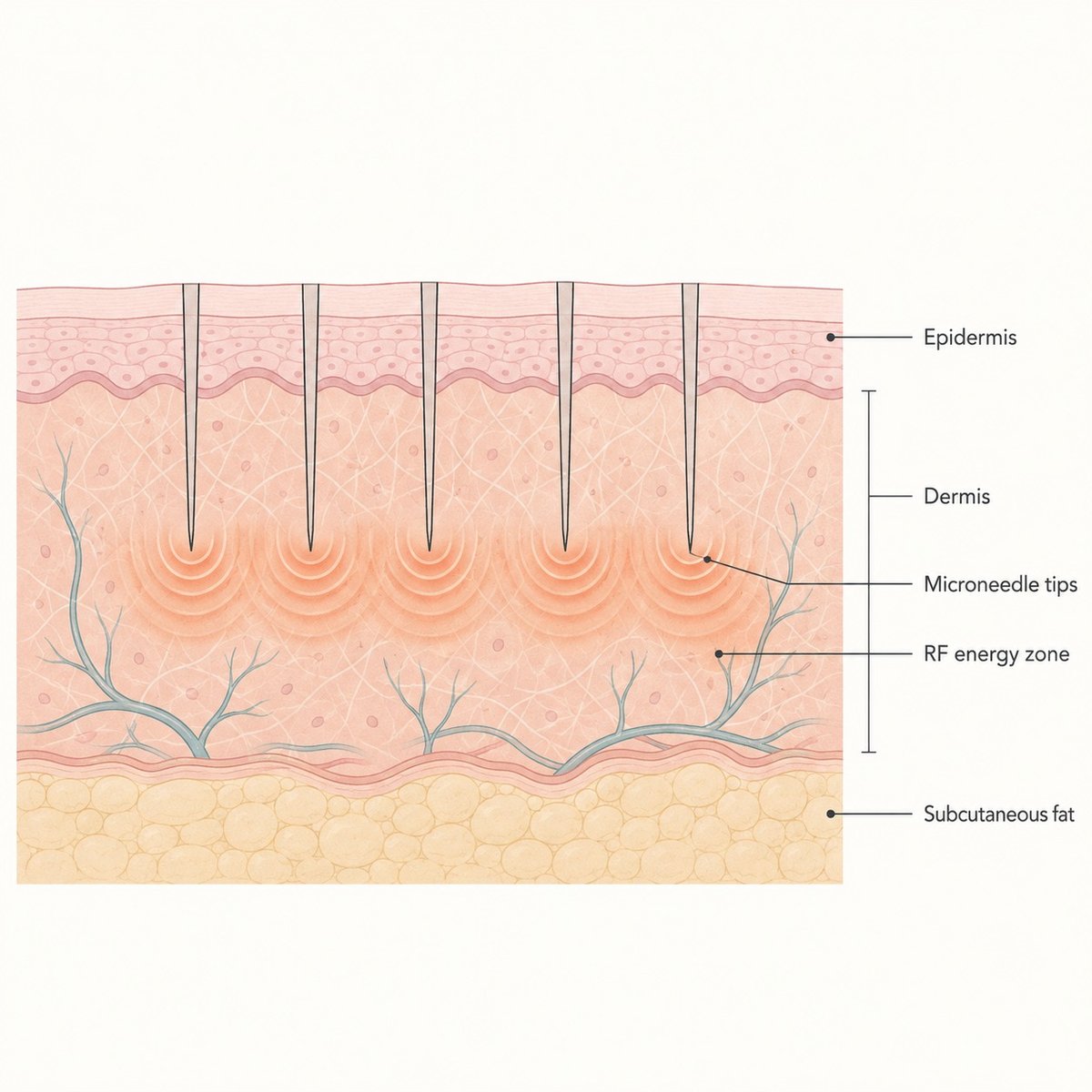
Potenza is a radiofrequency (RF) microneedling device made by Cynosure. It uses a grid of ultra-fine needles to deliver RF energy directly into the dermis — the layer of skin where collagen and elastin fibers live. The combination of mechanical stimulation (from the needles) and thermal stimulation (from the RF heat) triggers the skin's repair response, which may support new collagen formation over time.
Unlike surface-only treatments, RF microneedling works beneath the epidermis. That's why it's often used for concerns like enlarged pores, acne scarring, skin texture irregularities, and mild laxity. Individual results vary, and the degree of improvement depends on your skin type, the settings used, and how many sessions you complete.
How Tip Type Changes What You're Paying For
Here's what most pricing conversations miss: Potenza's tip selection isn't cosmetic — it fundamentally changes what the device is doing to your skin.
The device is compatible with several tip configurations. The two most discussed are the monopolar tip and the bipolar tip, and their energy delivery patterns are genuinely different.
Monopolar tips: RF energy travels from the needle tips through the tissue to a grounding pad. This creates a broader, deeper thermal column and is generally associated with tighter, firmer outcomes. It tends to require more recovery time and is often priced higher because of the energy intensity involved.
Bipolar tips: Energy flows between pairs of needles, creating a more contained thermal zone. This means less heat spread beyond the immediate target area, typically less downtime, and a profile that tends to suit first-timers or those with sensitivity concerns. Pricing is usually lower.
Some providers also use combination modes that shift between monopolar and bipolar within a single session. When you see a price range for Potenza at a clinic, tip selection is often the first variable splitting the low end from the high end. Asking "which tip will you use and why?" is one of the most useful questions you can bring to a consult.
Why Needle Depth Affects Both Results and Cost
Needle depth is measured in millimeters — typically anywhere from 0.5 mm to 4.0 mm depending on the area being treated and the goal. Shallow settings stay closer to the epidermis; deeper settings target the mid-to-deep dermis.
Why does this matter for price? A few reasons.
First, depth requires more careful calibration. Treating the cheeks at 2.5 mm is a different technical challenge than treating under-eye skin at 0.5 mm. A well-trained provider adjusts depth zone by zone across the face, which takes more time and skill — and that expertise is often reflected in the session fee.
Second, deeper settings tend to produce more downtime. If your provider recommends a 3.0 mm pass for acne scarring, you should expect more redness and downtime than a 1.5 mm texture pass. Different protocols can result in meaningfully different experiences, so depth isn't just a line item — it affects how you'll feel afterward.
Third, some zones of the face simply cannot be treated at the same depth as others. The periorbital area (around the eyes) is treated at much shallower settings than the cheeks or jawline. If your concern is primarily fine lines around the eyes, your provider may use a dedicated eye-area protocol that differs from the rest of the face — which can shift the session structure and price.
How Many Sessions Do You Actually Need?
There's no universal answer here, and anyone who gives you one without examining your skin isn't doing you a favor.
That said, general patterns exist. For mild texture concerns or early pores, studies suggest a series of two to three sessions spaced four to six weeks apart tends to show meaningful improvement. For moderate acne scarring, three to four sessions is a more typical recommendation. For skin laxity, results may take longer to become visible and maintenance sessions are often factored into the plan.
What this means practically: when you're comparing prices, a single session quote tells you almost nothing about the total investment. A single session priced lower than a competitor's might still cost more overall if the provider's protocol calls for five sessions instead of three. Ask your provider: "What's your recommended protocol for my concern, and what does the full course cost?"
Package pricing (bundled sessions at a lower per-session rate) is common for RF microneedling. Whether a package makes sense for you depends on how confident you are in proceeding — if you're not sure yet, starting with one session before committing to a bundle is a reasonable approach. Individual results vary.
Side Effects, Downtime, and What to Watch For
Potenza RF microneedling has a well-documented safety profile when performed by trained providers, but it's not without trade-offs. Understanding what's normal versus what warrants a call to your provider is part of informed consent.
Common and expected reactions:
Redness and warmth: Typically appear immediately and usually settle within 24 to 48 hours for superficial passes, longer for deeper settings.
Mild swelling: Especially in thinner-skinned areas like the under-eye region. Usually resolves within one to two days.
Pinpoint marks or micro-crusting: Small scab-like marks at the needle entry points. They typically flake off within a few days. Never pick at them — doing so can increase PIH (post-inflammatory hyperpigmentation) risk.
Temporary dryness or tightness: The skin may feel dehydrated as it heals. Gentle moisturizer is your best friend during this phase.
Less common but worth knowing:
Post-inflammatory hyperpigmentation (PIH), particularly in deeper skin tones. Sun protection before and after treatment significantly lowers this risk.
Temporary purging or breakout-like responses, especially in acne-prone skin. This is typically short-lived but worth discussing with your provider beforehand.
In rare cases, infection at needle entry points — a reason why pre-treatment skin prep and post-treatment hygiene matter.
If you notice spreading redness, fever, worsening pain, or signs of infection beyond the first 24 to 48 hours, seek medical care right away. Like any procedure that breaks the skin barrier, Potenza carries real (if uncommon) risks. A thorough pre-consultation — disclosing medications, skin conditions, and any history of cold sores — is essential.
What Beautystone Includes in the Price Breakdown
Pricing at Beautystone isn't presented as a single number for "Potenza." When you consult at our Hapjeong clinic, the quote you receive reflects the specific tip type planned for your skin, the depth protocol by facial zone, and the recommended number of sessions — listed together rather than buried in fine print.
We don't publish a single flat fee here because the right answer genuinely varies. A young patient with mild pore texture doesn't need the same protocol — or budget — as someone addressing moderate post-acne scarring across the cheeks and temples. Quoting the same number for both would be misleading.
For current session pricing and any active promotions, see /en/price and /en/promotion. All pricing listed is Seoul clinic pricing, subject to change.
The Bottom Line
Here's the short version of everything above:
Potenza pricing varies because it's not a one-size-fits-all procedure — tip selection, depth, and session count all shift the cost.
Monopolar tips go deeper and cost more; bipolar tips have less downtime and are typically priced lower.
Needle depth determines both the depth of your results and how much recovery you should expect.
Session count has the biggest impact on total investment — always ask for the full protocol cost, not just a per-session quote.
Like any procedure, Potenza comes with trade-offs. The potential for real improvement in texture and pore appearance is well-supported, but downtime, multiple sessions, and the need for sun protection are real considerations.
Ultimately, the choice depends on your skin, your goals, and your budget. If you're considering Potenza RF microneedling, a consultation is the best way to get a protocol — and a price — that actually fits your situation. Beautystone is a dermatology clinic in Seoul's Hapjeong area. See current offers at /en/promotion.
Frequently Asked Questions
Q. Does Potenza RF microneedling hurt?
A. Most people describe it as warmth and pressure rather than sharp pain. Topical numbing cream is applied before the session, which significantly reduces discomfort. Monopolar settings at deeper depths tend to feel more intense than shallow bipolar passes, so the experience varies by protocol. Your provider should discuss what to expect for your specific settings.
Q. How many Potenza sessions will I need?
A. It depends on your concern. Mild texture or enlarged pores may respond well in two to three sessions; moderate acne scarring typically calls for three to four. Your provider should outline a full protocol at your consultation rather than recommending a single session with no plan. Individual results vary.
Q. Can I wear makeup after Potenza?
A. Generally, makeup is discouraged for at least 24 hours after treatment — longer if deeper settings were used or if there are visible micro-crusting marks. Most clinics recommend waiting until redness and any pinpoint marks have fully resolved. Ask your provider for their specific post-care guidelines, since protocols can differ.
Q. Is Potenza safe for all skin tones?
A. Potenza can be used across a range of skin tones, but post-inflammatory hyperpigmentation (PIH) risk is higher in deeper skin tones. A careful provider will adjust depth and energy settings accordingly and emphasize sun protection before and after treatment. Discuss your skin tone and any previous PIH history at your consultation.


![[Wi Young-jin] CureJet vs Potenza: cleanse or remodel?](https://framerusercontent.com/images/2raXkXYV4e1v80g7u2Tb6KKkCQ.jpg?width=1080&height=1080)


Contouring & Volume
Hip Dip Filler Before and After: 4 Checks

Body
Potenza Treatment Interval: Why 4 Weeks?

Lifting
Ultherapy Before and After: Why Wait 90 Days?

Contouring & Volume
Belotero Revive Cost: 2cc Price vs. 3 Sessions

skin
Lip Hyperpigmentation Laser: Does It Work?

Contouring & Volume
Men's Forehead Filler: Hollow or Just Lines?