

Sculptra keeps stimulating collagen for months, so gum-invasive dental work is worth planning around. Here’s how to sequence the two sensibly.
Published
Updated

Author
Wi Young-jin · Chief director
Seoul National University College of Medicine · Seoul National University Hospital Specialist
→
You booked your Sculptra session weeks ago. Then the dental office calls to confirm the deep cleaning you had forgotten about, and it lands four days later. Is that a problem?
It’s a more common collision than you’d expect. Sculptra isn’t a treatment that finishes when you walk out the door — it sets off a collagen response that keeps unfolding for months. Anything that stirs up inflammation in the same neighborhood, including dental work that breaks the gum, can make it hard to tell what caused what.
In this article, we’ll cover how Sculptra keeps working after the injection, why gum-invasive dental work complicates the picture, how the two are commonly sequenced, and what to do if they’ve already overlapped.
What Sculptra Actually Does Under Your Skin
Sculptra is an injectable made of poly-L-lactic acid (PLLA) — a biocompatible, gradually resorbable material used in medicine for decades in dissolvable sutures. In the U.S. it’s FDA-approved as an injectable implant, first for facial fat loss and later for facial wrinkles and volume deficits.
Here’s the part that matters for scheduling: Sculptra isn’t a filler in the everyday sense. A hyaluronic acid filler adds volume the moment it’s placed. Sculptra mostly doesn’t. Much of what you see on the day is the sterile water the product is reconstituted in, and that settles within a few days.
The actual result arrives later. PLLA microparticles are deposited in the deep dermis and upper subcutaneous plane, where they sit as a scaffold and provoke a controlled, low-grade foreign-body response. Fibroblasts, the cells that build structural protein, migrate toward the particles and lay down new collagen around them over the following weeks and months. The particles break down gradually, and what remains is your own tissue. Individual results vary, and most people are treated across a series of sessions.
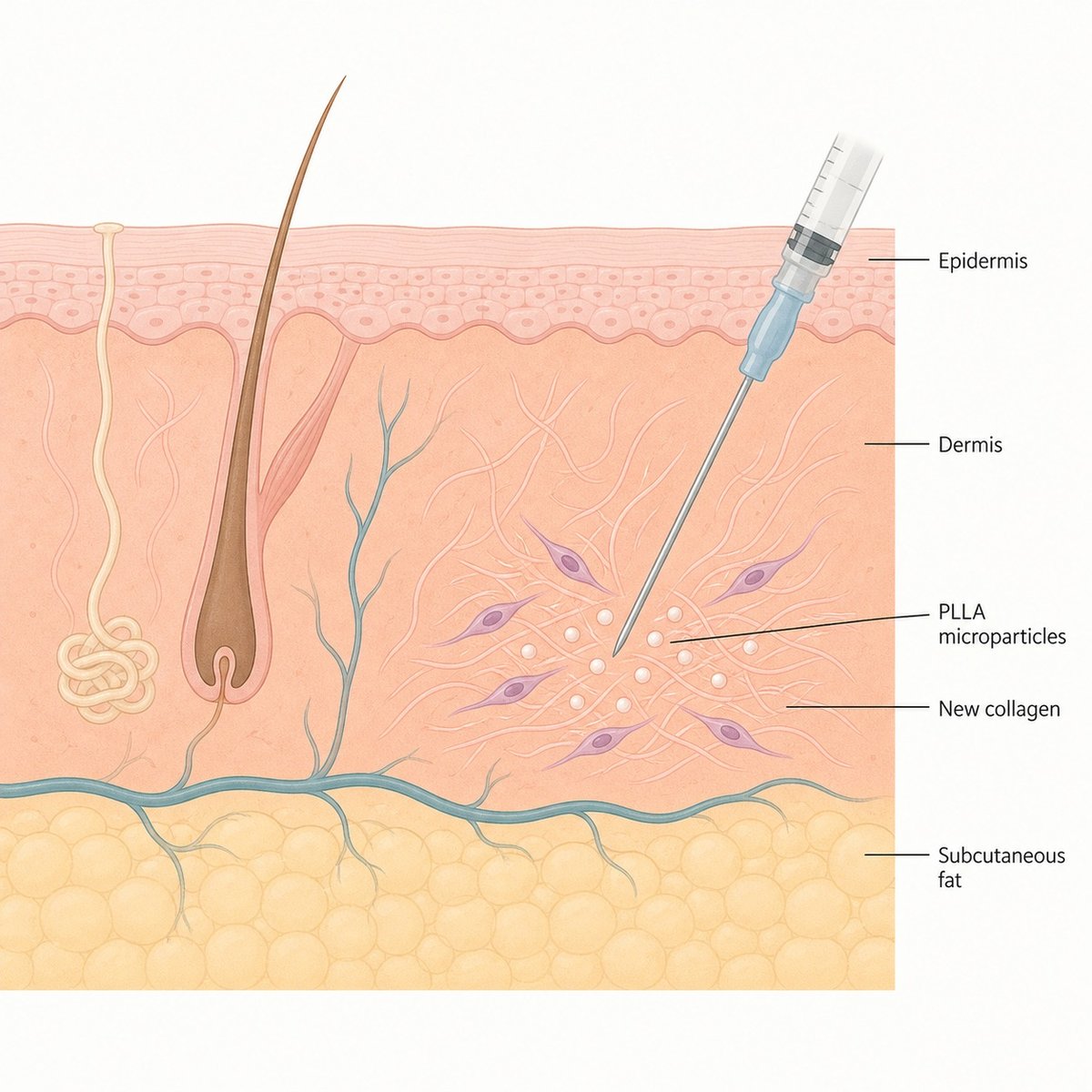
So the honest summary: for a good stretch of time after your appointment, there is active remodeling happening in your face. That’s the intended mechanism, not a complication — but it does mean your tissue stays reactive far longer than a single afternoon.
Why Dental Work Overlaps With a Collagen Stimulator
Not every dental appointment belongs in this conversation, and that distinction does most of the work here.
A polish above the gumline is a surface procedure. Scaling below the gumline, an extraction, periodontal surgery, or implant placement is a different animal — it creates a wound in one of the most bacteria-dense environments in the body. Transient bacteremia, meaning bacteria briefly entering the bloodstream, is a well-described consequence of gum-invasive dental procedures in the published dental literature.
The attribution problem: if a tender lump shows up along your jawline three weeks after both appointments, which one is responsible? Dental infections can present as facial swelling. So can a delayed reaction around injected material. Untangling them afterward is harder than spacing the appointments in the first place.
The trigger question: case reports describe late inflammatory reactions around injectables that appeared to follow a systemic immune event — an infection, a dental procedure, occasionally a vaccination. The literature on delayed reactions to injectable implants discusses these associations, though the evidence is largely observational and the underlying frequency appears low. A plausible mechanism worth planning around, then, rather than a proven chain of cause and effect.
One thing to be clear about: antibiotic prophylaxis before dental work is governed by cardiac and joint-prosthesis guidelines — specific heart conditions, prosthetic valves, certain joint replacements. Dermal fillers and collagen stimulators are not part of those criteria. Having had Sculptra isn’t on its own a reason to ask for preventive antibiotics, and that call belongs to your dentist and physician.
Side Effects and Risks: Delayed Nodules and Why Attribution Gets Hard
Like any injectable, Sculptra comes with trade-offs. Most are short-lived.
Early and common: swelling, redness, bruising, and tenderness at the injection points, typically settling within a few days. Individual results vary, and your provider will tell you what’s expected for the areas treated.
Papules and nodules: small firm bumps under the skin are the side effect most associated with PLLA specifically. They can surface weeks to months after a session, and technique factors such as dilution, injection depth, and product distribution are thought to play a role.
Delayed inflammatory reactions: less common, and this is the one that intersects with dental timing. A previously quiet treated area turns red, swollen, and tender months down the line. Reviews of delayed-onset nodules after injectable treatments describe a range of proposed triggers, including local trauma and systemic inflammatory events. Research indicates these reactions are uncommon, but they aren’t merely theoretical.
Here’s when to stop waiting and call someone: fever, redness that spreads rather than stays put, warmth over the area, a lump that grows quickly or turns sharply painful, discharge, or difficulty opening your mouth. With any of those, seek medical care right away — from your dentist if it reads as dental, from your injector or a board-certified dermatologist if it reads as the treated area.

How Far Apart Should You Space Them?
The short answer? There isn’t one number every provider agrees on, and you should be wary of anyone who presents one as settled guidance. No formal, universally adopted interval has been published for this pairing.
What’s commonly advised in practice is a buffer of roughly two weeks on either side of a Sculptra session for gum-invasive work, with some clinicians preferring longer around larger procedures. Treat that as a working convention rather than a rule — the right answer depends on how extensive the dental work is, how your previous sessions behaved, and what both providers think.
If both are elective and the order is yours to choose, most people find it simpler to finish the dental work first. Dental healing follows a fairly predictable timeline. Sculptra’s response doesn’t.
Routine cleaning above the gumline: generally low-stakes. Many providers don’t treat it as a conflict at all, though some like a few days of separation.
Deep scaling or root planing: this goes below the gumline and counts as gum-invasive. A buffer is commonly suggested, and it’s reasonable to ask for one.
Extraction, implant, or periodontal surgery: the most invasive end. If you can complete this and let it heal before starting Sculptra, that’s the cleanest sequence.
Emergency dental care: go. An abscess or a fractured tooth outranks injectable scheduling every time. Tell the dentist what you’ve had and when, then let them treat you.

What to Do If the Two Already Overlapped
First, the reassuring part: most overlaps pass without incident. What helps is a little record-keeping, because if something does come up, the details are exactly what both providers will ask for.
Write the dates down: the Sculptra session, the dental appointment, and which side of the mouth was worked on.
Take a photo: a neutral, well-lit shot of your face today beats a memory three weeks from now.
Tell each provider about the other: your dentist doesn’t automatically know about the injectable, and your injector doesn’t know about the extraction.
If a lump does appear, resist the urge to manage it yourself. Aggressive massage, heat, and squeezing don’t help and can make an inflamed area angrier. Book an appointment instead. Your provider will want to work out whether what they’re feeling is inflammatory, infectious, or simply product that settled unevenly, because those three are handled differently.
And if you were treated in Seoul and you’re now back home, that doesn’t leave you stranded. A local dermatologist can assess a nodule perfectly well, and a treatment record listing the product, dates, and volumes makes their job easier. Ask for it before you fly.
Questions Worth Asking Both Providers
A short list you can carry into either appointment.
For your injector: how long should I leave between this session and gum-invasive dental work, and does that change if I need an extraction?
For your injector: what should a normal bump feel like at week four, and what would make you want to see me sooner?
For your dentist: does this appointment go below the gumline, or is it a surface cleaning?
Neither provider can read the other’s chart. You’re the connection between them — a mildly annoying role to be handed, but a useful one.
The Bottom Line
Sculptra’s appeal and its scheduling quirk come from the same place: it works slowly, through your own collagen, over months rather than minutes.
The reaction is long: collagen remodeling continues for weeks to months after each session.
Gum-invasive work is what to plan around: scaling below the gumline, extractions, and implants — not a routine surface polish.
Common practice, not published rule: a buffer of about two weeks either side is often advised, but it varies by provider.
An overlap isn’t an emergency: record the dates, photograph your face, tell both providers, and get anything new assessed.
Like any procedure, Sculptra comes with trade-offs, and no amount of clever scheduling erases them. What good scheduling does is keep the picture readable.
Ultimately, the choice depends on your skin, your timeline, and what your dentist and your injector each need from you. If you’re considering Sculptra, a consultation is the best way to work out what fits your face and your calendar. Beautystone is a dermatology clinic in Seoul’s Hapjeong area — you can see current offers on our promotions page.
Frequently asked questions
Q. How long after Sculptra can I get a dental cleaning?
A. A routine polish above the gumline is usually treated as low-stakes, and many providers don’t consider it a scheduling conflict at all. For deep scaling or anything that goes below the gumline, a buffer of roughly two weeks on either side is commonly advised — though that’s a working convention rather than a published guideline. Mention the appointment to your injector before you book, and let them tell you what they prefer.
Q. Do I need antibiotics before dental work because I’ve had Sculptra?
A. Not for that reason. Antibiotic prophylaxis before dental procedures is decided by cardiac and joint-prosthesis criteria — specific heart conditions, prosthetic valves, and certain joint replacements. Cosmetic injectables aren’t part of those criteria. Your dentist and physician make that call from your medical history, so tell them what you’ve had and let them decide.
Q. Can dental work cause a Sculptra lump months later?
A. It hasn’t been established as a direct cause. Case reports and reviews describe delayed inflammatory reactions around injectables that followed systemic events such as infections or dental procedures, which makes a link plausible and worth planning around. Research indicates these reactions are uncommon. If a treated area turns red, swollen, or tender weeks or months later, get it assessed rather than waiting it out.
Q. Should I tell my dentist I’ve had Sculptra?
A. Yes, and tell your injector about the dental work too. It usually doesn’t change what either of them does on the day, but it changes how quickly they can interpret facial swelling if it turns up. Bring the dates and the product name with you. That one piece of information saves a lot of guesswork later.




Contouring & Volume
Hip Dip Filler Before and After: 4 Checks

Body
Potenza Treatment Interval: Why 4 Weeks?

Lifting
Ultherapy Before and After: Why Wait 90 Days?

Contouring & Volume
Belotero Revive Cost: 2cc Price vs. 3 Sessions

skin
Lip Hyperpigmentation Laser: Does It Work?

Contouring & Volume
Men's Forehead Filler: Hollow or Just Lines?