

Does Thermage FLX dissolve filler or shorten Botox? Here's the timing guide.
Published -
Updated -

Author
Wi Young-jin · Chief director
Seoul National University College of Medicine · Seoul National University Hospital Specialist
→
One of the most common questions we hear at Beautystone is from people who already have filler or Botox in place and want to add a radiofrequency lifting treatment. The concern makes sense: if Thermage FLX delivers heat deep into the dermis, could it melt the filler you spent money on, or cut your Botox short?
The reassuring reality is that combining these procedures is done routinely, and the available evidence suggests it's safe when sequenced correctly. In this article, we'll cover what Thermage FLX's heat actually does to settled filler and Botox, what the research shows, and how to plan the order and interval between procedures so you get the best outcome from both.
What Is Thermage FLX, and How Deep Does the Heat Go?
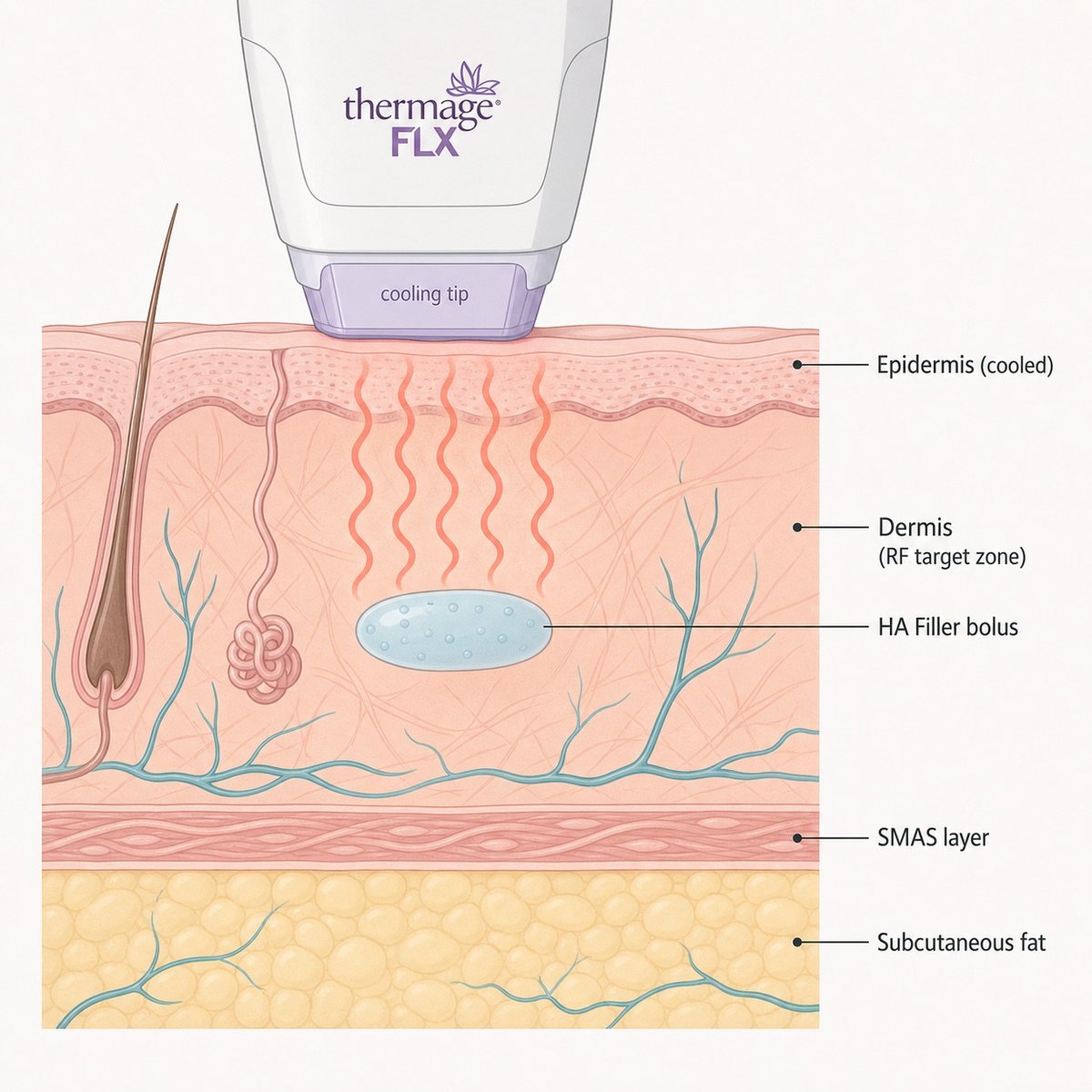
Thermage FLX uses monopolar radiofrequency (RF) energy to heat tissue from the deep dermis down into the subcutaneous layer. The device's cooling tip protects the skin surface while the RF warms deeper collagen-containing tissue to around 65–70°C — a temperature range that triggers collagen remodeling and tissue tightening over the following months.
Here's why depth matters for this question: hyaluronic acid (HA) filler is injected into the mid-to-deep dermis or the superficial subcutaneous plane depending on the treatment area. That puts filler and Thermage FLX's working zone in overlapping territory. Botox, by contrast, acts at the neuromuscular junction and doesn't occupy a distinct tissue plane the way filler does.
Does Thermage FLX Dissolve Filler or Make It Fade Faster?
Studies have looked at how RF energy affects hyaluronic acid structure and found that the heat levels Thermage FLX generates can influence HA cross-linking to some degree (see study). In practice, though, the clinical picture is more nuanced.
The key variable isn't whether heat touches filler — it's whether the filler has fully settled when the heat arrives.
Freshly injected filler (under two to four weeks old) is still integrating into tissue. At this stage, it's more susceptible to displacement or accelerated breakdown from external stimuli, including heat. Most practitioners agree that delivering RF energy over fresh, unset filler isn't ideal.
Settled filler (four weeks or more post-injection) has integrated into the surrounding tissue matrix. Research combining RF-based treatments with established filler has generally found this to be safe in a clinical setting (see study). Some practitioners theorize that heat could modestly accelerate HA metabolism over time, but large-scale clinical evidence for meaningful early filler loss in this context is limited. Individual results vary.
What About Botox? Can Thermage FLX Reduce Its Duration?
Botulinum toxin works differently from filler — it's not sitting in a tissue plane waiting to be displaced. It binds at the neuromuscular junction and doesn't behave like a physical gel under heat.
That said, there's a theoretical concern that localized heat could accelerate the metabolic clearance of botulinum toxin in the area, potentially shortening duration. The available evidence on this is limited, and most injectors who combine these treatments routinely don't report it as a significant real-world problem. Letting Botox fully take effect before layering Thermage FLX on top — typically two weeks — is the sensible precaution.
Side Effects and Risks: What to Know Before Combining
Combining Thermage FLX with filler or Botox is generally considered low-risk when sequenced correctly. Here's the full picture of what can go wrong, from the routine to the genuinely important.
Common and expected from Thermage FLX itself: Redness, mild swelling, and transient tenderness in the treated area are the things to plan for. These typically settle within one to three days. If they're worsening rather than improving, contact your provider.
Theoretical combination risks:
Filler displacement: Heat applied over freshly placed, unset filler could theoretically shift its position — which is why the two-to-four-week wait after injection matters.
Accelerated HA breakdown: RF heat could modestly speed up the metabolism of hyaluronic acid in the treated zone, possibly shortening filler duration in some individuals.
Shortened Botox effect: Local metabolic acceleration from heat may reduce Botox duration in some cases, though this isn't well-documented in the literature.
Seek medical care right away if you notice fever, spreading redness, severe pain out of proportion to the procedure, or any skin changes suggesting a vascular issue. These aren't sequencing problems — they're signs that something else is happening and need prompt evaluation.

Sequencing Guide: Order and Timing for Best Results
Here's a practical reference for the most common combinations. These are general guidelines — your provider's judgment based on your anatomy and treatment amounts takes priority.
Combination | Recommended order | Suggested interval |
|---|---|---|
Filler → Thermage FLX | Filler first | Wait 4–6 weeks after filler before Thermage FLX |
Thermage FLX → Filler | Thermage FLX first | Wait 2–4 weeks after Thermage FLX before filler |
Botox → Thermage FLX | Botox first | Wait 2 weeks after Botox (let it fully take effect) |
Thermage FLX → Botox | Thermage FLX first | Wait 1–2 weeks after Thermage FLX before Botox |
A popular sequencing strategy is to do Thermage FLX first and filler second. The rationale: Thermage tightens the structural foundation, and filler then adds volume where the skin needs it — working with a more defined canvas. Some practitioners also note that injecting filler into tissue that's been stimulated by RF may promote better integration, though this hasn't been formally studied.
Same-day combination is practiced by some experienced injectors in specific cases, but it's not the default recommendation. If you're considering it, the conversation with your provider should include exactly what filler, how much, and in which area — the calculus is different for a small chin touch-up versus a full midface volume restoration.
Who's a Good Candidate, and Who Should Wait?
Most people who have existing filler or Botox are fine candidates for adding Thermage FLX — provided the injected product has had time to settle. The cleaner question is timing, not eligibility.
You'll want to wait or have a more detailed conversation first if:
Your filler is less than four weeks old: the settling period matters. Don't rush it.
You have a pacemaker or internal metal implants in the treatment area: RF energy is contraindicated.
You're pregnant or breastfeeding: both filler and RF lifting are typically deferred.
You have active infection or inflammation in the treatment area: wait until the skin is calm.
You have a large volume of filler in place: the more material is present, the more nuanced the risk assessment. Discuss specifics with your provider.
Individual results vary, and the right combination and timing depend on your skin, the amount and type of product in place, and your goals.
The Bottom Line
Thermage FLX doesn't dissolve settled filler or meaningfully shorten established Botox when sequenced correctly. The evidence and the clinical track record both support combining these procedures safely. The recap:
Settled filler (4+ weeks): generally safe to treat with Thermage FLX. Freshly placed filler needs time to integrate first.
Botox: let it fully take effect (around 2 weeks) before adding RF heat on top.
Preferred order: many practitioners favor Thermage FLX first, filler second — but both directions work with the right interval.
Same-day combination: possible in specific cases, not the standard approach.
Like any combination of procedures, the right answer depends on your skin, your existing treatments, and how much of each product is in place. Individual results vary.
If you're thinking through how to add Thermage FLX to what you already have in place, a consultation is the best way to map out a sequence that makes sense for you. Beautystone is a dermatology clinic in Seoul's Hapjeong area — see current offers at /en/promotion. If something doesn't look or feel right after a procedure, talk to your provider rather than waiting it out.
Frequently asked questions
Q. Can Thermage FLX dissolve my filler?
A. Not in any clinically meaningful way when filler has had time to settle — typically four weeks or more. Research shows RF heat at Thermage FLX's operating temperatures can affect HA cross-linking to some degree, but established, integrated filler in clinical practice has generally been shown to be safe under RF treatment. Freshly injected filler (under two to four weeks) is a different story and should be given time to integrate before any heat treatment. Individual results vary, so discuss specifics with your provider.
Q. Will Thermage FLX make my Botox wear off faster?
A. There's a theoretical argument that localized heat could accelerate metabolic clearance of botulinum toxin, potentially shortening its duration. In practice, most injectors who routinely combine these treatments don't report this as a significant clinical problem. The sensible precaution is to let Botox fully take effect — usually about two weeks — before doing Thermage FLX in the same area. Individual responses vary.
Q. Should I do Thermage FLX before or after filler?
A. Many practitioners prefer Thermage FLX first, filler second. The logic is that RF tightens the structural framework first, and filler then fills volume gaps in that firmer canvas — often producing a more natural result. The reverse order also works with the right interval (waiting four to six weeks after filler before Thermage FLX). Both directions are used in practice; your provider will recommend based on your anatomy and treatment goals.
Q. Can Thermage FLX and filler be done on the same day?
A. Some experienced practitioners do combine them on the same day in specific cases, but it's not the standard recommendation. The variables that matter are the type and amount of filler, the treatment area, and whether the provider is set up to manage any interactions. If you're considering same-day treatment, that conversation should happen in detail with your provider beforehand rather than as a last-minute add-on.


Hair Removal
레이저 제모 1회에도 남는 몫이 있어요 — 밀도를 모자이크로 보는 법

Tattoo removal
Why Extremity Tattoos Are Slower to Remove

Tattoo removal
Tattoo Removal Cost: Why Quotes Vary by Area

Tattoo removal
Unused Tattoo Removal Sessions: What Happens?

Lifting
Forehead Thread Lifting: How Far Can It Go?

skin
Skin Booster Prices: What to Check in a Quote