

Want to prevent scars from pimples? Start while red marks are still healing: regenerative ointment plus daily sunscreen, and in-clinic care for deep acne.
Published
Updated

Author
Wi Young-jin · Chief director
Seoul National University College of Medicine · Seoul National University Hospital Specialist
→
Can you prevent pimple scars before they form?
Yes, in many cases, if you act while the mark is still red. The red mark a pimple leaves behind is not a finished scar yet. The skin is still healing underneath. If you care for it at this stage with a regenerative ointment and daily sunscreen, you can often stop it from hardening into a dented scar.
There are limits. Skin that was already deeply damaged may keep some trace whatever you do. If acne keeps coming back in the same spot or the inflammation was deep, ointment alone is usually not enough, and combining in-clinic procedures such as PDT or laser toning tends to work better.
Quick answers before you read
Q. Won't red marks just fade if I leave them alone?
A. Some do fade on their own. But managing them with a regenerative ointment at this stage can effectively keep them from turning into scars.
Q. Isn't laser after the scar forms the right way to treat acne scars?
A. Preventing scars at the red-mark stage usually gives much better results than treating them once they have formed.
"If you manage healing red marks with a regenerative ointment, you can prevent scars."
— Dr. Wi Young-jin (Beautystone Clinic, Hongdae)
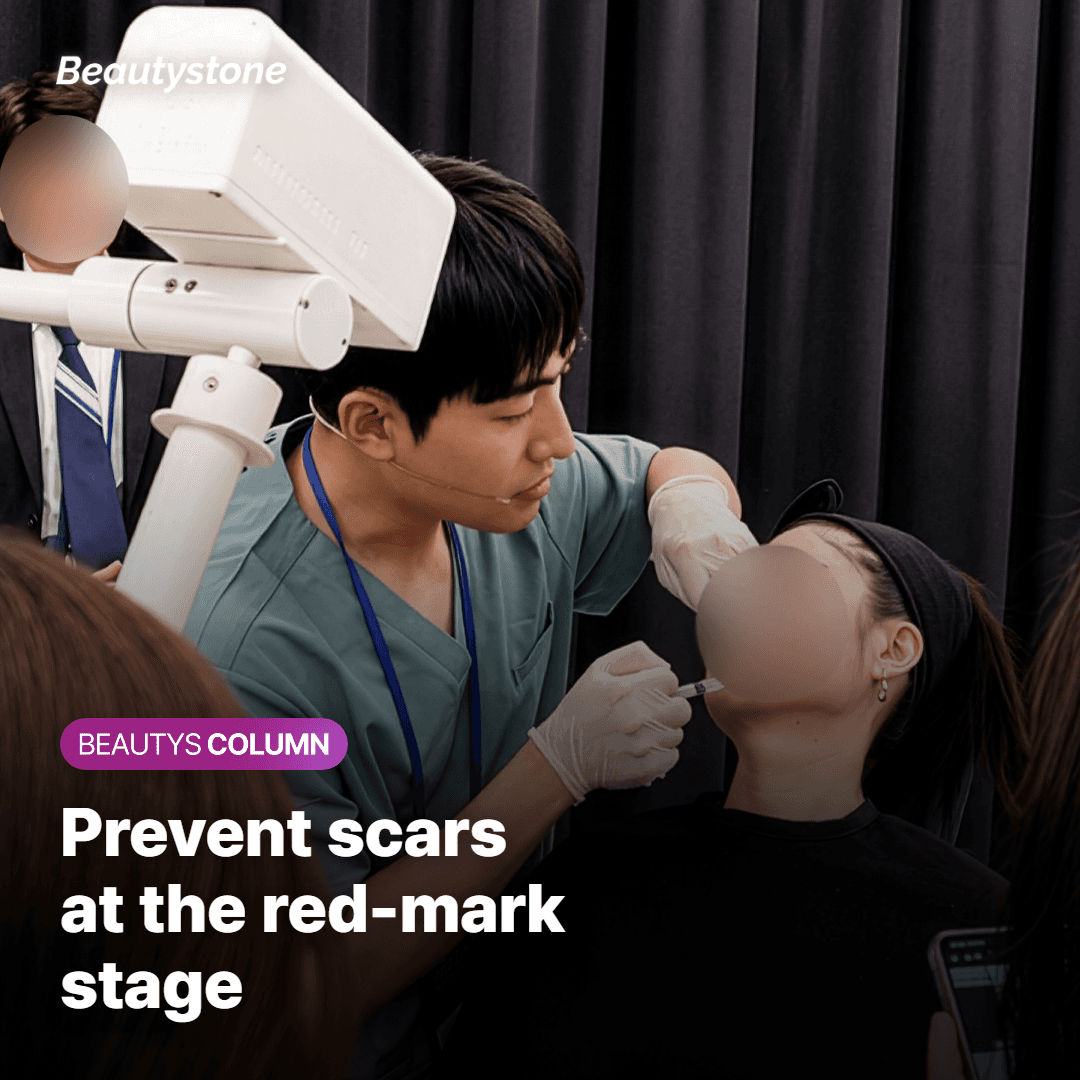
Red mark or real scar: what is the difference?
Acne scars form when acne damages the skin and the tissue heals unevenly. What is left behind can be a dent, discoloration, or a bumpy texture.
A red mark is different. It is simple discoloration on skin that is still recovering. A true scar means the collagen structure in the dermis itself has changed shape. That is why real scars are much harder to treat than red marks.
So the question is not only "how do I get rid of acne scars." It is "how do I keep this red mark from becoming one."
Why the red-mark stage is the window that matters
When people think about preventing pimple scars, most start with one rule: don't squeeze pimples. That is true. But there is something many people miss.
After a pimple breaks, the red-mark stage it leaves on the surface is the real golden time for scar prevention.
Right after a pimple breaks, the skin goes into recovery mode. The dermis starts making new collagen. Whether that process runs in an orderly way decides whether the skin heals smooth or a dented scar stays behind.
A red mark means recovery is still in progress. Collagen has not finished rearranging. It is an unstable stage that can still go either way.
Applying a regenerative ointment at this point seals the skin barrier. That cuts down moisture loss and inflammatory irritation while the skin heals. As a result, collagen fills in more evenly, and clearly more cases recover without a dent.
If you leave it alone instead, outside stress such as UV, friction, and dryness piles on. Damage in the dermis gets worse, and the collagen structure collapses and hardens. That is a depressed scar.

To be honest, one regenerative ointment cannot prevent every scar. When the skin is already deeply damaged, some trace may remain no matter how you care for it.
Still, compare people who started care at the red-mark stage with people who let it pass, and the rate of progression to dents is noticeably different. Based on the cases seen at our clinic, those who began care from the red-mark stage had a clearly lower rate of depressed scars.

Dr. Wi Young-jin's key point:
A red mark is not "a trace that is already left behind."
It is "skin that is still recovering."
If you lock in moisture and calm inflammation with a regenerative ointment now, collagen can fill in evenly and the mark is less likely to harden into a dented scar.
Preventing a scar at the red-mark stage is much easier than treating it later, and the results tend to be better too.
Which care fits your red marks?
At the red-mark stage you have three basic choices: do nothing, use a regenerative ointment alone, or pair the ointment with in-clinic procedures.
The tricky part is that the right choice differs from person to person. Skin thickness, how deep the inflammation went, and your acne type should all shape the approach.
Care method | Suitable cases | Scar prevention effect | Notes |
|---|---|---|---|
Leave it alone (do nothing) | Very shallow inflammation | Low | Risk of scarring with UV and dryness exposure |
Regenerative ointment alone | Superficial acne, shallow red marks | Moderate to high | Watch for clogged pores while acne is active |
Regenerative ointment + sunscreen | Most red-mark stages | High | Sunscreen every day until recovery is complete |
Regenerative ointment + in-clinic procedures | Deep inflammation, recurring cases | Highest | Check skin condition right after the procedure before applying ointment |
It depends on the case, but this is the usual starting point. If only red marks remain, the first recommendation is regenerative ointment plus sunscreen. Using just these two well is often enough to keep marks from turning into dents.
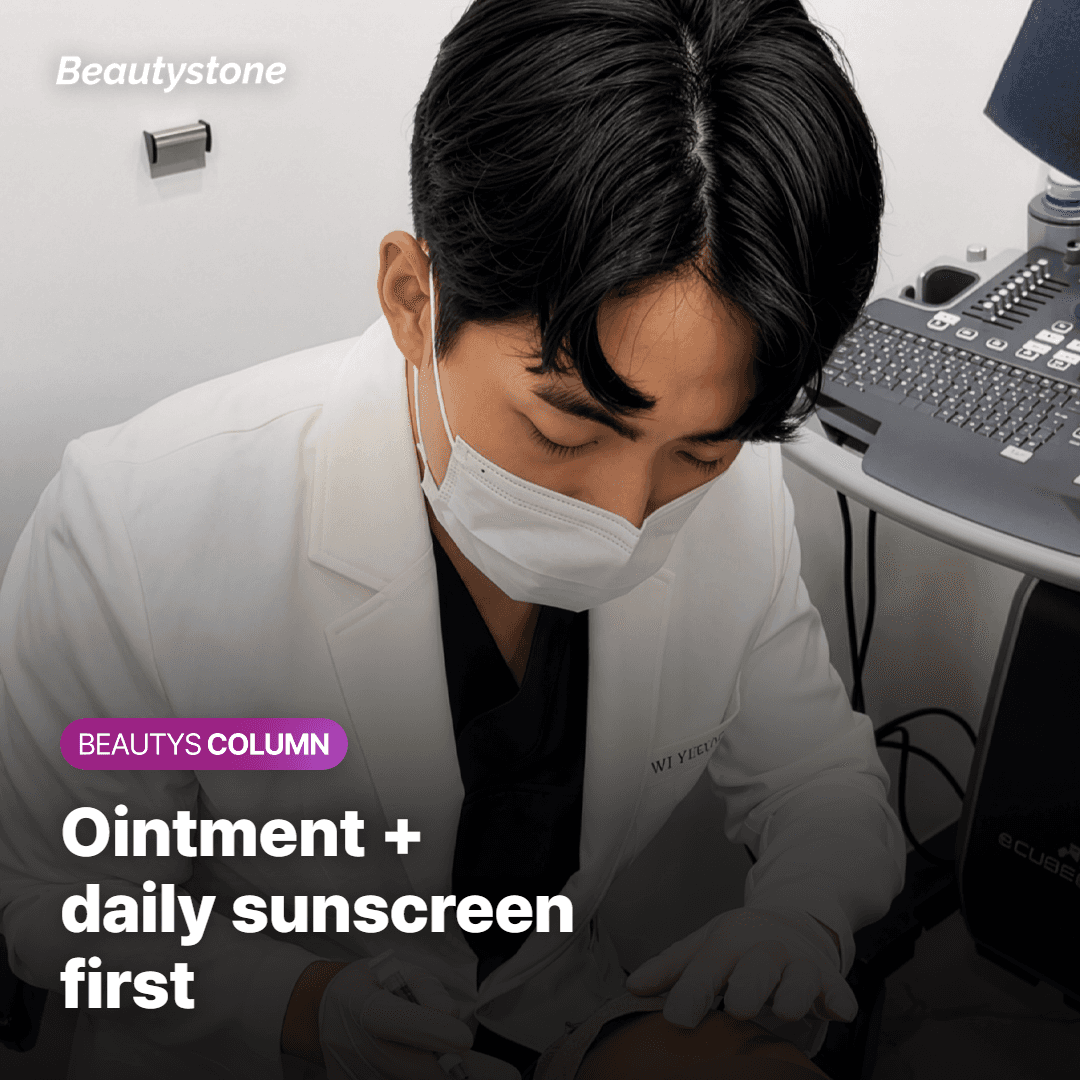
When is ointment alone not enough?
Ointment has limits in two situations: acne keeps coming back in the same spot, or the inflammation was fairly deep. For these cases, combining in-clinic procedures such as PDT or laser toning gives much better results.
Two more signs to take to a dermatologist. If you tend to develop raised (hypertrophic) scars, a steroid may be recommended instead of a regenerative ointment. And if the ointment seems to clog your pores and make your acne worse, stop using it and get your skin checked.
If you are in Korea and unsure which group you fall into, a short in-person look at the marks is the quickest way to choose between home care and in-clinic care.
Frequently asked questions
Q1. Which regenerative ointment should I use?
A. As the paper below shows, if you are someone who develops hypertrophic scars, applying a steroid is recommended instead.
Steroid use - preventing hypertrophic progression in acne scars
Q2. How long should I use regenerative ointment?
A. Until the red marks fade completely. The usual guide is 4 to 8 weeks after drainage.
Q3. I got more pimples while using the ointment. Can I keep using it?
A. In some people the ointment clogs pores and makes acne worse. If that happens, stop right away and see a dermatologist. There may be a lighter formula or a different approach that does the same job.
Q4. Is not squeezing pimples enough to prevent scars?
A. It helps, but it is only part of the answer. The red mark left after a pimple breaks is when collagen is still rebuilding, so caring for that stage matters just as much.
You can also ask questions before your visit. This was Dr. Wi Young-jin.
Read also
Is there a dermatologist in Hongdae who really treats acne well?
Shurink side effects? Myths about "sunken cheeks" and how to prevent it
"Isn't eye-area Botox just prevention?" When Sofwave is the better choice
Treating acne scars before a wedding: why 6 months out is the golden time
"Will one Curejet session fill all my pitted scars?" The reality, from the doctor
![[Wi Young-jin Column] Why barrier care beats lasers for acne](https://framerusercontent.com/images/gTHpRDvM70ZkZiafeHPrMi7U.jpg?width=1080&height=1080)

![[Wi Young-jin Column] Why leaving scabs leads to scars](https://framerusercontent.com/images/5jlNBIt9vHGi5re7XZK5XI1TWRY.jpg?width=1080&height=1080)


Lifting
Ultherapy Before and After: Why Wait 90 Days?

Contouring & Volume
Belotero Revive Cost: 2cc Price vs. 3 Sessions

skin
Lip Hyperpigmentation Laser: Does It Work?

Contouring & Volume
Men's Forehead Filler: Hollow or Just Lines?

Contouring & Volume
Calf Botox Timeline: When to Book Session 2?

Contouring & Volume
Thread Lift Cost: Smile Lines vs. Full Face?