

On Asian faces, 'empty space'—not fat—drives the look. Is yours muscle, sag, or fat?
Published
Updated

Author
Wi Young-jin · Chief director
Seoul National University College of Medicine · Seoul National University Hospital Specialist
→
📚 Contouring Facial Blank Space · Series Table of Contents
1. Understanding Blank Space
1.1 My Blank Space Self-Diagnosis (Current Article)
2. Blank Space Caused by Muscle
3. Blank Space Caused by Fat
4. Designing Blank Space
Have you ever looked in the mirror and thought, "My features are fine, but my face looks a bit large"? It can be frustrating when that feeling doesn't change even after losing weight or dieting.
More often than not, it is not a weight issue, but a blank space issue. In my clinical experience, what truly shapes the impression of an Asian face is actually less about the central features themselves, and more about the broad, seemingly empty spaces surrounding them.
A quick summary: An oversized-looking face is usually due to these "blank spaces". Once we determine whether that empty area is caused by muscle, sagging tissue, or pockets of fat, we can choose the right treatment for you.
What is this "Blank Space" and why does it define your look?
Unlike Western facial structures, Asian faces tend to have flatter midfaces and more prominent lower jaws. Additionally, because the skin and underlying tissues are relatively thick, the jawline can easily lose definition, making the face appear wider. This "seemingly empty, wide area" is what we call facial blank space.
Even with the same size eyes, nose, and mouth, if the space between them is wide, the features can look crowded in the center, and the face appears larger than it actually is. This is why simply contouring this blank space—without changing your features—can dramatically define your face.
When blank spaces are prominent, even lovely features can look flatter and larger. Conversely, once the blank space is contoured, your jawline becomes defined, making your face look smaller and more three-dimensional. In my clinic, when clients ask, "What should I change to look more beautiful?" the answer is incredibly often the surrounding space rather than their actual features.
If Western aesthetics focus on "adding volume to create dimension," Asian blank space contouring takes the opposite approach. We slim down what needs to be reduced, and lift relaxed tissues back up to create a defined contour.

Which of the three is causing your blank space?
There are three main causes of facial blank space. You can easily do a quick check at home.
How to check | What you feel | The Cause |
|---|---|---|
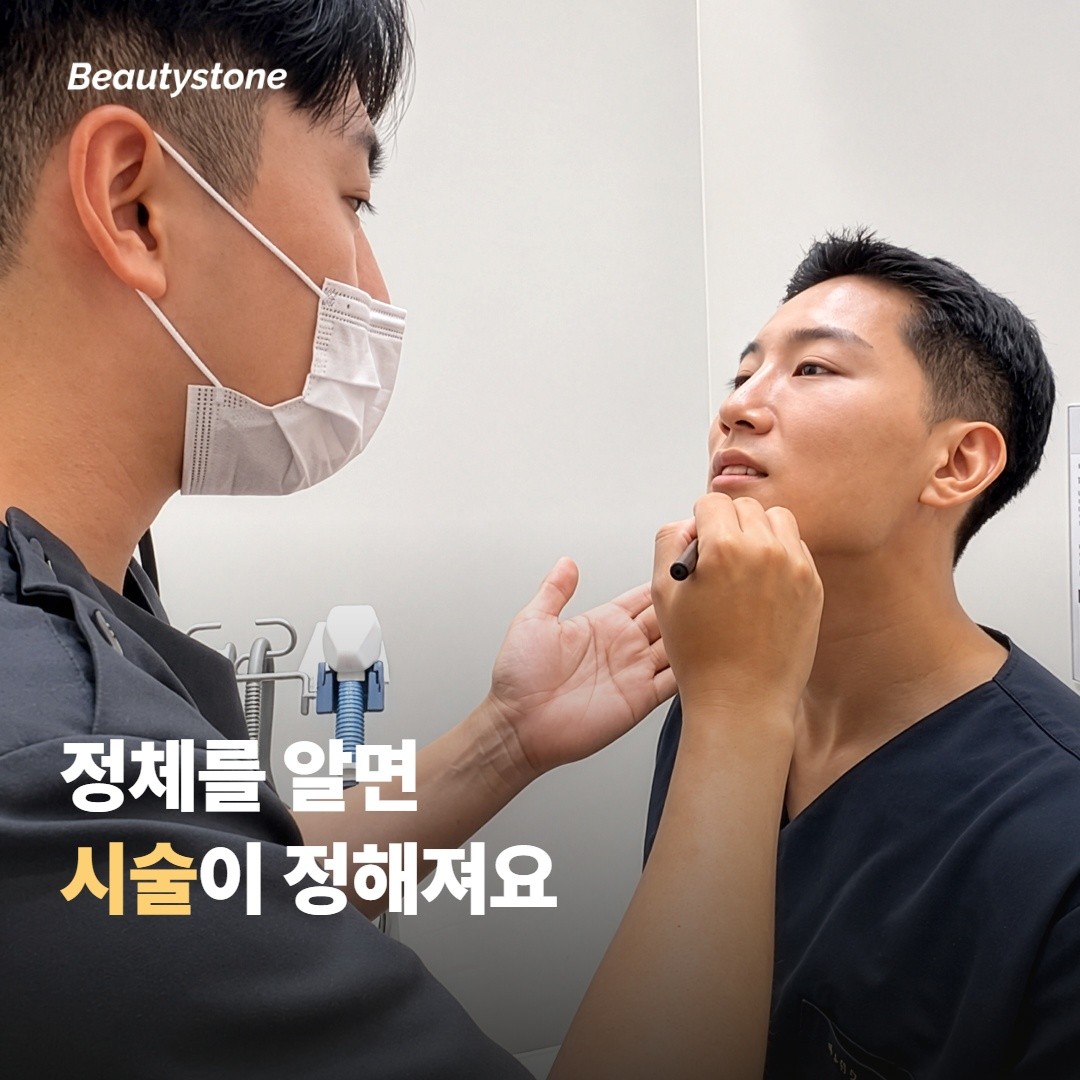
Bite down firmly | A hard block of muscle bulges at the corner of your jaw | Chewing muscle (Masseter*) |
Feel below your ears and jawline | It feels thick and heavy, but it is neither muscle nor fat | Salivary gland hypertrophy |
Look in the mirror while lying down | Your face looks slimmer lying down, and lifting your cheeks upwards improves your look | Sagging tissue (SMAS* laxity) |
Gently pinch under your chin | You can pinch thick fat that remains regardless of your posture | Accumulated fat |
* Masseter: A strong chewing muscle connecting your cheekbone to the corner of your lower jaw. It can grow larger and give the jaw a square look due to teeth grinding or clenching habits.
* SMAS: The superficial muscular aponeurotic system that wraps around the muscles beneath the skin. As it relaxes with age and gravity, the overlying tissue shifts downward, blurring the jawline.

Why do treatments differ based on the cause?
Even for the same concern of a "larger-looking face," different causes require completely different approaches.
For blank space caused by muscle, we use Botox to reduce the volume. This works by temporarily blocking nerve signals so that underutilized muscles gradually shrink.
For blank space caused by sagging, we need to lift rather than reduce. Trying to dissolve or reduce sagging tissues might actually make the face look hollow. In this case, lifting treatments like Ultherapy are ideal.
For blank space caused by pockets of fat, fat-dissolving injections that target only those specific areas are the right solution.
Choosing just one treatment repeatedly without diagnosing the root cause can result in spending time and money with little change in your appearance. This happens when someone with large masseter muscles only receives lifting treatments, or someone with sagging skin gets fat-dissolving injections. The treatments themselves are excellent, they just weren't the right match for that specific type of blank space.
In aesthetic dermatology, even for the same concern, the approach differs depending on the cause, and facial blank space is no exception. Muscle, sagging, and fat lie in different layers of the face and require different solutions, which is why your choices will vary even within non-surgical contouring methods. Diagnosing the underlying cause must always come before choosing a treatment name.

Most cases are a combination, so the order of treatment is key
In reality, most clients who visit our clinic present with a combination of two or three factors rather than just one. They might have moderately developed muscles, a touch of sagging, and some fat accumulated under the chin.
That is why, rather than trying to address everything at once, it is much more natural to target the most prominent factor first. Typically, we lift the sagging foundation first, reduce any remaining muscle bulk next, and then address localized fat at the very end.
In the end, the path to contouring always starts in the same place: identifying where your blank space comes from. That self-awareness is the very first step toward a beautifully defined look.
Frequently Asked Questions
Q. If I lose weight, will my blank space decrease?
Blank spaces caused by localized fat can be partially reduced through weight loss. However, muscle volume and sagging tissue do not change much with diet alone. This is why identifying the cause first is so important.
Q. Can I decide my treatment based on self-diagnosis alone?
While it is helpful for pointing you in the right direction, the exact proportion of muscle, sagging, and fat can only be accurately determined through a hands-on, professional evaluation. The ideal order of treatments depends on this balance.
Q. Can I have all these treatments done at the same time?
Treatments targeting different layers can absolutely be performed on the same day. However, we often space them out to account for swelling and recovery. Most importantly, securing the sagging foundation first yields the most stable results.


Contouring & Volume
Hip Dip Filler Before and After: 4 Checks

Body
Potenza Treatment Interval: Why 4 Weeks?

Lifting
Ultherapy Before and After: Why Wait 90 Days?

Contouring & Volume
Belotero Revive Cost: 2cc Price vs. 3 Sessions

skin
Lip Hyperpigmentation Laser: Does It Work?

Contouring & Volume
Men's Forehead Filler: Hollow or Just Lines?