

Can darker skin or light hair get GentleMax Pro? How wavelength and settings adapt.
Published
Updated

Author
Wi Young-jin · Chief director
Seoul National University College of Medicine · Seoul National University Hospital Specialist
→
When looking into laser hair removal, we often think, "My skin is on the darker side, will it be okay?" Conversely, those with lighter hair might wonder, "Will the laser even react?" GentleMax Pro is a device that can operate two wavelengths together, making it easier to select and use a more suitable setting depending on the combination of skin tone and hair color.
To answer briefly, GentleMax Pro can accommodate a wider range of skin tones compared to single-wavelength devices. However, because the settings and precautions vary depending on the combination of skin tone and hair color, we must approach it in a way that suits your specific skin, rather than assuming a "one-size-fits-all" method.
This article contains information about procedures at Beautystone in Hapjeong. For your safety, it is best to consult with a medical professional before the procedure to determine the right wavelength, number of sessions, and precautions for you.
By reading this article, you will learn
What wavelengths GentleMax Pro uses and how it uses them
How the approach differs according to skin tone
Roughly how many sessions you will need and at what intervals
Useful precautions to know before receiving the treatment
What kind of device is GentleMax Pro?
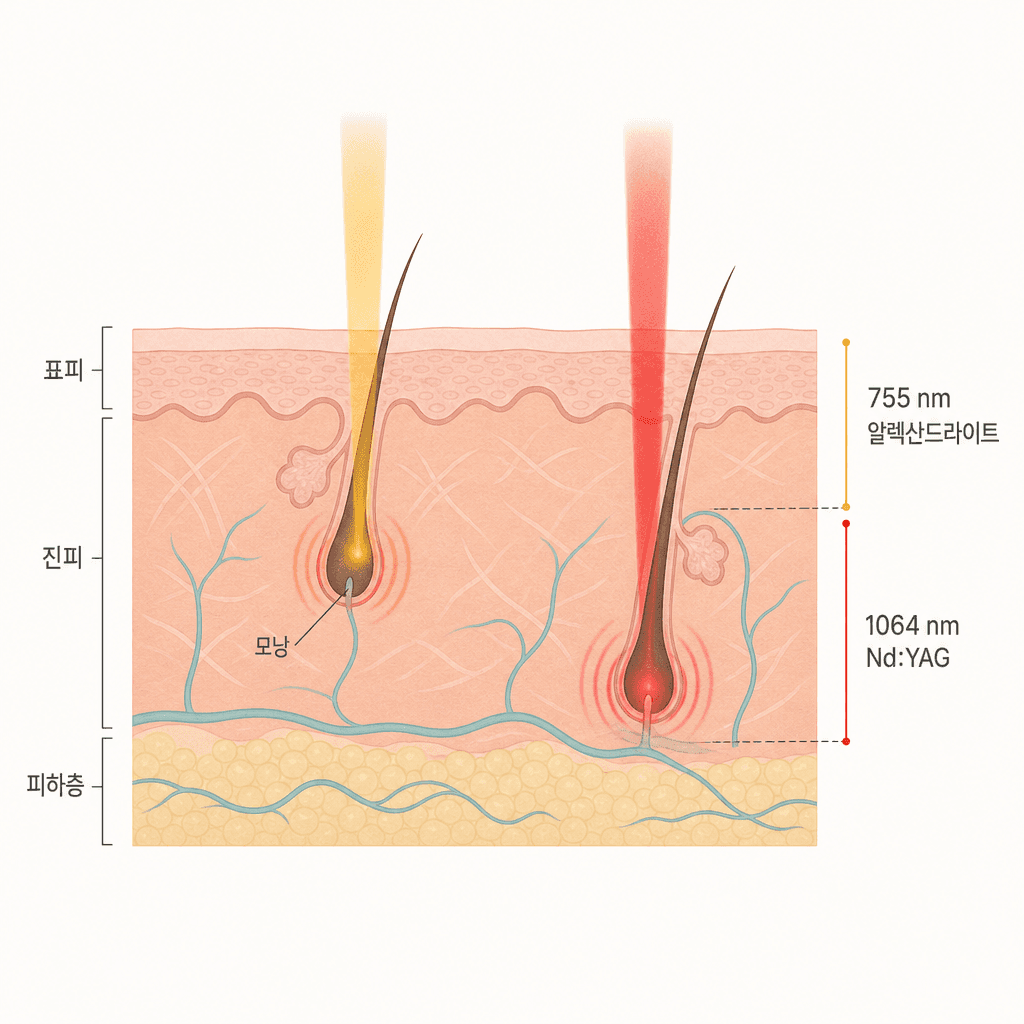
GentleMax Pro is a laser hair removal system equipped with both a 755 nm Alexandrite* wavelength and a 1064 nm Nd*:YAG* wavelength. Since it features two wavelengths with different skin depths and melanin* absorption rates, it allows us to select and apply the most appropriate wavelength according to the patient's skin tone and hair color.
The principle of laser hair removal is that light is selectively absorbed by the pigment (melanin) in the hair, causing thermal damage to the hair follicle. Because of this, the greater the contrast between the pigment of the skin and the pigment of the hair, the easier it is for the energy to focus solely on the hair. The National Institutes of Health (NIH) Clinical Overview of Laser Hair Removal notes that the Alexandrite (755 nm) wavelength has a high absorption rate for light skin + dark hair combinations, while the Nd:YAG (1064 nm) wavelength has a lower melanin absorption rate, allowing for safer use on relatively darker skin.
Melanin*: The pigment that gives color to skin and hair. Laser hair removal utilizes the property of this substance to absorb light.
Alexandrite*: A 755 nm wavelength laser with high melanin absorption, highly effective for light skin and dark hair combinations.
Nd*: YAG: A 1064 nm wavelength laser that penetrates deeply into the skin with relatively lower melanin absorption, offering safety for darker skin types.

How does the approach differ according to skin tone?
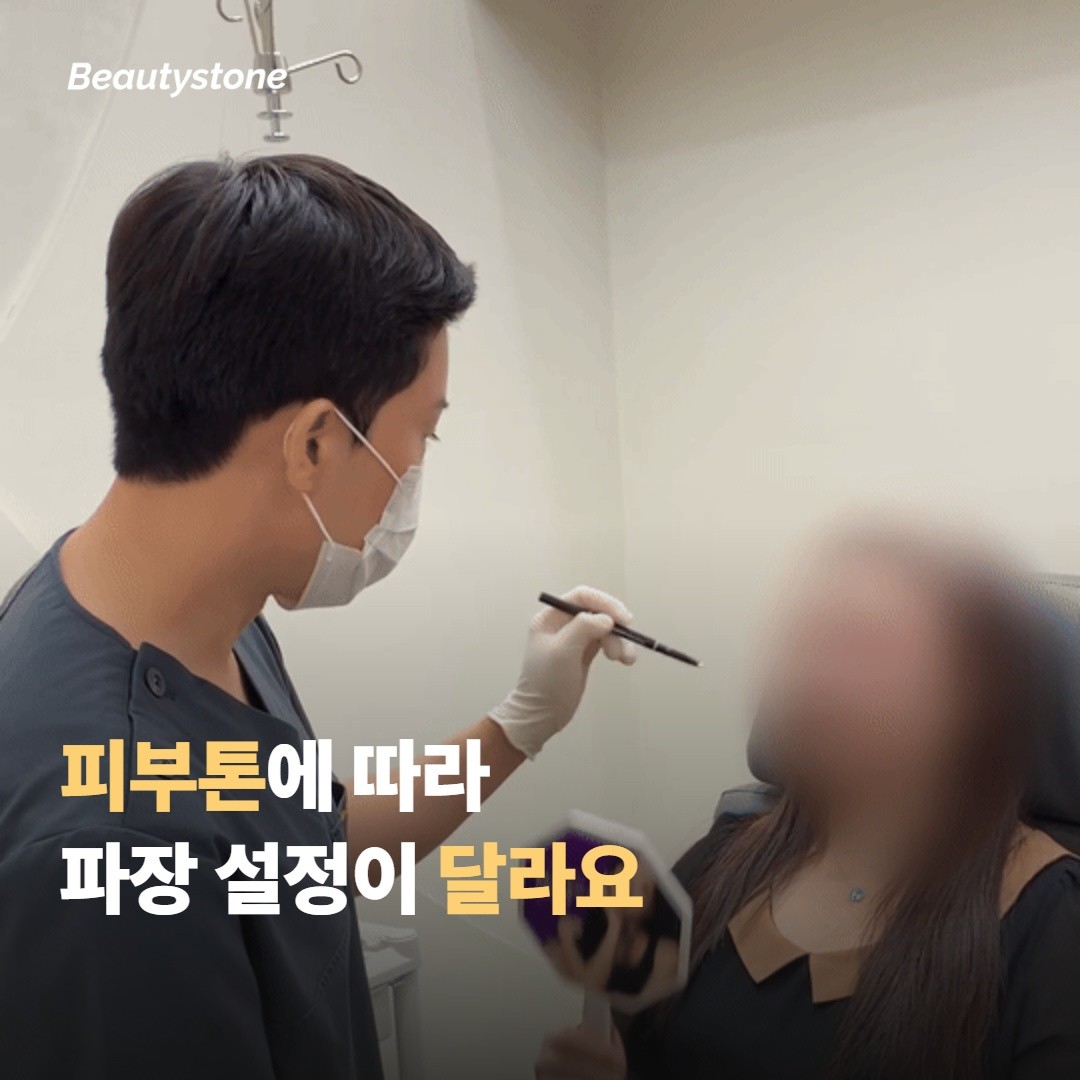
Skin tones are typically categorized from Type I (very fair) to Type VI (very dark) using the Fitzpatrick scale*. The American Academy of Dermatology (AAD) guidelines on laser hair removal indicate that laser hair removal is most effective on fair skin with dark hair, and that darker skin tones require a more cautious approach.
Fitzpatrick Scale*: A classification system that divides skin into 6 types based on its response to UV light. It is used in clinical settings to objectively categorize skin tone.
Here is a summary of the general differences in approach according to skin tone type.
Even with the same device, results and risks vary depending on which wavelength, energy level, and cooling settings are used. This is why the process of assessing both skin tone and hair color before the procedure to establish the settings is so important.
How many sessions are recommended, and at what intervals?
Laser hair removal is not a one-time treatment. Hair grows in cycles of anagen (growth), catagen (regression), and telogen (resting) phases, and only the active growth-phase hair is targeted during each session. The AAD data mentioned above notes that hair is reduced by about 10% to 25% after the initial treatment, and most people receive 2 to 6 sessions spaced 4 to 6 weeks apart.
The number of sessions required varies depending on the treatment area, hair thickness, hair color, and skin tone. Generally, areas with shorter hair growth cycles like the face and underarms require shorter intervals, while larger areas like the legs and back tend to require more sessions.
For darker skin tones, treatments are approached with lower energy settings, meaning that the results accumulate more gradually and the number of sessions tends to increase. Lighter hair also responds more weakly, which may require additional sessions. Discussing this with your medical team beforehand will help you plan your overall schedule.

Why Beautystone in Hapjeong?
During our hair removal consultations at Hapjeong Beautystone, we focus on "what wavelengths and settings fit my skin tone and hair color" rather than simply telling you "what device we use." Since the approach differs for every combination of skin tone and hair color—even with the same GentleMax Pro device—we recommend checking your skin condition before the procedure to set the number of sessions and intervals together. Since we are located within walking distance of Hapjeong Station, you can easily drop by for a light initial consultation to check your skin tone.
Precautions to keep in mind before your treatment
Laser hair removal is relatively safe when performed correctly, but irritation can occur from improper settings or care. The AAD states that treatments performed by inexperienced providers can result in burns, hyperpigmentation, hypopigmentation, and scarring, emphasizing the importance of receiving treatment from a qualified specialist.
Here are the precautions to keep in mind before and after the treatment:
Thoroughly protect skin from UV rays starting 2 weeks before treatment — If skin pigment darkens, the laser will react more with the skin itself.
Stop waxing or using hair removal creams 4 to 6 weeks before treatment — The hair root must remain intact for the laser to work.
Avoid hot water and saunas on the day of and the day after treatment — Adding heat irritation can increase skin irritation.
Minimize UV exposure for 1 to 2 days after treatment — Sensitive skin carries a higher risk of hyperpigmentation.
Redness and stinging during recovery usually subside within one to three days.
The American Academy of Dermatology's guides on laser hair removal safety and side effects explicitly state that it is safe not to perform laser treatments on skin that has been exposed to UV rays or recently tanned. This article provides general information. For your safety, please consult directly with your treating medical provider to evaluate your skin condition and suitability for the procedure.

Frequently Asked Questions
Q. I have a darker skin tone. Can I still get GentleMax Pro hair removal?
A. If you have a darker skin tone, the 1064 nm Nd:YAG wavelength can be used relatively safely. However, the energy and cooling settings must be adjusted carefully, and results tend to accumulate more slowly. It is crucial to evaluate your skin condition and determine the wavelength and settings before the procedure.
Q. Is laser hair removal effective for light-colored hair?
A. Since laser hair removal relies on melanin in the hair absorbing the light, the lighter the hair color, the weaker the response may be. While it is possible to perform, you may need more sessions or experience limited results, so it is best to align your expectations with your medical provider beforehand.
Q. Can I get multiple areas treated at the same time?
A. Yes, it is possible to get multiple areas treated during a single visit. However, because skin thickness and hair conditions vary by area, the wavelength and energy settings must be tailored for each spot, which may increase the total treatment time. Informing us of your desired areas during consultation will help us plan your schedule and session count.
Q. What should I do if redness or stinging lasts long after the treatment?
A. Some redness and stinging for one to three days after the treatment is a common reaction. Avoiding hot water and UV exposure while applying gentle, non-irritating moisturizers will help most reactions subside. If it persists for more than three days, or if blisters, oozing, or severe swelling occur, please contact your treating clinic for safety.


![[Wi Young-jin] GentleMax Pro Plus price & output guide](https://framerusercontent.com/images/9ExM3nIrTtCa9caOWsdiTEpv3mw.jpg?width=1080&height=1080)


Lifting
Ultherapy Before and After: Why Wait 90 Days?

Contouring & Volume
Belotero Revive Cost: 2cc Price vs. 3 Sessions

skin
Lip Hyperpigmentation Laser: Does It Work?

Contouring & Volume
Men's Forehead Filler: Hollow or Just Lines?

Contouring & Volume
Calf Botox Timeline: When to Book Session 2?

Contouring & Volume
Thread Lift Cost: Smile Lines vs. Full Face?