

Juvelook Volume fills hollow cheeks with HA and collagen. Here's what to expect.
Published
Updated

Author
Wi Young-jin · Chief director
Seoul National University College of Medicine · Seoul National University Hospital Specialist
→
If you've noticed your cheeks looking a little flatter than they used to — or the lines running from your nose to the corners of your mouth are gradually deepening — you're not alone. Midface volume loss is one of the earliest visible signs of facial aging, and it tends to accelerate in your mid-30s and 40s.
Juvelook Volume is a newer kind of injectable that's designed to address both concerns at once: immediate HA volume to restore contour, plus a collagen-stimulating ingredient that builds structure over time. Whether it actually delivers on that promise is worth looking at closely.
In this article, we'll cover what Juvelook Volume is, how it works, what the treatment and recovery look like, what the risks are, and who's likely to benefit most.
What Is Juvelook Volume?
Juvelook Volume is a hybrid injectable that combines two distinct ingredients working on different timelines:
Hyaluronic acid (HA): The same material used in conventional dermal fillers — it adds volume immediately by attracting and retaining water within the tissue.
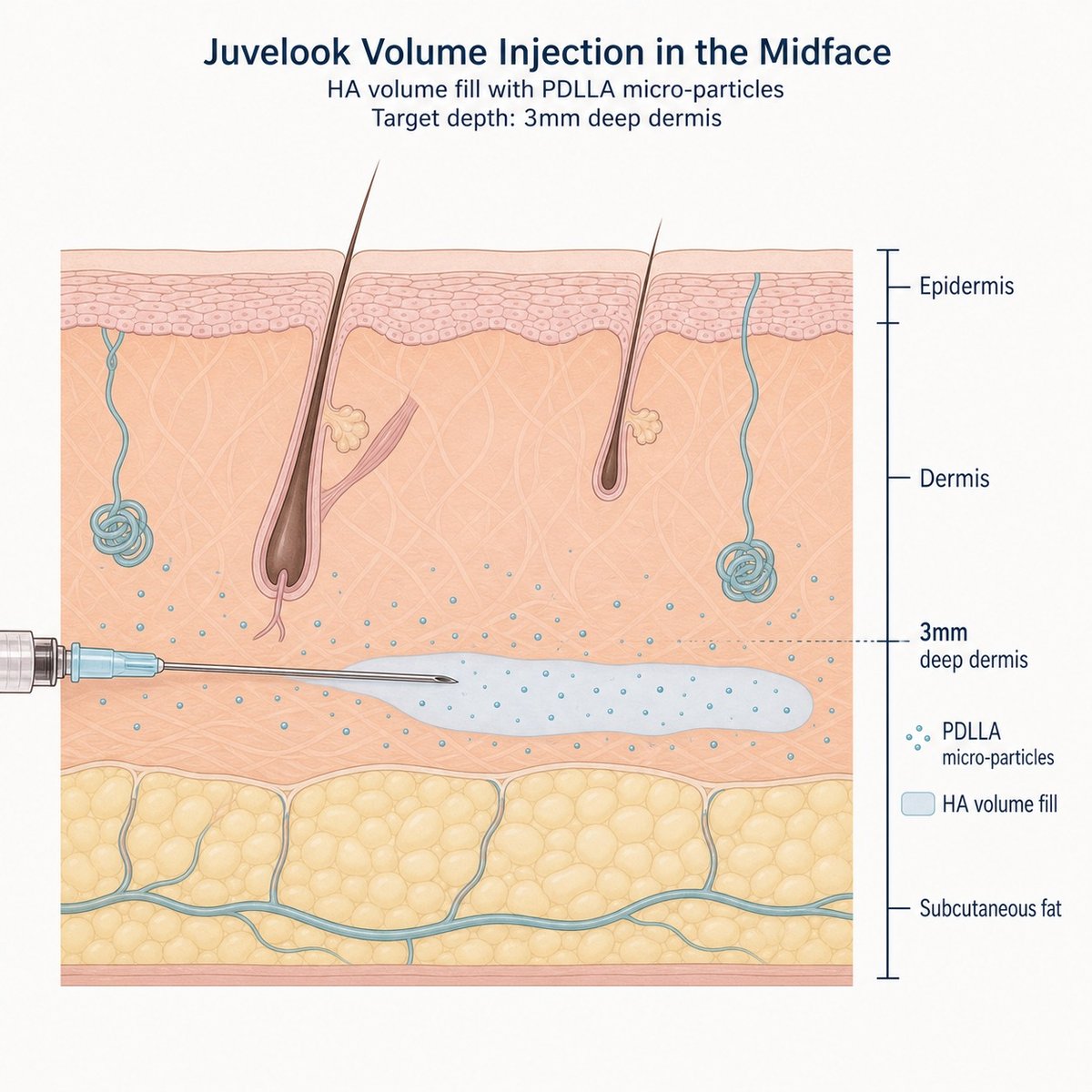
Poly-D,L-Lactic Acid (PDLLA): A collagen-stimulating biopolymer. Once injected, PDLLA micro-particles are gradually absorbed while triggering the skin's own collagen synthesis response.
The standard Juvelook (without "Volume") is primarily a skin booster that works through the PDLLA collagen-stimulating pathway. Juvelook Volume adds HA to make results visible immediately — a meaningful difference when you're targeting areas like the cheeks that need structural support, not just hydration.
It's sometimes described as a filler that keeps working after you leave the clinic. That's a fair characterization — though the collagen response develops over weeks, not days, and individual results vary.
How Does Juvelook Volume Work?
When Juvelook Volume is injected, two processes begin at different speeds.
The HA component works immediately, filling the injected area and restoring contour to the cheeks or softening the depth of nasolabial folds from the day of treatment. This effect is visible right away but decreases gradually as HA is naturally metabolized over time.
The PDLLA component works more slowly. The micro-particles disperse into surrounding tissue and activate fibroblasts — the cells responsible for collagen production — to generate new collagen over the following weeks and months. Research published in PMC supports the collagen-stimulating mechanism of injectable PLLA formulations, with studies indicating that new collagen formation can continue for several months post-treatment. That work studied PLLA rather than the PDLLA used here; the two share the polylactic-acid family and a comparable collagen-stimulating mechanism, though the isomer differs and they do not break down on the same schedule. Individual results vary.
The combination means you get a visible correction on day one, plus structural improvement that builds gradually — and that typically outlasts the HA portion alone.
What Can Juvelook Volume Treat?
Juvelook Volume is most commonly used for midface concerns driven by volume loss:
Hollow cheeks: Restoring the soft fullness that tends to flatten with age or weight changes
Nasolabial folds: Reducing the depth of the lines running from the nose corners to the mouth
Midface contour: Re-establishing the gentle projection of the upper cheek that visually lifts the eye area
Subtle overall volume correction: For patients who want a natural result rather than a visibly filled look
It's not typically the right tool for fine surface lines — resurfacing or a lighter skin booster would suit those better. For significant structural laxity, HIFU or lifting threads address the deeper fascia layer differently. Juvelook Volume sits in between: more than a booster, more gradual than a traditional filler, targeting volume and collagen quality at once.
What to Expect: Timeline and Recovery
One of the most common questions we hear is how long until results are visible — and how much downtime is involved. Here's a realistic breakdown.
Day of treatment: Topical numbing cream is applied 20–30 minutes before injections. Sessions typically take 30–45 minutes. Mild discomfort at injection sites is normal.
First 48 hours: Swelling and redness at injection sites are common. Bruising is possible. Cold compresses help. Most people are comfortable going out the next day, though some schedule treatment before a lower-profile weekend.
Weeks 1–4: The HA settles and initial swelling resolves. Collagen production is beginning beneath the surface, though it isn't visible yet. The volume result typically looks natural and settled by week two.
Months 1–3: The PDLLA-driven collagen response becomes more noticeable. Skin may feel firmer and the corrected area can appear more defined. This is often when patients say the result looks most natural.
Duration: Studies suggest the collagen benefit from PDLLA may persist for six months to over a year in many patients. Maintenance sessions help sustain the outcome. Individual results vary significantly.
Side Effects and Risks
Juvelook Volume is generally well tolerated, but knowing what's possible before treatment helps you make an informed decision.
Common and expected:
Swelling: Usually mild and resolves within 3–5 days
Redness and bruising: Normal at injection sites; fades within days
Tenderness: Especially near the nasolabial area; usually settles within a week
Temporary asymmetry: Swelling resolves unevenly in some patients — wait two weeks before assessing the final result
Less common but worth knowing:
Nodules or bumps: Can form if product is placed too superficially; most resolve with massage or on their own, though some cases need clinical management
Vascular occlusion: Rare but serious. If injection enters a blood vessel, it can restrict blood flow to surrounding tissue. Seek medical care right away if you notice skin blanching, a mottled appearance, worsening pain, or any vision changes after treatment.
Redness and swelling are common and usually settle within a few days. If they worsen or spread beyond the injection sites, contact your provider right away.
Like any injectable, Juvelook Volume requires precise technique and a provider who understands midface anatomy. Choosing an experienced injector matters.

How Much Does Juvelook Volume Cost?
Pricing for Juvelook Volume varies depending on factors specific to your treatment plan:
Amount of product used: Cheek and nasolabial correction typically requires more volume than a basic skin booster session
Treatment area and number of sites: Addressing both cheeks and folds in one session costs more than treating a single area
Provider experience: Specialist injectors with advanced anatomy training typically reflect that in their pricing
Number of sessions: Some patients see good results in one session; others benefit from two or three over several months
Rather than a price range that may not reflect your actual situation, a consultation is the most reliable way to get an accurate estimate based on what you need. See current offers at /en/promotion.
Who Is a Good Candidate?
Juvelook Volume tends to work well for people who:
Are in their 30s–50s and noticing early to moderate midface volume loss
Want longer-lasting structure rather than a short-term fill
Prefer gradual, natural-looking improvement to immediate dramatic change
Have tried HA fillers before and want something that also stimulates collagen
It may not be the right fit if you have very significant volume loss requiring large structural correction, if you're looking for instant transformation, or if you're pregnant or breastfeeding. Anyone with autoimmune conditions or a history of collagen disorders should discuss candidacy with their provider before proceeding.
As with any injectable, your provider will assess your anatomy, understand your goals, and confirm whether Juvelook Volume — or a different approach — makes the most sense for your face and concerns.
The Bottom Line
Juvelook Volume combines HA for immediate volume with PDLLA to stimulate collagen over time — addressing hollow cheeks and nasolabial folds on two timelines
Results develop gradually and may last a year or more with maintenance, though individual outcomes vary
Downtime is mild for most people, with swelling and redness typically settling within a few days
Like any injectable, it carries real risks — vascular occlusion is rare but requires prompt medical attention if it occurs
Like any procedure, it comes with trade-offs. The gradual collagen benefit is real, but patience is part of the process — the full picture doesn't emerge in the first week, and results differ from person to person.
Ultimately, the choice depends on your skin, your goals, and your budget.
If you're considering Juvelook Volume, a consultation is the best way to find out what fits you. Beautystone is a dermatology clinic in Seoul's Hapjeong area — see current offers at /en/promotion.
Frequently asked questions
Q. Does Juvelook Volume hurt?
A. Topical numbing cream is applied before treatment, so most patients describe the sensation as mild pressure or slight stinging at injection sites. Areas near the nasolabial folds and nose can be more sensitive. Sessions typically take 30–45 minutes and are generally well tolerated.
Q. How long do Juvelook Volume results last?
A. The HA volume component typically lasts several months as it's gradually metabolized by the body. The collagen-stimulating PDLLA component can support results for six months to over a year in many patients. Maintenance sessions help sustain the outcome long-term. Individual results vary.
Q. How much does Juvelook Volume cost?
A. Pricing depends on the amount of product used, the areas treated, provider experience, and number of sessions. Addressing both cheeks and nasolabial folds in the same session requires more product than treating a single area. A consultation gives you the most accurate estimate — or see current offers at /en/promotion.
Q. How soon can I see results from Juvelook Volume?
A. The HA volume effect is visible from day one once initial swelling settles, usually within 1–2 weeks. The collagen-building response from PDLLA develops over 1–3 months and is typically most noticeable around the second or third month. Individual results vary.





Contouring & Volume
Hip Dip Filler Before and After: 4 Checks

Body
Potenza Treatment Interval: Why 4 Weeks?

Lifting
Ultherapy Before and After: Why Wait 90 Days?

Contouring & Volume
Belotero Revive Cost: 2cc Price vs. 3 Sessions

skin
Lip Hyperpigmentation Laser: Does It Work?

Contouring & Volume
Men's Forehead Filler: Hollow or Just Lines?